

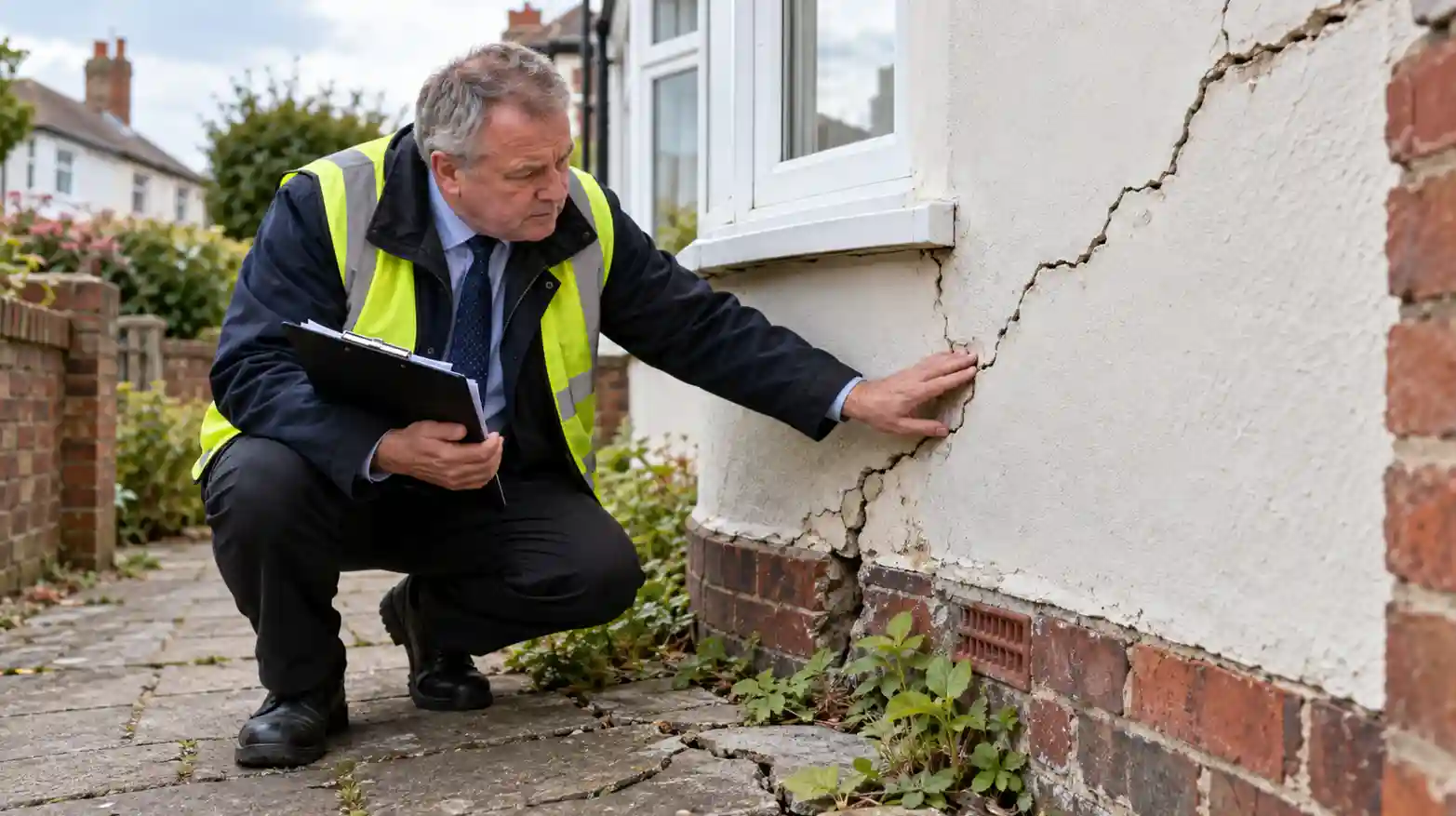
A dated photograph of a crack, however sharp, is a record of one moment. It says nothing about whether the wall behind it is still moving, or why.
That distinction is where most people get stuck once a surveyor, engineer or insurer first raises the word “subsidence”: they expect the next step to produce a diagnosis, when really it starts a process of building evidence. One observation might show that a wall is cracked. Another might show that the crack is widening. A drain survey might find a damaged pipe, while ground investigation might uncover shrinkable clay and tree roots. The useful question is whether those pieces of evidence tell the same story.
If you’ve reached this point, you’ve probably already had the “is this crack serious?” conversation, and possibly the “who do I call?” one too. What follows is the next stage: what the investigations actually measure, why different checks are used together, and how professionals move from a suspicious crack towards an evidence-based explanation.
Finding a crack is not the same as finding the cause
The same visible symptom — a diagonal crack running from a door or window opening, a door that has begun sticking, distortion around an opening or a floor that appears out of level — can arise for different reasons. Shrinkable clay affected by dry weather or vegetation, leaking drainage affecting the supporting ground, historic settlement that stopped long ago and ordinary movement within the building can produce overlapping signs.
That is why how much damage is visible and what is causing it are separate questions.
BRE Digest 251 is widely used in the UK to classify visible damage to low-rise buildings from Category 0 to Category 5. Category 0 covers negligible hairline cracking below about 0.1mm; Category 5 describes very severe damage, with typical cracking above 25mm and potential stability implications. But the classification is principally a description of damage and likely repair implications, not a subsidence diagnosis. BRE itself stresses that crack width alone is an oversimplification: number, pattern, location and whether cracks are changing all affect how the damage should be interpreted. BRE guidance on assessing cracks in houses
A moderate-width crack therefore does not mean “moderate subsidence”, any more than a wider crack identifies whether a tree, drain, foundation problem or something else caused it.
Watching the building rather than the photograph
Where there is uncertainty over whether movement is continuing, monitoring turns a snapshot into a timeline.
The simplest devices are tell-tale crack monitors: overlapping plates fixed across a crack so that relative movement can be seen and measured. More precise systems, including Demec monitoring, use fixed reference points and a separate measuring gauge. Electronic sensors can take the process further where continuous or remote monitoring is justified.
The instrument is only part of the exercise. Useful monitoring needs a baseline, consistent measuring points and repeat readings that can be compared. Depending on the suspected movement, the professional may monitor crack width, displacement, floor or structural levels, or a combination of them.
A one-off level survey can show that something is out of true. Repeated measurements are what begin to show whether it is still changing.
How long that takes depends on the question being asked. RICS says cracking may sometimes need monitoring for as long as 12 months, and in exceptional cases longer. That does not mean every suspicious crack requires a compulsory year of observation. Clear evidence may allow conclusions sooner, while seasonal cases can justify a much longer record. RICS consumer guidance on subsidence
The reason seasons matter is that movement associated with clay moisture can be cyclical. A crack may open during a dry period and partly close after wetter weather. What matters is not simply that it moved, but whether it repeats a seasonal pattern, stabilises, recovers or continues beyond its previous range.
Monitoring can therefore establish whether movement is active and how it behaves. The cause still has to be established from the wider evidence.
Why drains are often checked early
Drainage is commonly investigated where below-ground pipes run close to affected foundations, particularly where leaking water could soften or wash material away from supporting ground.
A CCTV drain survey passes a camera through accessible pipework and can identify displaced joints, fractures, root intrusion, deformation, collapse and other defects. Compared with digging beside a foundation, it is relatively quick and non-destructive, which makes it an obvious early investigation in the right circumstances.
But finding a damaged drain is not the same as proving that it caused the movement.
CCTV principally shows the physical condition of the pipe. A displaced joint or crack may be highly relevant, but the footage alone does not necessarily establish that water is actively escaping at a rate capable of affecting the foundations. Where that distinction matters, further leakage, water or other appropriate testing may be required.
The result then has to make sense alongside the building. Is the defect close to the affected foundation? Does the soil type make washout or softening plausible? Does the pattern of movement fit?
A clean drain survey is useful for the opposite reason: it removes one credible mechanism and lets the investigation concentrate elsewhere.
In a formal subsidence claim, drainage is only one part of the picture. Financial Ombudsman guidance says a thorough investigation will commonly involve crack monitoring, nearby drain CCTV, trial holes and boreholes or ground samples rather than expecting any one test to provide the answer. Financial Ombudsman guidance on subsidence investigations
What geology and trees can tell you
Shrinkable clay is a familiar cause of subsidence because changes in moisture content can make susceptible soils shrink and swell. Vegetation can influence that process by drawing moisture from the ground, particularly during the growing season.
Whether that matters at a particular house depends on much more than the presence of a large tree. Soil susceptibility, foundation depth, the location and characteristics of vegetation, weather and the movement actually recorded at the structure all need considering together.
The British Geological Survey produces specialist Property Subsidence Assessment data combining geology with factors such as tree proximity, likely foundation depth, building age and type, storeys and potential drainage failure. It can provide property- and postcode-level susceptibility information, principally for professional and property-sector use through BGS data resellers. It is not a diagnostic postcode checker capable of telling a homeowner that a particular crack has been caused by subsidence. BGS Property Subsidence Assessment dataset
The same caution applies to trees. A mature tree close to cracking on shrinkable clay may give an investigator a credible mechanism to test; its presence is not proof of causation. Roots found during ground investigation can strengthen the evidence about which vegetation reaches the relevant soil, but roots alone still do not demonstrate that damaging desiccation caused the structural movement.
That is also why removing a tree simply because it stands near a cracked building can be the wrong first response. BGS advises obtaining specialist advice before removing mature trees or shrubs near buildings on shrink-swell ground because changing an established moisture regime can itself create problems. BGS guidance on shrink-swell hazards around property
Ground history can introduce entirely different mechanisms. Made or infilled ground, old extractive workings and historic mining can produce movement unrelated to trees or seasonal clay behaviour. In former coal-mining areas, the government’s current service allows an address to be checked and a mining report obtained where relevant through the Mining Remediation Authority. Check whether a property is affected by coal mining
When the investigation goes below ground
A trial pit dug beside the affected part of a building can answer something that a crack or old drawing cannot: what foundation is actually there, how deep it is and what material it bears upon.
That can matter considerably in older houses, altered properties or buildings where assumptions about foundation construction turn out to be wrong.
Boreholes or hand-auger investigations can examine the ground below and beside the foundation in greater depth. Samples may be analysed to help establish soil characteristics and moisture conditions. Where vegetation is suspected, roots encountered during the investigation may sometimes be identified to determine which species has reached the relevant ground.
For somebody who has only just found a suspicious crack, that does not mean excavation is automatically the next step. A professional may reasonably begin with inspection, history, monitoring and targeted drainage investigation depending on the evidence available.
Once the case develops into a formal subsidence investigation, however, trial holes and ground investigation are far from exceptional. Financial Ombudsman guidance describes shallow trial holes, boreholes, soil samples, drain CCTV and monitoring as the sort of evidence normally expected where an insurer needs the cause properly investigated.
The distinction explains why two properties with apparently similar cracks can follow very different investigative paths. One may stabilise under monitoring without excavation. Another may require foundations, drains, soils and vegetation to be investigated together before anybody can responsibly recommend repair.
What each investigation actually tells you
| Investigation | What it can tell you | What it cannot establish by itself |
|---|---|---|
| Visual inspection and crack mapping | Pattern, extent, location and visible damage classification | Whether movement is currently active or its cause |
| Crack monitoring | Whether monitored points are stable, cyclical or progressively moving | What is driving any movement |
| Level / movement surveys | Whether parts of the structure are changing position over time | Why that movement is occurring |
| CCTV drain survey | Condition and defects in accessible drainage near the building | That a visible drain defect is leaking or caused the movement |
| Geology and vegetation assessment | Whether shrinkable soil and relevant vegetation create a plausible mechanism | That a particular tree or soil mechanism caused this damage |
| Trial pits | Actual foundation depth, form and immediate supporting ground | How the building has moved over time |
| Boreholes and soil/root analysis | Ground profile, soil characteristics and potentially relevant roots | Causation without structural and monitoring evidence alongside it |
That table is the investigation in miniature. Each test answers a narrower question than people often expect; diagnosis comes from whether the answers fit together.
A structural engineer or chartered surveyor may coordinate or interpret the investigation, while an insurer-led claim can bring in drainage specialists, geotechnical investigators, arboriculturalists, engineers and loss adjusters. The important point is not how many specialists become involved, but whether the evidence they produce leads towards the same credible mechanism.
The records homeowners can provide are more useful than they look
Formal monitoring should not be replaced with photographs taken on a phone, but a good personal record can make a professional investigation substantially more useful.
Photograph a crack from broadly the same position and distance each time, ideally with a scale visible, and record when it was first noticed. Keep previous structural reports, survey documents, drainage records, earlier monitoring and any historic insurance correspondence that came with the property. Old photographs can be particularly valuable if they establish that apparently new damage was present years earlier.
Timing is useful too. Note events that coincide with a change: prolonged dry weather, a significant leak, major tree work, construction next door or changes to drainage and hard landscaping. None proves causation, but it can help an investigator decide which explanations deserve testing.
What homeowners should not do is turn record-keeping into their own ground investigation. Digging beside foundations, removing suspected trees, repairing potentially relevant drainage or filling and redecorating monitored cracks before the investigation is complete can alter the evidence and make the eventual cause harder to establish.
If an insurance claim is likely, significant investigation and remedial work should also be coordinated with the insurer rather than commissioning expensive intrusive work first and assuming it will be reimbursed later.
Why the process can feel slow
The frustrating part of suspected subsidence is that the question homeowners most want answered — “What is causing this?” — is often the question that cannot responsibly be answered on the first visit.
A crack may need time to reveal whether it is active. Drainage may need inspecting and, where necessary, testing. Ground conditions need relating to the foundation that actually exists rather than the one somebody expected to find. Trees and geological susceptibility have to be treated as evidence to investigate rather than convenient culprits.
For landlords, managing agents, flat owners and commercial occupiers, the engineering logic is broadly the same even though responsibility for commissioning work, notifying insurers and paying for structural repairs may sit elsewhere under a lease, tenancy or management arrangement.
The purpose of the investigation is not to accumulate as many surveys as possible. It is to narrow the possibilities until the movement pattern, building, drainage, foundations, ground and history support an explanation strongly enough to act on.
Sometimes that points to leaking drainage. Sometimes it points to seasonal clay movement influenced by vegetation. Sometimes the investigation discovers foundations or ground conditions nobody expected. And sometimes monitoring shows that an alarming-looking crack is historic and no longer moving.
That answer can take longer than expected when the first crack appears. The alternative — deciding the cause too early and repairing the symptom before understanding the mechanism — is precisely how the wrong repair gets carried out.
Important: This article provides general property information, not surveying, structural-engineering, geological, insurance or other professional advice for an individual property. Crack appearance, movement and ground conditions need to be interpreted in context. If you suspect active subsidence or significant structural movement, seek advice from an appropriately qualified chartered surveyor or structural engineer and notify your buildings insurer where a claim may be involved before commissioning major remedial work.

