

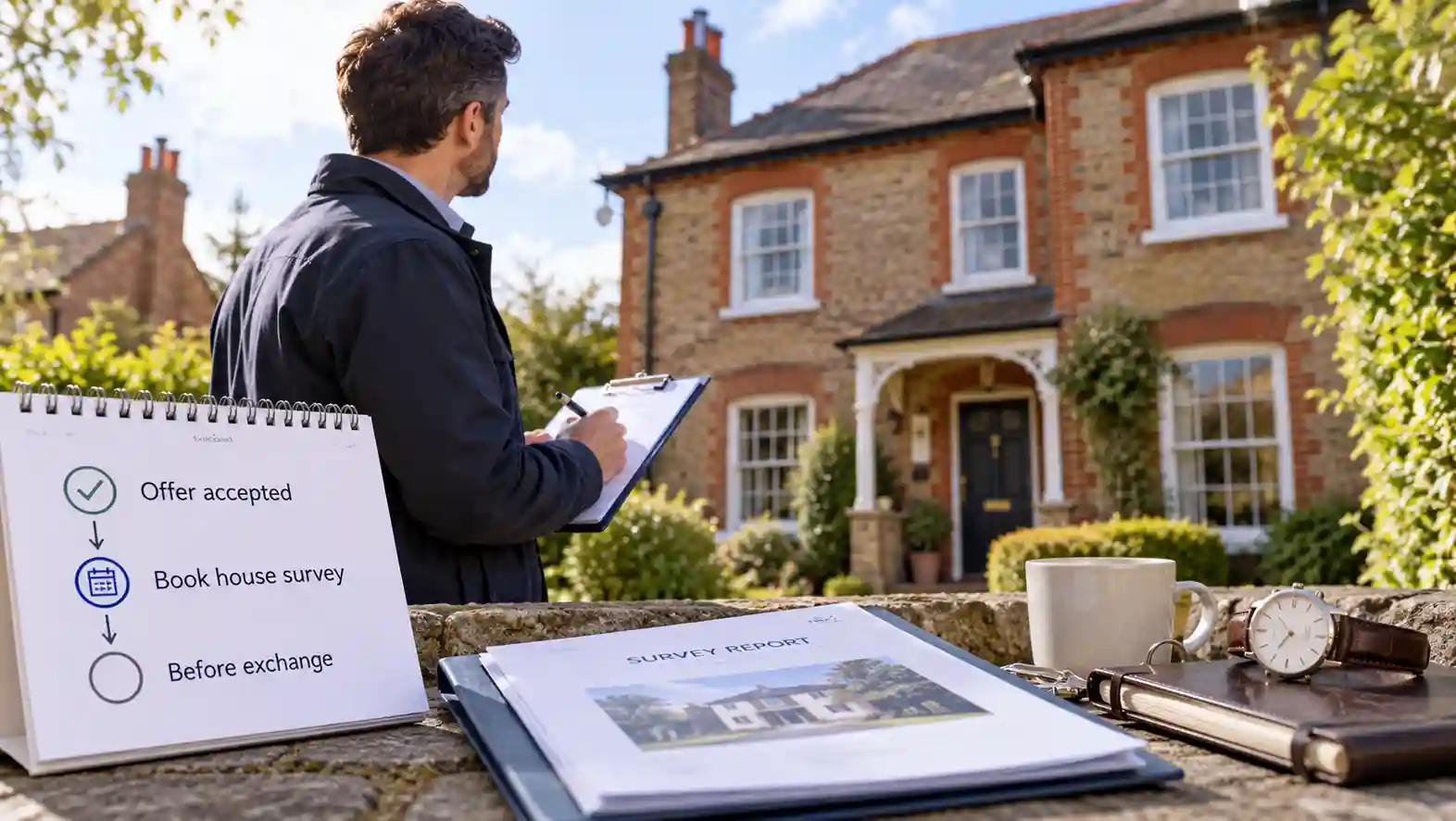
Your offer has been accepted. Somewhere on your list of things to sort out is “book a survey” — and almost immediately, a set of competing instincts kicks in. Book it too early, and you risk paying for an inspection on a purchase that falls through before it goes anywhere. Wait too long, and you risk a serious finding arriving with barely enough time to investigate it before you’re expected to exchange contracts.
For a straightforward purchase in England or Wales, the practical default is usually to get the survey moving reasonably soon after the offer is accepted rather than treating it as one of the last jobs before exchange. A useful first step is to start getting quotes and checking surveyor availability as soon as the offer is accepted, even if you decide to wait briefly before formally instructing the inspection. That does not mean paying for a survey on day one; it means understanding the lead time, deciding what level of survey the property justifies and leaving enough room after the report arrives for anything it might uncover.
This article principally covers England and Wales, where the legal position makes that timing question particularly important. Scotland works differently because most marketed homes already have a seller-provided Home Report before the buyer makes an offer, and the point of legal commitment follows a different process.
The trade-off at the heart of the decision
In a conventional purchase in England and Wales, an accepted offer is not legally binding until contracts are exchanged. Up to that point, either side can normally withdraw from the proposed transaction, although money already spent on surveys, legal work, mortgage fees and other costs may be lost. GOV.UK guidance on making an offer
That is why survey timing matters as much as the survey itself.
Book immediately and the purchase might collapse for reasons that have nothing to do with the building: a seller’s onward purchase could fail, a mortgage application could run into difficulty or another transaction in the chain could fall apart. The survey fee has still been spent.
Wait until every other part of the purchase appears secure and the opposite risk grows. A survey might uncover movement, roof problems, damp, drainage concerns or alterations that need further investigation when the transaction is already being pushed towards exchange.
The question is therefore not simply “How soon can I get a survey?” It is how much money you are prepared to put at risk in order to buy yourself enough time to investigate the property properly.
There is no single correct answer to that trade-off because the balance changes with the property and the transaction.
The straightforward mortgage buyer
For many buyers using a mortgage, a sensible approach is to start arranging the survey soon after the offer is accepted and run it broadly alongside the mortgage and conveyancing work.
It is important not to confuse the lender’s valuation with the buyer’s survey. RICS describes a mortgage valuation as a limited assessment undertaken for the lender to decide whether the property provides adequate security. It is not a substitute for an independent survey of the property’s condition. RICS guide to house surveys and mortgage valuations
That does not mean there is never a reason to wait for the lender.
A buyer particularly concerned about wasting a survey fee might choose to wait until the mortgage application has passed some initial hurdles or the lender’s valuation has been completed. If the lender immediately declines the property, that could save the cost of a survey.
The price of that caution is time. If the valuation itself takes a week or two, and the buyer only then starts looking for a surveyor who has another fortnight’s waiting list, an apparently sensible attempt to avoid one wasted fee can push the meaningful investigation of the property several weeks into the transaction.
The choice is therefore between sequencing the work to reduce money at risk and running more of it in parallel to protect the timetable. For an uncomplicated purchase with no obvious signs that the mortgage will fail, parallel working will often make more practical sense. Where the mortgage or transaction is unusually uncertain, waiting for a particular hurdle to be cleared may be reasonable.
What matters is making that choice consciously.
The cash buyer
A cash buyer does not have a lender’s valuation or mortgage offer creating natural milestones in the transaction, so there is even less reason to let the survey drift simply because nobody else is waiting for it.
That does not mean a cash buyer should automatically commission an inspection the moment an offer is accepted. If the seller has an unstable onward chain or there is some other obvious reason the transaction may disappear quickly, waiting briefly may reduce the chance of wasting the fee.
But where the property itself is the main uncertainty, the survey is often one of the most valuable early pieces of due diligence a cash buyer can obtain. There is no lender independently deciding whether the property is acceptable security, so the buyer is particularly reliant on their own legal, valuation and condition checks.
Being able to buy without a mortgage removes one source of delay. It should not remove scrutiny of what is being bought.
Older, altered or unusual properties
Where a property is older, heavily altered, of unusual construction or already gives you reasons for concern, there is a stronger argument for bringing the survey forward.
An extension of uncertain age, visible cracking, a converted loft, an unusual roof, obvious moisture problems or a non-standard form of construction may produce findings that change more than the eventual repair budget. They can change whether you still want the property at all.
RICS recommends choosing a survey appropriate to the property, with more detailed inspection available for older, unusual or significantly altered homes. Its Home Survey guidance also makes clear that a survey may identify matters requiring further investigation before the buyer commits.
Where a finding could fundamentally change the decision to buy, discovering it early has an obvious advantage: more of your options remain open.
Fast-moving transactions and long chains
Fast purchases create one type of pressure; long chains create another.
Where a seller is pushing for a quick exchange, surveyor availability can itself become the bottleneck. A respected local surveyor may not be able to inspect immediately, and the written report does not necessarily arrive on the day of the visit. Finding out the likely inspection and reporting dates when the offer is accepted can therefore be more important than deciding whether to instruct on a particular day.
Long chains can encourage the opposite behaviour. If several linked sales have to remain intact before anyone can exchange, a buyer may understandably hesitate to spend money while another part of the chain looks fragile.
That reduces the risk of paying for a survey on a purchase that disappears. But waiting until the whole chain suddenly wants to exchange can produce a different problem: the survey finds something important precisely when everybody else is pressing for a quick answer.
Neither approach is automatically wrong. It is a genuine trade-off between money at risk and time at risk.
Leave time for what happens after the survey
The survey date is not the end of the due-diligence process. Sometimes it is the beginning of another one.
A surveyor may recommend further investigation by a structural engineer or another appropriately qualified specialist. The report might identify concerns about drainage, electrics, roofing, damp, movement or alterations that require more information before the buyer can make a sensible decision.
Survey findings can lead buyers to seek additional professional advice, renegotiate the price or reconsider the purchase altogether. That is why working backwards from exchange can be more useful than asking for the “perfect” week in which to book.
If a significant finding appeared on the report, would you realistically have enough time to obtain another inspection or quotation, understand what the problem means, discuss any legal implications with your conveyancer and decide whether to negotiate or proceed?
A survey arriving immediately before a planned exchange can create pressure at exactly the point when the buyer should be making their least rushed decisions.
Scotland: the survey comes much earlier, but the timing still needs thought
Scotland is substantially different because most homes marketed for sale must already have a Home Report. The seller normally commissions it before marketing, and it contains a Single Survey and valuation, an Energy Report and a Property Questionnaire. Scottish Government guidance on Home Reports
That means a buyer usually has condition and valuation information available before making an offer rather than arranging their first survey only after an offer has been accepted.
It does not mean a Scottish buyer can never commission another survey.
A buyer may want a more detailed inspection because of the property’s age, construction or something identified in the Home Report. A lender may also require further valuation work. Citizens Advice Scotland specifically notes that a buyer can make an offer subject to survey, allowing the price to be negotiated before paying for an additional inspection. Citizens Advice Scotland on buying a home
The legal commitment point is also different from England and Wales. Scottish offers are dealt with through solicitors and the contractual negotiations are known as missives. There is normally no binding contract until the conditions have been agreed and missives are concluded, although the precise effect of an offer and acceptance depends on their terms. mygov.scot guidance on making an offer and concluding missives
So the idea that a buyer who wants an independent survey in Scotland must necessarily obtain it before making an offer is too absolute. Depending on the transaction, the buyer may inspect before offering or make the offer subject to an additional survey and ensure the issue is resolved before becoming legally committed.
The practical lesson is the same as elsewhere, but the sequence is different: tell the solicitor early if your offer needs to remain conditional on further survey work rather than assuming there will automatically be an England-style post-offer window in which to decide.
A brief note on auctions
Traditional property auctions create another timing problem entirely.
In a traditional auction, a successful bid normally creates the sale contract immediately. There is no conventional post-offer period in which the buyer can commission a survey and then decide whether to exchange.
RICS advises auction buyers to inspect the property and consider obtaining an appropriate survey and valuation before buying. RICS guide to property auctions
If physical condition matters to whether or how much you bid, that work therefore belongs before the traditional auction, not after it.
Conditional auctions or Modern Method arrangements are different because commitment can occur in stages and the reservation terms vary. The buyer should understand exactly when money becomes at risk and when the binding sale contract will be formed rather than assuming every type of auction follows the traditional hammer-fall sequence.
The decision worth making deliberately
The right time to book a survey is not a fixed number of days after an offer is accepted. It is a judgement about which risk you are more willing to carry: spending money while the wider transaction may still fail, or leaving so little time that a significant finding becomes difficult to investigate properly.
For a straightforward England or Wales purchase, that usually points towards getting the survey organised reasonably early and allowing it to run alongside the mortgage and conveyancing process. A fragile chain or uncertain mortgage application may justify waiting for a particular hurdle to clear. An older or unusual property may justify moving faster.
The important thing is not to let the survey become something that simply happens whenever the rest of the transaction leaves room for it. Its purpose is to give you information while you can still act on it.
This article provides general property information, not legal, surveying, mortgage or other professional advice for your individual transaction. The point at which a buyer becomes legally committed and the survey process differ across the UK. The main discussion above concerns conventional purchases in England and Wales, with separate sections explaining important differences in Scotland and traditional auctions. If survey timing could affect an offer, contractual commitment or significant expenditure, take advice from your conveyancer and an appropriately qualified surveyor.

