

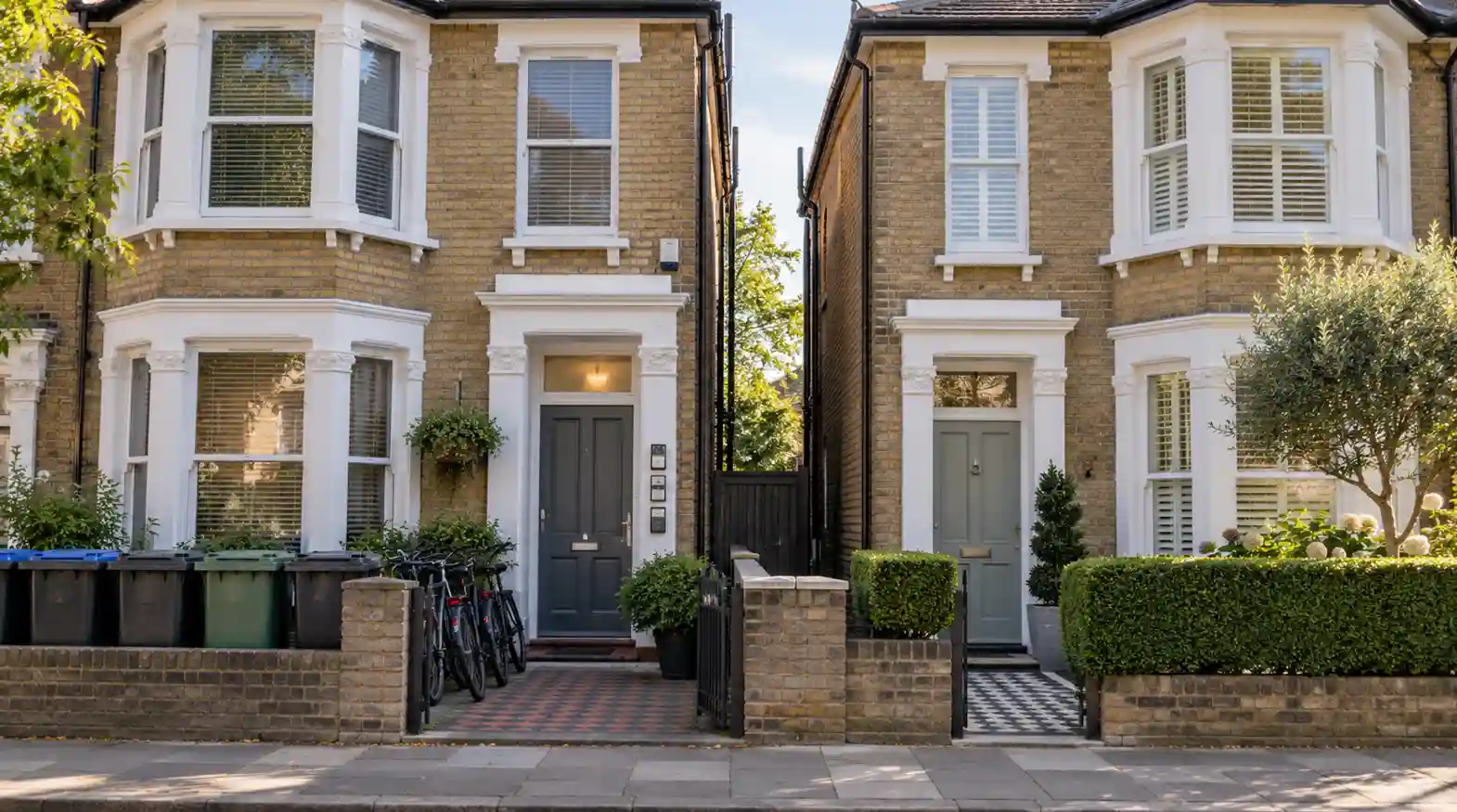
“The house next door is being turned into an HMO” is a sentence that can provoke alarm on a residential street before anyone has moved in. Neighbours picture overflowing bins, cars on every verge, constant comings and goings and a landlord who never appears.
Some of those concerns are occasionally borne out. Many never are. A well-run shared house occupied by working professionals can be quieter than the family home it replaced, and plenty of people live next to HMOs for years without noticing anything beyond an extra wheelie bin.
What matters, for an existing homeowner and a prospective buyer alike, is that “there is an HMO next door” is not in itself a legal complaint. The useful questions are narrower: is the house authorised to be used this way, does it have a licence where one is required, who is responsible for managing it, and is anything happening that genuinely interferes with neighbouring homes?
They sound like variations of the same question, but they belong to different parts of the system. Getting that distinction wrong is one reason neighbours can spend months complaining without achieving very much.
It also works in the other direction. A landlord may believe that obtaining an HMO licence settles everything, only to discover that planning permission was required separately. A buyer may find a property on the council’s licensing register and assume that its legal position is beyond doubt, when the register says considerably less than that.
What can you actually establish about the house next door?
In England, a house in multiple occupation generally means a property occupied by at least three people forming more than one household who share facilities such as a kitchen or bathroom. Three unrelated adults sharing a house will ordinarily meet that basic definition; a family of five living together will not. Certain converted buildings and flats can also fall within the wider legal definition.
The government’s guidance on houses in multiple occupation explains the basic position, but being an HMO doesn’t necessarily mean that a property requires an HMO licence.
In England, national mandatory licensing generally applies to HMOs occupied by five or more people forming at least two households. Since October 2018, the previous three-storey threshold has no longer applied. Councils can also introduce additional licensing schemes covering smaller HMOs, including some houses shared by three or four people.
A shared house that needs a licence in one neighbourhood may therefore fall outside the licensing requirements in another. The number of bedrooms, or even the fact that tenants appear to rent rooms individually, won’t necessarily settle the question.
One useful starting point is the council’s HMO licensing register. Under section 232 of the Housing Act 2004, local housing authorities must maintain registers of relevant licences, exemption notices and management orders, with information available for public inspection. Many councils also make their licensed-HMO registers searchable online.
A register entry can identify the licence holder and the maximum permitted occupancy, among other details. That is valuable information if the neighbour wants to raise a management problem or suspects overcrowding.
But the register has limits. It is not a complete directory of every lawful house share, and it doesn’t necessarily establish who currently lives at the property or whether every licence condition is being met. If the address doesn’t appear, the sensible approach is to ask the council’s housing licensing team whether a licence is required and whether one has been issued or applied for.
A licence also has a specific purpose. The council considers whether the accommodation is suitable for its permitted occupants, whether the manager is a fit and proper person and whether relevant safety and management standards are met. It is not a vote on whether the neighbours want a shared house on their street.
That distinction is important because a house can be legitimately occupied by several unrelated tenants without requiring the permission of everyone living nearby. Equally, a landlord cannot dismiss genuine concerns about safety, occupancy or management simply by pointing to the existence of a licence.
Why a licensed HMO may still have a planning problem
One of the least obvious features of HMO regulation is that licensing and planning permission are separate matters.
In England, an ordinary family home generally falls within planning use class C3. A smaller HMO, usually occupied by between three and six unrelated people, falls within class C4. Changing a C3 house into a C4 HMO is normally permitted development, meaning a separate planning application is not required for that change alone.
But some councils have removed that right through Article 4 directions.
These directions allow authorities to require planning applications for specified changes that would otherwise be permitted development. They are particularly relevant in areas where councils want to assess the cumulative effects of shared housing on residential streets.
The result can be surprisingly localised. BCP Council’s HMO planning guidance confirms that Article 4 controls apply across Bournemouth and in Talbot Village in Poole. Other authorities have introduced their own arrangements, with different geographical boundaries and commencement dates.
An Article 4 direction doesn’t ordinarily make an existing, lawfully established HMO unlawful simply because its use began before the direction took effect. The property’s planning history matters, as does whether the particular use was already lawful.
Larger HMOs accommodating more than six residents fall outside ordinary class C4. A material change from a family home to such a use will generally require planning permission, irrespective of whether the property lies within an Article 4 area.
For a neighbour, planning is also the stage at which some concerns can be considered before the accommodation is occupied. Where an application is required, issues such as parking, waste storage, residential amenity and the effect of a concentration of HMOs may be relevant under the council’s planning policies.
The fact that somebody objects to unrelated adults sharing a home is a different matter. Planning decisions are not meant to be determined by assumptions about the type of people who might rent the rooms.
If a property appears to have changed use without a permission it requires, that is a matter for the planning enforcement team. The council will need to examine the property’s history and actual use before deciding whether a breach has occurred and whether enforcement is justified. Planning enforcement is discretionary and subject to legal limitations; it isn’t an automatic consequence of receiving a complaint.
There is a professional lesson here too. For landlords, letting agents and investors, obtaining an HMO licence is not evidence that every necessary planning permission exists. Nor does a planning approval establish that a property satisfies licensing or management requirements. A purchaser acquiring an income-producing HMO should establish both positions rather than assume that years of occupation prove the use is lawful.
The same distinction helps a homeowner decide whether a concern about the house next door is a planning issue at all. Quite often, the real problem begins only after the property is occupied.
When the problem is the way the house is managed
Imagine two HMOs on the same street. Both accommodate several adults, and both operate lawfully. At one, the bins are adequate, the frontage is maintained and the manager responds when something needs attention. At the other, rubbish regularly accumulates beside the pavement, the shared entrance is neglected and neighbours repeatedly report the same problems.
The legal status of the houses may be identical. The experience of living next to them plainly isn’t.
For many neighbours, this is where the most useful remedies are found. It isn’t necessary to establish that the property should never have become an HMO if the actual complaint concerns waste, unsafe structures or poor management.
In England, the Management of Houses in Multiple Occupation (England) Regulations 2006 place obligations on managers of HMOs within their scope. Among other things, they require suitable facilities for storing refuse, appropriate maintenance of shared areas, and the keeping of gardens belonging to the HMO in a safe and tidy condition. Relevant boundary walls, fences and railings must also be maintained so they do not endanger occupants.
These regulations can apply to smaller HMOs even where no HMO licence is required, although certain converted blocks of flats are subject to different arrangements.
That is a distinction neighbours may find particularly useful. A landlord cannot necessarily answer a complaint about persistent rubbish or an unsafe shared area by saying that the house is too small to need a licence.
But the regulations shouldn’t be read as guaranteeing that every shared house will look immaculate. A garden that appears untidy to a neighbour isn’t automatically a breach, and the responsibilities of occupants also matter. The useful question is whether an identifiable management duty is being neglected.
Noise presents a different problem. An HMO doesn’t have a special entitlement to disturb neighbouring households, but the fact that several unrelated people live there doesn’t lower the threshold for statutory nuisance either. Repeated excessive music, shouting or late-night disturbance must be assessed on its actual effects, just as noise from an ordinary family home would be.
Where it is safe and appropriate, a conversation with the occupants or manager may resolve the matter. If it continues, keeping a record of the dates, duration and effect on your home gives environmental health something more useful to assess than a general complaint that the house is noisy. The government’s guidance on noise nuisance explains the council’s powers and the limits of what can be treated as a statutory nuisance.
A licence may provide another route where it contains relevant conditions concerning anti-social behaviour. But the conditions vary, and an HMO manager shouldn’t automatically be treated as legally responsible for every personal act of a tenant.
Serious harassment, threats or suspected criminal activity are matters for the police and appropriate community safety services. Credible evidence of overcrowding, obstructed escape routes or unsafe living conditions belongs with the council’s housing team. Parking restrictions and obstruction may involve entirely different enforcement powers.
On-street parking is a particular source of frustration when an ordinary house becomes shared accommodation. Several adults may each own a car, leaving neighbours competing for the same spaces. But vehicles parked lawfully on a public road cannot normally be excluded because their owners live in an HMO. That pressure may matter when a planning application is assessed, but it does not automatically provide a remedy once lawful occupation is established.
The common thread is that different problems require different responses. A house whose landlord has failed to provide adequate waste facilities is not the same as one whose tenants happen to own several cars.
What should neighbours expect from the landlord?
A landlord who receives rent from several tenants may appear to be the obvious person to hold responsible for everything that happens at the house. In practice, the distinction between the landlord’s own obligations and the conduct of individual occupants matters.
Landlords aren’t automatically liable in private nuisance for everything their tenants do. Whether a landlord has authorised or participated in a nuisance can be relevant, while the person causing a particular disturbance may be personally responsible for it.
HMO management duties are another matter. The person responsible for managing the property may have obligations concerning refuse, safety, shared areas and licence conditions, even where they aren’t directly liable for an individual tenant’s behaviour.
That makes the way a complaint is presented important.
A letter saying that the landlord must stop all the tenants causing trouble is unlikely to get very far if it contains no particulars. A factual account that bins have repeatedly overflowed, refuse has accumulated for several weeks or an unsafe fence remains unrepaired gives the manager something identifiable to investigate.
Photographs taken lawfully from your own property or public areas, along with dates and a record of previous correspondence, may help. There is no need to investigate the occupants’ private lives or confront them about their household arrangements.
A responsive manager may be able to resolve problems that would otherwise become council complaints. That is in the interests of neighbours, occupants and landlords alike. It also matters commercially: persistent unmanaged problems can affect an HMO landlord’s relationship with the licensing authority and create avoidable costs or enforcement risk.
The manager is not obliged to satisfy every demand made by surrounding homeowners. Good management includes protecting tenants from unreasonable complaints as well as addressing legitimate ones.
If you’re buying or selling beside an HMO
The existence of an HMO next door is information worth considering before buying a home, but it isn’t enough to establish whether the property will be a good or bad neighbour.
A licensed, well-managed HMO may cause no meaningful inconvenience. A poorly managed one, particularly where serious problems have persisted for years, may be a very different proposition. What matters is the evidence about that particular property and street.
A buyer can check the local licence register, examine relevant planning records and find out whether an Article 4 direction applies. Visiting at different times can be revealing too. A street that feels quiet on a weekday morning may be different on a Friday evening, while bin-collection day can show whether waste arrangements are working.
None of this predicts how future occupants will behave. But it offers a more sensible basis for judgement than simply seeing an HMO on a licensing register and assuming the worst.
There is no reliable universal percentage by which a neighbouring HMO automatically reduces the value of a property. Local demand, the type and condition of accommodation, the street’s character and any proven history of nuisance are all more meaningful than the label alone.
For estate agents and valuers, that distinction matters. A neighbouring property that is lawfully occupied by several adults should not automatically be described as an adverse condition. Persistent waste, noise or other documented problems are more specific facts and may affect a purchaser’s judgement or the property’s marketability.
Buyers should also take care over the seller’s responses to conveyancing enquiries. A property may have been involved in formal complaints or a dispute about the neighbouring HMO, and the seller’s answers could be relevant even where the issue has subsequently improved.
The same principle works for sellers. An HMO next door is not automatically a neighbour dispute, but a history of serious complaints, correspondence or unresolved disagreements may need to be disclosed when answering the relevant property information questions. Accurate replies are safer than assuming that a buyer will never discover the history.
For investors considering an HMO property itself, the due-diligence implications go further. The licensed occupancy, planning position, local Article 4 controls, physical condition and management arrangements can all affect the property’s lawful use and potential income. A building being advertised or operated as an HMO is not proof that every relevant permission and obligation has been dealt with.
Why the rules change across the UK
The position described above relates mainly to England. HMO definitions, licensing thresholds and planning rules differ elsewhere, so a neighbouring property should be assessed under the system applicable where it stands.
Wales retains the three-storey requirement for national mandatory HMO licensing, unlike England. The Welsh Government’s HMO licensing statistics and accompanying explanation describe the national scheme covering relevant HMOs with at least five occupants and three storeys, alongside additional licensing schemes that councils may operate.
Welsh planning rules also differ from England’s. A material change from an ordinary house to an HMO may require planning permission, rather than automatically benefiting from the English C3-to-C4 permitted development arrangement. Landlords may additionally need registration or licensing through Rent Smart Wales, separate from HMO licensing.
Scotland operates its own HMO licensing system. A home occupied by three or more unrelated people sharing facilities will generally require a licence, subject to the statutory rules and exemptions. The Scottish Government’s guidance on private-renting regulation explains the national approach and the role of local authorities.
Northern Ireland also has a distinct licensing regime administered by local councils. Its official HMO licence guidance provides a starting point, although the relevant statutory household definition and detailed requirements differ from those in England.
The distinction matters because advice about an HMO licence, an Article 4 direction or an occupancy threshold may be completely correct for one part of the UK and misleading in another. Checking the local council’s rules is therefore essential before alleging that a neighbouring property is operating unlawfully.
When the house next door really is a problem
The neighbour who hears that an HMO is opening may have understandable questions. There could be legitimate concerns about a conversion, its management or the effects of additional residents on a street that already has limited parking and waste facilities.
But a shared house is not a nuisance simply because it is shared.
If the concern is licensing, the useful evidence concerns occupancy and the applicable scheme. If it is planning, the relevant facts are the property’s use and planning history. If the problem is persistent rubbish, unsafe conditions or excessive noise, the response should focus on those failures and the people responsible for addressing them.
That may sound less satisfying than demanding that the HMO be stopped altogether. It is also far more likely to achieve something.
A well-run shared house can be an ordinary part of a residential neighbourhood. A badly run one can create real difficulties, just as any poorly managed property can. The difference is that HMO regulation provides some additional responsibilities and enforcement routes, although those powers have limits.
For homeowners, buyers and property professionals, the useful question is therefore not whether the house next door is an HMO. It is whether the property is lawfully occupied, responsibly managed and causing a problem that somebody actually has the power to put right.
Important: This article provides general property information and is not legal or other professional advice. HMO definitions, licensing, planning and management obligations vary by jurisdiction, council scheme and individual property circumstances. Neighbour disputes, enforcement decisions and property-sale disclosures depend on the facts and applicable law. Where serious safety risks, significant losses or formal legal action are involved, seek appropriate council or specialist advice.

