

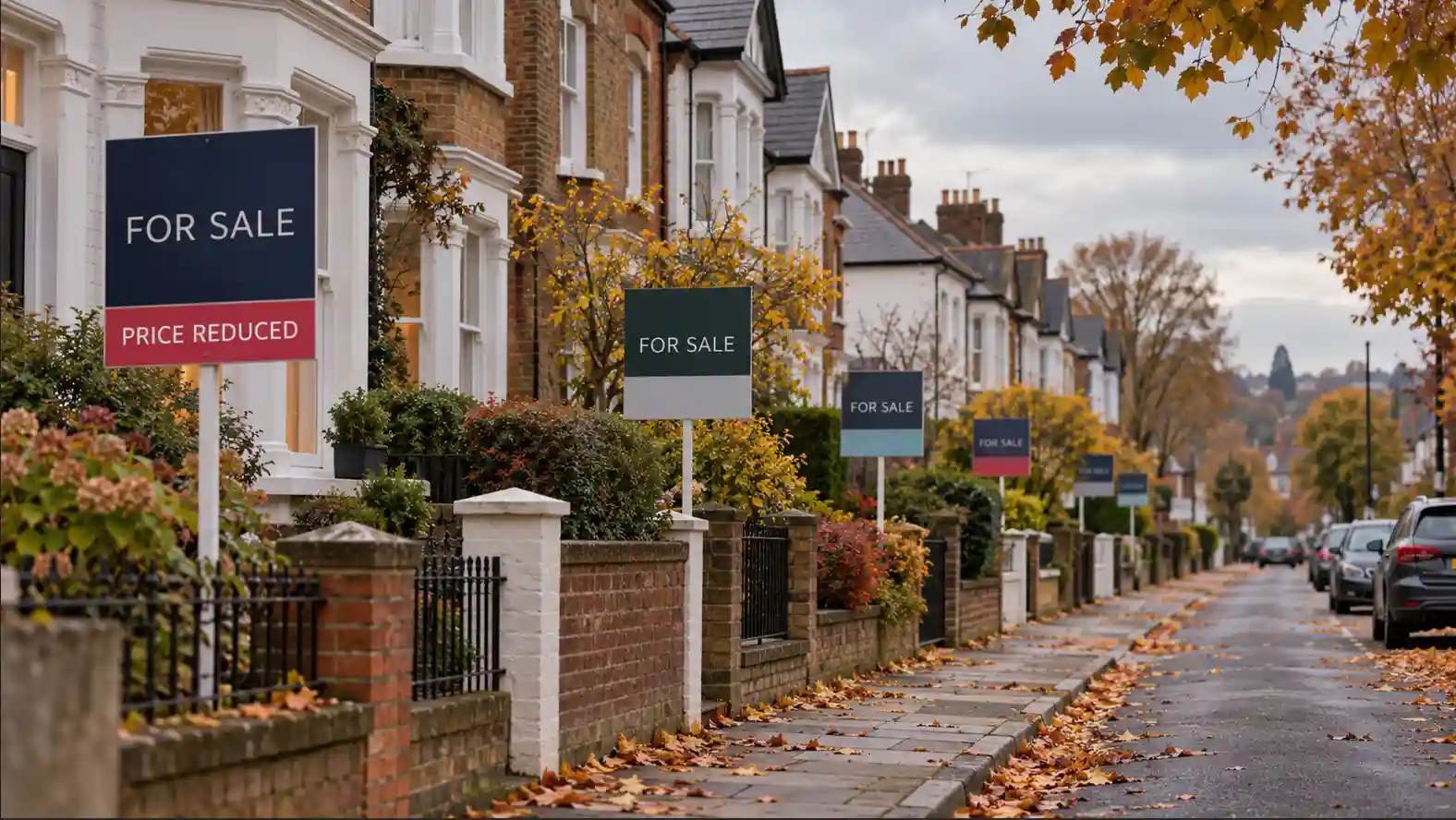
The average asking price of homes newly listed for sale in Great Britain rose by 1% in October, according to Rightmove. But behind that increase lies a more difficult market for sellers, with rising mortgage costs, fewer agreed sales and more competition for buyers.
On the face of it, October’s figures should be encouraging for anyone hoping to sell a home. The average asking price of newly marketed properties increased by £3,575 to £371,015, according to Rightmove’s latest House Price Index. Yet prices remain 0.1% below their level a year earlier, and the increase has fallen short of the stronger seasonal recovery that sellers might normally hope to see during the autumn market.
October is traditionally a month when asking prices strengthen after the quieter summer period. As Reuters noted in its reporting of the figures, Rightmove’s index is not seasonally adjusted, making the usual autumn pattern important when interpreting a monthly increase. The latest rise therefore says more about what sellers are asking than whether the housing market is gathering momentum.
The underlying activity figures are less encouraging. Sales agreed are 8% below the corresponding period last year, enquiries from potential buyers have fallen by 9%, and new property listings are 3% higher. The total number of homes available for sale is at its highest for this time of year since 2014. Sellers are competing for buyers whose mortgage budgets have become increasingly stretched.
That does not mean transactions have stopped. Rightmove says the decline in agreed sales is broadly consistent with the year-to-date pattern, rather than evidence of an abrupt deterioration during October. Homes are still finding buyers, but the market has become more selective, and the difference between an advertised price and what a purchaser can actually afford is becoming harder to ignore.
Higher mortgage costs are changing the market
The most immediate pressure is the cost of borrowing. Rightmove’s mortgage tracker puts the average two-year fixed rate at 5.55%, up from 5.29% in September and 4.25% in February. It estimates that the increase since February has added approximately £250 a month to the cost of a typical new mortgage, based on its modelling. That is not the additional cost faced by every buyer, but it illustrates how quickly the financial calculations behind a property purchase can change.
A household that could afford a particular property earlier in the year may now find the mortgage payment uncomfortable, even though its income and deposit are unchanged. Some buyers will need to borrow less, find additional savings or reconsider the type of property they want. Others may choose to delay purchasing rather than commit to repayments that leave too little room for ordinary living expenses.
For sellers, the effect is more subtle than a straightforward reduction in demand. People may still want to move and continue viewing properties, but the amount they are prepared or able to offer can fall as borrowing costs rise. A seller seeking the price a neighbouring property achieved earlier in the year may be negotiating with purchasers whose financial circumstances have changed substantially since that sale was agreed.
The national asking-price figure also conceals considerable variation between different parts of the market. Rightmove’s October breakdown shows that, excluding inner London, asking prices for properties typically bought by first-time buyers increased by just 0.2%, while second-stepper homes recorded a rise of 0.1%. At the top of the property ladder, the increase was 0.8%. These figures do not cover precisely the same geographical mix as the national headline, but they illustrate why the overall 1% rise should not be interpreted as a uniform strengthening of prices.
Regional differences are becoming more pronounced as well. Four of Great Britain’s five lowest-priced regions recorded monthly asking-price falls: the North East declined by 2.0%, Scotland by 1.9%, the North West by 0.6% and Wales by 0.3%. Yorkshire and the Humber was the exception, with a modest 0.3% increase.
These figures measure what sellers initially ask for newly marketed homes, rather than changes in the value of identical properties. The mix of properties listed can vary from month to month. Nevertheless, the pattern is significant because some lower-priced markets had previously shown greater resilience than more expensive parts of the country. Rising borrowing costs appear to be influencing seller expectations even where homes are comparatively affordable.
London’s stronger prices conceal a weaker market
London recorded the largest monthly asking-price increase in October, at 2.5%, with inner London rising by 3.9%. Taken alone, those figures might suggest a recovery in the capital. But the increase followed a difficult summer in which London asking prices fell by a combined 6% across July and August. Even after October’s improvement, prices remain 1.7% below their level a year earlier, making London the weakest-performing region in Rightmove’s annual comparison.
The wider market indicators reinforce that distinction. Rightmove reports that 38% of London listings have undergone a price reduction, while properties are taking an average of 78 days to find a buyer. Higher asking prices on newly advertised homes are therefore appearing alongside continuing difficulty for many properties already on the market.
There are several possible explanations. Autumn typically attracts sellers who have waited through the summer, while the mix of properties entering the market can also influence the average asking price. Some London owners may be reluctant to reduce expectations after a prolonged period of weaker prices, particularly where the proceeds are needed to finance an onward move. Others may have sufficient financial flexibility to remain in their existing property rather than accept an offer they consider too low.
That creates a market in which prices can appear firmer without a corresponding improvement in transactions. The difficulty is not necessarily that sellers misunderstand local values. Some know that the price available today may leave them unable to afford their next home. Remaining on the market, or withdrawing from it, can be a rational response to those circumstances.
The picture also differs considerably by property type. Recent evidence shows that flats are experiencing greater difficulty attracting buyers, with leasehold costs, property condition and competition from houses influencing purchasing decisions. A well-presented family house in a desirable location and a leasehold flat with substantial service charges may face entirely different markets, even within the same postcode.
More homes for sale, but fewer transactions
One of the most important questions raised by October’s report is why the market can have plenty of properties available without producing stronger sales.
A growing stock of homes for sale does not necessarily mean that new listings are continually increasing. Properties accumulate when they remain on the market for longer, when agreed sales fail to progress or when more homes arrive than buyers are willing to purchase. The resulting choice can benefit purchasers, but it also creates greater competition between sellers.
Independent figures from Landmark Information Group’s third-quarter residential property report support the broader picture of subdued activity. Across England and Wales, new listings fell by 2% compared with the same quarter last year, while sales subject to contract declined by 11%. Property-search orders were 12% lower and completed transactions fell by 7%.
These figures cover different stages of the buying and selling process and are not directly interchangeable with Rightmove’s October measures. They also refer to a different period. But they demonstrate why listing activity alone is an insufficient measure of the market’s health. Properties can continue coming to market while fewer transactions advance through conveyancing and reach completion.
For estate agencies, that distinction has commercial consequences. A substantial portfolio of available properties does not automatically translate into fee income if fewer sales are successfully completed. Agents may spend longer marketing individual homes, negotiating reductions and managing chains that become more vulnerable when buyers struggle with mortgage affordability. Conveyancers, surveyors and mortgage intermediaries can experience the effects later in the transaction process, although the timing and extent of the pressure will differ between businesses.
For homeowners, the implications depend heavily on why they are selling. Someone with no urgent need to move may choose to wait for a more favourable offer. A seller relocating for employment, settling an estate or relying on the proceeds to fund an onward purchase may have less flexibility. In that situation, the original asking price can become less important than the amount the market will actually support within the time available.
The evidence used to establish an appropriate asking price is consequently more important when buyers have several comparable properties to consider. A price that is defensible against recent completed sales may still need to reflect competing homes currently available, their condition and the financial limits facing purchasers.
There is a different calculation for housebuilders. Developers can sometimes maintain advertised prices while offering mortgage contributions, deposit assistance or other incentives. That may help sales proceed without an obvious reduction in the headline asking figure, although the incentive still has a commercial cost. Private homeowners generally have fewer options for changing the effective financial terms of a transaction.
Buyers, meanwhile, may have more opportunity to negotiate, particularly where a property has been available for some time. Yet greater choice does not automatically mean better affordability. The same mortgage rates that encourage sellers to reconsider their expectations may prevent purchasers from borrowing enough to take advantage of lower prices.
What would show a genuine recovery?
October’s modest asking-price rise is not evidence of a collapsing housing market, but neither is it convincing proof of recovery. The more revealing indicators will be whether buyer enquiries improve, agreed sales begin rising consistently, and fewer properties require reductions before attracting acceptable offers.
Marketing times also matter. If homes start finding buyers more quickly, that would suggest demand is better matching the prices sellers expect. A prolonged period of abundant stock and slow sales, by contrast, would indicate that the imbalance is continuing even if asking prices remain relatively stable.
There is an important distinction between the information available now and what will emerge later. Rightmove’s index reflects the prices attached to homes entering the market in recent weeks. The UK House Price Index, drawing on completed transactions, records a later stage of the process and is revised as additional sales are registered. The two measures cannot be expected to move together every month, but completed-sale evidence will eventually provide a clearer picture of what purchasers have actually paid.
The forthcoming Autumn Budget on 28 October may also influence confidence and expectations surrounding borrowing costs. Its effect on the housing market will depend on what is announced and how financial markets, lenders and households respond. For now, the existing evidence does not establish how many purchases have been delayed because of Budget uncertainty.
The central message of October’s figures is that sellers’ ambitions and buyers’ financial capacity are becoming increasingly difficult to reconcile. Some properties continue to sell successfully, and conditions vary widely between regions, price ranges and property types. But higher mortgage costs and greater choice have reduced the ability of many sellers to dictate terms.
For a market to recover convincingly, it needs more than homeowners willing to ask higher prices. It needs enough purchasers able and prepared to pay them.
This article provides general property-market news and analysis, not an individual valuation, mortgage recommendation or financial advice. Asking prices differ from achieved sale prices, and market conditions vary by property, location and circumstances. Sellers should consider recent comparable sales and appropriate professional advice, while buyers should assess mortgage affordability with a suitably regulated adviser.

