

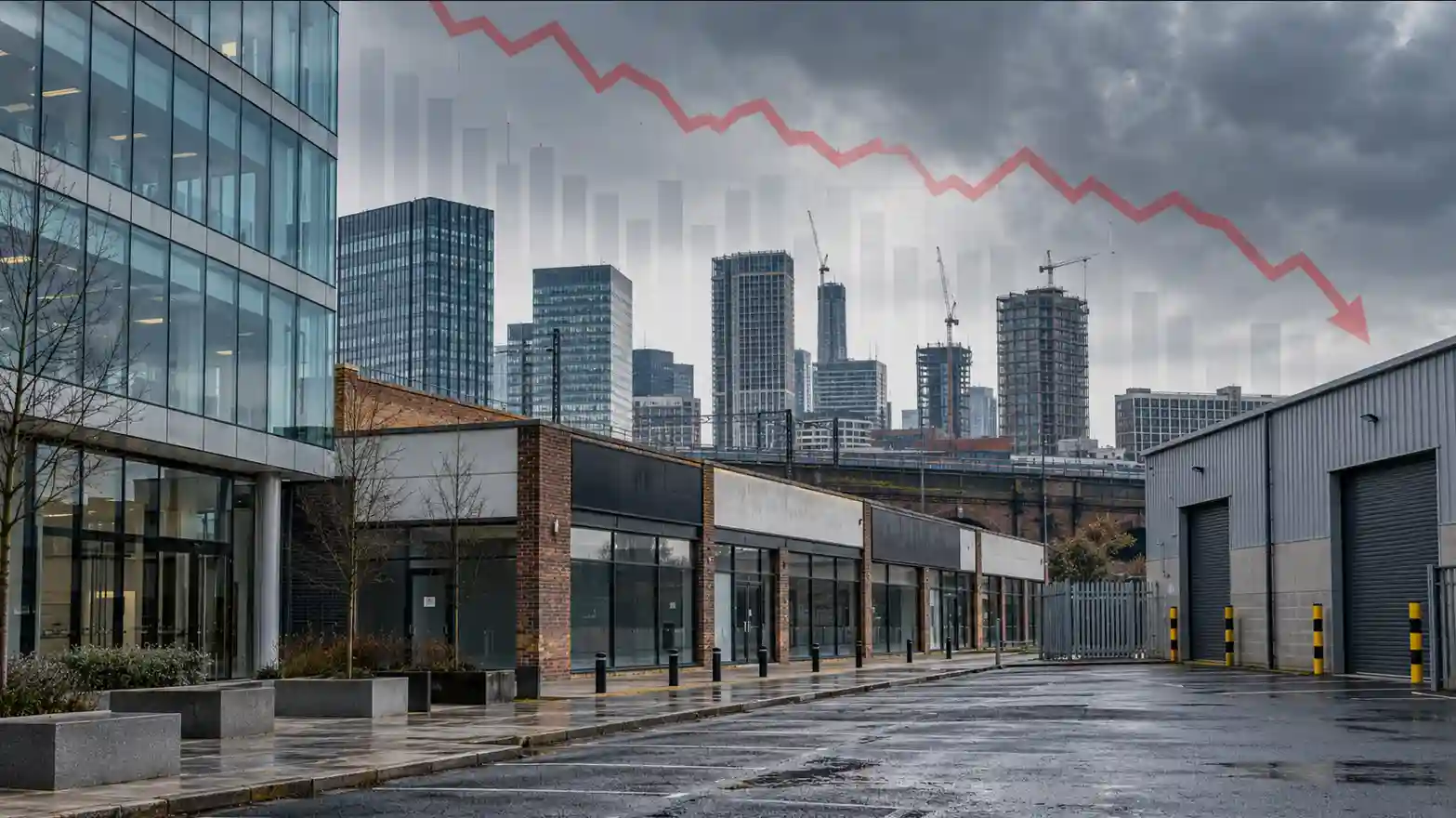
Commercial property buyers are reportedly seeking lower prices as borrowing costs rise and investment returns come under pressure. New UK figures reveal why valuations are weakening, although activity in some sectors remains surprisingly resilient.
There is an apparent contradiction at the heart of commercial property this autumn. Across parts of the UK market, demand for space remains reasonably resilient and market rental values continue to edge upwards. Yet buildings are being valued lower, while international investors are reportedly returning to sellers to renegotiate prices agreed when financing conditions were more favourable.
A Financial Times report published on 19 October describes buyers across international commercial property markets seeking reductions or reconsidering acquisitions as higher borrowing costs undermine previously agreed transactions. The reporting does not establish how many UK deals have been renegotiated, and a comprehensive domestic figure has not been independently verified. There is, however, evidence that the financial conditions behind those negotiations are affecting British property valuations.
According to CBRE’s UK Monthly Index, commercial property capital values fell by 0.9% during the third quarter of 2026, while market rental values increased by 0.5%. Total investment returns remained positive at 0.5%, reflecting the contribution of property income even as capital values declined. The fall in values was more pronounced than the 0.2% decline recorded in the preceding quarter.
Steven Devaney, CBRE’s senior director of research, attributed the deterioration to higher government bond yields and borrowing costs, which have caused the returns demanded by investors to increase.
Rising rental values, falling capital values and positive investment returns can all occur simultaneously. The first measures the market’s assessment of rental potential, not necessarily what individual tenants are already paying under their leases. The second reflects changing property valuations, while total return also captures income. Together, the figures reveal why investors may become unwilling to pay yesterday’s price for a building whose tenants and existing rental income have not changed.
When an agreed price no longer works
Commercial property transactions can take months to arrange, particularly where substantial borrowing, complex ownership structures or extensive due diligence are involved. During that period, an investor’s original financial assumptions may change. A property that appeared attractive when finance was cheaper can become much less appealing if the cost of debt increases or a lender becomes less willing to advance the anticipated amount.
The change in borrowing conditions is substantial enough to matter. Knight Frank’s October investment research records the five-year SONIA swap rate rising from 4.03% at the end of June to 4.74% in early October. Over the same period, the ten-year government bond yield increased from 4.76% to 5.42%. Neither figure represents the actual rate offered to every property borrower, but both help explain why investors are reassessing financing costs and the returns they require.
Commercial property is valued substantially by reference to the income it is expected to generate. As investors demand higher yields to compensate for risk and alternative investment opportunities, a given income stream supports a lower capital value. The mechanism is particularly important when market interest rates change faster than rental income can increase.
A purely hypothetical calculation illustrates the sensitivity. A building generating £500,000 annually in net operating income would have a simple capitalised value of £10 million at a 5% yield. If an investor instead required 6%, the same income would support approximately £8.33 million, a reduction of almost 17%. That is not the movement recorded by CBRE, and actual commercial valuations require more detailed assumptions, but it explains why property values can fall even when market rental values are increasing.
For a buyer relying on debt, the effect can be more complicated than a lower projected investment return. If the lender’s valuation falls, the amount available to borrow may also decline. The purchaser could then need to contribute additional equity while facing higher interest costs, making the acquisition considerably less attractive than it appeared when the price was negotiated.
An investor in that position may seek to reduce the purchase price, arrange alternative finance or reconsider proceeding. But renegotiation is not an automatic right. In England and Wales, the position changes once binding contracts have been exchanged; a buyer cannot ordinarily impose a lower price simply because borrowing has become more expensive. Any subsequent variation depends on agreement or the terms of the transaction. The opportunity to reopen negotiations therefore depends not only on financial pressure but on how far the parties have progressed towards completion.
The same change in financial conditions can affect existing owners. A building may remain occupied and generate sufficient income to meet its current borrowing costs, yet encounter difficulty when its loan matures and replacement finance is assessed against a lower valuation or more demanding lending criteria. The consequences of commercial property refinancing pressure may therefore extend beyond transactions currently being negotiated.
A weaker market is not a market without buyers
One of the more revealing findings in the latest UK research is that falling valuations have not prevented significant transactions from taking place.
Knight Frank reported that industrial and logistics investment reached £2.76 billion during the third quarter, an increase of 85% from £1.49 billion in the preceding three months. Large portfolio deals accounted for £1.41 billion, or approximately 51% of the total. The figures include major acquisitions of logistics assets and industrial estates, demonstrating that investors are still prepared to commit substantial capital where the financial and commercial terms are attractive.
That increase should not be interpreted as an equally strong recovery across all commercial property. Knight Frank identifies several large portfolio transactions as the main reason for the jump in investment volumes, and those deals are not representative of every smaller building or individual investor. Nevertheless, the evidence challenges the impression that rising borrowing costs have brought acquisitions across Britain to a standstill.
The identity of the buyers is particularly revealing. Institutional investors accounted for 40% of industrial and logistics investment during Q3, according to Knight Frank, benefiting from longer investment horizons and comparatively limited reliance on debt. They can approach acquisitions differently from purchasers whose returns depend heavily on borrowing at competitive rates. For the latter, higher financing costs may make an otherwise attractive asset impossible to purchase at the asking price. For the former, the same market conditions may provide an opportunity to acquire property from sellers facing pressure.
This is the distinction missing from a simple narrative of falling values. Commercial property is not becoming unattractive to every investor simultaneously. Its appeal increasingly depends on the price, the security of the income and the financial resources of the prospective purchaser. Transactions can continue, and even increase in volume, while the valuation assumptions used in other deals come under pressure.
Nor are all property sectors behaving alike. CBRE recorded a 1.1% fall in office capital values during Q3, with weakness concentrated in Outer London, the M25 area and other parts of the UK, while central London office values remained broadly unchanged. Industrial capital values declined by 0.9%. Retail proved more resilient, recording capital-value growth of 0.2% and the strongest total return among the main sectors, at 1.8%.
The differences between individual assets can be greater still. A modern office occupied by a financially secure tenant under a long lease presents a very different investment proposition from an older building requiring substantial refurbishment to remain attractive to occupiers. Similarly, a successful retail park with established tenants may attract interest that would be difficult to generate for a secondary high-street property facing prolonged vacancy.
The latest figures therefore point towards an increasingly selective market rather than a uniform withdrawal of investment. Strong buildings with secure income may continue attracting competitive bids, while properties requiring substantial capital expenditure or carrying greater uncertainty can face more demanding yield expectations. Higher financing costs magnify those differences because investors must consider not only what a property earns today but what it may cost to maintain, improve and eventually sell.
Who has the stronger negotiating position?
The outcome of a transaction often depends on whether the buyer or the seller has greater financial flexibility.
An owner with a fully let property, manageable long-term borrowing and no pressing reason to sell can afford to reject offers that fall below expectations. If rental income remains dependable, continuing to hold the building may be preferable to accepting a reduction that reflects temporary uncertainty in financing markets.
A seller approaching a loan maturity, facing pressure to return capital to investors or needing money for another acquisition may have fewer choices. Accepting a lower price can sometimes be preferable to refinancing on more expensive terms or carrying an asset that no longer fits the owner’s financial position.
That is where well-capitalised buyers may have an advantage. Investors with committed equity or limited dependence on new debt can sometimes proceed when more leveraged competitors cannot. They may also be able to negotiate more favourable terms with owners who place particular value on the certainty of completing a sale.
The negotiation is not necessarily evidence that either party has misjudged the property’s underlying quality. The seller may reasonably emphasise secure tenants and continuing rental income, while the buyer is concerned with the return available after financing costs and future expenditure. Both can be assessing the same asset rationally but arriving at different prices.
Limited transaction activity can make that disagreement harder to resolve. Valuers rely partly on evidence from comparable sales, and a market with fewer completed transactions offers less information about the prices buyers are genuinely willing to pay. A valuation remains an important professional assessment, but it cannot guarantee that a particular property will sell for that amount within a chosen period.
There are benefits to a market adjusting through negotiation. A lower price can enable a transaction to proceed, improve the prospective buyer’s return and release capital for a seller whose priorities have changed. But repeated failed negotiations can have the opposite effect, reducing liquidity and making investors more cautious about committing time and money to acquisitions that may not complete.
This creates consequences for commercial agents, valuers, lenders and investment managers, not simply for property owners. A reduction in completed transactions can affect fee income and reduce the comparable evidence available for future valuations, while lenders may need to reassess the security supporting existing and proposed borrowing.
Why tenants can be affected without moving
The effects of weaker investment valuations are not confined to the businesses buying and selling buildings. Commercial occupiers can experience indirect consequences even though the value of their premises does not automatically change their lease or contractual rent.
A landlord facing more expensive refinancing may have less financial capacity to undertake refurbishment, improve energy performance or contribute towards a new tenant’s fit-out. Development and redevelopment plans can become harder to justify when the anticipated value of the completed building has fallen relative to construction and financing costs.
Some occupiers may benefit from the same pressures. Landlords concerned about vacant space and the loss of rental income may become more flexible when negotiating incentives or lease terms with new tenants. A purchaser who acquires a building at a lower price may also have more room to invest in improvements or offer competitive terms, although neither outcome is guaranteed.
The underlying distinction is between the property and the finances of the business that owns it. A well-occupied building can remain attractive to tenants while the landlord faces difficulties refinancing the asset. Equally, an owner with sufficient capital may continue improving a building despite weaker market valuations.
The Royal Institution of Chartered Surveyors’ second-quarter commercial property monitor provides useful earlier context. Investment enquiries remained in negative territory, with a net balance of −8%, even as parts of the occupier market showed improvement. Surveyors also reported a pronounced divide between prime and secondary property, particularly in offices and retail. The findings are not evidence of October deals being renegotiated, but they reinforce the separation between demand to occupy buildings and demand to own them as investments.
What happens if financing costs stay elevated?
The coming months will help determine whether the latest pressures amount to a temporary adjustment in transaction pricing or something more persistent.
CBRE’s third-quarter figures establish that UK capital values have weakened, while Knight Frank’s industrial investment data shows that substantial acquisitions are still taking place. Further evidence from investment volumes, achieved yields and commercial lending conditions will be needed to establish whether difficulties are broadening or remaining concentrated among more heavily financed transactions and weaker assets.
The Bank of England’s next interest-rate decision is scheduled for 5 November. Bank Rate currently stands at 3.75%, but its movement alone will not determine commercial property financing costs. Government bond yields, interest-rate swaps, lender margins and individual property risks can all influence the terms offered to borrowers. Even a stable Bank Rate would not necessarily prevent changes in the amount investors can borrow or the returns they require.
There are reasons for caution in both directions. Continued rental growth, established occupational demand and the availability of long-term institutional capital could support investment activity despite higher borrowing costs. Conversely, prolonged pressure on financing and yields could make refinancing more difficult, delay transactions and encourage investors to reduce the prices they are prepared to offer.
The question is therefore not whether rising borrowing costs make all commercial property unattractive. The latest UK evidence shows that investors are still prepared to buy, and that some sectors are performing considerably better than others. What is changing is the price and financial structure needed to make individual acquisitions worthwhile.
For buyers and sellers negotiating this autumn, the difficulty is that those calculations can change before a transaction is completed. The building may be producing the same rent, the tenant may still be in occupation and the physical property may be entirely unchanged. But if the cost of capital rises, the price a buyer can justify may no longer be the price the seller expected to receive.
This article provides general commercial property news and market analysis, not investment, valuation, financial or legal advice. The financial illustration is simplified and does not represent an actual transaction or a forecast of market yields. Property values, financing terms and investment returns depend on the specific asset and circumstances. Investors, borrowers, landlords and occupiers should obtain appropriate professional advice before making decisions.

