

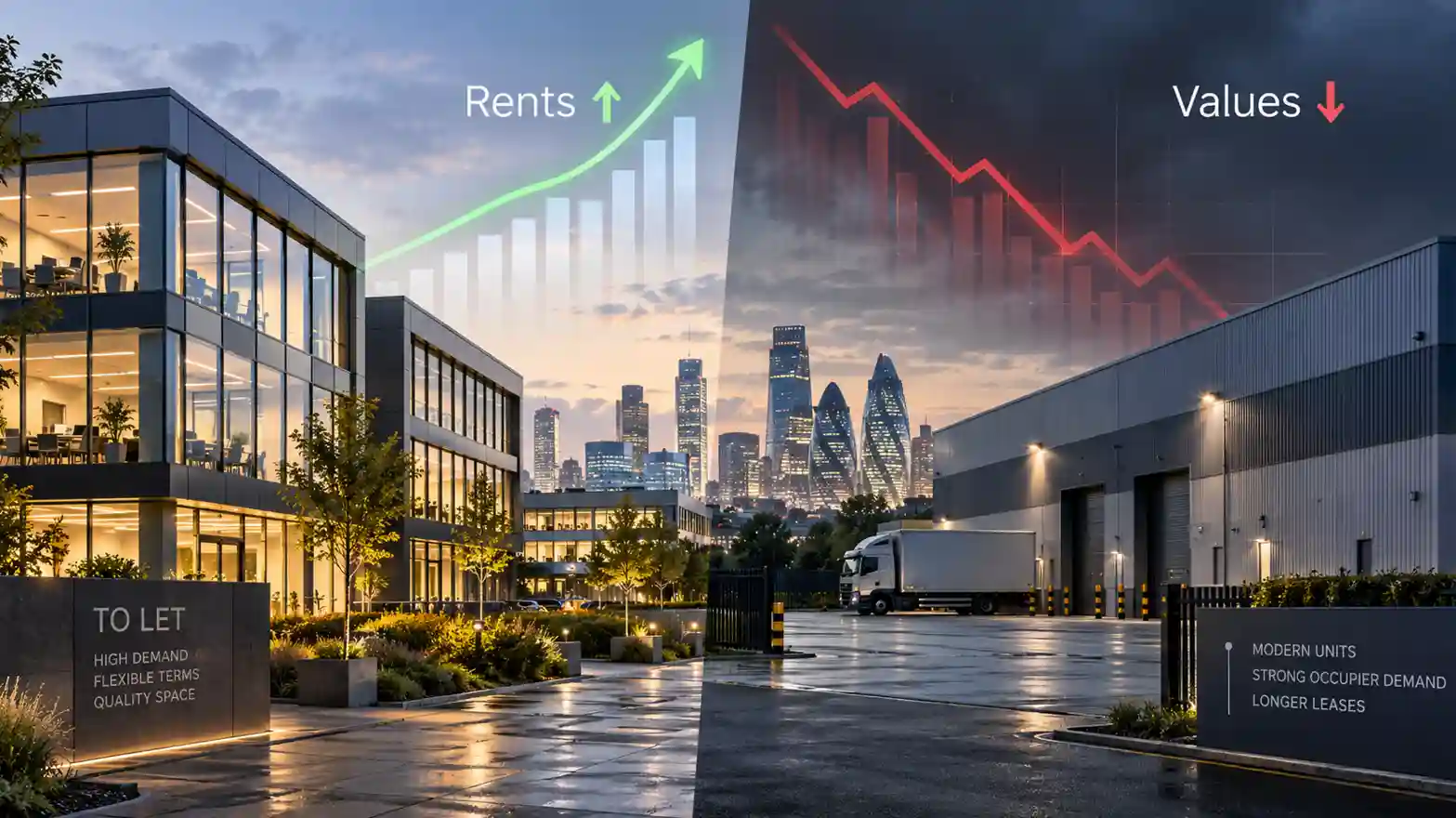
In the second quarter of 2026, UK commercial rental values rose while capital values fell. CBRE’s UK Monthly Index recorded rental value growth of 0.6% across commercial property while capital values declined by 0.2%. Offices showed rental values rising 0.3% while capital values fell 0.6%, with weakness concentrated in Outer London and M25 stock. Industrial rental values rose by 1.0%, yet industrial capital values still slipped 0.2%.
That is not a contradiction. If commercial property value were simply rent multiplied by a fixed number, it could not happen. But the number investors are prepared to pay for each pound of property income is not fixed.
There is also an important distinction inside those figures. Rental value growth is not the same thing as growth in the passing rent actually being collected. A lease may fix the rent received by the landlord for several years while the market rental value of the space rises or falls around it. A building can therefore experience improving market rents, unchanged passing income and falling capital value at the same time.
The investment question is not simply whether rent is rising. It is what is happening simultaneously to the price the capital market is prepared to pay for that income.
Value is income capitalised at a market yield — and both sides of that equation move
The basic mechanism is familiar but easy to underestimate. An income-producing commercial property is valued by reference to its income and the rate at which investors are prepared to capitalise that income. If market rent rises while the yield remains unchanged, that should support value. If the yield moves outward far enough at the same time, however, the positive effect of rental growth can be overwhelmed.
The yield is not merely a crude measure of how “risky” the property is. It reflects the market’s current pricing of the cash flow, including perceived income risk, expectations for rental growth or reversion, liquidity, financing conditions and the returns available elsewhere. Investors may accept a lower initial yield where they have strong conviction about future rental growth or where an under-rented asset offers visible reversion; conversely, a higher current yield can reflect an expectation that income will weaken as well as compensation for uncertainty.
That is why the same level of current income can support very different values at different points in the cycle. The income has a price, and the market continuously resets that price as its view of future growth, risk and competing returns changes.
A simple illustration, clearly hypothetical
Take a property earning £100,000 a year which the market prices at a 5% yield. On that simplified basis, the value is £2 million. Now assume the relevant income rises by 5% to £105,000, but during the same period the market yield moves out to 6% because financing has become more expensive or investors require greater compensation to own this type of asset.
Capitalising £105,000 at 6% produces a value of £1.75 million. Income has increased by 5%, yet value has fallen by 12.5% because the movement in the capitalisation rate was considerably more powerful than the improvement in income.
These figures are deliberately simplified and are not a valuation model for a live property. The point is the relationship: stronger income and weaker capital pricing can exist at exactly the same time.
The reverse mechanism is equally important. If rents are relatively flat but the market becomes willing to capitalise the income at a lower yield, capital values can rise without much improvement in the occupier cash flow. Property performance is therefore the interaction of occupational fundamentals and capital-market pricing rather than one mechanically following the other.
Rising rents do not protect value if the required return moves far enough
The forces moving property yields can originate well beyond the building itself.
Risk-free rates matter because commercial property competes for capital with government bonds and other investments. The Bank of England’s July 2026 Monetary Policy Report noted that 10-year gilt yields had risen by around 350 basis points between the start of quantitative tightening in February 2022 and the end of June 2026, with both higher expected rates and increased term premia contributing to the movement.
There is no fixed mathematical spread that commercial property must maintain over gilts, and different sectors and assets price very differently. But when investors can obtain materially higher returns from lower-risk alternatives, the price they are prepared to pay for property income can change even if the rent roll itself remains healthy.
Debt adds another transmission mechanism. CBRE’s Q2 commentary attributed part of the quarter’s capital-value weakness to higher swap rates feeding into real-estate borrowing costs. If leveraged purchasers face more expensive debt, the amount they can pay while still achieving the required equity return falls. The property has not necessarily become worse to occupy; it has become more expensive to finance at the old price.
Sector and asset expectations then sit on top of that macro backdrop. Investors can demand a wider yield because they expect weaker rental growth, greater vacancy, higher capex, poorer liquidity or faster obsolescence. Equally, they may accept a tighter yield where they expect strong rental reversion, constrained supply or particularly durable income. That is why describing every outward yield movement simply as “higher interest rates” can be just as misleading as attributing every value movement to rents.
Different sectors — and different buildings — reprice for different reasons
The Q2 2026 figures show how these forces interact. Industrial rental values rose by 1.0% over the quarter, substantially faster than the 0.3% increase recorded for offices, yet industrial capital values still declined slightly. Office capital values fell further, with the weakness concentrated in particular sub-markets rather than uniformly across UK offices.
The market was not denying that occupational values were improving. It was attaching a different capital price to those future income streams.
That distinction becomes more important as the analysis moves from a sector index to an individual property. Two buildings in a market experiencing identical rental growth can still reprice very differently because one carries greater capex exposure, weaker covenant, poorer liquidity, shorter income or greater risk of functional obsolescence. One may also be significantly under-rented and offer genuine reversion, while another already sits above market rent and therefore has much less future growth embedded in its current income.
The investor consequently needs to separate three things that are easily blurred together: what rent the property collects today, what the market believes the space could rent for, and the yield investors are prepared to apply to the cash flow they expect over the ownership period.
Those three variables need not move together.
Thin transaction evidence can make the value signal less precise
There is a further complication when investment markets are quiet: yield evidence itself becomes less plentiful.
CoStar reported UK commercial-property investment of £9.7 billion in Q1 2026, almost 40% below its five-year first-quarter average. Different market-data providers can report somewhat different totals depending on their coverage and methodology, but the broader point is that investment activity began 2026 at relatively subdued levels.
That matters to valuation because actual transactions remain particularly valuable evidence of the prices and yields buyers and sellers are agreeing in the market. The current RICS standard on comparable evidence in real estate valuation specifically recognises the difficulties created by limited transactions, a lack of up-to-date evidence, complex assets and imperfect market transparency.
A valuation is therefore not a guaranteed exit price. It is a professional opinion supported by the best evidence reasonably available. When transactions are sparse, the range of judgement around that opinion can increase because there are fewer recent arm’s-length deals against which the assumed yield can be tested.
That does not make valuation unreliable or mean published capital-value indices should be disregarded. It means investors should understand the evidence underneath them. A sector index can show a modest value movement while an individual secondary asset — for which there have been very few genuinely comparable sales — may discover a significantly different clearing price when it is actually marketed.
This is particularly relevant in periods of repricing because valuations and transactions do not necessarily adjust at exactly the same speed. A theoretical yield movement becomes a realised capital value only when the market is willing to transact at it.
What this means in practice
Commercial property value is not simply today’s rent multiplied by a stable market convention. It reflects the cash flow investors expect to receive and the yield at which the market is prepared to price that cash flow at a particular point in time.
That means an investor needs to ask more than whether rents are rising. They need to understand whether market rental values are moving, whether the property’s actual passing income can capture that movement, what reversion is available at future lease events, and whether the capital market is demanding a higher or lower yield for owning that income.
A building with rising market rents and falling capital value is therefore not inherently contradictory or necessarily a poor asset. It may be benefiting from strong occupier fundamentals while simultaneously being repriced because financing costs, risk-free rates or investor sentiment have changed. Conversely, a property can show rising capital value without much rental growth if yields compress because investors become more willing to own the income.
The useful investment judgement is identifying which side of the equation is responsible for the change.
If the problem is weak occupational demand, the investor has a property problem. If rents and occupier demand remain strong but the required yield has moved outward because the wider cost of capital has changed, the investor is dealing primarily with a repricing problem. Often both forces operate together, but separating them is essential before deciding whether a fall in value represents deteriorating real estate, a changed capital market or an opportunity created by the interaction of the two.
This article provides general market and pricing information, not valuation, financial, tax or investment advice for individual circumstances. Yields, capital values, rental values, passing rents and required returns vary materially by sector, location, asset quality, lease structure and market conditions and should be independently assessed before any investment decision.

