

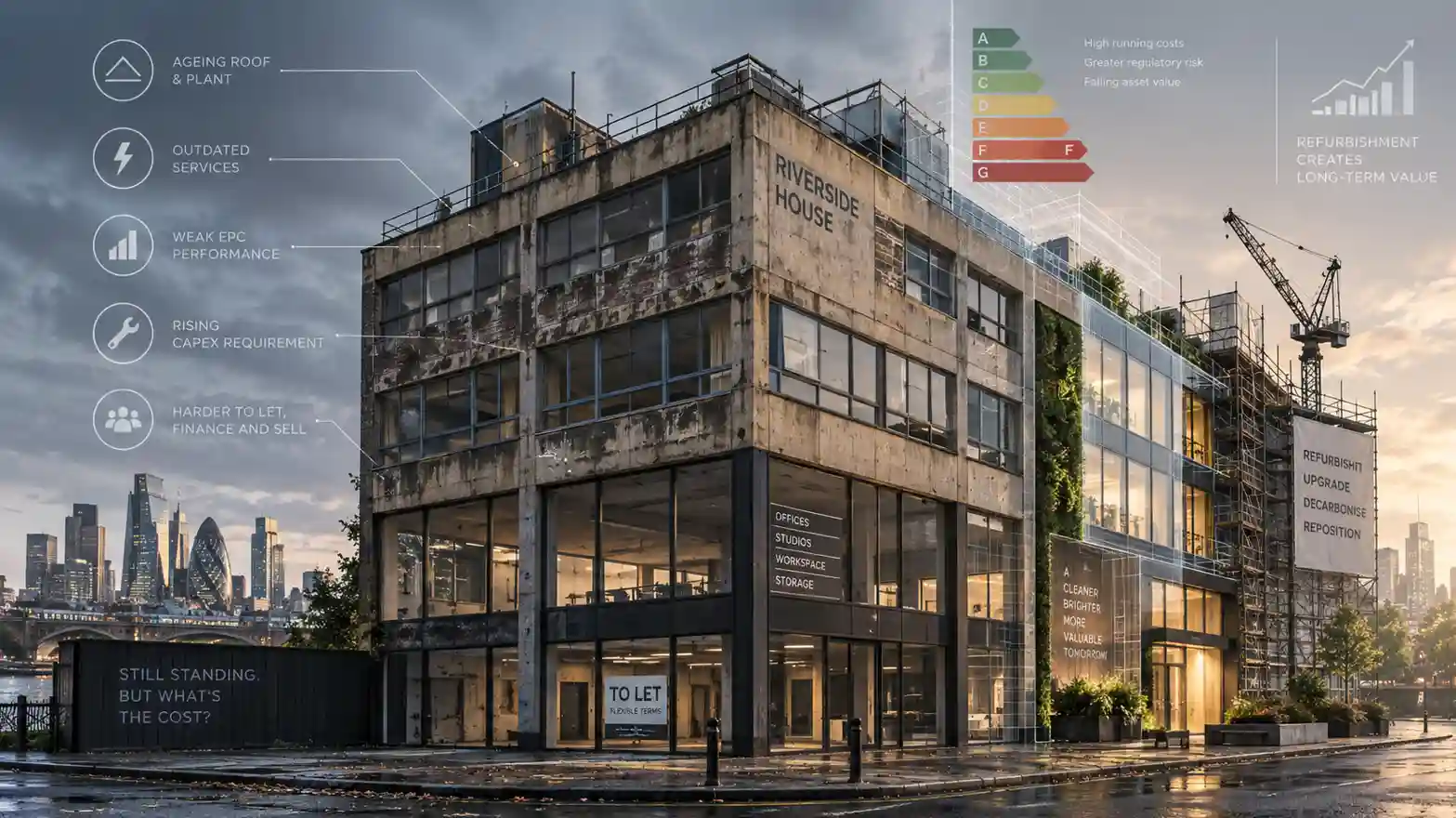
“Stranded asset” has become one of those phrases that can lose useful meaning when it is reduced to an ESG warning label. Strip the terminology away and the underlying investment question is much more practical: will this property remain desirable enough to occupy, let, finance and sell over the period I intend to own it — and what capital will be required to keep it that way?
Stranding does not require a building to become simultaneously unlettable, unfinanceable and unsaleable or to fall to zero value. For a property investor, the more useful concept is the risk of premature value impairment or accelerated obsolescence because regulatory requirements, occupier expectations, financing criteria or competing buildings move faster than the asset can economically adapt.
That process can happen gradually. Rent weakens relative to better stock, incentives rise, voids lengthen, purchasers demand a higher yield and lenders become more cautious. Eventually the cost of repairing, upgrading or repositioning the property can approach — or exceed — the value that intervention would create. The building may still function perfectly adequately in a physical sense while the investment has already begun to strand economically.
Obsolescence starts before regulation forces the issue
A property can lose competitiveness long before an EPC deadline or another regulation prevents it being let. The underlying problem is often functional: a building designed perfectly well for the market of twenty or thirty years ago may no longer support the way occupiers now use space. Ageing mechanical and electrical systems can become expensive to operate or replace; insufficient electrical capacity can constrain machinery, automation or fleet charging; accessibility may fall below occupier expectations; and layouts, servicing arrangements or building dimensions can become increasingly difficult to reconcile with what competing properties now offer.
The weakness manifests differently by sector. In offices, an older building may struggle because of inefficient floorplates, weak amenity, poor environmental performance or the cost of bringing the space up to the standard required by occupiers competing for staff. Knight Frank’s Q2 2026 regional office-market research shows the continuing concentration of demand in better-quality accommodation, with Grade A space accounting for 64% of take-up during the quarter, Grade A vacancy at just 3% and average regional prime rents rising 7% over the year.
Industrial property can become functionally secondary for different reasons: low eaves, inadequate yard depth, insufficient loading, limited power or an internal configuration that makes modern automation difficult. Retail, leisure and hospitality assets can face another form of obsolescence where unit size, access, servicing or a highly specialised historic configuration no longer matches the occupiers willing to trade in that location.
The useful investment question is therefore not whether a building is “old”. Plenty of older property remains highly competitive and valuable. It is which characteristics determine occupier demand for this particular asset, which of those characteristics are deteriorating relative to competing stock, and whether they can be economically corrected. Physical age and economic obsolescence are not the same thing.
Capex only becomes meaningful once you know what it fixes — and who actually pays it
Future capital expenditure is where an apparently attractive investment yield can become misleading. A roof approaching the end of its economic life, obsolete plant, lift replacement, façade repairs, electrical upgrades or substantial refurbishment all represent potential claims on the future cash flow of the property. RICS’s current professional standard on ESG and sustainability in commercial property valuation, effective from April 2026, recognises that significant sustainability-related capital and operating expenditure can affect commercial-property valuation and that obsolescence may accelerate where an asset falls below regulatory or market expectations.
But an investor should not simply total every anticipated building cost and assume the landlord bears it all. Commercial leases can allocate repairing and replacement obligations very differently. A tenant with extensive repairing obligations may carry significant responsibility for the condition of its premises, while multi-let properties may allow some repair, maintenance and replacement expenditure to be recovered through service charges. Conversely, major improvements, repositioning expenditure and asset-management initiatives intended primarily to enhance the landlord’s investment may remain substantially with the owner.
The RICS service-charge standard makes the underlying discipline clear: recoverability ultimately depends on the lease, and improvement expenditure should not simply be treated as an ordinary recoverable operating cost. Lease length, repairing covenants, schedules of condition, service-charge drafting, dilapidations and the timing of works can therefore alter the investor’s true capex exposure materially.
Once responsibility is understood, the harder question is whether spending the money actually creates or preserves enough value. A £1 million refurbishment is not justified merely because the building needs £1 million spent on it. The investor needs a realistic estimate of the post-works rent, the void and finance cost while the works are undertaken, the incentives and professional costs required to re-let the space, and the risk that competing stock or occupier requirements move again before that value is captured.
The exit yield applied to the improved income matters just as much as the rental uplift. Spending enough to increase the rent does not guarantee that a future purchaser will price the building like prime stock. If location, configuration, continuing obsolescence or another structural weakness means buyers still demand a materially wider yield, the capital-value increase may be considerably smaller than an appraisal assuming substantial yield compression suggests. Refurbishment can therefore improve the income and still fail to create an adequate investment return.
The calculation is not simply cost of works versus today’s property value. It is whether the total capital committed — acquisition, works, void, finance, incentives and contingency — produces a post-refurbishment asset whose sustainable income and realistic terminal value justify the money and risk required to create it.
Regulation can accelerate stranding, but it does not define it
Energy regulation matters because it can bring forward the point at which improvement becomes necessary, but the current position needs to be described precisely.
In June 2026, the government published its interim response on strengthening Minimum Energy Efficiency Standards for the privately rented non-domestic sector in England and Wales. Its current intention is that, from 2031, privately rented non-domestic buildings over 1,000 square metres should reach EPC B where cost-effective. Buildings below that threshold are intended to remain subject to the existing EPC E minimum standard, while the previously proposed EPC C milestone for 2027 will not be taken forward.
The government’s MEES interim response is equally important for what it does not yet do. EPC B for larger buildings is not currently an enacted 2031 legal requirement. The government says the higher standard will only take effect following successful secondary legislation, with existing flexibility mechanisms including the seven-year payback test and exemptions intended to remain.
That distinction prevents two opposite investment mistakes: assuming every commercial building below EPC B is already legally doomed, or assuming that because final legislation has not yet been enacted an owner can sensibly ignore the direction of travel until the law changes. Occupiers considering long leases, lenders underwriting multi-year loans and purchasers modelling an eventual exit may all price the future competitiveness and compliance route of the asset before a statutory deadline forces the issue.
Energy performance therefore belongs inside the wider obsolescence analysis rather than sitting in a separate ESG box. The legal position also differs across the UK, so the England-and-Wales MEES proposals should not be applied automatically to Scotland or Northern Ireland.
Cheap, stranded or repositionable depends on whether there is an economic route back
Not every secondary building trading at a discount is a stranded asset in waiting. Some of the strongest commercial-property returns can come from assets where the market has correctly identified a problem but overestimated what it will cost to solve it. That is fundamentally different from a property whose difficulties cannot be repaired at an economic cost.
An office with dated finishes and inefficient plant may be highly repositionable if refurbishment can secure materially stronger rent and broaden the occupier market. An industrial property with an otherwise strong location may justify substantial investment if improved power or specification unlocks demand that already exists. A poorly configured building may also contain alternative-use or redevelopment value that makes the current use less important than the land or planning opportunity underneath it.
The test is whether there is a credible, costed path back to full investability. That path becomes increasingly doubtful where physical limitations are inherent, planning prevents a viable alternative use, the market rent after refurbishment still cannot support the capital required, or the asset needs repeated substantial intervention merely to remain behind newer competing stock.
Current capital-market evidence supports that distinction. Knight Frank’s Active Capital Survey 2026 found investors increasingly differentiating between well-located, ESG-compliant assets capable of meeting modern occupier requirements and properties facing longer-term obsolescence. That does not mean every lender refuses older property or every modern building receives favourable financing; debt still depends on income, covenant, leverage, sector, location and sponsor quality. But obsolescence and future capex can affect the investment case from several directions at once: occupiers influence rent and void risk, lenders influence the amount and cost of debt, and future purchasers determine the yield at which the remaining cash flow can ultimately be sold.
That last point matters particularly when assessing refurbishment. An investor can spend heavily, improve the building and still discover that the asset remains structurally secondary in the eyes of the capital market. If the expected exit yield compression never arrives, the investment has to stand on the rental growth and cash flow it genuinely creates rather than on an assumed re-rating that the building may never earn.
A property can therefore begin losing investability well before it becomes impossible to transact, while a discounted property with an economically credible route back can remain exactly the sort of opportunity a capable asset manager should be looking for.
A £3 million investment can really be a refurbishment business plan
Take a hypothetical older office building available for £3 million and producing an attractive passing yield. Technical due diligence suggests that roughly £600,000 of work may be required during the ownership period to replace ageing plant, improve energy performance and reconfigure the space sufficiently to remain competitive. That number alone represents 20% of the acquisition price, but it is still not the full investment exposure.
The buyer first needs to establish which elements genuinely fall to the owner under the existing leases and which, if any, can properly be recovered or passed through. The timing of lease events matters because refurbishment may require vacant possession or may coincide naturally with expiry. The appraisal then needs to include any void period, lost rent, professional costs, finance, incentives, contingency and the opportunity cost of the additional capital.
Only then does the post-works value become meaningful. If the refurbishment allows the building to secure a stronger tenant at a materially higher sustainable rent, reduces future capex risk and makes the eventual investment attractive to a broader buyer and lender pool, the £600,000 may unlock considerably more than £600,000 of value. But that conclusion also depends on the capitalisation rate a future purchaser is likely to apply. If the improved building still commands a secondary yield because its location or fundamental configuration has not changed, the increase in value may be much smaller than the rental uplift alone suggests.
If the location cannot support the required rent, the building remains structurally inferior to competing stock or the exit valuation depends on an unrealistic yield assumption, the same £600,000 may simply slow the rate of decline rather than produce an adequate return. The revealing question is therefore not whether the current yield looks attractive, but whether the investor is genuinely buying a stable income-producing property or acquiring a refurbishment strategy with interim rent attached. If it is the latter, it should be underwritten with the contingency, programme risk and required return expected from an asset-management project rather than the assumptions appropriate to passive income.
The investor is buying the building at the end of the hold period too
Today’s rent roll describes today’s asset. It does not tell the investor what the building will cost to own through the next lease cycle, what rent it will produce afterwards or what another purchaser will be willing to pay for that income when the time comes to sell.
The purpose of a stranding analysis is therefore not to identify buildings that fail an arbitrary sustainability test and avoid them. It is to understand where future economic obsolescence could come from, when capital will be required, who bears that cost, what the intervention can realistically do to the income, and how the resulting asset is likely to be valued at exit.
A secondary property with a credible and profitable route to repositioning can be a compelling investment, just as a modern building bought at an unjustifiable price can still be a poor one. The word “stranded” should not replace the appraisal, but neither should today’s income be allowed to conceal tomorrow’s building.
The property an investor ultimately needs to price is not merely the one earning rent on completion day. It is the asset expected to emerge after the next round of lease events, capital expenditure and market change — with the sustainable rent, remaining obsolescence and exit yield that another investor is likely to see when the hold period ends.
This article provides general commercial-property, regulatory and investment information, not valuation, surveying, engineering, legal, tax, financial or investment advice for individual circumstances. Building condition, lease obligations, service-charge recoverability, energy performance, refurbishment costs and regulatory requirements vary materially between properties and jurisdictions and should be independently investigated and professionally assessed before an acquisition or asset-management decision.

