

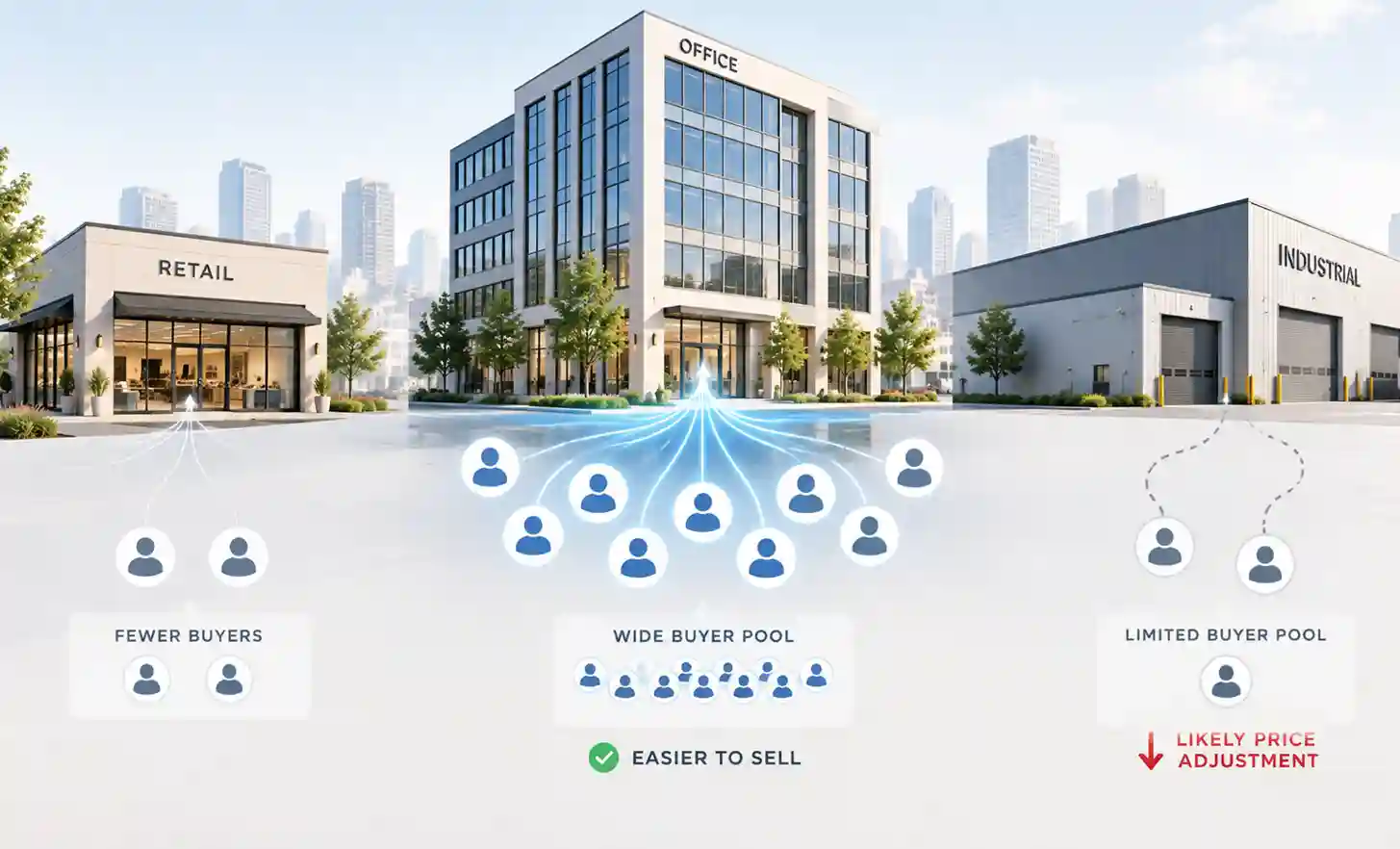
Most commercial property acquisitions get underwritten backwards. The purchase price is scrutinised, the yield is compared with alternatives, the tenant covenant is checked and the financing is stress-tested — while the exit, the point at which the investment thesis eventually has to be converted back into cash, is often allowed to rest on the assumption that another buyer will simply turn up when required.
For a highly sought-after asset in a deep market, that assumption may prove entirely reasonable. For a meaningful part of commercial property, it is much less comfortable.
The useful question is not merely “will somebody buy this one day?” Almost any property can find a buyer at some price. The relevant investment question is how many credible buyers are likely to exist, how long they may take to transact, what financing they can obtain and what price concession may be required to make the market clear.
Liquidity is therefore not the same thing as marketability or the existence of interested parties. It is the ability to convert an asset into cash within a reasonable period without having to accept a disproportionate discount simply to produce a transaction.
Owning an asset and having genuine liquidity in it are not the same thing.
Commercial property is not one market — and liquidity is highly asset-specific
A £750,000 secondary retail investment in a regional town and a £25 million logistics warehouse let to a strong national occupier are not simply different sizes of the same trade. They draw from different sources of capital, different lending markets and different investment strategies, and the number of buyers realistically capable of acquiring each can be radically different.
The same applies within sectors. A prime office in a major market, a secondary provincial office approaching a lease event and a specialist owner-occupier building may all carry the label “office investment”, yet their realistic resale markets bear little resemblance to one another.
Liquidity should therefore be thought of as a characteristic of the particular asset at a particular point in time, not as something commercial property either possesses or lacks as an asset class.
Current market conditions reinforce that point. MSCI’s September 2026 analysis of commercial real-estate liquidity found that even Central London — one of the world’s largest and most established property markets — had fallen to its lowest recorded level on MSCI’s Capital Liquidity Scores as higher long-term rates put renewed pressure on the market.
That is useful context because it shows that liquidity is not guaranteed even by scale or reputation. Buyer depth expands and contracts with financing conditions, relative pricing and confidence, and those movements can matter independently of whether the occupier fundamentals of the underlying building remain sound.
The buyer pool is built from more than sector and location
Lot size is one of the first filters because different pools of capital operate at different scales. Some private investors are highly active in smaller commercial investments that would simply be too small to justify the process and resource required by a large institution. At the other end of the spectrum, a very large asset can exclude buyers unable or unwilling to write the equity cheque or assemble the necessary finance.
There is no universal dividing line between “private” and “institutional” property, and attempts to create one are usually too crude. What matters is whether the asset sits inside a range that enough realistic purchasers can actually transact.
The smaller-lot auction market illustrates how distinct one buyer universe can be. In its July 2026 commercial auction results, Allsop reported an average lot size of about £713,000, with 77% of responding purchasers completing without finance and 85% having previously bought at auction. More than half of the sold lots were outside London and the South East.
Those figures should not be extrapolated across UK commercial property; they describe a particular auction market. They are useful precisely because they demonstrate that a deep market can exist around a very specific combination of lot size, pricing, transaction method and buyer type.
A £700,000 investment capable of attracting numerous experienced cash buyers can therefore be more liquid in practical terms than a £12 million property sitting in an awkward gap between the private capital naturally attracted to its location and the institutional investors for whom its size, sector or risk profile is insufficiently compelling.
Tenant and lease characteristics narrow the field further. A secure covenant with substantial term remaining can fit income strategies that will not consider short leases or speculative reletting risk. A vacant building, highly specialised property or asset carrying substantial capex may appeal to value-add investors while being irrelevant to buyers seeking passive income.
Financing completes the picture because the next purchaser has to fund the acquisition too. If lenders are cautious about the asset’s sector, location, condition or lease profile, the pool of buyers dependent on conventional debt can shrink even when some well-capitalised purchasers remain interested.
Exit liquidity is therefore not produced by one variable. It is the intersection of price, lot size, sector, location, income, physical asset and available capital.
The asset you eventually sell may have a different buyer pool from the one you buy today
This is where static exit assumptions become dangerous.
The investor does not sell today’s lease profile five or seven years from now. They sell whatever remains of it.
A property acquired with ten years remaining on the lease might reach the planned exit with only four or five years left. A building currently requiring little immediate expenditure can be approaching a major refurbishment cycle by then. A tenant considered exceptionally strong today may have a different financial position in several years’ time, while the sector itself may have rotated into or out of favour with investors and lenders.
The asset can also move between buyer pools as the business plan develops. Successful refurbishment may broaden the market by reducing obsolescence risk and improving income quality. A lease extension can convert a value-add proposition into an income investment. Conversely, failure to execute the asset-management plan can leave a property with shorter income, greater capex and fewer buyers than it had when acquired.
That means exit liquidity needs to be underwritten against the expected asset at the point of sale, not simply inferred from how easily the property could be sold today.
It also means the exit date itself can become part of the investment strategy. Selling before a major lease event may present one risk profile to buyers; selling after a successful renewal or reletting may present another. Neither is automatically superior, but assuming the same buyer universe exists at both points ignores one of the main ways value is created or lost through asset management.
Illiquidity matters most when the investor loses the ability to wait
A property that takes six months rather than six weeks to sell is not necessarily a bad investment. Nor is a thin buyer pool automatically unacceptable if the purchase price compensates adequately for it.
The real cost of illiquidity appears when the investor needs a transaction rather than merely wants one.
A refinancing failure may require equity to be raised quickly. A fund may reach the end of its life. A joint venture may need to unwind. Another investment opportunity may require capital to be recycled. The owner may simply decide that its portfolio strategy has changed.
In each case, the difference between a broad buyer market and a thin one becomes optionality.
A patient owner can expose an unusual property to the market, wait for the right purchaser and reject bids that do not reflect its view of value. An owner operating against a loan maturity, fund deadline or capital requirement has less freedom to do so. The relevant price is no longer necessarily the value the asset might achieve given enough time; it becomes the price at which a transaction can actually be executed inside the available window.
That is how illiquidity often reveals itself in practice. The property may not be unsaleable at all. Instead, the price has to move further to find the marginal buyer, because there are fewer bidders competing to establish the clearing price. A seller with time can resist that adjustment; a seller under pressure may have little choice but to accept it.
This is why liquidity cannot be reduced to yield. A higher yield may partly compensate for a thinner resale market, but it does not guarantee that the premium is sufficient once time-to-sale, transaction uncertainty and the potential need for a price concession are considered. The liquidity risk may remain invisible for years while the rent arrives exactly as expected, only to become expensive when the owner’s timetable changes.
Exit assumptions belong in the acquisition appraisal
The discipline therefore needs to begin before the property is purchased.
An acquisition model that assumes today’s yield simply reappears at exit is making several assumptions at once: that capital-market pricing is unchanged, that the future lease profile remains acceptable to the same buyers, that the building has not acquired material capex or obsolescence problems and that sufficient purchasers still want the asset when it is offered for sale.
Some of those assumptions may be reasonable. They should nevertheless be visible.
The investor should have a defensible view of who the likely next buyer is expected to be. Is the business plan creating an institutional-quality income stream, or is the likely exit still to another private value-add investor? Will the future lot size broaden the market or push the asset into an awkward middle ground? Does the planned lease event increase liquidity, or could a shorter unexpired term materially reduce the available buyer base? Will the next purchaser be able to obtain ordinary debt against the asset, or is the exit dependent on a narrower pool of cash or specialist capital?
The exit yield then needs to reflect that future property rather than acting as a convenient balancing figure that makes the acquisition return work. This connects directly with the other investment disciplines in this section: yield, obsolescence, capital value and leverage all affect the eventual exit, but liquidity determines whether the assumed exit can actually be executed.
A robust investment thesis does not need certainty about who will buy several years in the future. It does need more than the assumption that somebody will.
Two attractive investments can have very different exit risk
Consider two simplified acquisitions.
Asset A offers a comparatively modest initial yield but occupies a recognised investment market. Its lot size is accessible to several categories of purchaser, the building is relatively conventional, the lease profile is easy to understand and finance is generally obtainable for assets of its type.
Asset B offers a materially higher yield but is more specialised, sits in a thinner regional market and has a smaller natural buyer universe. Its income may be perfectly sound, but a future purchaser will need to be comfortable with a less conventional property and may have fewer financing options.
The higher yield on Asset B may be entirely sufficient compensation. A specialist investor who understands the location, has patient capital and can improve the property might rationally prefer it to Asset A.
But the comparison changes once the exit is modelled as part of total return rather than treated as a mechanical terminal value. A longer marketing period, wider exit yield, thinner competition between bidders or the possibility that the sale has to wait for a suitable specialist purchaser can all consume part of the income premium that made Asset B look more attractive at entry.
That does not make the illiquid asset inferior. It means the investor should be paid for the illiquidity as deliberately as they expect to be paid for covenant risk, capex or leverage.
The next buyer belongs in today’s investment case
Before approving a commercial-property acquisition, one question deserves to be answered explicitly:
Who is the realistic next buyer for this asset, in the condition and lease position in which I expect eventually to sell it, and why should they want it?
The answer does not need to identify a particular future purchaser. It should identify a credible market.
If the investment strategy is supposed to convert a secondary building into institutional stock, the planned works, rent, covenant and lease structure should genuinely move the asset towards that market. If the likely exit remains to regional private investors, the expected lot size and financing assumptions need to remain compatible with that buyer base. If the property will still require a specialist purchaser, the exit appraisal should price the depth of that market rather than quietly assume it has become mainstream.
Commercial property does not need stock-market liquidity to be a good investment. Illiquidity can itself create opportunity because patient and knowledgeable capital can be paid to accept complexity other investors avoid.
The mistake is not buying something difficult to sell. It is paying a price and underwriting a return that assume it will be easy.
This article provides general commercial-property market and investment information, not valuation, legal, tax, financial or investment advice for individual circumstances. Buyer demand, financing availability, marketing periods, transaction costs and achievable sale prices vary materially by property, sector, location and market conditions and should be independently assessed before an acquisition or disposal decision.

