

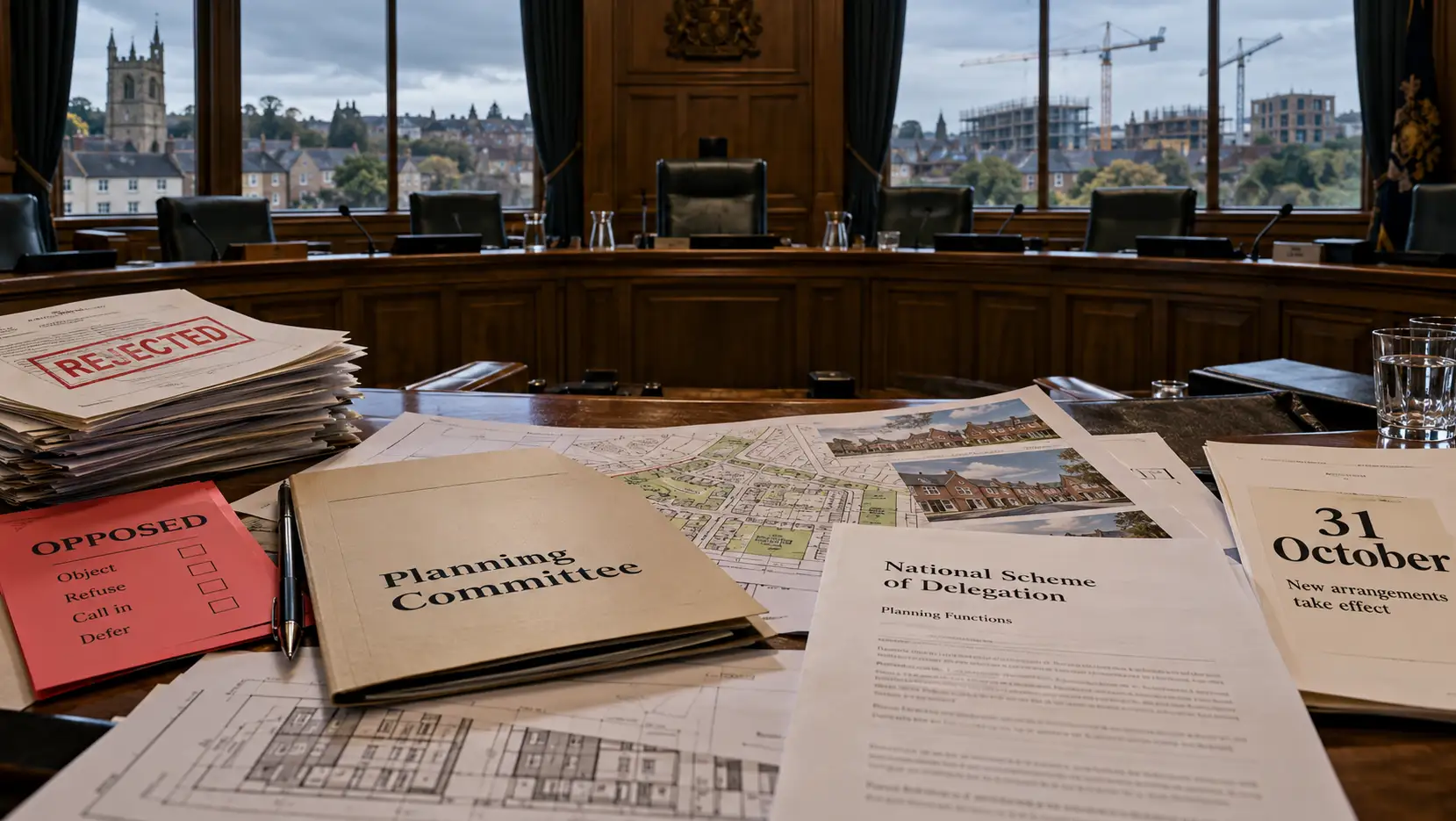
Councils do not often vote against changes they are about to be legally required to make. On 6 October, Tameside did. By 26 votes to 22, the Greater Manchester borough’s full council rejected a recommendation to bring its constitution into line with the government’s National Scheme of Delegation for planning applications, a change due to take effect across most local planning authorities in England on 31 October.
Reform UK, Conservative and independent councillors combined to defeat the ruling Labour group. Reform’s group leader, Allan Hopwood, called the reform an “egregious overreach of power”. The council’s monitoring officer warned that rejecting the changes could leave planning decisions vulnerable to legal challenge, and a further meeting to reconsider the matter was among the possible next steps.
Tameside is not alone. Bolton councillors also rejected the changes, while Central Bedfordshire’s full council voted against amending its constitution on 24 September, with just six members supporting the proposal, 20 opposing it and 23 abstaining. Derbyshire County Council took a different course, formally maintaining its opposition while approving the amendments needed to comply with the law.
These councils are not rejecting planning officers’ involvement in determining applications. Officers already make the overwhelming majority of planning decisions. The dispute is about the minority of cases where elected councillors and local residents believe public committee scrutiny matters most, and whether removing established routes to that scrutiny will make planning more efficient or simply less accountable.
What changes on 31 October
The reform comes through the Planning and Infrastructure Act 2025 and the Town and Country Planning (Discharge of Local Planning Authority Functions) (England) Regulations 2026. It applies to specified planning functions at covered local planning authorities in England, not to the devolved planning systems in Wales, Scotland or Northern Ireland.
Until now, councils have operated their own delegation arrangements, deciding which planning applications can be determined by officers and which should go before elected members. The new national framework substantially narrows that local discretion.
Under the government’s statutory guidance, applications and planning functions are divided into two schedules. The first covers matters that must ordinarily be decided by officers, including householder applications, minor commercial development and qualifying residential schemes of up to nine dwellings on sites smaller than half a hectare. Various technical approvals are also included, subject to exceptions for matters such as applications involving the council’s own interests or certain linked and retrospective proposals.
The second schedule includes larger housing developments, major commercial schemes and other specified applications. These, too, will normally be decided by officers. They can reach a planning committee only where they raise a significant planning matter or a significant economic, social or environmental issue for the area, and a nominated senior planning officer and nominated councillor agree that committee consideration is justified. Where those two disagree, the officer-decision route prevails.
For residents, the most noticeable change will be the removal of familiar local referral arrangements. Ward councillors will no longer be able to require an application to go to committee simply by exercising a call-in power, while councils cannot automatically refer applications because they have attracted a specified number of objections. Committees determining applications under the scheme will also be limited to 13 members.
There is, however, an important distinction between removing automatic call-in powers and preventing councillors from raising concerns altogether. During the parliamentary debate on the regulations, housing minister Matthew Pennycook explained that councils could retain arrangements allowing councillors to request that qualifying applications be considered under the referral gateway. Such a request would not guarantee a committee hearing, but it means elected members need not be excluded entirely from identifying cases that merit closer scrutiny.
The practical outcome will therefore depend partly on how individual councils operate the new referral process. National rules determine which applications may be considered by committee, but authorities retain some discretion over how potentially significant cases are identified for assessment.
Importantly, the change will also affect applications that remain undetermined on 31 October, not just those submitted after that date. Some cases previously called in or expected to reach committee under a council’s existing arrangements may instead have to be decided by officers. Applicants and residents with cases already in progress could therefore find that the decision-making route changes before their application is determined.
Is committee really the bottleneck?
The government’s case is that planning committees can add delay and unpredictability, particularly when applications that comply with planning policy are referred for political consideration. Routine decisions should be handled consistently by professional officers, ministers argue, allowing committees to concentrate on proposals with genuinely significant consequences for their communities.
Yet the scale of existing delegation makes this a more complicated argument than it first appears. In a parliamentary debate on 30 June, Pennycook said that 96% of planning decisions in England were already being made without a planning committee. Tameside’s council leader, Eleanor Wills, cited the same proportion for her own authority.
The reform is therefore aimed at changing the handling of a relatively small share of applications. But that does not necessarily make its impact insignificant. As the minister acknowledged, the minority reaching committees includes major schemes capable of delivering substantial numbers of homes. A small proportion of planning decisions can represent a much larger share of proposed housing, investment and infrastructure.
For applicants caught in that minority, the consequences of delay can be considerable. Committee meetings may be scheduled weeks ahead, an application deferred for further information can face additional delays, and a refusal against an officer’s recommendation may lead to an appeal. For a householder, an extension delayed by several months can disrupt building plans and increase costs. For a small developer paying interest on land and development finance, the uncertainty can threaten the economics of an entire project.
That exposure is especially relevant to the smaller housebuilders whose difficulties we have examined in our coverage of the decline of small housebuilding businesses. A large developer may be able to absorb delays across several sites. A smaller firm depending on one scheme has far less room to manoeuvre. More predictable planning decisions could reduce one of its commercial risks, even where the eventual decision would have been the same.
But there is little justification for treating committees as the principal cause of planning delay. Applications can remain unresolved because planning departments lack experienced staff, technical consultees respond slowly, additional information is required or negotiations over planning obligations take longer than expected. None of those problems disappears merely because an officer rather than a committee determines the application.
The government has itself acknowledged that the expected effect on housing delivery is positive but relatively small, rather than a complete solution to the planning system’s difficulties. That is a more credible basis on which to judge the reform. Removing avoidable committee delays may help some developments progress, but it cannot guarantee that permission will be granted, that a scheme remains financially viable or that additional homes will ultimately be built.
What residents still have, and what they lose
For neighbours, the most important point is that the ability to object to a planning application remains. Councils must still consider relevant representations raising material planning matters, whether the application is determined by a professional officer or elected councillors.
Concerns about overlooking, loss of daylight, highway safety, parking or flood risk may still influence an application. Equally, as our guide to how councils decide planning applications explains, the number of objections is not itself a lawful reason for refusal. Planning decisions must be based on the development plan and other material considerations, not simply on how many people support or oppose a proposal.
What changes is the opportunity for those arguments to be heard in public before elected representatives. Planning committee meetings allow residents to observe councillors questioning officers, discussing the planning merits and voting on an application. Depending on the council’s procedures, objectors and applicants may also be permitted to speak. An officer’s decision is recorded through the administrative process, but it does not provide that same public debate.
For some residents, the distinction is fundamental. Their objection may receive proper consideration in an officer’s assessment, yet they may still feel that a development affecting their neighbourhood should be openly examined by people elected to represent them. The opportunity for public scrutiny can give a difficult decision greater legitimacy, even when the final outcome is disappointing.
Supporters of the reform have a reasonable counterargument. Councillors sitting on planning committees are required to apply planning policy and relevant legal considerations, just as officers are. They cannot lawfully refuse an acceptable application simply because it is unpopular. Where a committee adds little to the planning assessment but introduces weeks of delay, the additional process may achieve less than residents expect.
The issue becomes more significant because neighbours have no general right to appeal against the granting of planning permission to somebody else. They may be able to challenge an unlawful decision through the courts, but that is not an opportunity to have the planning merits reconsidered simply because they disagree with the outcome. Losing a familiar route to committee therefore removes one form of scrutiny without creating an equivalent appeal right for objectors.
The government’s guidance seeks to address transparency by advising councils to record applications considered for committee referral, the outcomes and the reasons for those decisions, and to report and publish that information. These are important recommendations, although the guidance does not make every element an unconditional statutory requirement in its own right.
Whether such records reassure residents will depend on their quality. A clear explanation of why a controversial proposal did not meet the committee referral criteria could strengthen confidence in the process. A brief administrative decision offering little insight into the reasoning may instead reinforce the impression that important choices have moved further from public view.
The legal exposure councils face
This is where the opposition in Tameside, Bolton and Central Bedfordshire becomes more than an argument about the proper balance between elected councillors and planning officers. Councils may object to the policy, but they cannot vote to exempt themselves from legislation made nationally.
That distinction was made explicit in Central Bedfordshire’s published council minutes. After councillors rejected the constitutional amendments, the monitoring officer advised that the legislation would apply regardless. The council lacked the power to override Parliament’s requirements, and the decision meant its constitution would not provide an updated framework explaining how the authority should operate under them.
The government’s guidance also warns that if a council allows its planning committee to determine an application that the regulations require officers to decide, the resulting decision may be vulnerable to judicial review and could be quashed.
That risk should not be exaggerated. A council’s refusal to amend its constitution does not automatically invalidate every planning decision it subsequently makes, nor does the legislation retrospectively affect decisions taken before commencement. The concern is whether a particular decision has been made through a legally compliant procedure.
For an applicant, however, a successful challenge can have consequences well beyond the legal dispute itself. Development expenditure, professional fees, finance commitments and construction programmes may already depend on the permission. Losing an approval because the wrong body made the decision could create months of uncertainty and substantial additional costs, even if the proposal eventually receives permission again.
There is a further irony in the councils’ resistance. Unless they establish referral arrangements that comply with the national rules, more decisions could end up being made by officers rather than the committees councillors are trying to protect. A refusal intended to defend local democratic scrutiny could therefore temporarily restrict it further. That would not necessarily follow in every dissenting authority, but it is a practical risk where existing constitutional procedures cannot lawfully be used.
The councils opposing the changes therefore face a difficult choice. Maintaining their previous arrangements might appear to protect local democracy, but operating those arrangements unlawfully could expose the very applicants and communities they represent to additional uncertainty. Derbyshire’s decision to object politically while implementing the required changes demonstrates that resistance and legal compliance are not mutually exclusive.
With commencement approaching, the immediate responsibility of affected councils is to ensure that planning decisions can continue lawfully. The longer-term argument about who ought to make those decisions is unlikely to end on 31 October.
Can faster decisions also be trusted?
The reform’s success will not be measured simply by how many councils amend their constitutions before the deadline. The more important question is whether changing the route to a decision produces greater consistency and fewer delays without undermining public confidence.
For householders and small developers, there are genuine potential gains. More predictable procedures could reduce waiting times and the financial uncertainty attached to a planning application. Councils may also be able to concentrate their committee resources on the proposals with the greatest local consequences, while leaving routine matters to officers already responsible for most of the planning workload.
Yet the resistance demonstrates that efficiency is not the only measure of a successful planning system. Decisions about buildings, neighbourhoods and future development affect communities long after an application has been approved or refused. Residents may reasonably expect their elected representatives to have a meaningful role in examining those decisions, particularly where the consequences are substantial or controversial.
The government has already received these concerns through its consultation process, and the final arrangements contain provisions intended to preserve committee consideration for significant applications. Whether those safeguards prove sufficient will depend on how councils use the referral gateway and how openly they explain decisions.
There will be opportunities to judge the results. The government’s guidance recommends that councils keep and publish records explaining which applications were considered for committee referral, what was decided and why. Together with the formal review required by 31 October 2028, those records should help assess whether the new arrangements are operating transparently. Establishing whether the reform has actually improved decision times or housing delivery will require a broader examination of planning performance.
The deeper issue is whether local accountability can be maintained when fewer decisions are debated in public. A well-run planning system needs professional judgement, consistency and timely decisions. It also needs residents to believe their concerns have been taken seriously, even when the outcome is not the one they wanted.
If the new rules reduce avoidable delays while preserving credible scrutiny of significant developments, the government’s argument will be strengthened. If they merely make decisions less visible without producing meaningful improvements, the resistance already evident in several councils may prove difficult to dismiss.
Speed can be legislated. Legitimacy has to be earned.
This article reflects the legal and policy position on 20 October 2026, before the National Scheme of Delegation takes effect on 31 October. It concerns covered local planning authorities in England. Individual planning applications, objections and legal challenges depend on their circumstances. This article does not constitute professional planning or legal advice.

