

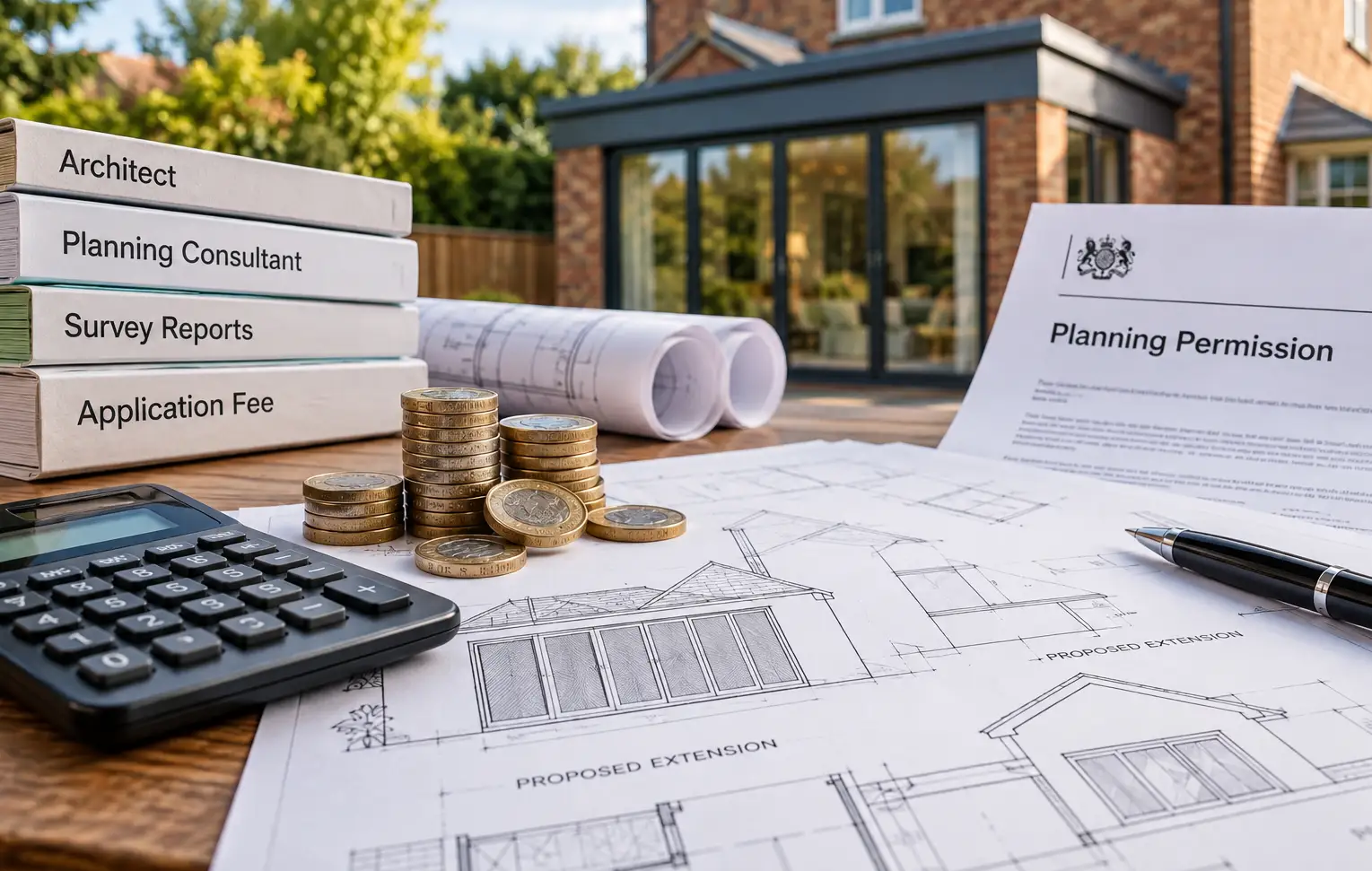
Search for “cost of planning permission” and the answer that comes back is almost always a single number — the statutory application fee. It’s the easiest figure to state and, for most real projects, only one part of what actually gets spent between having an idea and holding a decision notice that lets you build it. Anyone budgeting a project around the application fee alone is budgeting for the council’s charge for considering the application, not the whole cost of getting a scheme through planning.
The fee itself, and why quoting one national figure is already misleading
There genuinely is no single “cost of planning permission” that applies across projects, because the statutory fee in England depends on what’s being proposed.
As at September 2026, a householder application to enlarge, improve or alter a single existing house — the category covering many extensions and similar alterations — costs £548. Certain operations within the curtilage of a house, including some outbuildings and boundary works, sit at £272. Where the same enlargement or alteration category affects two or more existing dwellings or flats, the fee is £1,083.
Building new homes is different again. A full application creating fewer than 10 new dwellinghouses currently costs £610 for each dwelling; schemes creating between 10 and 50 are charged £659 for each dwelling, with a different calculation applying above that. The Government’s current 2026 planning-fee guidance gives the national England schedule and explains the annual indexation system.
Even that is not necessarily the amount paid to submit an application. Planning Portal now operates three service-charge bands for applications submitted through its platform. A householder application to enlarge, improve or alter an existing dwelling sits in Band 2, currently £149 including VAT, while householder work within or along the boundary of an existing dwelling sits in Band 1 at £99 including VAT. Planning Portal’s current application bands and charges
For someone submitting an ordinary extension application through Planning Portal, that means the £548 statutory planning fee is accompanied by a £149 platform charge before a designer, surveyor or planning consultant has charged anything. The platform charge is not itself a statutory planning fee, and different submission arrangements may exist, but it is a real cost for applicants using that route.
Another fee change is proposed for December 2026
The timing is unusually important this year. England’s statutory planning fees increased on 1 April 2026 following the annual inflation-linked adjustment, and a further restructuring of fees has since been proposed.
At the time of writing, legislation.gov.uk still lists the relevant instrument as draft regulations, with 8 December 2026 specified as the intended commencement date. Draft 2026 planning-fee regulations The figures therefore matter for anyone planning to submit around that date, but they should not be described as already in force.
| Application or request | Current fee | Draft fee if the regulations take effect on 8 December 2026 |
|---|---|---|
| Alteration or enlargement of one dwellinghouse | £548 | £575 |
| Certain works within the curtilage/boundary of a dwellinghouse | £272 | £285 |
| Discharge of conditions — householder development | £89 | £125 |
| Discharge of conditions — other development | £309 | £435 |
| Non-material amendment — householder | £46 | £53 |
| Section 73 variation/removal of condition — householder | £89 | £112 |
| Section 73 variation/removal of condition — major development | £2,076 | £3,150 |
The difference is modest for an ordinary householder application, but considerably more significant for developers dealing with conditions, amendments or major section 73 applications. The Government’s proposed national schedule also raises the maximum application fee for the largest schemes from £427,537 to £513,512. Government planning-fee proposals and fee schedule
For a project being submitted after several months of design work, the practical lesson is simple: check the fee again immediately before submission rather than treating the number used in the original project budget as fixed.
Where the real money goes before an application is even submitted
For anything beyond the simplest project, the statutory application fee can be overtaken by the cost of producing an application that is properly designed, evidenced and capable of being validated.
A measured survey of an existing building or development site may be needed before accurate drawings can be produced. An architect, architectural technologist or other designer may then prepare existing and proposed plans, elevations and supporting design material, with the fee depending on the complexity of the project and how much development of the scheme is needed before it is ready to submit. Planning-consultant input can add another cost where policy, development principle, use, heritage or site constraints make the planning case more complicated.
Structural engineering is sometimes commissioned during the same design period, particularly where structural feasibility influences the scheme itself, but it should not simply be treated as a standard planning-application cost. Detailed structural design more commonly belongs to the technical and Building Regulations stage unless a particular planning issue makes it relevant earlier.
The largest variation comes from the evidence the site actually needs. Protected or significant trees can require arboricultural work. Ecological constraints can bring habitat or species surveys, sometimes within limited seasonal windows. Heritage-sensitive proposals can require assessment of significance and impact. Flood risk, drainage, highways, transport, contamination, noise and daylight or sunlight can all become relevant depending on the proposal and where it sits.
This is why two superficially similar applications can have completely different budgets. A modest rear extension on an unconstrained suburban house may require little beyond the normal plans and supporting material. An extension of similar size involving a listed building, protected trees or ecological constraints may need substantially more professional work before the council will even determine it.
The useful document is the local planning authority’s validation list, not a generic internet list of every report that might conceivably exist. Government guidance confirms that a valid application must satisfy the national information requirements and any applicable local requirements, and that local information requested for a particular proposal must be reasonable and relevant. Government guidance on planning-application validation requirements
Checking that early can save money in both directions. It can reveal a specialist report that really will be needed before the application budget has been fixed, but it can also stop an applicant commissioning work simply because somebody assumes every project needs it.
Biodiversity Net Gain adds another layer for some development. Ordinary householder applications are exempt, and from 6 August 2026 developments on sites of no more than 0.2 hectares are also generally exempt provided the relevant priority-habitat restriction does not apply. The former self-build and custom-build exemption, however, no longer applies to new applications made from 6 August 2026. Where BNG does apply, ecological assessment, calculation and the cost of securing the required biodiversity gain can become part of the development budget rather than an incidental paperwork exercise. Current Government guidance on BNG exemptions
Pre-application advice: a cost that can save a larger one
Many councils offer paid pre-application advice, and the charge varies because this is a discretionary local service rather than a nationally fixed application fee.
For a routine extension with no obvious planning difficulty, formal pre-application advice may add little. On a constrained site, a substantial redevelopment or a proposal where the principle, scale or design is genuinely uncertain, it can be worthwhile if it exposes a fundamental problem before the applicant commits to a full set of drawings and specialist reports.
For larger or more complicated developments, the relationship with the authority can go further through a Planning Performance Agreement. A PPA is essentially a project-management arrangement setting out matters such as timescales, actions and resources for handling a complex application. Councils can charge for that additional service separately from the statutory application fee. Government guidance also makes clear that neither ordinary pre-application advice nor a PPA commits the authority to approving the eventual proposal. Government guidance on pre-application engagement and Planning Performance Agreements
There is another reason to take early design and planning advice seriously: getting the first application wrong is no longer softened by a general free repeat application.
If a valid application is withdrawn before determination, the fee is not ordinarily refundable. Planning Portal guidance on application costs and refunds The 2023 planning-fee regulations also removed the previous general fee exemptions for repeat applications following refusal or withdrawal; the transitional arrangements have since expired. 2023 regulations explanatory memorandum on removal of the “free-go”
A failed first attempt can therefore mean losing the original application fee and professional expenditure, paying for whatever redesign or additional evidence is required, and then paying another application fee to try again. That changes the economics of submitting a marginal scheme simply to see what the council says.
The costs that arrive after permission is granted
Getting a decision notice marked “granted” does not necessarily close the planning-stage budget.
Permissions frequently contain conditions requiring further details to be agreed. Materials, landscaping, drainage, ecology, contamination, highways arrangements or other matters may have to be submitted before work begins or before a particular stage of development. The council’s discharge fee is only one part of that cost: producing the drawings, specifications, calculations or reports needed to satisfy the condition can cost considerably more than the submission itself.
Designs also change. A builder may uncover a practical problem, a developer may alter a specification or an owner may decide that part of the approved proposal no longer works. Depending on the scale and legal nature of the change, dealing with it can involve a non-material amendment, a section 73 application to vary or remove a condition, or sometimes a fresh planning application. Each route can bring another statutory fee and another round of professional work.
For larger development, the financial consequences can extend far beyond application administration. Planning obligations under section 106 can require works or financial contributions necessary to make a development acceptable in planning terms and can bring legal and professional costs of their own. Government guidance on planning obligations and section 106
Community Infrastructure Levy can create a separate liability in areas where a charging schedule is in force. Some development is exempt or can qualify for relief, including particular residential extensions, annexes and self-build situations, but the availability of an exemption and the procedure for securing it matter. Government Community Infrastructure Levy guidance
For a normal domestic extension, CIL, section 106 or a PPA may never become a meaningful part of the budget. For a development site, conversion or multi-unit scheme, however, leaving such costs out because they are not technically “the planning application fee” can distort an appraisal far more seriously than getting the headline council fee wrong by a few hundred pounds.
Building an honest budget
The useful way to budget planning is additive rather than searching for one national average.
Start with the statutory fee for the application actually being made and any platform charge attached to the chosen submission route. Add the cost of defining the scheme properly through surveys, drawings and professional advice. Then identify what this particular site genuinely requires in supporting evidence rather than copying a report list from another project.
Where the planning risk is meaningful, decide whether spending money earlier on pre-application advice, consultant input or — on a major scheme — a PPA is likely to reduce the chance of more expensive redesign or resubmission later. Beyond the decision itself, allow for the possibility of conditions, amendments and, where relevant, BNG, CIL or planning obligations.
There is no defensible national figure that captures all of that. Professional fees vary, site constraints vary and the planning work needed for two schemes with similar construction costs can be radically different. Publishing a neat universal figure would create the appearance of certainty rather than a useful budget.
The better question is what has to happen, and what has to be paid for, before this particular project can move from an idea to an implementable permission.
One project may need little more than straightforward drawings, a statutory application fee and the submission charge. Another may need months of design work, ecological or heritage evidence, pre-application engagement, amendments, condition submissions and developer contributions before meaningful construction work starts.
The statutory application fee is real and worth checking. It just isn’t the same thing as the cost of getting planning permission.
Important: This article provides general property information, not a cost estimate or professional planning advice for a particular development. The statutory fees discussed apply to England and were checked against the position in September 2026; planning systems and fees differ in Wales, Scotland and Northern Ireland. The proposed December 2026 fee changes remain dependent on the relevant regulations being made and coming into force. Application requirements, professional fees, pre-application charges, Biodiversity Net Gain, Community Infrastructure Levy and planning obligations depend on the proposal, location and circumstances. Check the current position with the relevant planning authority and appropriately qualified advisers before committing expenditure.

