

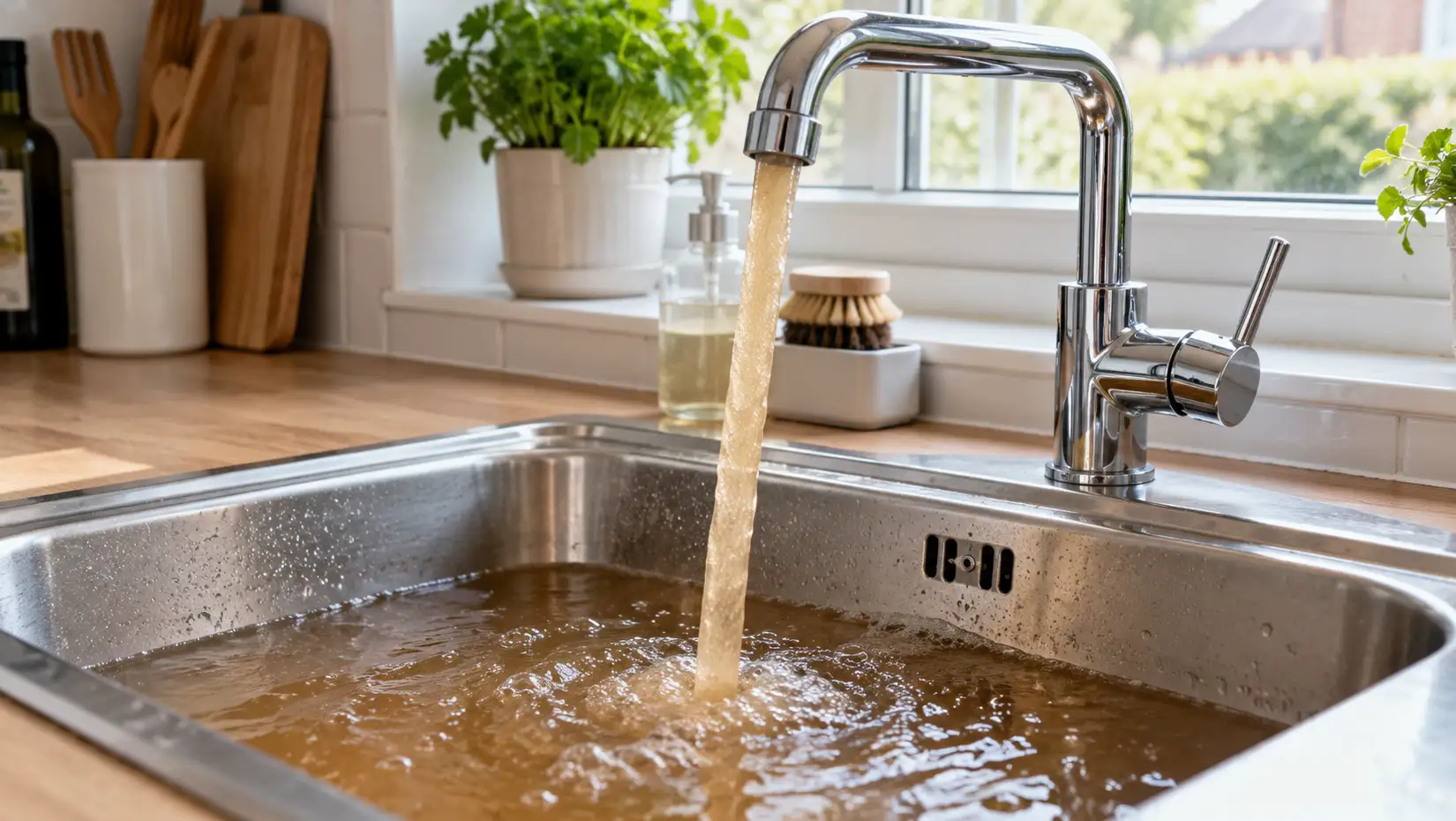
A glass of water that looks slightly off, or tastes faintly of something it shouldn’t, is one of those small domestic moments that is disproportionately unsettling. The instinct is immediately to wonder whether it is safe, followed fairly quickly by another question: is something wrong with the water arriving at the property, or with the pipes and fittings inside it?
Many of the common explanations are straightforward once the source has been narrowed down, but appearance, taste and smell are not safety tests in themselves. The useful first step is therefore not guessing what a particular colour means. It is working out how far through the water system the problem extends.
Start with the cold kitchen tap
Before looking for a cause, establish the pattern.
The cold kitchen drinking-water tap is the most useful starting reference point, because water used for drinking and cooking should normally be taken from there rather than from the hot-water system or from a cold tap that may be supplied through stored water. Then compare what happens elsewhere. Is the same symptom present at every cold tap, or only one? Does it affect cold water, hot water or both? Does it disappear once fresh water has been drawn through, or return every time the property has been standing overnight?
Neighbours can provide useful evidence too. If several nearby homes develop the same discolouration at roughly the same time, a shared upstream cause becomes much more likely. If only your property is affected, the investigation starts moving towards its supply pipe, any shared private pipework, storage and the plumbing within the building.
That distinction is more accurate than thinking simply in terms of “the mains” and “the tap”. Water may have travelled through a company main, a communication pipe, a private or shared supply pipe and then several layers of internal plumbing before it reaches the glass. In England and Wales, Ofwat distinguishes between company-owned mains and communication pipes and the supply pipe serving the property, while some older properties share parts of their supply pipe with neighbouring homes. Ofwat: Responsibility for water-supply pipes
The pattern tells you which part of that route deserves attention first.
Cloudy or milky water is often just air
This is one of the few water-quality symptoms that has a genuinely useful test you can perform simply by filling a glass.
If freshly drawn water looks milky or cloudy, leave the glass standing and watch what happens. Where the cloudiness clears from the bottom upwards, tiny air bubbles are the likely explanation. The Drinking Water Inspectorate describes trapped air of this kind as harmless; it can occur following interruptions or work on the water network and can also arise from conditions within a property’s plumbing. Drinking Water Inspectorate: White or cloudy water
Something that looks dramatic as it leaves the tap can therefore disappear completely as the bubbles rise out of the glass.
Persistent white or cloudy water that does not behave this way deserves a little more caution. It should not automatically be written off as hard water. Chalk deposits can affect appearance, but recurring cloudiness can also be associated with internal plumbing — for example where cold-water pipework is being warmed by nearby hot pipes, a stop tap is partly closed or the tap itself contains an aerator.
A visible chalky residue left behind as water dries is more suggestive of hardness and limescale, which is a different problem from genuinely milky water and is covered separately in our guide to hard water and limescale.
Where cloudiness is new, persists rather than clearing, or is accompanied by an unusual taste or smell, the water supplier is the better next step than repeatedly trying to diagnose it from appearance alone.
Brown, orange or black water needs a different response
Brown, orange or very dark water can look considerably more alarming, although one common explanation is material that has accumulated within the water-distribution system and then been disturbed.
Older mains can contain corrosion products and deposits incorporating iron, manganese and other material. Under normal flow these may remain largely undisturbed. A burst, valve operation, repair, reinstatement of a main or sudden high flow — including water drawn for firefighting — can alter the flow sufficiently to disturb those deposits and temporarily carry them towards customers.
The Drinking Water Inspectorate identifies these circumstances as common causes of brown, black and orange water in England and Wales. It also makes the important point that colour does not establish where the material originated: persistent discolouration can instead come from the service or supply pipe, internal plumbing or a water-storage tank within the property. Drinking Water Inspectorate: Brown, black or orange water
That makes the neighbour comparison particularly useful. If a row of houses suddenly develops the same problem, local network disturbance moves higher up the list. If the neighbouring homes remain clear but yours repeatedly runs brown, the condition of the pipe serving your property and the plumbing beyond it becomes more relevant. In a converted building, terrace or other property with shared pipework, even that boundary may not be as simple as one house versus another.
Colour should not be used to identify the precise deposit either. Brown or orange water may contain iron-related material and darker deposits may include manganese, but the appearance of a glass of water is not a chemical analysis.
Most importantly, suddenly discoloured drinking water should not simply be assumed safe because disturbed deposits are a common explanation. The Drinking Water Inspectorate advises consumers to seek guidance from their water supplier rather than making that assumption themselves. Where the supplier advises flushing and the water then becomes clear, its instructions can be followed; where the discolouration does not clear, repeatedly returns or is accompanied by an unusual taste or smell, it needs reporting rather than ever-longer flushing.
Any boil-water, do-not-drink or other restriction issued by the supplier takes precedence over general advice.
Taste and odour can bring the investigation much closer to home
Taste and odour are harder to judge because very small concentrations of some compounds can be noticeable long before a problem becomes visible. They are also one of the areas where the plumbing inside the property can matter surprisingly often.
A particularly distinctive example is the antiseptic, medicinal or TCP-like taste sometimes reported from drinking water. Where the supply contains a chlorine residual, certain plastic and rubber components can react with it and produce compounds with a strong taste at very low concentrations. Flexible hoses serving washing machines and dishwashers are a recognised source, particularly where water associated with the hose can migrate back towards the drinking-water pipework. Tap washers, seals, kettles and other fittings can also be implicated.
The Drinking Water Inspectorate’s guidance on taste and odour covers this type of reaction as well as several other property-side causes. Drinking Water Inspectorate: Taste and odour in drinking water
Timing becomes useful here. If an unusual taste appears shortly after a dishwasher, washing machine, tap, kettle or section of plumbing has been replaced, that change is worth mentioning when the problem is investigated. If the cold water tastes normal but the flavour appears only after boiling, the kettle itself becomes a more plausible suspect.
A metallic or bitter taste points in another direction. Water that has stood for hours in contact with copper, iron, galvanised pipework or certain fittings can pick up a metallic character, which is why it may be most noticeable first thing in the morning and diminish once fresh cold water has been drawn through. A metallic taste that appears suddenly at every drinking outlet, however, should not be diagnosed indefinitely as “old pipes” simply because the property happens to be old.
Older black alkathene supply pipe creates one of the more unusual clues. This type of pipe was installed widely in parts of the country during the 1960s and 1970s, and water that has stood in contact with some of it can develop a taste described remarkably consistently as resembling a wooden pencil. That does not mean every black plastic pipe is defective or that a vague strange taste proves alkathene is present, but where the age of the property, pipe type and standing-water pattern fit, it can be a genuinely useful clue.
Modern plumbing materials can affect taste too, particularly when newly installed or where a component is unsuitable or deteriorating. The important principle is that fittings and materials in contact with drinking water should be suitable for potable-water use and comply with the applicable water-fittings requirements; a persistent plastic, rubber or chemical taste after plumbing work is better investigated at source than disguised with a filter.
Smell can mislead in a different way. If water appears to smell stagnant or sewage-like at the sink, fill a clean glass from the cold kitchen tap and take it into another room before smelling it. If the odour has disappeared, the water may never have been the source: waste material in the sink, overflow or plughole can create a smell that seems to come from the tap simply because that is where you notice it. If the smell remains in the glass away from the sink, the water or plumbing deserves investigation and the supplier should be contacted.
More generally, a sudden, particularly strong or unpleasant new taste or smell that makes the water unpalatable is a reason to contact the water supplier rather than spending days trying to identify it from household fittings alone.
There is one odour that deserves a much firmer response. A petrol, diesel, oil or solvent-like smell or taste should not be treated as another nuisance flavour to flush away. Fuel spilled or leaked into soil can affect plastic water pipes and contaminate the water passing through them. Oil-storage installations, vehicle leaks and machinery can all create the circumstances for this type of problem.
If kitchen-tap water smells or tastes of petrol, diesel or oil, WaterSafe’s advice is to contact the water supplier straight away and not drink the water or use it for cooking until advice has been obtained. WaterSafe: Petrol, diesel or oil taste and odour
At that point, establishing the detailed cause can wait until the immediate drinking-water question has been dealt with.
What changed just before the problem appeared?
A sudden change in water quality often becomes easier to understand when you stop looking only at the water and reconstruct what happened around it.
A burst or repair in the street shortly before brown water appeared points in one direction. A new kitchen tap, replacement pipework or a dishwasher connected shortly before an antiseptic taste began points in another. A property that has been standing empty may have a greater volume of stagnant water sitting in its internal plumbing than one occupied every day.
Filters, water softeners and other treatment equipment belong on this list too. They are not merely possible solutions to water-quality complaints; if installed, poorly maintained or malfunctioning, they can become part of the problem.
The Drinking Water Inspectorate warns that domestic filters need appropriate maintenance and cartridge replacement, and that small black particles appearing downstream of an activated-carbon filter may actually be carbon from the filter rather than material arriving from the mains. Drinking Water Inspectorate: Domestic water filters and softeners
That is why buying another filter before finding the source can be exactly the wrong sequence. A filter does not repair a deteriorating supply pipe, fix an appliance hose affecting nearby drinking-water plumbing, resolve disturbed sediment in the public network or provide an appropriate response to suspected fuel contamination. Once you know whether the issue sits in the public supply, a private pipe, an appliance, internal plumbing or simply an aesthetic preference about otherwise satisfactory water, you can decide whether treatment equipment has any useful role at all.
A recent fuel or heating-oil spill close to the route of a water pipe is more urgent still.
The question “what changed?” will not solve every water problem, but it frequently reduces a long list of theoretical causes to the few that actually fit the property and the timing.
Reading the pattern without over-diagnosing it
| What you notice | What it may suggest | What is worth checking next |
|---|---|---|
| Milky water that clears from the bottom upwards | Tiny air bubbles, often following pressure changes or arising within the plumbing | See whether it settles completely; if it persists or has an unusual taste or smell, contact the supplier |
| Brown, orange or black water affecting nearby homes too | A shared upstream or network disturbance becomes more likely | Check for a known incident or works and contact the water supplier |
| Recurring discolouration confined to your property | Supply pipe, shared private pipework, tank or internal plumbing becomes more relevant | Compare the cold kitchen tap with other outlets and report persistent problems to the supplier before moving on to property-side investigation |
| TCP or medicinal taste after appliance or plumbing work | Plastic/rubber hose, seal or fitting may be interacting with the drinking-water supply | Check what was recently installed and have the relevant appliance connection or plumbing investigated |
| Metallic taste strongest after water has stood overnight | Prolonged contact with internal or supply pipework may be contributing | Compare freshly drawn cold water with the first water of the day; report persistent concerns |
| Drain or sewage smell noticed at the sink | The sink or waste may be the source rather than the drinking water | Smell a clean glass in another room; if the odour remains in the water, contact the supplier |
| Petrol, diesel, oil or solvent-like taste or smell | Possible contamination affecting the water supply or pipework | Do not drink or cook with it; contact the water supplier immediately |
None of these patterns proves a diagnosis. Their value is in telling you which boundary in the system to investigate next.
There is also an important limit to symptom-based diagnosis: water that looks clear and tastes normal has not thereby passed every possible water-quality test.
Lead is the obvious example in older housing. It can dissolve into drinking water from old lead supply or internal pipework while the water stands in contact with it, without producing a colour or taste that reliably warns the occupant. The Drinking Water Inspectorate advises that homes built before 1970 may contain lead pipework and that water companies can advise on testing where lead is suspected. Drinking Water Inspectorate: Lead in drinking water
That is a different question from a sudden brown-water or strange-taste complaint, but it is an important reason not to mistake sensory checks for comprehensive water testing.
When the water route is more complicated than one house and one main
Blocks, converted buildings, commercial premises and private water supplies make the diagnostic chain longer.
In a flat, hotel, office or other larger building, water may pass through shared incoming pipework, communal storage tanks, boosted systems and internal distribution serving different floors or units. The useful comparison is no longer simply “me versus the neighbours”. It may be one tap versus one flat, one flat versus one floor, or one floor versus the whole building.
If one kitchen tap develops an odd taste while every other outlet in the flat is normal, the problem may be extremely local. If every occupier supplied from one part of the building reports the same discolouration while another wing remains unaffected, shared internal infrastructure moves higher up the list. If the entire building and neighbouring properties outside it develop the same symptom simultaneously, the investigation moves further upstream.
For landlords, managing agents and facilities managers, establishing that scope before instructing work can prevent a contractor being sent to dismantle one tenant’s tap when the actual problem sits in shared pipework or a communal tank.
A private borehole, spring, well or other private supply creates a different chain again. There may be a water source, treatment equipment, storage and private distribution network before the water even reaches the property’s internal plumbing. A change in colour, taste or smell can originate at any one of those stages, and there may be no public water-company mains system to investigate.
Private water supplies are regulated separately across the UK. In England and Wales, local authorities have statutory responsibilities for private supplies and are the relevant regulatory point of contact where water quality is in doubt. Drinking Water Inspectorate: Private water supplies
Elsewhere in the UK, the relevant local and national arrangements should be followed rather than assuming the public-supply route described for a mains-fed home applies unchanged.
Source first, fix second
Strange-looking or strange-tasting tap water is unsettling largely because the cause is unknown. Many common symptoms do turn out to have straightforward explanations, but useful reassurance comes from locating the source rather than assuming one.
Start with the cold kitchen drinking-water tap and establish how far the symptom extends. Compare cold with hot, one outlet with the rest of the property and, where useful, your property with others supplied nearby. Think about what changed immediately before the problem appeared and about the route the water has travelled before it reaches the glass.
Those observations can distinguish harmless trapped air from persistent discolouration, move an investigation from the public network towards a supply pipe or internal fitting, reveal that an unpleasant smell never came from the water at all, or show why the filter somebody is proposing would have nothing to do with the actual problem.
They also have limits. Sudden discolouration should not be declared safe from a photograph or a general rule, fuel-like tastes and odours require immediate supplier advice, and perfectly normal-looking water does not exclude every possible contaminant.
The purpose of reading the pattern is not to become your own water-quality laboratory. It is to establish who needs to investigate next — and to make sure the right part of the system gets fixed.
This article provides general property information, not legal, plumbing, water-quality or other professional advice for your individual circumstances. Appearance, taste and smell can provide useful clues but cannot establish that drinking water is safe. If your water suddenly becomes discoloured, develops a persistent or particularly strong unusual taste or odour, or you have any genuine concern about its safety, contact your water supplier or the appropriate private-water-supply authority for advice. Do not drink or cook with water that smells or tastes of petrol, diesel, oil or similar fuel until specific advice has been obtained. Any boil-water, do-not-drink or other restriction issued by a water supplier or public authority takes precedence over general guidance.

