

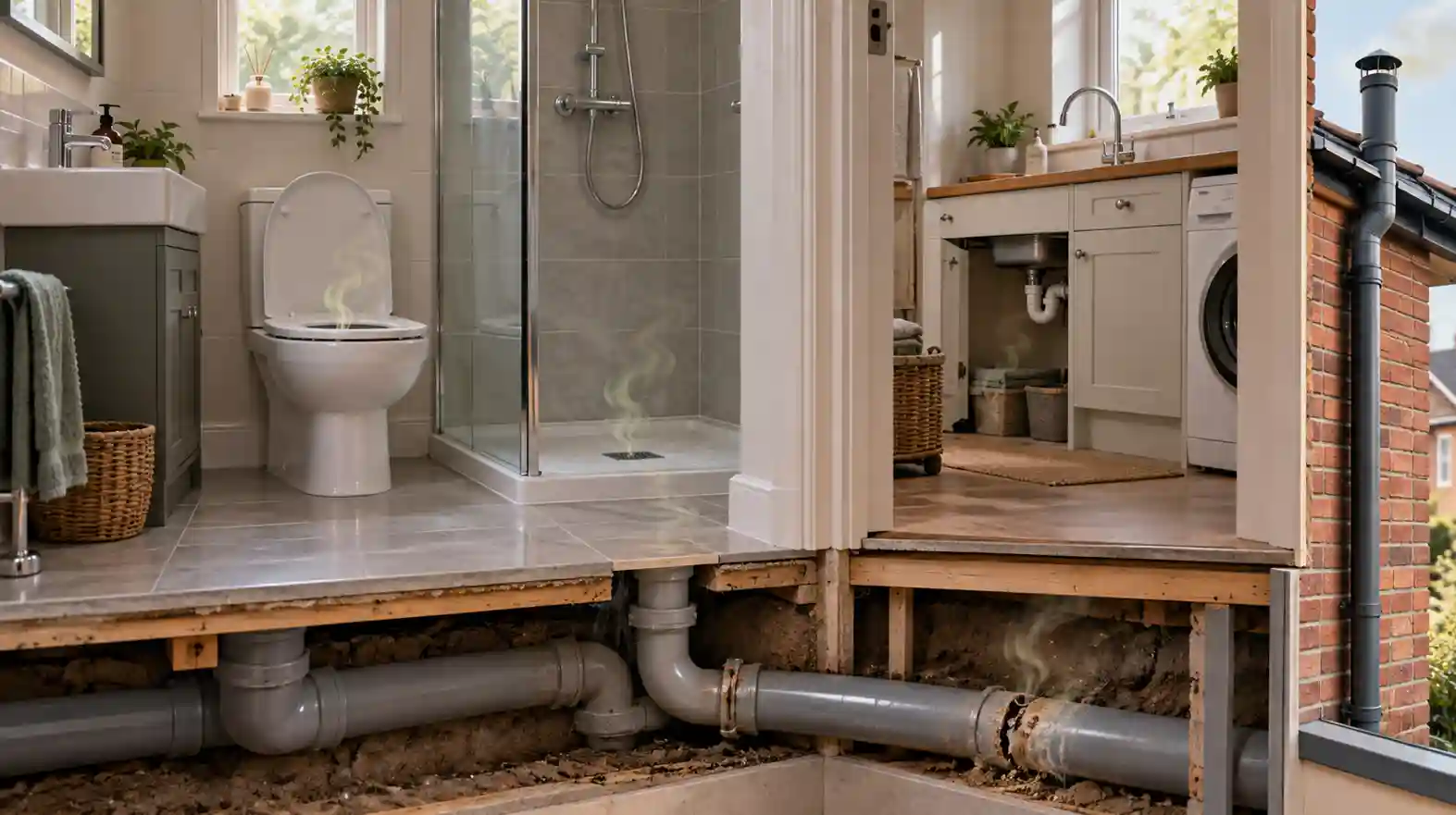
Everything drains normally. There’s no visible leak, no backed-up toilet, nothing obviously wrong — and yet the smell is unmistakably there. Sometimes it’s stronger in one room, sometimes it appears only after the washing machine empties or somebody flushes a toilet, and sometimes the property smells perfectly normal for days before the problem unexpectedly returns.
A sewage smell with nothing visibly wrong is one of the more disorienting problems a property can throw up, precisely because the obvious explanation — a blocked drain — is only one possibility. A trap can have lost its water seal; pressure elsewhere in the drainage system can disturb that seal; material around a plughole or waste can create a remarkably similar smell; or a joint can allow foul air to escape without leaking enough water to leave a stain. Even a partial blockage can affect pressure and airflow while wastewater still appears to drain reasonably normally.
The useful clue, in other words, is often not simply where the smell is strongest, but what happened immediately before it appeared.
Before anything else: rule out gas
A drainage smell and the odorant added to natural gas can both be described as sulphurous or like rotten eggs. If there’s any genuine doubt about whether what you’re smelling could be gas — particularly around a boiler, cooker, gas fire, meter or associated pipework — treat that as the priority rather than continuing to investigate the drains.
In England, Scotland and Wales, call the National Gas Emergency Service immediately on 0800 111 999; National Gas confirms the service operates 24 hours a day. In Northern Ireland, the 24-hour Northern Ireland Gas Emergency Service number is 0800 002 001, as confirmed by Firmus Energy’s emergency information.
If gas is suspected, open doors and windows, don’t smoke or use naked flames, and don’t operate electrical switches that could create an ignition source. Turn the supply off at the meter if it is safe to do so and follow the emergency service’s instructions rather than attempting to trace the smell yourself. This isn’t something to leave until every drainage explanation has been ruled out: where there is genuine doubt, gas comes first.
Once that possibility has been excluded and the smell is clearly associated with drainage, the problem becomes much more methodical.
The water seal you never think about
Most sinks, basins, baths and showers discharge through a trap designed to retain some water after the fitting has emptied. A WC achieves the same basic protection through the water retained within the pan. That water isn’t there by accident: it creates the physical barrier between the room and foul air inside the drainage system, and if the seal disappears or becomes too shallow, the air on the other side can find its way back into the property.
The simplest way this happens is evaporation. A basin in a guest bathroom that hasn’t been used for months, a shower in an empty flat or a floor drain in a little-used utility area can gradually lose enough water for the seal to stop doing its job. The first test is therefore almost embarrassingly simple: use the fitting. Run water into a little-used sink or shower, flush the WC, or refill a floor drain if you know one is present and see whether the smell disappears.
What happens afterwards is more useful than the first result. If the smell stays away, a dried trap becomes a very plausible explanation. If it returns shortly after another appliance empties or a toilet is flushed, simple evaporation no longer explains the whole pattern because something may be reducing the water seal again.
Pressure changes within the drainage system can do exactly that. When a large volume of water discharges through pipework that is restricted, poorly arranged or inadequately ventilated, it can disturb the water in another trap. That can produce the apparently illogical complaint that a downstairs shower smells only after the upstairs WC is flushed. Gurgling from another basin, bath or shower at the same moment is worth noting too: it doesn’t identify the cause on its own, because a partial blockage can produce similar behaviour, but it tells you considerably more than the smell by itself.
There is also a much more local explanation worth eliminating before assuming that anything is wrong deeper in the drainage system. Material around a plughole, inside an overflow or within the accessible waste beneath a sink can produce a surprisingly convincing sewage-like smell. Where the water itself seems to smell, WaterSafe suggests filling a clean glass and smelling it away from the sink. If the odour disappears once the glass is taken elsewhere, the sink, plughole or local waste becomes a much more plausible source than the incoming water — a useful distinction to make before somebody starts investigating buried drainage.
Why drainage systems need to breathe
Wastewater moving through pipework also moves air. If that air cannot move appropriately, pressure within the system changes: negative pressure can disturb the water seals protecting rooms from foul air, while pressure elsewhere in the system needs an appropriate route to dissipate. That is why sanitary drainage is ventilated rather than simply being a collection of sealed pipes carrying water downhill.
An open soil or discharge-stack vent provides communication with outside air. An air admittance valve, or AAV, works differently: it opens when negative pressure develops, allowing air into the pipework, and closes again afterwards. The distinction matters because an AAV is not simply a smaller version of an open vent and does not automatically replace every ventilation requirement elsewhere in the drainage system.
For England, Approved Document H: Drainage and Waste Disposal deals specifically with protecting trap water seals and ventilating sanitary pipework. It says discharge stacks should be ventilated so that pressure does not cause trap seals to be lost, while AAVs should not adversely affect the ventilation needed by the below-ground drainage system and should remain accessible for maintenance. Scotland, Wales and Northern Ireland operate under their own building-standards or building-control guidance, so Approved Document H should not be treated as a UK-wide set of rules.
For the homeowner, however, the behaviour of the system is usually more useful than the regulation. If one basin gurgles when another fitting empties, a shower starts smelling after a toilet is flushed, or the water in a trap visibly changes level after a large discharge elsewhere, tell the plumber exactly that. It directs the investigation towards the way the system is behaving rather than simply towards whichever fitting happens to smell.
The timing of building work can be just as useful. A new bathroom, ensuite, utility room, loft conversion or extension can alter waste-pipe runs, stack connections and ventilation arrangements. If a property that never previously smelled of drains develops the problem immediately after plumbing or building work, that chronology deserves to be near the top of the investigation rather than treated as coincidence.
The outside vent can occasionally provide a clue as well. Where the smell appears mainly around an upstairs window or rooflight, particularly in certain wind conditions, the source may not be inside the room at all: the position or condition of an external soil vent may deserve inspection.
Reading the pattern
The smell itself tells you relatively little. The sequence around it can tell you considerably more.
| When the smell appears | What it may point towards | What to notice next |
|---|---|---|
| One little-used bathroom, shower or drain smells after a long period of disuse | Evaporated water seal | Refill the trap and see whether the smell stays away |
| Smell appears just after a washing machine or dishwasher pumps out | Appliance waste issue, pressure disturbance or partial restriction | Note whether another fitting gurgles or smells at the same moment |
| Basin, bath or shower gurgles when a WC is flushed | Pressure disturbance caused by ventilation, pipe arrangement or a partial blockage | Watch the water in nearby traps and whether drainage is becoming slower |
| Smell comes from around the rear or base of a WC | Pan connector or nearby soil-pipe joint becomes more plausible | The floor can remain dry even while foul air escapes |
| Smell began after a bathroom, ensuite, extension or plumbing alteration | Changed waste or ventilation arrangement, poorly seated connection or other installation fault | Tell the investigator exactly when the problem started |
| Several fixtures smell or behave differently rather than just one | Wider restriction or ventilation problem | A system-level fault becomes more credible |
| Several rooms smell after the building has been vacant | Multiple traps may have dried out | Refill all little-used traps, not just the fitting nearest the smell |
None of those patterns is conclusive. A partial blockage and a ventilation fault can both make fittings gurgle, while a failed joint and a dry trap can both produce a strong odour without producing a puddle. The point of the table is not to turn a homeowner into a drainage engineer; it is to turn “the house smells of drains” into information that gives one a much better place to start.
That distinction becomes particularly useful when the problem is intermittent. If flushing one particular WC produces an odour in another room every time, that relationship is much more valuable diagnostically than knowing which room happened to smell strongest when somebody first noticed it.
When it’s neither a dry trap nor an obvious venting problem
Once little-used traps have been replenished, obvious local waste build-up has been dealt with and the smell still returns, physical defects become more credible. That does not automatically mean a collapsed drain beneath the garden: a WC pan connector can fail to seal properly, a joint on a soil or waste pipe can be imperfect, a concealed pipe can be cracked or disconnected, or an AAV can stop sealing correctly. Work carried out during refurbishment can also leave a connection that still carries wastewater away but is no longer reliably gas-tight.
One of the most useful things for a property owner to understand is that a foul-air leak does not have to produce a visible water leak. A joint can remain largely dry during ordinary use while still allowing drainage air into a boxed-in service space, floor void or cupboard for much of the day. The fact that the floor is dry or the ceiling below is unstained therefore does not prove that every drainage connection is properly sealed.
Nor does the place where the smell emerges necessarily identify the defective joint. Foul air escaping into boxing, a service riser, ceiling void or space beneath a floor can find its way into the room through gaps around pipe penetrations, access panels, skirtings or floorboards some distance away. In flats and converted properties, the position can be even more misleading because the soil stack may be shared with several dwellings; a fault in communal pipework or a service riser can appear to belong to one bathroom even though the underlying system extends beyond that property.
This is also where choosing the right investigation matters. A CCTV drain survey can be extremely useful where the suspected problem is inside accessible below-ground drainage: obstructions, displacement, root intrusion and some structural defects can often be inspected directly. But a camera travelling through an underground drain cannot prove that the rubber connector behind an upstairs WC is airtight, tell you whether an AAV in a cupboard is closing correctly, or diagnose every above-ground waste joint hidden behind boxing.
That means it is possible to pay for a perfectly competent CCTV survey of the wrong part of the system. The symptoms should decide where the investigation begins: several outside drains repeatedly backing up makes camera inspection much more logical than an odour that started immediately after one upstairs WC was replaced. A competent plumber or drainage professional may first operate the fittings, watch how trap water behaves, listen for pressure changes and inspect accessible above-ground connections before deciding whether the below-ground drainage needs examining.
The question worth asking before agreeing to any specialist investigation is therefore not simply how much it costs, but what fault it is intended to prove or rule out. If every clue points towards an internal soil-stack connection but the proposed response is automatically to survey the drains beneath the garden, it is reasonable to ask why that is the first test.
For flats, the same principle has an ownership dimension. If the evidence begins to point towards a shared soil stack or communal service riser, the tenant or leaseholder may eventually need the landlord, managing agent or freeholder to investigate parts of the system that cannot sensibly be dealt with from inside one dwelling.
Vacant units and rarely used facilities
Vacant buildings create ideal conditions for one of the simplest faults in this article. A house waiting for sale, an empty rental, a seldom-used annexe, office toilets on an unused floor, vacant retail premises or hotel rooms closed for part of the year may contain several traps that go for weeks or months without being replenished.
The resulting smell can seem disproportionately serious. Somebody opens a building after a long closure and assumes that the drainage system has failed, when several evaporated water seals may account for most of what they are smelling. For an owner reopening a little-used room, the sensible starting point is simply to refill the traps and then see whether the problem returns.
For landlords, letting agents and facilities managers responsible for several empty spaces, that makes periodically running water through little-used sanitary fittings a sensible part of vacancy management rather than something left until the day before a new occupier arrives. The follow-up matters, though: refill all the traps rather than only the fitting closest to the smell, then watch what happens over the following days.
If the building remains odour-free until another long period of disuse, evaporation is a persuasive explanation. If the smell returns that afternoon after a WC is flushed elsewhere, or every time a particular appliance discharges, the dried trap may have been a symptom of a wider pressure or drainage problem rather than the whole cause. That distinction is particularly useful in converted houses, HMOs, blocks and older commercial properties where years of alterations may have left a drainage layout far less straightforward than the arrangement of the rooms suggests.
The smell has a reason, even when nothing’s blocked
A sewage odour with no visible fault does not automatically mean that an expensive drainage repair is waiting underneath the floor. Sometimes the answer genuinely is a water seal that disappeared while a fitting wasn’t being used, and the problem is solved in minutes.
But “everything drains normally” is not the same thing as “the drainage system is fine”. A partial restriction can affect pressure before it causes a complete blockage; discharge elsewhere can disturb another trap; a sink can smell because waste has accumulated locally; a WC connection can pass foul air without leaving a puddle; and alterations carried out years after the property was built can change the way the whole system behaves.
The quickest route to the cause is therefore not to keep deodorising the room or pouring different treatments into every plughole. Notice the sequence instead: which fitting was used beforehand, what happens when the washing machine pumps out, whether another basin gurgles after a toilet is flushed, whether topping up an unused shower trap solves the problem for weeks or only for hours, and whether the smell appeared for the first time after plumbing or building work.
Those observations cost nothing, but they can determine where a competent investigation should begin and whether the next useful person is a plumber examining internal sanitary pipework or a drainage specialist looking further downstream. If there is no repeatable pattern after the simple accessible checks have been made, persistence is itself useful information: that is the point to stop guessing and have the system investigated properly.
Air freshener can disguise the symptom. It cannot restore a missing water seal, correct a drainage-pressure problem or make a leaking joint airtight.
This article provides general property information, not legal, financial, plumbing or other professional advice for individual circumstances. If there is any possibility that an unexplained odour is natural gas, treat it as a gas emergency rather than continuing to investigate the drainage system. In England, Scotland and Wales call 0800 111 999; in Northern Ireland call 0800 002 001. Persistent drainage odours without an identifiable accessible cause should be investigated by an appropriately competent plumber or drainage professional.

