

Clearing a blockage feels like solving the problem. The water flows again, the smell goes, life moves on — until, a few weeks or months later, it happens again.
At that point, the recurrence is telling you something useful: either the conditions that created the blockage are still present, the pipe has a defect or poor layout that encourages material to collect, or both. Clearing the obstruction has restored the flow; it hasn’t necessarily explained why the blockage formed.
That distinction matters because there is a point at which paying repeatedly to unblock the same drain becomes less sensible than finding out what is happening inside it.
Clearing and curing are different jobs
Rodding, jetting and mechanical clearing can restore flow through a blocked drain. For a genuinely one-off obstruction that clears completely and never returns, that may be all that is required.
Recurring problems are different, but they do not divide neatly into “people are putting the wrong things down the drain” on one side and “the pipe is broken” on the other.
A slightly displaced joint or poor section of pipe may cope adequately under normal use but repeatedly catch grease, wipes or excess solids. Roots can enter through an existing defect and then trap material that would otherwise have passed. A marginal pipe layout and unsuitable usage can therefore reinforce each other.
It also matters how much of the drainage system is affected. If one sink repeatedly drains slowly while everything else in the property works normally, its trap or local waste pipe deserves attention before assuming there is an underground drainage failure. If several connected fixtures begin slowing or backing up together, the restriction may lie further downstream of the point where their branches join.
Neither pattern identifies the cause. It helps locate where the search should begin.
Why blockages come back
Fats, oils and grease are among the most avoidable causes of recurring blockages. They can enter kitchen pipework warm and mobile, then cool and harden further along the system, where they combine with food debris and other material.
Running hot water or washing-up liquid afterwards does not make that risk disappear. Water UK’s guidance on fats, oils and grease warns that cooking fats can still set hard in colder pipework and advises wiping grease from pans, using sink strainers and keeping collected fats and oils out of the drainage system.
Toilets have their equivalent problem when wipes, sanitary products and other unsuitable items enter pipework that was principally intended to carry human waste and toilet paper.
Where those habits continue, repeated clearing can produce repeated blockages without there being a major defect in the underground drain.
But pipe condition matters too.
An open or displaced joint can create a lip where passing material catches. Roots entering through a joint, fracture or other opening can progressively narrow the bore and trap further debris. Cracking, deformation and partial collapse can create similar obstruction points.
The drain’s geometry can also matter. Pipes need appropriate gradients and layouts to carry their contents effectively. Approved Document H for England says foul drainage should be laid to even gradients and that changes of direction and gradient should be properly arranged around access points. A badly laid section or localised sag can allow water and solids to remain where they should have continued downstream.
Older pipe materials introduce another possibility. Pitch-fibre drains were commonly installed in certain parts of the UK from the 1940s to the 1970s. Unlike modern plastic or traditional clay drainage, the material can deform, delaminate internally and ultimately collapse, restricting the available bore. RICS guidance on building pathology also notes that pitch fibre can react adversely to hot water, fats and oils.
A recurring blockage is not proof that any of these defects exists. It is the reason to start asking whether repeated clearance is treating the obstruction while leaving the conditions that produce it untouched.
When a CCTV drain survey becomes worth paying for
A CCTV survey becomes particularly useful when the question changes from “can you unblock this?” to “why does this keep happening?”
There is an important distinction first, though: the same symptom does not necessarily mean the blockage occurred at the same physical point.
From inside the property, two incidents can look identical. The kitchen sink backs up again, or the downstairs toilet stops clearing properly. Unless somebody actually located the obstruction during each clearance, you may not know whether both blockages formed in the same section of pipe.
That makes the information recorded during a call-out surprisingly valuable. Where possible, ask what was removed and where the obstruction was found. Even better is a location or distance measured from a known access point or inspection chamber.
Three incidents in which the kitchen sink backed up are evidence of recurrence. Three incidents in which the obstruction was found at approximately the same measured point along the same drain are much stronger evidence that something about that section deserves investigation.
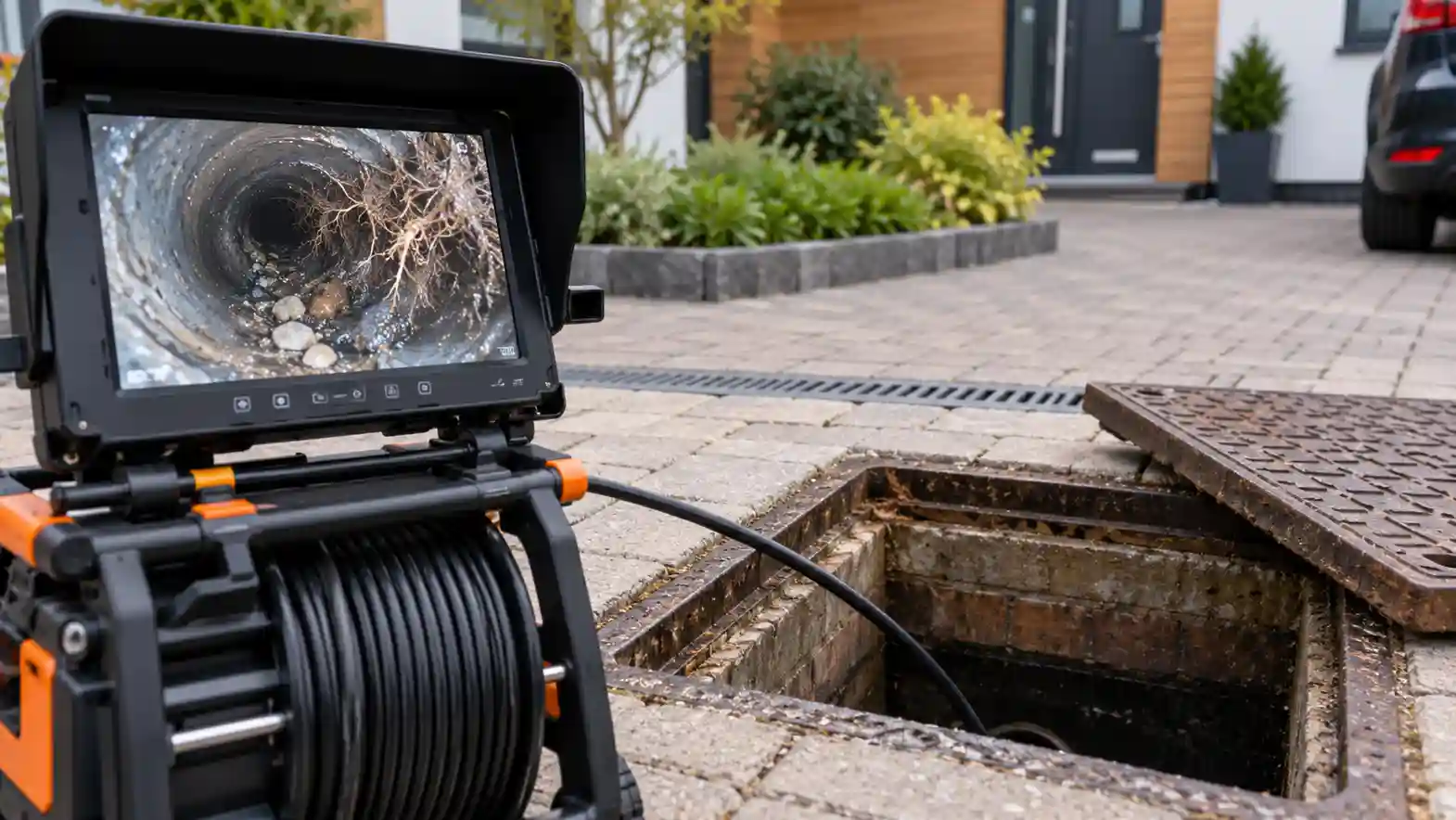
A CCTV camera passed through accessible drainage can then reveal displaced joints, roots, cracks, deformation, partial collapse, deposits and other visible features of the pipe.
Timing matters. If the pipe is still heavily blocked, the camera may simply reach the obstruction and stop. Thick deposits or dirty standing water can also prevent a useful view of the pipe wall. Where recurrence is being investigated, it can therefore make sense to restore flow and clean the relevant run sufficiently before inspecting the exposed pipework.
A survey is only as useful as the record it produces.
WRc’s recognised sewer-inspection framework is based on structured identification and reporting of features and defects rather than simply recording video. WRc’s guidance on CCTV sewer inspection and condition assessment reflects the importance of consistent defect recognition and survey reporting.
For a homeowner or landlord commissioning a diagnostic survey, the practical outcome should ideally include the footage together with a report that identifies what was inspected, where significant observations were located and any parts of the system that could not be examined.
Tight bends, an impassable collapse, inaccessible branches or heavy deposits may leave parts of a drainage system unseen. An uninspected section should be described as uninspected rather than quietly treated as clear.
CCTV also shows physical condition, not legal responsibility. A camera may reveal a displaced joint beyond the garden boundary, but the footage itself does not decide whether the homeowner, landlord, sewerage company or somebody else must repair it. That depends on the position and status of the pipe and, in some cases, which part of the UK the property is in.
That responsibility question belongs in PFP’s separate drainage-responsibility coverage. Here, the immediate issue is whether the recurring blockage has an identifiable physical explanation.
Reading the pattern
| What is happening | What it tells you | Sensible next step |
|---|---|---|
| One blockage clears fully and does not return | Consistent with a one-off obstruction | Monitor rather than assuming the drain needs investigation |
| The same single fixture repeatedly blocks while others work normally | The problem may be local to its trap or branch pipe | Check local pipework and usage before assuming an underground defect |
| Several connected fixtures slow or back up together | The restriction may lie downstream of where those branches join | Locate and clear the obstruction, recording where it was found |
| A blockage repeatedly returns at the same confirmed position after proper clearance | A local defect, root entry point, poor alignment or persistent deposit becomes more plausible | CCTV inspection of the cleared run is justified |
| CCTV shows roots, deformation, displaced joints or recurring standing water at the problem location | Physical pipe condition may be contributing to recurrence | Relate the defect to the symptoms before deciding on repair |
| Ground starts sinking or sewage repeatedly escapes around the drain route | Leakage, collapse or loss of ground support may require more urgent investigation | Move beyond routine unblocking to professional investigation |
The value of the table is not that it diagnoses a drain from symptoms. It distinguishes the evidence that merely shows something has blocked again from evidence that increasingly points towards a particular section of pipe.
A camera finding does not automatically mean an expensive replacement
Finding something wrong on CCTV is not the same as proving that it is responsible for the blockage.
Older drainage can contain minor displaced joints, local cracking or other defects while continuing to function. A defect several metres away from the point where waste repeatedly accumulates may be incidental; pronounced deformation at exactly the recurring obstruction point is much harder to ignore.
The appropriate repair depends on what has actually been found. Changed usage and proper cleaning may resolve some recurring problems. Root ingress can require removal and attention to the point through which the roots entered. Certain localised pipe defects may be repairable without replacing an entire run, while severe deformation or collapse can require substantially more work.
Pitch fibre illustrates the point particularly well. RICS notes that pitch-fibre drainage does not automatically require replacement simply because the material is present; its actual condition matters.
The purpose of CCTV is therefore not to find something that can be sold as a repair. It is to provide evidence against which the proposed remedy can be tested.
If significant excavation, lining or replacement is recommended, three questions matter:
What defect can you show me? Where exactly is it? How does it explain the blockage that keeps returning?
A survey that answers those questions is much more useful than dramatic footage accompanied by the conclusion that the drains are simply “bad”.
Commercial kitchens have a more predictable recurring risk
Restaurants, cafés, takeaways and other hot-food businesses generate much greater quantities of fats, oils and grease than a typical household. Where recurring drainage problems occur, it therefore makes sense to look not only at the pipe but at how much FOG is being allowed to enter it and what is supposed to stop that happening.
Water UK advises businesses to prevent fats, oils and grease entering drains and to use appropriate collection equipment and specialist waste-oil services.
For building work in England, Approved Document H goes further: drainage serving kitchens in commercial hot-food premises should have a grease separator complying with the relevant BS EN 1825 standards or another effective means of grease removal.
That is more useful than assuming every commercial blockage requires larger pipes or more frequent jetting. A separator or other grease-management system also has to be appropriate, correctly used and maintained; repeatedly clearing downstream drainage while substantial quantities of FOG continue entering it is unlikely to deal with the underlying cause.
There is separate legal protection for the public sewer network in England and Wales. Section 111 of the Water Industry Act 1991 prohibits allowing matter into a public sewer, or a drain or sewer communicating with one, where it is likely to damage the system, interfere with free flow or adversely affect treatment. The practical point for a property operator is not to wait for enforcement: grease control is part of managing the drainage system properly in the first place.
For commercial landlords and facilities managers, the same diagnostic discipline still applies. Establish whether the recurrence is being driven by what enters the system, by the condition and layout of the drainage, or by a combination of both before turning repeated reactive clearance into a permanent maintenance strategy.
Stop guessing, start tracking
Once a drain starts blocking repeatedly, a basic record becomes surprisingly valuable.
Note when it happened, which fixtures were affected, what was done to restore flow and what was actually removed. Where the contractor identified the obstruction, record its location or measured distance from a known inspection point. Keep CCTV footage and reports rather than relying on a verbal explanation several months later.
That evidence can prevent two expensive mistakes: continuing to pay for clearance when the same physical problem remains underground, and authorising structural drainage repairs when usage rather than pipe condition is driving the recurrence.
A drain that blocks once may simply have blocked once. A drain that keeps returning to the same problem after proper clearance is asking a different question.
Another successful unblocking restores the flow. Finding out why it needed unblocking again is what is more likely to end the pattern.
Important: This article provides general property information, not plumbing, drainage, legal or other professional advice for an individual property. Recurring blockages can have more than one contributing cause, and responsibility for drainage varies according to the location and status of the pipe and the UK jurisdiction involved. Where a blockage repeatedly returns, sewage escapes, ground movement is visible or underground pipe damage is suspected, use an appropriately experienced drainage professional. Never enter a drain, sewer, manhole or other confined space yourself.

