

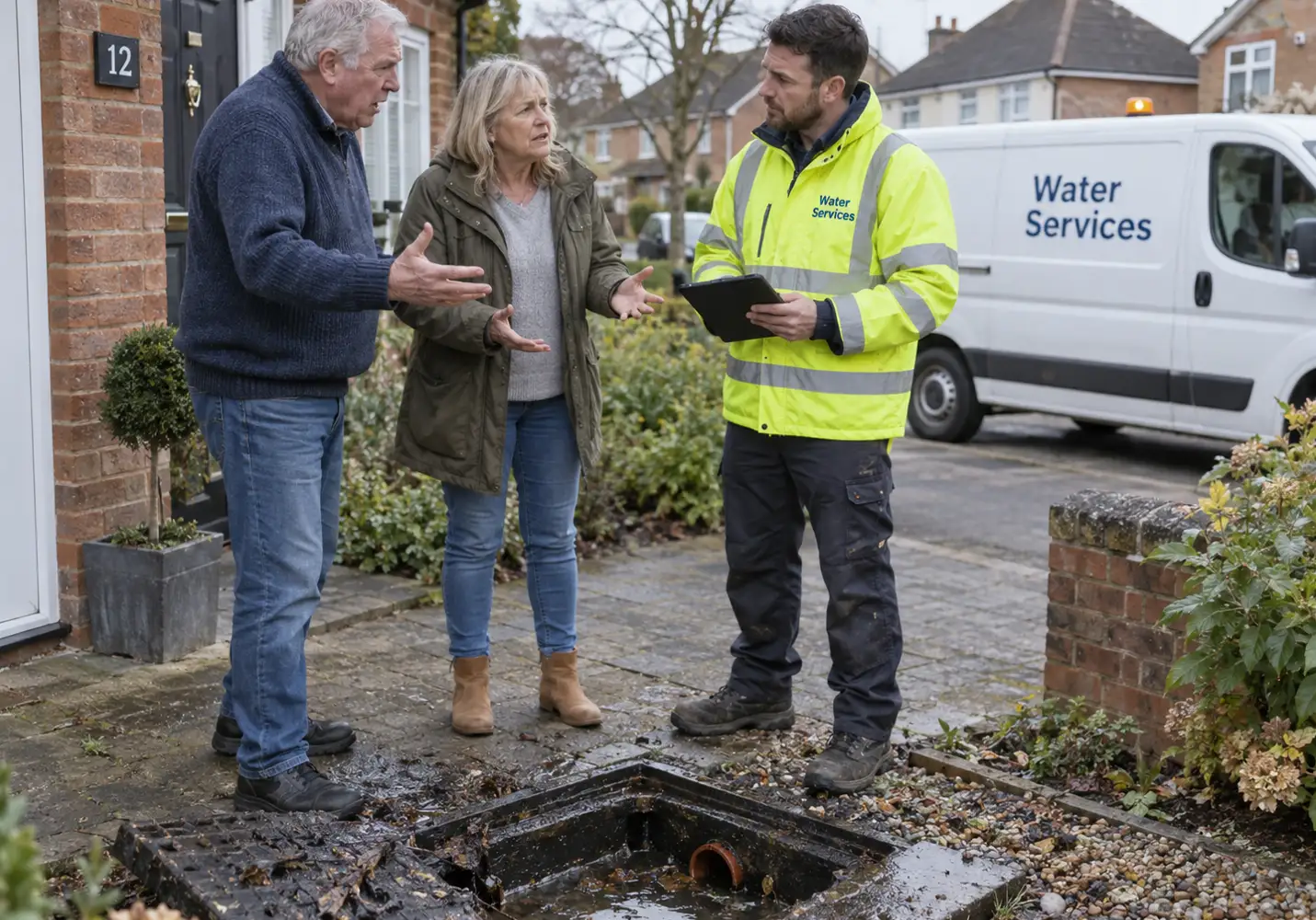
A contractor’s quoted several thousand pounds to dig up and repair a section of underground drain in the garden. Before that invoice gets authorised, there’s a genuinely important question worth answering first: is this actually your pipe to pay for? The answer isn’t always what most homeowners assume, and getting it wrong can mean paying for a repair that was never your responsibility in the first place.
The assumption worth challenging immediately
“It’s in my garden, so it must be mine” feels intuitive, and it’s wrong often enough to be worth stating plainly: where a pipe sits — even well within your property boundary — doesn’t automatically determine who’s responsible for it.
What matters is what the pipe serves, whether it forms part of the public sewerage network, and where responsibility changes under the rules applying in that part of the UK. A public sewer can run through a private garden. Conversely, pipework outside the walls of your home isn’t automatically the water company’s simply because it’s underground.
Location is a clue, not the answer.
The basic vocabulary, through an example rather than a definition list
Picture a small terrace of three houses — call them A, B and C — with C nearest the road.
Each property starts with pipework carrying its own wastewater away from the house. A pipe serving a single property is generally described as a drain. In England and Wales, the part of a single-property drain that continues outside that property’s curtilage towards a sewer is referred to as a lateral drain.
Now imagine A’s pipe joining B’s, and their combined wastewater then joining C’s before the pipe finally reaches the larger sewer in the road. Once a pipe carries drainage from more than one property it is, in legal and technical terms, a sewer, rather than simply one property’s drain.
Before ownership changes in England and Wales in 2011, many of those shared sections were private sewers maintained collectively by the properties they served. Today, many of them are public infrastructure even though they still run beneath private gardens.
That’s why everyday expressions such as “my drain”, “the shared drain” and “the sewer in the garden” can be misleading. They describe where a pipe seems to be or who uses it; they don’t necessarily tell you who legally maintains it.
England and Wales: the 2011 transfer changed almost everything
This is the single most important historical change for homeowners in England and Wales.
On 1 October 2011, most private sewers and lateral drains that were already connected to the public sewerage network on 1 July 2011 transferred automatically to the local sewerage company. Homeowners didn’t have to apply for the transfer.
Ofwat’s guidance on the transfer of private sewers confirms that private sewers and lateral drains meeting those conditions transferred to the regulated sewerage companies.
In practical terms, the starting position for a typical house connected to the public sewer is now relatively simple: the homeowner is generally responsible for the private drain serving only their property within its boundary, while the sewerage company is normally responsible once the drainage becomes part of the public system. That can include a lateral drain outside the property’s boundary and shared sewerage running beneath private land.
So if houses A, B and C in our example have an older shared sewer running through their gardens, the fact that part of it lies beneath B’s lawn does not mean B automatically pays to repair that section.
Ofwat’s current guidance on public and private sewers confirms that public sewers may run through private gardens and that the normal householder responsibility is the private drainage leading to the public sewer.
There are exceptions, which is why this should still be checked rather than guessed. The 2011 transfer doesn’t mean that every drainage pipe constructed since then automatically became public. Private and unadopted drainage still exists, including on some developments and privately managed sites, and adoption status matters. New-development drainage can also pass through a formal adoption process before the sewerage company takes responsibility.
So if the property is on a relatively new development, private estate, caravan site, block or another arrangement with communal infrastructure, don’t assume that the 2011 rule resolves the question. Ask the sewerage company whether the particular sewer has actually been adopted.
Scotland: a genuinely different framework
The England-and-Wales 2011 transfer isn’t the rule to use in Scotland, but that doesn’t mean Scottish homeowners simply remain jointly responsible for every shared drain.
Scottish Water’s current guidance says the homeowner is generally responsible for the private drain serving the property, while Scottish Water maintains the public sewer network. Its more detailed drainage guidance explains that, in general, when a drain leaves the property’s curtilage or joins drainage coming from a separate property’s curtilage, it becomes part of the public sewer system.
That means a shared section between ordinary neighbouring houses may already fall within Scottish Water’s responsibility even though it crosses private land.
There are more complicated arrangements. Blocks of flats, common courtyards, properties within a single curtilage, private developments and genuinely private wastewater systems can produce different responsibility boundaries. The useful starting point is therefore not “shared means jointly private”, but to establish where the private drain ends and the Scottish Water sewer begins.
Scottish Water’s pipework responsibility guidance gives the current basic division between the homeowner’s private drain and Scottish Water’s public sewer network.
Northern Ireland: private shared drainage can still matter
Northern Ireland is different again.
A drain taking wastewater from one property to the sewer is normally the property owner’s responsibility within the property’s boundary. A private sewer, however, can collect wastewater from several properties, and where it genuinely remains private, responsibility can rest jointly with the owners of the properties it serves.
NI Water is responsible for the public sewer network, so the practical question is whether the problem is on a private drain or private sewer, or has reached infrastructure maintained by NI Water.
NIDirect’s guidance on sewerage services expressly distinguishes private drains, jointly maintained private sewers and public sewers.
NI Water also advises that a blockage is more likely to be its responsibility where more than one property is affected, there is wider sewer flooding, or the problem is outside the property boundary — although those are useful indicators rather than a substitute for confirming the actual pipe status.
What this means practically, wherever you are
The detailed rules differ, but the starting question is remarkably consistent: what kind of pipe has actually failed?
| Location | Usual starting position | Important qualification |
|---|---|---|
| England | Private drain serving your home within the boundary is usually yours; public sewer/lateral drainage beyond it is commonly the sewerage company’s | Private or unadopted drainage still exists |
| Wales | Broadly the same post-2011 position as England | Check adoption status on unusual or newer developments |
| Scotland | Your private drain is generally yours; the public sewer is Scottish Water’s | A drain may generally become public when it leaves the curtilage or joins drainage from another property’s curtilage |
| Northern Ireland | Your private drain is normally yours; NI Water maintains public sewers | A genuinely private sewer serving several properties can remain jointly owned |
This table is deliberately a starting point, not a substitute for checking the actual drainage serving a particular property. Blocks of flats, private estates, historic layouts, pumping stations and private sewage systems can all produce exceptions.
How to actually check
Your sewerage provider is usually the best first call before authorising an expensive underground repair.
In England and Wales, that means the relevant sewerage company; in Scotland, Scottish Water; and in Northern Ireland, NI Water. If the blockage or damaged section may be on infrastructure they maintain, they can normally establish whether it falls within their network and tell you what happens next.
Public sewer records and drainage plans can be extremely useful, but they shouldn’t be treated as infallible proof that every unshown pipe is private. Older drainage records can be incomplete, and private drains won’t necessarily appear on public sewer maps at all.
Documents from when the property was bought or built may also contain drainage plans, easements or adoption information. On a managed development, the freeholder, factor, estate management company or managing agent may hold records showing whether drainage remains privately maintained.
Inspection chambers provide useful physical clues but not legal proof. A chamber receiving wastewater from several properties strongly suggests you’re looking at shared drainage, but the presence of that chamber in your garden does not by itself establish ownership.
A CCTV drainage survey can be valuable where the route or condition of the pipe is uncertain. It can show where pipes run, where branches join, whether there is a collapse, displaced joint, root ingress or obstruction, and approximately where the defect lies.
What a CCTV survey cannot establish on its own is legal ownership or adoption status. A camera can show you the pipe; it cannot tell you whether a statutory transfer, adoption agreement, title provision or public-sewer designation makes somebody else responsible for it. Use the survey to establish the physical facts, then confirm responsibility from the relevant records or authority before committing to excavation.
Shared private drains and neighbour access
Where drainage genuinely remains private and serves more than one property, responsibility can be shared between the properties using it. But don’t assume there is a universal rule that every owner automatically pays an equal share, or a share calculated according to usage.
The precise financial position can depend on title deeds, leases, easements, historic agreements and the law applying in that part of the UK. Northern Ireland, for example, expressly recognises joint responsibility for private sewers serving several properties, while in England and Wales many of the shared pipes that would once have created that problem transferred into public ownership in 2011.
Access is a separate issue again. If privately owned drainage can only be repaired from a neighbour’s land, check the property’s deeds and any existing rights before assuming either that access can simply be taken or that the neighbour can prevent essential work indefinitely. Rights and remedies differ between jurisdictions and circumstances, so a genuine dispute may need legal advice rather than a drainage contractor trying to resolve a property-law question.
If the pipe turns out to be a public sewer, the situation is different: the sewerage company has its own statutory powers to access land for inspection and maintenance. The homeowner doesn’t normally need to negotiate access to somebody else’s garden on the company’s behalf.
Where the blockage appears to have been caused by one household putting unsuitable material into the drainage system, that may create a separate question about recovering costs. It doesn’t by itself change who owns or maintains the pipe.
Tree roots: two separate questions, not one
Tree roots are a common finding in older damaged drains because roots can exploit defective joints, cracks and other openings in search of moisture.
But finding roots on a CCTV survey doesn’t answer the ownership question. The first issue remains: who is responsible for maintaining the damaged pipe?
A second, separate question is whether another person — perhaps the owner of a nearby tree — could ultimately bear some liability for the damage. That depends on matters such as causation, foreseeability, the condition of the drain and the circumstances of the particular case. The mere presence of a neighbour’s roots inside a pipe doesn’t automatically make the neighbour liable for the repair bill.
The sensible sequence is therefore to establish responsibility for the drainage first, repair or contain the problem through the party responsible for it, and treat any potential claim against a third party as a separate issue rather than refusing to deal with a failed drain while ownership arguments continue.
Properties with septic tanks or private treatment systems
Not every property connects to a public sewer network at all.
Homes in rural and more remote locations may instead use a septic tank, cesspit or private sewage treatment plant, serving one property or sometimes several. These are genuinely private wastewater systems and sit outside the ordinary public-sewer responsibility rules discussed above.
The owner or owners are generally responsible for maintaining the system and associated private drainage, and separate environmental rules govern discharges, emptying and operation. Those rules also differ between England, Wales, Scotland and Northern Ireland.
That’s a substantial subject in its own right and deserves dedicated Property Front Page coverage rather than a partial explanation here.
Before you authorise any repair
The consumer message worth taking from all of this is straightforward: establish who’s actually responsible for the specific length of pipe before authorising expensive excavation, relining or replacement work on the strength of an assumption.
This isn’t a suggestion that contractors routinely get responsibility wrong or mislead homeowners. Many experienced drainage companies will themselves tell a customer to contact the sewerage provider where a defect appears to lie on public infrastructure.
It’s simply that the answer depends on things a homeowner has no particular reason to know already: where the private drain becomes a sewer, whether shared drainage has transferred or been adopted, which UK nation the property is in, and whether the site has an unusual private arrangement.
If somebody has quoted thousands of pounds for underground drainage work, the sequence should therefore be: establish where the defect actually is, establish whose asset that section of pipe is, and only then establish who should be paying somebody to repair it.
Five minutes spent checking responsibility before signing off the work can occasionally save a very significant amount of money.
This article provides general property information and is not a substitute for confirming responsibility for your specific drainage with the relevant sewerage provider, property records or professional adviser. Drainage ownership and maintenance rules differ across England, Wales, Scotland and Northern Ireland, and private or unusual drainage arrangements can fall outside the usual examples.

