

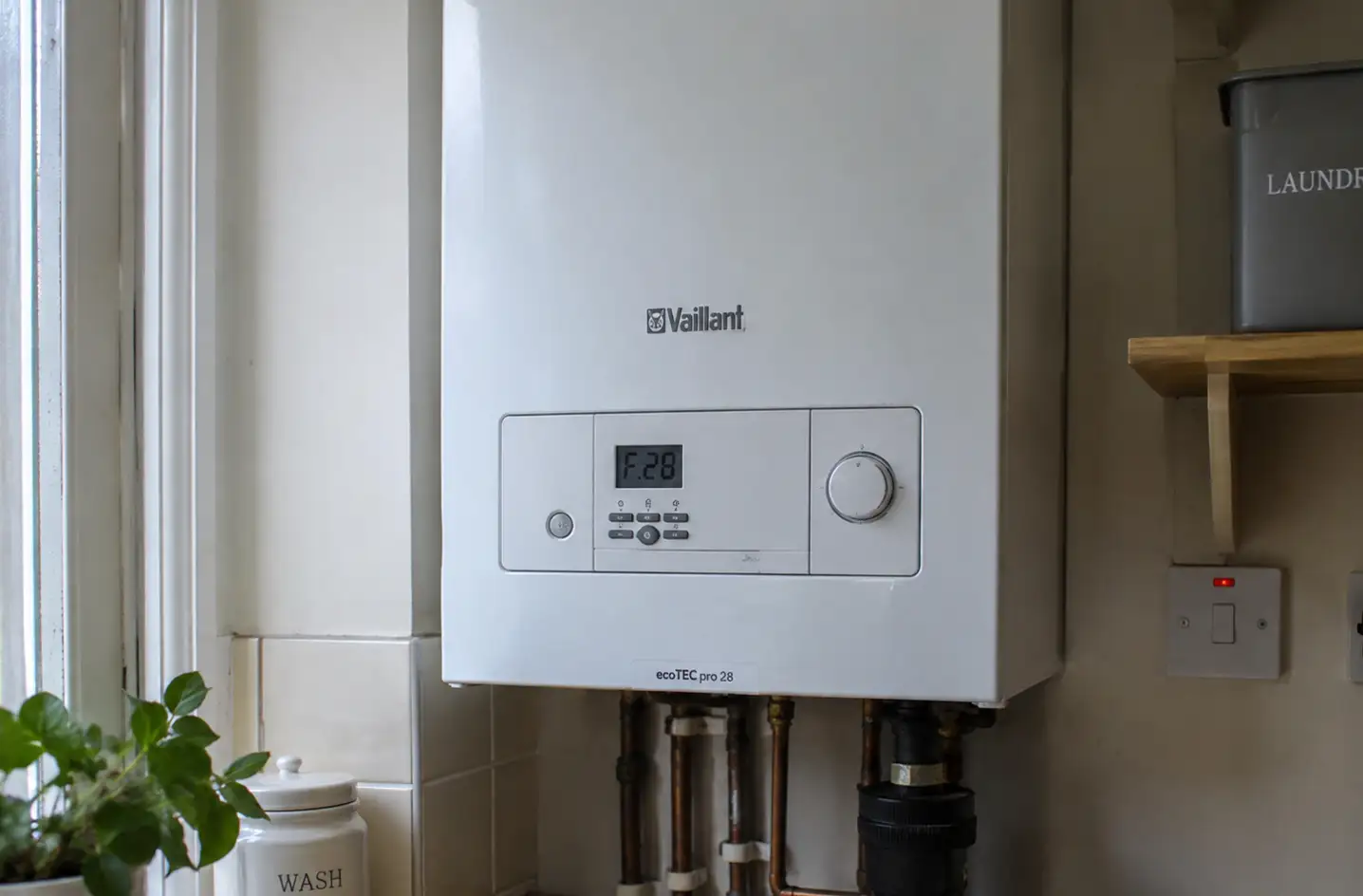
The house is cold, or the taps are running cold when they shouldn’t be, and the first question isn’t really “what’s wrong with the boiler” — it’s “what has actually stopped working, and who do I need to call about it.” Those aren’t always the same question, and working through what’s still functioning is a faster route to an answer than staring at the boiler hoping for inspiration.
The checks below are mainly aimed at homes with a boiler-based wet central-heating system, particularly a gas boiler. Heat pumps, electric-only heating and communal or district heat networks work differently, so if your home doesn’t have its own boiler, the right first contact may be the system operator, landlord or specialist responsible for that equipment rather than a boiler engineer.
Start with the pattern, not the boiler
What’s still working, and what isn’t, narrows things down considerably before you touch anything.
No heating and no hot water at all points towards something affecting the system centrally — loss of electrical power, interruption to the fuel supply, the boiler failing to operate, low system pressure on systems where that’s relevant, or another fault capable of stopping the whole system together.
Hot water works, but heating doesn’t tells you the boiler or heat source is capable of producing heat, which shifts attention towards the heating side of the system — the room thermostat, programmer, heating controls, circulation or a motorised valve on systems that use one.
Heating works, but hot water doesn’t points in the opposite direction. On a system with a hot-water cylinder, controls associated with the cylinder may be relevant; on a combi boiler, the cause will be different because the boiler produces hot water directly. The useful clue is that the whole appliance hasn’t necessarily failed simply because one service has.
The boiler appears to be operating, but the radiators stay cold needs a little more distinction. If every radiator is cold, a control or circulation problem becomes more plausible. If only one or two radiators are affected while the rest heat normally, local issues such as a radiator valve, trapped air or system balancing become more relevant than a complete boiler failure.
None of these patterns gives you a certain diagnosis. What they give you is a sensible starting point, and a much better description of the problem if you do end up calling someone.
Before assuming the boiler itself has failed
A surprising number of apparent boiler failures turn out to involve something simpler elsewhere in the system, and there are several ordinary checks you can make without opening or dismantling anything.
First confirm that the property has electricity and that the boiler display or normal power indicator is on. A gas boiler still needs electricity for its controls, pump and ignition, so a power cut can remove both heating and hot water even though the gas supply itself is perfectly normal.
Check the room thermostat is set above the current room temperature and hasn’t been accidentally turned down. Check the programmer, timer or smart-heating controls as well: make sure the date and time are correct, that heating and hot water are actually scheduled to operate, and that a holiday or frost-protection mode hasn’t been activated inadvertently.
If you use a gas prepayment meter, check that the supply hasn’t stopped because the meter has run out of credit. If other gas appliances that were already being used have stopped working as well, that can also point towards a wider supply issue rather than a fault confined to the boiler. Don’t deliberately light another appliance simply to test for gas if you have any reason to suspect a gas leak.
Look at the boiler’s pressure gauge or display if it has one. Pressure that’s outside the manufacturer’s normal operating range can prevent some sealed heating systems from operating, but the correct pressure and the method of repressurising vary between boilers. Read the manufacturer’s user instructions rather than assuming that a figure or filling procedure from another boiler applies to yours; our companion article on boiler pressure covers that subject properly.
Check the display for an error code or warning light as well. That information can dramatically narrow the investigation even if you don’t attempt to interpret or repair the underlying fault yourself.
There’s one seasonal possibility that’s particularly worth remembering. If a condensing boiler stops working during prolonged freezing weather and part of its condensate pipe runs outside, that pipe can freeze and cause the boiler to shut down. Manufacturers including Worcester Bosch provide user guidance for identifying and safely thawing an accessible frozen condensate pipe using warm, not boiling, water, provided it can be reached safely at ground level. Follow the instructions for your own boiler rather than assuming every fault in cold weather is frozen condensate. Worcester Bosch’s frozen-condensate guidance explains the principle.
And it’s still worth an honest word with everyone else in the household: has somebody changed a thermostat setting, switched the boiler off, altered a smart-heating schedule or already tried to reset something? Occasionally the explanation really is that simple.
What’s safe to do yourself, and where the line sits
You can safely read the boiler display, check normal user controls, thermostat and programmer settings, record the pressure reading and look up the displayed fault code in the manufacturer’s user manual.
A single reset can also be reasonable if your boiler’s own user instructions identify resetting as an appropriate action for the fault you’re seeing. Repeatedly resetting a boiler that immediately locks out again isn’t a repair; it’s a sign to stop and have the underlying fault investigated.
What you shouldn’t do is remove an integral boiler casing, dismantle components, interfere with the burner, gas valve, flue or combustion system, or carry out work beyond normal manufacturer-approved user actions. The Gas Safe Register distinguishes between purely decorative covers and integral appliance casings that form part of the appliance or combustion circuit; work involving the latter belongs with an appropriately qualified Gas Safe registered engineer.
If you smell gas, the normal boiler checks stop immediately. Don’t operate electrical switches or use a naked flame; ventilate the property if you can do so safely and follow the gas-emergency instructions for your part of the UK.
In England, Scotland and Wales, call the National Gas Emergency Service on 0800 111 999. The Health and Safety Executive’s domestic gas guidance confirms the number and advises opening doors and windows and, if you know how and it is safe to do so, turning off the gas at the meter.
In Northern Ireland, the gas emergency number is 0800 002 001, not the Great Britain number. NIDirect’s utility emergency guidance confirms the Northern Ireland procedure.
A carbon-monoxide alarm sounding, or symptoms such as headache, dizziness, nausea, unusual weakness or confusion that appear in the property and improve outside it, also need to be treated as a safety issue rather than a boiler troubleshooting exercise. Leave the affected area, stop using the suspected appliance if it is safe to do so and seek appropriate emergency and medical advice; severe symptoms such as difficulty breathing, collapse or sudden confusion warrant 999.
An error code is a clue, not the diagnosis
If your boiler is showing an error or fault code, it’s genuinely useful information — note it down, along with the boiler’s make and model, since this can speed up a call to an engineer considerably.
But resist treating the code itself as a complete diagnosis. Different manufacturers use completely different coding systems, and even within one boiler range a code can describe a condition that has several possible underlying causes.
Your boiler’s own user manual or the manufacturer’s official website is therefore the right place to establish what a particular code means and whether it identifies any normal user action you can safely take.
If a permitted reset clears the fault and the boiler operates normally afterwards, keep an eye on it. If the same code immediately returns, or keeps returning over subsequent days, repeatedly resetting the appliance is no substitute for finding out why it is locking out.
It might not be the boiler at all
This is worth taking seriously as its own possibility, because it changes who you should actually call.
A central-heating system relies on more than the boiler alone. Room thermostats, programmers, smart controls, wiring, circulation pumps, zone or motorised valves and the radiator system itself can all fail in ways that look, from the living room, remarkably like “the boiler’s broken”.
A single cold radiator with an otherwise properly operating heating system is particularly unlikely to justify replacing or repairing the boiler. At the other end of the scale, every radiator being cold while the boiler appears to fire suggests the investigation needs to include circulation and controls rather than concentrating only on the heat source.
The same principle matters in homes without an individual boiler. If you’re supplied by a communal or district heat network and both heating and hot water disappear, the fault may be with the building or network system rather than anything inside your flat. In that situation the managing agent, landlord or heat-network operator may be the right first contact.
You don’t need to diagnose which component is responsible yourself. Knowing that the fault can exist elsewhere in the system simply helps prevent an unnecessary assumption that the boiler itself must be replaced.
Boiler engineer, heating engineer, or electrician?
The right professional genuinely depends on what’s actually gone wrong, which is exactly why working through the checks above matters.
A fault involving a gas appliance itself needs an appropriately qualified Gas Safe registered engineer. Gas Safe registration isn’t simply a badge of good practice: anyone carrying out gas work covered by the regulations must be properly registered and competent for that type of work.
A broader wet heating-system problem — circulation, radiator valves, motorised valves or related pipework, for example — is generally heating-engineer territory, and many Gas Safe boiler engineers handle the wider heating system as part of their work.
A fault genuinely confined to electrical controls or fixed wiring may instead require a competent electrician, although modern heating controls often overlap with the heating system sufficiently that a heating engineer may diagnose the problem first.
If the electricity or gas supply to the property itself has failed, that’s a network or supplier problem rather than something a boiler engineer can repair. A boiler engineer can’t restore a street-wide gas outage, and an electrician can’t repair a power cut on the public electricity network.
Before paying an independent call-out, it’s also worth checking whether the boiler is still covered by a manufacturer’s warranty, service contract or home-emergency policy and whether that cover requires you to use a particular repair route. That shouldn’t delay action where there’s a safety risk, but it can avoid paying privately for work that was already covered.
If you’re not sure who applies, describe the pattern rather than offering your own diagnosis: whether heating works, whether hot water works, whether the boiler has power, the pressure reading, the exact fault code and what you’ve already checked. A competent firm can usually tell from that whether the problem sounds like something they deal with.
If the household is vulnerable to cold
Where a loss of heating affects somebody whose age, health, disability or other circumstances make prolonged cold particularly risky, say so clearly when arranging help rather than treating it as an ordinary comfort issue.
It’s important, though, to distinguish help with a supply interruption from repair of a privately owned boiler. An energy supplier or network operator doesn’t normally become responsible for repairing your boiler simply because somebody in the household is vulnerable.
In Great Britain, eligible households can join their energy supplier’s or network operator’s Priority Services Register. Ofgem says this can provide extra help during gas or electricity supply emergencies, including priority support and assistance when supplies are disrupted. It isn’t a boiler-repair service, but it is worth having in place for households that may need additional help when essential energy supplies fail.
When booking an engineer for a private heating fault, explain any particular vulnerability as well. Individual firms may be able to prioritise urgent cases, but that’s something to ask rather than assume.
What you should have by the time you call someone
A few minutes of checking should leave you with a much better description of the problem: whether heating works, whether hot water works, whether the problem affects one radiator or all of them, whether the boiler has electrical power, what the pressure gauge says, the exact fault code, and whether anything changed immediately before the failure.
Have the boiler’s make and model available too. If the fault appeared during freezing weather, mention that. If you’ve already carried out one manufacturer-approved reset, say so rather than allowing the next person to assume nobody has tried it.
And if other homes nearby have lost gas or electricity at the same time, mention that as well — because at that point the most useful call may not be to a boiler engineer at all.
That’s the information that turns a vague “the heating’s broken” into a conversation about the actual pattern of failure, and gives you a much better chance of reaching the right professional first time.
This article provides general property information and does not replace professional gas, heating or electrical advice. Never dismantle or repair a gas appliance beyond normal actions specifically permitted by its manufacturer’s user instructions. If you smell gas or suspect carbon monoxide, stop troubleshooting and follow the appropriate emergency procedure immediately.

