

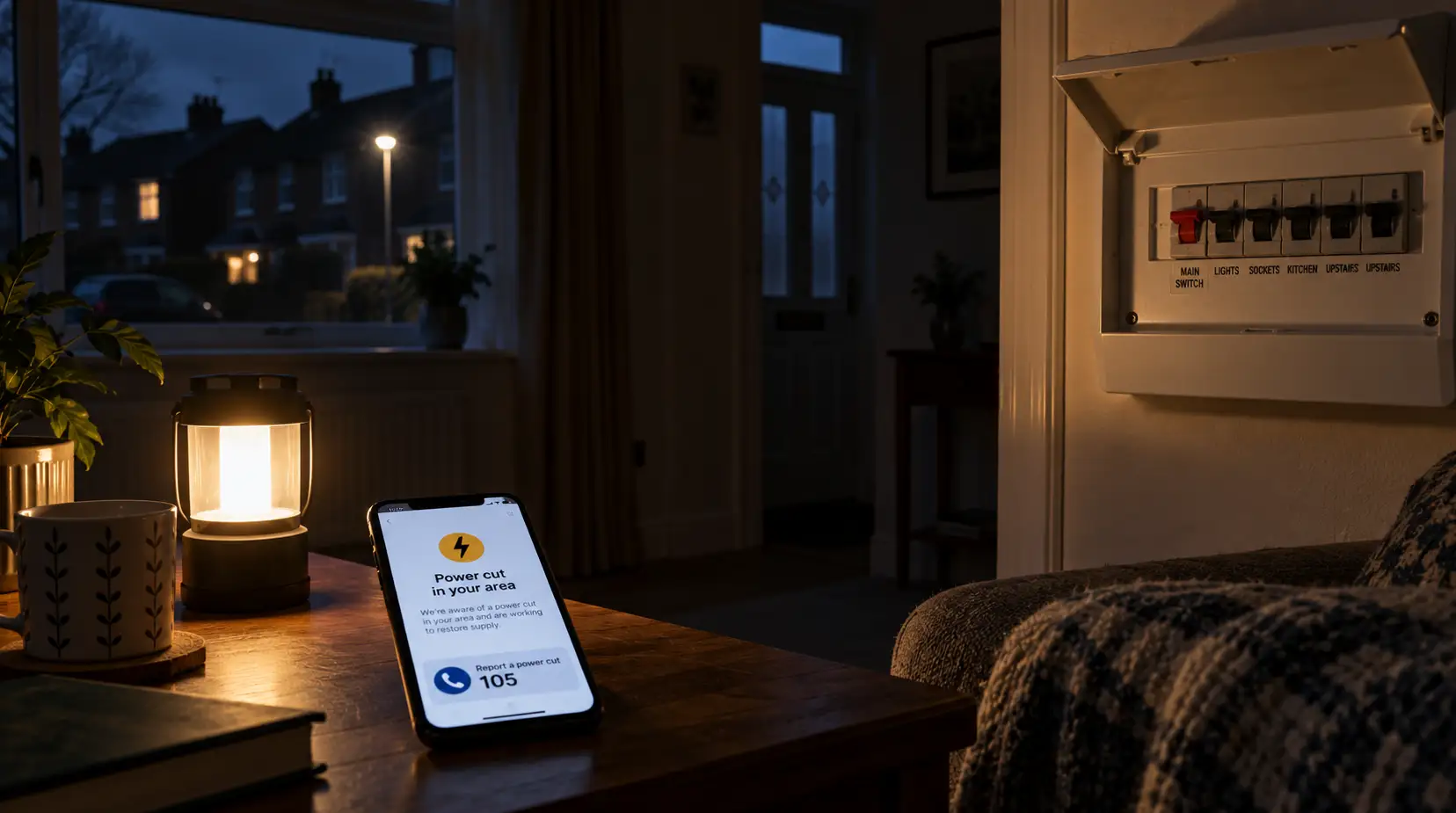
The lights go off. Before reaching for a phone, there is one genuinely useful question to answer: where, roughly, has the electricity stopped? A fault in one circuit, a failed meter, a problem with the individual service to your property and a network outage can all leave you without power, but they belong to different people.
Getting that distinction roughly right matters more than diagnosing the failed component. It can be the difference between reaching the organisation that can actually help and spending an evening on hold to a company whose only useful advice is to call somebody else.
Start close to home and work outward
Begin with scope. If one room, one group of sockets or one circuit is off while the rest of the property is working normally, the problem is much more likely to sit inside your own electrical installation than on the public network. Check the consumer unit from the front only if it is safe to do so. A breaker or RCD that has operated may explain the loss of power; if it trips again after being reset, stop repeatedly switching it back on and arrange competent electrical investigation.
If the whole property is off and the consumer unit shows nothing obviously unusual, look outward. Several neighbouring properties being off makes a network problem highly likely, and dark street lighting can be another clue, although neither test is perfect. More importantly, neighbours still having power does not prove that the fault is inside your home: an individual service cable or network connection can fail while the house next door remains live. If your whole property is dead and the consumer unit appears normal, 105 is still a sensible first route for ruling out the network side.
Blocks of flats add another layer. If only your flat is affected while neighbouring flats and the common lighting or lifts remain live, a fault within the flat becomes more plausible. If several flats or the common parts are also affected, the building manager or managing agent may need to be involved as well as the network operator because some communal electrical equipment is managed within the building. Tenants should report apparent faults in the fixed installation promptly to the landlord or agent, but a genuine network outage still belongs with the network operator.
The number that matters is 105
In England, Scotland and Wales, 105 is the free number for reporting electricity power cuts and network faults. It connects you to the distribution network operator responsible for the local cables and substations, regardless of which energy supplier sends your bill. That makes it useful not only when an entire street is dark, but when your own property has lost supply and the cause is unclear.
If somebody in the household could be particularly vulnerable during an outage, it is also worth knowing about the Priority Services Register. Eligible customers can receive additional support from suppliers and network operators, including priority support in emergencies and advance notice of planned cuts where possible. Registration does not guarantee uninterrupted power, so anyone dependent on essential electrically powered equipment still needs an appropriate personal contingency plan.
Northern Ireland is different. The 105 service and the Ofgem compensation rules in this article apply to Great Britain, not Northern Ireland. Power cuts in Northern Ireland are handled by NIE Networks, which provides outage information and reporting through NIE Networks Powercheck.
Your supplier, network operator and electrician do different jobs
In Great Britain, your energy supplier is the company that bills you and deals with your account and meter-related customer service. The distribution network operator maintains the local network carrying electricity towards the property. Once the fault is within the property’s own consumer unit, circuits, sockets or fixed wiring, it normally becomes a job for a competent electrician.
The boundary is not always obvious from inside a dark house, which is why householders do not need to diagnose the exact failed cable before calling. If the whole property is off, the consumer unit appears normal and there is no obvious wider outage, start with 105 to rule out the network side. If the network supply is intact but the actual electricity meter is faulty and has cut off the supply, Ofgem directs customers to their energy supplier.
Do not confuse the electricity meter with a smart-meter in-home display. The small display in a kitchen or hallway can go blank or lose communications while the meter and electricity supply continue to work normally. Prepayment customers should also rule out exhausted credit or a problem with the prepayment arrangement before treating the situation as a network outage.
Compensation: the useful rules, not just a headline figure
Compensation becomes relevant only after the fault has been identified as a qualifying network interruption. Ofgem’s current power-cut compensation guidance gives the live position, and the amounts are uprated periodically. From 1 April 2026, under normal weather conditions, a qualifying interruption affecting fewer than 5,000 premises can trigger an initial payment once supply has been off for more than 12 hours: £100 for a domestic customer and £195 for a non-domestic customer, followed by £45 for each additional 12-hour period.
A single large incident affecting 5,000 or more premises uses a 24-hour restoration threshold instead. The same £100 domestic and £195 non-domestic initial payments apply, followed by £45 for each additional 12-hour period, but the total payment under that large-incident standard is capped at £400. Severe-weather outages work differently again: Ofgem uses network-impact storm categories rather than Met Office warning categories. Category 1 uses a 24-hour threshold and category 2 a 48-hour threshold; the current initial payment is £90, followed by £45 for each additional six hours, up to £2,235.
Frequent shorter outages can matter too. Ofgem’s current consumer guidance says a home or business can qualify for an extra £100 if the power goes off more than four times between 1 April and 31 March and each qualifying cut lasts at least three hours; unlike the standard long-interruption payment, this repeated-interruption payment has to be claimed from the network operator. Standard qualifying interruption payments are normally arranged automatically, although it is sensible to contact the operator if an expected payment does not arrive.
None of these guaranteed-standard payments is a general reimbursement scheme for everything the outage costs you. Ofgem specifically excludes damaged electrical equipment or appliances from these power-cut payments, and a business’s lost trade, spoiled stock or other consequential losses are a separate insurance and resilience question.
Safety comes before deciding who owns the fault
A fallen or damaged network cable should be treated as live whether or not it is sparking. Energy Networks Association guidance tells householders to keep well clear of damaged electrical cables, call 105 in Great Britain or NIE Networks in Northern Ireland, and call 999 if anyone is injured. Energy Networks Association — Electrical Safety Guidance for Home Owners/Occupiers
The same principle applies inside the property: burning smells, arcing, smoke, exposed wiring or water around electrical equipment are not invitations to keep narrowing down the diagnosis. Keep away from the affected area, isolate the supply only if that can be done safely, and obtain appropriate electrical or emergency assistance. The ownership question can wait until the immediate danger is controlled.
Businesses follow the same fault path, but the financial question changes
A shop, office, workshop or other commercial property can lose power for the same broad reasons as a home: an internal fault, a meter problem or the wider network. The same first observations therefore matter — whether the whole premises is affected, whether neighbouring properties are off and whether the network operator has identified a fault.
What changes is the cost of being without electricity. The current guaranteed-standard payment is higher for a qualifying non-domestic normal-weather interruption, but it is not designed to reimburse the full cost of lost trading, spoiled temperature-sensitive stock or interrupted operations. Businesses with meaningful outage exposure therefore have a separate business-continuity and insurance question beyond identifying who needs to restore this particular supply.
Working out where the problem sits
| What you find | What it points towards | Who to contact |
|---|---|---|
| One circuit or part of the property is off, or a breaker/RCD trips again | Internal electrical or appliance fault | Competent electrician; landlord or agent as appropriate in rented property |
| Whole property is off and neighbouring properties are also affected | Network outage | 105 in Great Britain |
| Whole property is off, neighbours have power and the consumer unit appears normal | Could still be an individual network/service fault | Start with 105 to rule out the network side |
| Network supply appears intact but the actual electricity meter has failed and interrupted supply | Meter fault | Energy supplier in Great Britain |
| Fallen network cable, arcing, exposed live equipment or another immediate electrical danger | Safety emergency | Keep clear; 105/999 or appropriate emergency electrical help |
The purpose of the table is not to identify a failed component from the kitchen. It is to get the fault into the right ownership area quickly enough that the first call has a realistic chance of helping.
Establish where the fault sits before deciding who’s failed you
A power cut feels binary — the property has electricity or it does not — but responsibility is not. A circuit fault inside the home, a failed meter, a damaged individual service and a wider network outage can all produce darkness while requiring different people to put them right.
A few safe observations about what still works, whether the whole property is affected and what is happening nearby usually narrow the problem quickly. Where the entire property has failed and the answer remains unclear, 105 exists precisely because householders should not need to know the name of their local network operator or the location of the failed cable before asking for help.
And if the cut becomes prolonged, use the live Ofgem rules rather than an old figure copied from elsewhere. The payment depends on the scale and duration of the outage and whether severe-weather rules apply; repeated outages have their own standard. The useful sequence is still the same one the article began with: first establish roughly where the fault sits, then contact the organisation responsible for that part of the system.
This article provides general property and consumer information, not electrical, legal, financial or insurance advice for individual circumstances. Do not open electrical equipment, remove covers, approach fallen power lines or exposed live parts, or repeatedly reset protective devices that continue to trip. Where there is fire, smoke, arcing, damaged network equipment, water affecting electrics or another immediate danger, keep clear and seek appropriate emergency assistance.

