

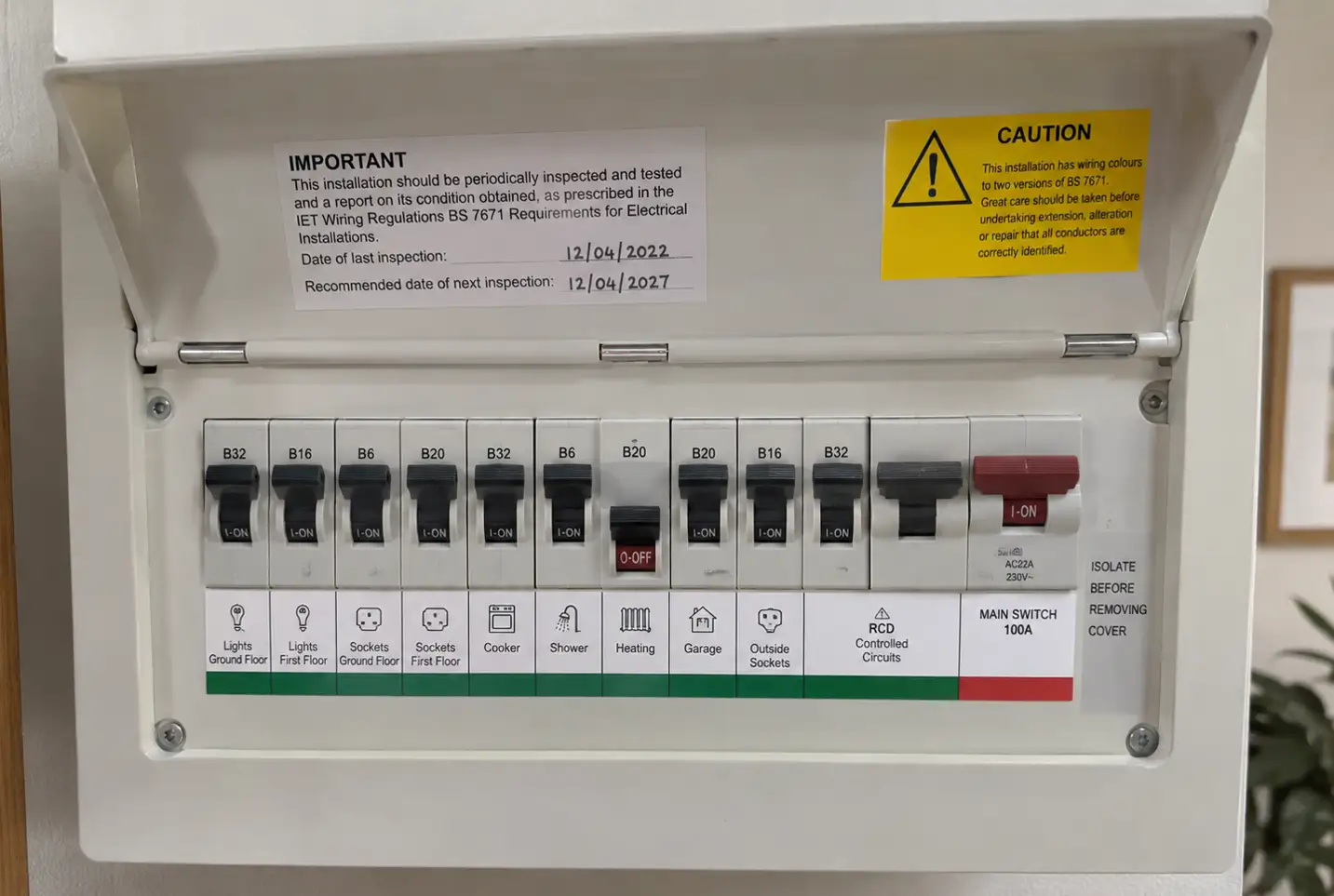
“The fuse box keeps tripping,” “the switch keeps going down,” “the power keeps cutting out” — these all describe the same broad experience, and the most important thing to understand before anything else is this: when a protective device in your consumer unit trips, the sensible starting assumption is that it has responded to something it was designed to detect.
Occasionally the protective device itself can be faulty, but that’s something to establish through proper testing, not something to assume because the tripping is inconvenient. The useful question isn’t really “why is this switch being annoying?” — it’s “what has caused it to operate, and does that need investigating?”
What’s actually switched off
Modern consumer units — what most people still call the fuse box — can contain several different types of protective device, and knowing broadly which one has tripped can narrow things down considerably.
An MCB (miniature circuit breaker) protects a circuit against excessive current. That can happen because the circuit is overloaded — several high-demand appliances drawing more current than the circuit is designed to carry — or because a fault such as a short circuit produces a much larger current than it should.
An RCD (residual current device) does a different job. It monitors the current flowing through the circuits it protects and switches off very quickly if it detects an imbalance indicating that current is taking an unintended path to earth. That can happen because of a faulty appliance, damaged wiring, moisture or, in the circumstances RCD protection is designed to guard against, current passing through a person. An RCD significantly reduces the risk of death or serious injury from electric shock, but it isn’t a guarantee that electricity can never hurt you.
A single RCD can protect several circuits, which is why one RCD operating can remove power from a sizeable part of the house even though only one appliance or circuit has the actual fault.
An RCBO combines those two forms of protection for an individual circuit: it provides overcurrent protection like an MCB and residual-current protection like an RCD. Many newer consumer units use RCBOs so a fault on one circuit can be disconnected without necessarily taking several unrelated circuits with it.
Electrical Safety First’s explanation of RCD protection provides a useful overview of what residual-current protection is actually doing.
As a practical shorthand:
| What you see | What it can tell you |
|---|---|
| One MCB has tripped | Overload, short circuit or another fault associated with that circuit |
| One RCD has tripped and several circuits have gone off | A leakage-to-earth fault may exist on one of the circuits or appliances that RCD protects |
| One RCBO has tripped | The problem is confined to that circuit, but could involve overcurrent or earth leakage |
| A device trips whenever one particular appliance is used | The appliance or the circuit supplying it needs investigating |
| The whole property is off but no protective device appears tripped | Check whether there is a wider electricity-supply interruption before assuming the consumer unit has failed |
You don’t need to diagnose the electrical fault from the switches yourself. The value is simply in knowing which device operated and which parts of the house lost power, because that gives an electrician useful information before testing begins.
Why these devices trip
This bears repeating, because it changes how you should think about the problem: the trip itself is usually the protection responding to an abnormal electrical condition, not the underlying fault.
An MCB can operate because too much current is being drawn from the circuit. A portable heater, kettle and toaster being used simultaneously on the same socket circuit, for example, can contribute to an overload if the combined demand exceeds what that circuit can safely carry. An MCB can also trip because an appliance or the fixed wiring has developed a short circuit or another overcurrent fault.
An RCD is looking for something different. A defective appliance, damaged cable, moisture inside electrical equipment or deteriorated fixed wiring can allow some current to flow by an unintended route rather than returning normally through the circuit.
RCBOs can respond to either type of problem.
Occasionally a protective device itself can become defective, but repeated tripping shouldn’t be dismissed as a “sensitive fuse box” without proper testing. Electrical Safety First specifically advises that an RCD which keeps tripping is likely to indicate a fault in an appliance or the wiring and should be investigated by a registered electrician.
One-off, or a pattern?
This distinction matters enormously.
A single trip that coincides with an obvious, temporary overload can have a straightforward explanation. If several unusually high-demand appliances were operating on the same circuit and an MCB tripped, reducing the load before resetting it may resolve that particular situation.
Repeat tripping is different. If the same device operates again without an obvious temporary overload, something needs investigating rather than simply being reset each time.
Intermittent unexplained tripping deserves attention too. A fault that appears only occasionally isn’t automatically less important than one that happens every hour. Temperature, moisture, movement of a damaged cable or the operating cycle of a particular appliance can all make electrical faults come and go.
And a device that trips again immediately after one sensible reset should not simply be reset repeatedly. At that point the fault condition may still be present, and repeatedly restoring the supply adds no useful information.
The practical dividing line is therefore less about how many minutes have passed and more about whether there is a clear, harmless explanation for a one-off event. If there isn’t — or if it happens again — investigation becomes the sensible next step.
Working out if it’s a specific appliance
If there are no signs of burning, overheating, water ingress or physical electrical damage, and the protective device permits a normal reset, there is a limited amount of observation you can reasonably do with ordinary plug-in appliances.
Unplug portable appliances on the affected socket circuit before resetting the protective device once. If it remains on, reconnect those appliances individually rather than all at once. If reconnecting or switching on one particular appliance reliably causes another trip, stop using that appliance and leave it unplugged until it has been repaired, tested or replaced.
That can be useful evidence, but it isn’t permission to keep repeating the experiment indefinitely.
Don’t dismantle an appliance, remove a socket or switch faceplate, interfere with fixed wiring or disconnect a hard-wired appliance in an attempt to isolate the fault yourself. And don’t remove covers from the consumer unit.
If the protective device still trips with ordinary plug-in appliances disconnected, if you can’t identify a clear appliance trigger, or if it won’t reset at all, that’s where household investigation should stop and proper electrical testing should begin.
Above all, never bypass, hold in place or otherwise defeat a protective device because it keeps operating. Doing so removes the protection while whatever caused it to trip may still be present.
Is moisture relevant?
It can be, though it isn’t automatically the explanation just because the property has outdoor sockets or a bathroom.
Outdoor electrical equipment, garden lighting, exterior sockets and appliances exposed to rain can develop insulation or water-ingress faults that cause residual-current protection to operate. The same applies where an internal leak, spill or condensation has reached electrical equipment.
If the tripping consistently appears during wet weather or shortly after using a particular outdoor appliance, that’s useful evidence to give an electrician.
A recent plumbing or roof leak near electrical equipment is more significant still. Don’t repeatedly reset a circuit that may contain wet electrical fittings simply to see whether it stays on. If water has reached sockets, switches, lights or other fixed electrical equipment, keep clear and have the installation assessed before assuming that drying the visible surface has removed the hazard.
Moisture is therefore one possibility among several, not a diagnosis in itself.
“It reset fine, so everything’s okay now, right?”
No — not necessarily.
A protective device successfully resetting tells you only that the condition which made it operate isn’t preventing the device from being reset at that particular moment.
An intermittent appliance fault, damaged insulation, moisture that comes and goes, or another developing electrical defect can all produce a pattern of trip, reset, apparently normal operation, then another trip later.
A loose or deteriorating electrical connection can also present its own overheating and arcing risks even where it doesn’t produce a neat, repeatable trip every time.
So a successful reset after an unexplained event isn’t proof that nothing is wrong. If unexplained tripping returns, the fact that the switch stays up between incidents doesn’t remove the need to find the cause.
Finding a properly qualified electrician
For recurring or unexplained tripping, use a properly registered electrician rather than relying solely on a tradesperson describing themselves as qualified.
The registration framework isn’t identical in every UK nation. Electrical Safety First’s registered electrician search brings together appropriate scheme registrations across England, Wales, Scotland and Northern Ireland and allows you to check contractors rather than simply accepting a logo or claim on an advert.
Registered contractors are assessed against recognised competence requirements and electrical safety standards, including BS 7671 where applicable to installation work.
For this type of problem, the important service isn’t simply replacing the device that happens to have tripped. A competent electrician should be able to carry out fault-finding and testing to establish whether the cause is an appliance, the fixed installation, moisture, insulation breakdown, overload or the protective device itself.
When it’s genuinely urgent
Some warning signs move this beyond ordinary fault-finding.
A burning smell, smoke, visible scorching, melting, buzzing or crackling, obvious sparking, or signs that electrical equipment is overheating all need immediate attention. Electrical Safety First specifically warns homeowners not to ignore burn marks, arcing sounds, repeated circuit-breaker operation or excessive heat. Its electrical fire-prevention guidance gives further advice on recognising these warning signs.
Don’t touch switches or the consumer unit merely to find out whether they feel hot.
If there are warning signs elsewhere in the installation and you can safely isolate the affected circuit or switch off the supply without approaching damaged, wet, smoking or overheating equipment, doing so can reduce the risk while help is arranged.
If the consumer unit itself is smoking, sparking or visibly burning, don’t approach it to operate the main switch. Get everyone to safety and call 999 if there is a fire.
A circuit breaker or RCD that simply trips immediately every time it is reset, without smoke, burning or other signs of immediate danger, isn’t necessarily a fire emergency — but it is a clear reason to stop resetting it, leave the affected circuit off and arrange an electrician promptly.
And if anybody has received an electric shock, don’t assume they’re fine simply because they can stand up afterwards. Electrical injuries can have effects that aren’t immediately obvious and may require medical assessment.
The point of understanding this
A tripping protective device is your electrical installation giving you information, not something to defeat so the power stays on.
Understanding roughly which device has operated, what lost power with it, whether the trip coincided with a particular appliance or event, and whether it was a one-off or a repeating pattern gives a competent electrician a genuine head start.
The safe homeowner role is observation: note which switch moved, what was running at the time, whether weather or water might be relevant, and whether one portable appliance repeatedly triggers the fault.
The line comes before dismantling, repeated resetting or experimenting with fixed wiring.
A fuse box that keeps tripping doesn’t need somebody who can persuade the switch to stay up. It needs somebody to establish why it wanted to go down in the first place.
This article provides general property information and does not replace professional electrical advice. Never remove consumer-unit covers, work on fixed or live wiring, or bypass a protective device. Recurring or unexplained tripping should be investigated by a competent registered electrician.

