

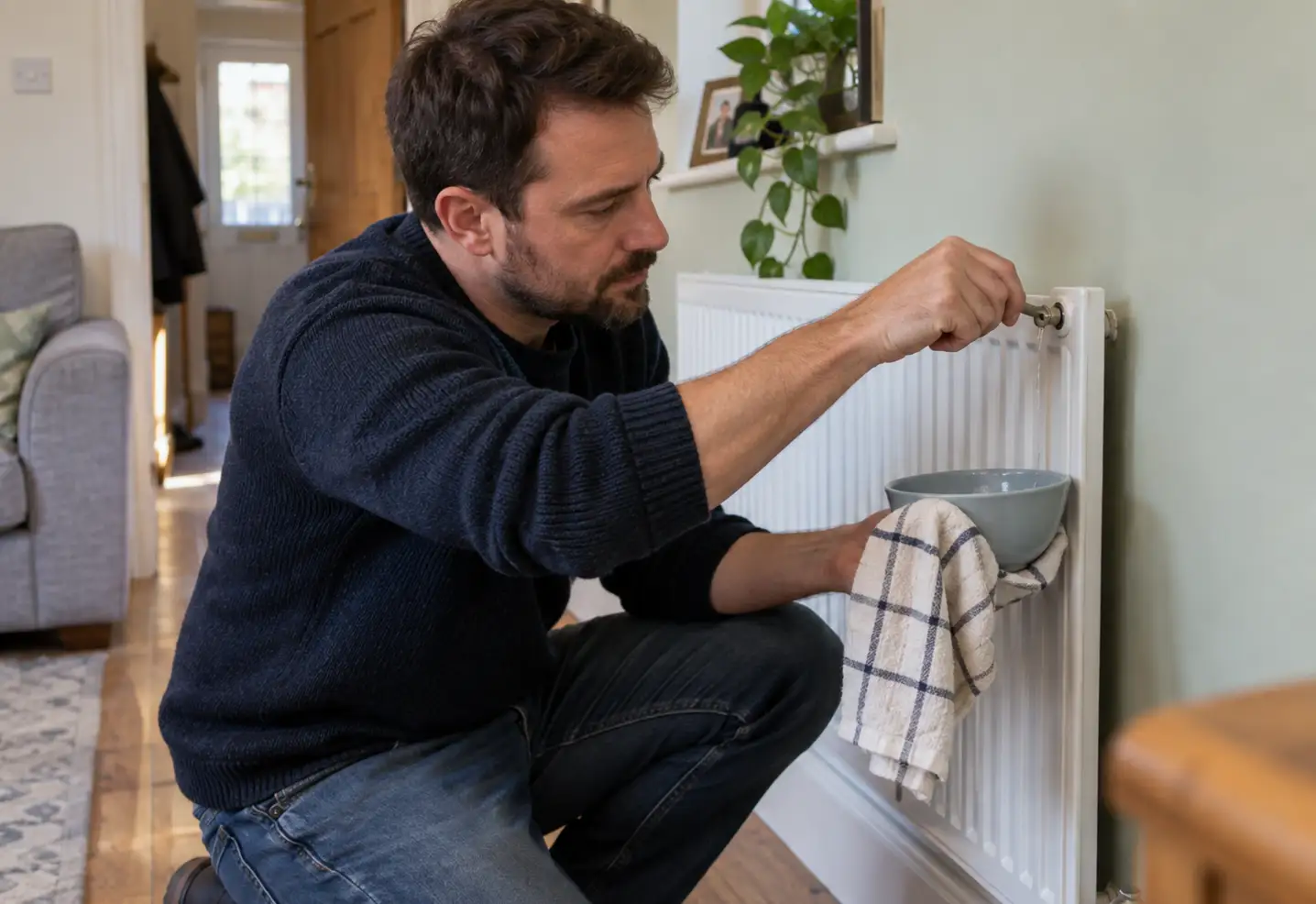
You top it up, it works fine for a few days, and then the gauge is low again. Repeat that cycle enough times and it stops feeling like maintenance and starts feeling like a mystery with no obvious culprit.
It’s worth being clear about something before going any further: topping up the pressure restores the number on the gauge. It does absolutely nothing to explain where the water went, and that question is the one actually worth answering.
What the pressure gauge is actually telling you
A sealed central-heating system contains a closed circuit of water, and that water needs to remain within the pressure range specified for the particular boiler and system.
There isn’t one universal “correct” figure that applies to everything. Many domestic sealed systems sit somewhere around 1 to 1.5 bar when cold, but the manufacturer’s instructions and the markings on your own boiler are the references that matter.
Pressure also isn’t supposed to remain absolutely identical while the system heats and cools. Water expands when heated, so the gauge will normally rise while the heating is operating and fall again as it cools. The useful comparison is therefore usually cold pressure against cold pressure, rather than comparing a hot reading with a cold one and assuming the difference itself is a fault.
What shouldn’t become routine is repeatedly finding the cold pressure below the boiler’s normal range and having to put water back into the system without knowing why.
Worcester Bosch’s guidance on heating-system pressure says its systems will typically require topping up only occasionally and advises contacting the installer where repressurising is needed much more frequently.
The pattern is the clue
How the pressure behaves over time often tells you more than the low reading itself.
A one-off drop after bleeding radiators or other heating-system work can have an obvious explanation. Venting air from a sealed system can lower its pressure, and the system may need to be returned to the manufacturer’s specified cold pressure afterwards.
Pressure that repeatedly falls over days or weeks without any recent work, however, deserves investigation. The faster it falls, the stronger the indication that water is leaving the sealed system somewhere or that a component isn’t behaving as intended.
Pressure that climbs unusually high while the heating is running, then falls very low again after it cools is a different pattern. Some rise while hot is normal; a large swing towards the boiler’s high-pressure zone makes the expansion vessel and pressure-relief system much more relevant.
Pressure that continues rising even when the heating is off points in another direction again and can lead an engineer to consider whether water is continuing to enter the sealed circuit — for example through a filling arrangement that isn’t shutting off properly.
The patterns are useful enough to summarise:
| What the pressure does | What it can point towards |
|---|---|
| Small one-off drop after radiators have been bled | Normal consequence of venting the system |
| Falls repeatedly from a normal cold reading | Leak, discharge or another system fault |
| Falls very quickly over hours or a few days | More significant leak or fault becomes more likely |
| Rises sharply when heating, then drops low again when cold | Expansion vessel or pressure-relief system worth investigating |
| Water appears from the external relief pipe | Pressure-relief valve has discharged; the reason still needs finding |
| Pressure rises even with heating off | Water may still be entering the sealed system |
None of these is a diagnosis by itself. What the table gives you is something much more useful to tell an engineer than simply “the pressure keeps going down”.
What’s commonly behind it
A number of different faults can cause pressure loss, and it’s worth understanding the range rather than assuming that every low gauge means a hidden pipe is leaking.
A visible leak at a radiator valve, pipe joint or fitting is the simplest to identify. It may show itself as a drip, staining, corrosion, a damp skirting board or moisture around a valve.
A leak in concealed pipework — beneath a floor, inside a wall or buried in screed — produces the same loss of system water without necessarily leaving an immediately obvious mark where you can see it.
A leak within the boiler or around its immediate connections is another possibility. Anything that requires opening an integral boiler casing belongs with an appropriately qualified engineer rather than household investigation.
The pressure-relief valve, or PRV, is designed to discharge water safely if the sealed system becomes excessively pressurised. Its discharge pipe normally terminates outside the property. If that pipe is dripping or shows evidence of recent discharge, the water disappearing from the heating system may be going outside rather than into the house.
That still doesn’t establish the root cause. The PRV itself may not be sealing properly, or it may have opened because something else — often excessive pressure elsewhere in the system — made it do exactly what it was designed to do.
The expansion vessel is one of the components that can create that pattern. Its job is to accommodate the increase in water volume as the heating system warms. If it loses its charge or otherwise stops functioning properly, pressure can rise much more sharply as the system heats. The PRV may then discharge water; when everything cools again, the gauge can end up much lower than where it began.
Bleeding radiators provides a straightforward exception. If you’ve recently vented air from several radiators, a subsequent reduction in pressure isn’t mysterious. Restore the pressure only in accordance with the boiler manufacturer’s user instructions and then see whether it remains stable.
There are other possible faults, which is why the pattern helps narrow the investigation but shouldn’t be treated as a substitute for one.
What to look for, without taking anything apart
A useful amount of evidence can be gathered without opening a boiler or dismantling the heating system.
Look around visible radiator valves, exposed pipe joints and towel rails for staining, verdigris, rust marks, dampness or an actual drip. Very small leaks sometimes evaporate on warm pipework before they produce a puddle, so dried staining can be as relevant as obvious water.
Watch the pressure from cold through a normal heating cycle if the boiler is otherwise operating safely. Note the cold starting pressure, how high it rises when the system is hot, and what it returns to after it has fully cooled. You don’t need to stand beside the boiler continuously; a few recorded readings are enough to give an engineer something meaningful to work with.
If the pressure-relief discharge pipe is readily visible outside, check from ground level whether its end is wet, dripping or noticeably stained. Worcester Bosch advises homeowners with repeated pressure loss to check visible joints and the external pressure-relief discharge for signs of water.
Don’t block, plug or alter that discharge pipe. It belongs to a safety device.
It’s also useful to note whether the filling valve or filling loop was definitely shut again after the last top-up. Don’t start dismantling or adjusting unfamiliar filling equipment, but that information can help an engineer if the pressure is behaving strangely in both directions.
The aim is evidence gathering, not diagnosis by disassembly.
Why repeatedly topping up isn’t a long-term solution
This is worth its own section, because it’s the habit this article is specifically trying to interrupt.
A sealed heating system is intended to retain treated water. When you repeatedly replace lost system water with fresh mains water, you don’t just restore the pressure: you also dilute the corrosion inhibitor that’s intended to protect the metal components inside the heating system, while introducing fresh oxygen-bearing water into what should largely remain a closed circuit.
Modern heating-system guidance treats water quality and inhibitor concentration as something that needs maintaining for exactly this reason. Sentinel’s current guidance notes that leaks and routine system top-ups dilute inhibitor protection and recommends checking inhibitor levels after system water has been added.
That doesn’t mean one legitimate repressurisation suddenly ruins a heating system. It means frequent topping-up shouldn’t be treated as harmless routine maintenance while the reason for the water loss remains unknown.
Over time, inadequate protection can contribute to internal corrosion and the formation of magnetite sludge, which in turn can affect radiators, pumps, valves and boiler components.
The sensible sequence is therefore to repair the cause of repeated water loss first and then make sure the condition and protection of the system water are appropriate, rather than endlessly adding fresh water to compensate for a fault.
“But I can’t find a leak anywhere”
This is one of the most common and genuinely frustrating positions to be in, and it doesn’t mean the pressure loss is imaginary.
Some heating leaks are extremely small. They can lose enough water over days or weeks to move the gauge while never producing a dramatic puddle. Water can evaporate from a hot pipe or radiator connection, soak into building materials, or escape from concealed pipework where you simply can’t see it.
Some of the missing water may not be entering the property at all. If the pressure-relief valve has discharged, it’s being deliberately routed outside.
And sometimes the issue is not a straightforward leak from pipework but a component fault creating a cycle of excessive pressure, discharge and subsequent low pressure.
None of that is a reason to start lifting floors or cutting holes into walls yourself.
A competent heating engineer can start by looking at the behaviour of the whole system: pressure changes hot and cold, the expansion vessel, PRV discharge, visible joints, filling arrangements and the boiler itself. Where concealed leakage remains a serious possibility, pressure testing or specialist leak-detection methods can narrow the search before destructive opening-up is considered.
When it’s time to stop topping up and get it investigated
The useful dividing line isn’t a particular number of calendar days. It’s whether the system is repeatedly losing pressure without a known explanation.
If you’ve bled radiators once, restored the system to the correct cold pressure and it then remains stable, there’s little mystery to solve.
If you’re having to repressurise it repeatedly, the boiler keeps locking out on a low-pressure fault, visible water is appearing anywhere around the system, the external relief pipe is dripping, or the gauge is making large swings between cold and hot, that’s the point to investigate rather than continue resetting the symptom.
The same applies if you’re no longer confident about how the filling arrangement on your particular boiler should be operated. Follow the manufacturer’s instructions rather than copying a generic filling-loop procedure from another model; different boilers use different arrangements.
Where a gas boiler needs internal investigation or repair, use an appropriately qualified Gas Safe registered engineer. Gas Safe registration applies throughout the UK, including Northern Ireland, and the engineer’s ID card should show that they’re qualified for the appliance and work involved.
The point worth remembering
A boiler that repeatedly loses pressure is giving you evidence of a problem somewhere in the sealed heating system.
Topping it up can restore operation temporarily, and there are perfectly legitimate occasions when a small repressurisation is needed — particularly after bleeding radiators or other system work. What it shouldn’t become is the permanent answer to a gauge that keeps falling for no identified reason.
The useful information is the pattern: how quickly it falls, whether it changes dramatically between cold and hot, whether the PRV discharge is wet, whether any visible fittings are leaking, and what happened immediately before the problem started.
That’s a far better head start for an engineer than simply knowing how many times you’ve visited the filling loop.
This article provides general property information and does not replace professional diagnosis of your specific heating system. Follow the manufacturer’s instructions for normal user actions such as repressurising. Do not open or repair boiler internals yourself; where gas work is involved, it must be carried out by an appropriately qualified Gas Safe registered engineer.

