

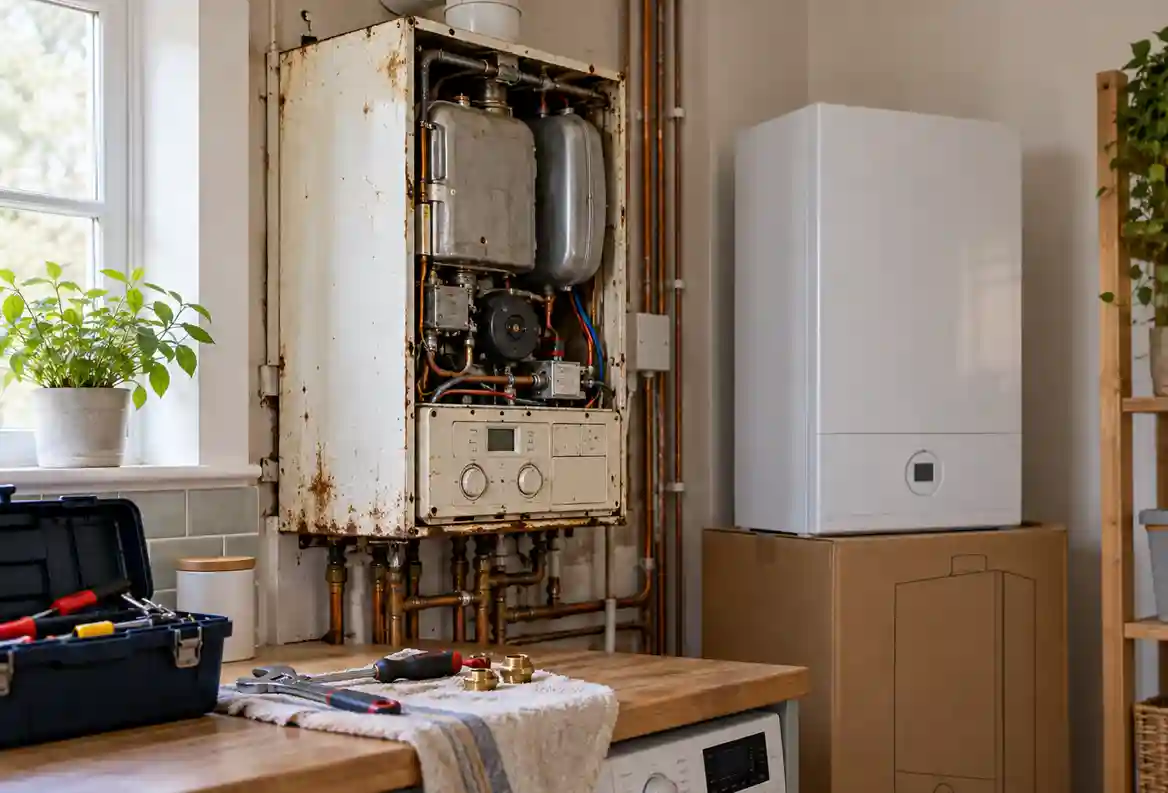
The engineer has just quoted a repair. It’s not an unreasonable amount, and the boiler will probably run again once the part’s fitted. The question nagging at you isn’t whether this particular repair is worth it — it’s whether you’re about to be back here again in eight months, paying for the next thing.
That’s a different question from “can it be fixed?”, and it’s the one worth actually answering before writing the cheque.
There is one exception before getting into the economics. If a gas engineer has identified the appliance as unsafe or marked it “Danger Do Not Use”, it should not simply be switched back on while you decide whether repairing it represents better value. HSE’s gas-safety guidance is clear that an appliance considered unsafe should not be used. Safety comes first; the repair-or-replacement judgement starts after that.
Age is a clue, not a verdict
It is tempting to reach for a simple rule — replace at ten years, fifteen years, or whenever a particular part fails — and plenty of boiler marketing encourages exactly that kind of thinking.
There is some useful context behind the numbers. Energy Saving Trust currently describes the average boiler lifespan as around 10 to 15 years, which means an appliance approaching or beyond that range deserves a different conversation from a relatively young boiler suffering its first isolated fault. It does not mean a boiler reaches its tenth or fifteenth birthday and suddenly becomes uneconomic to repair.
A well-maintained older boiler with one straightforward failure, readily available parts and a long history of reliable service can still be a perfectly sensible repair prospect. A much younger boiler that has suffered repeated faults, has significant deterioration elsewhere or is becoming difficult to support can present a worse case.
Age matters because it tends to travel with other things that matter more directly: accumulated wear, future parts availability, efficiency compared with newer equipment and the possibility that one failure is becoming part of a pattern. It provides context for the decision; it does not make the decision.
What does today’s repair actually buy you?
What’s failed, specifically, is still the sensible place to start.
A relatively contained failure involving a sensor, valve, control or another replaceable component is very different from an expensive fault affecting a major part of the appliance, but even component names should not become automatic rules. A heat exchanger, fan or circuit board can be prohibitively expensive on one model and a viable repair on another once the actual part price, labour and access are known.
The useful figure is therefore the fitted cost of repairing this boiler, not an internet rule saying that a particular component always means replacement.
Parts availability deserves more scrutiny than simply asking whether today’s part can be obtained. If a manufacturer no longer sells the boiler, that does not automatically mean support has ended; components may remain readily available for years. But if an engineer is increasingly struggling to source several model-specific parts, that tells you something about how repairable the appliance may remain after today’s fault has been fixed.
A better question is:
“Is this one part available, or is this boiler still generally well supported for parts?”
Fault history then changes the meaning of the quote. A boiler that has needed one unrelated repair in six years is telling a very different story from one that has produced three call-outs in fourteen months. Keeping a simple record of dates, faults and rough costs is surprisingly useful because “it keeps breaking down” is a feeling, while a sequence of failures is evidence.
There is an important trap in that history, though. Money already spent on the boiler should inform your view of its reliability, but it should not make the next repair more attractive simply because you’ve already invested heavily in keeping it alive.
Suppose £800 has been spent over the previous two years and another £500 repair is now proposed. The question is not, “I’ve already spent £800, so should I protect that investment?” That money has gone.
The question is:
“Starting today, what does another £500 buy me?”
If it buys a repair on an otherwise sound appliance with good parts support and no wider concerns, it may be excellent value. If it buys another period of uncertain operation from a boiler that has already developed several unrelated failures, the same £500 means something quite different.
This is also where the engineer’s view of the rest of the appliance becomes useful — but only if it is based on evidence rather than age-based prediction. Nobody can tell you with certainty that a pump will fail in six months or a circuit board next year. What they can sometimes identify is corrosion, leakage, deteriorating components, signs of overheating or other observable problems discovered while investigating today’s fault.
One of the most useful questions you can ask is therefore:
“Apart from the part you’re repairing today, is there anything you can actually see or test that concerns you about the rest of the boiler?”
That separates an informed assessment of condition from the vague argument that something else might fail simply because the boiler is old.
And before condemning the appliance at all, make sure the fault really sits inside it. Controls, motorised valves, circulation problems, sludge, radiators and other parts of the heating system can produce symptoms that appear to implicate the boiler. Replacing the appliance will not cure a problem elsewhere in the system.
Compare the repair with the job you would actually be buying instead
Another common mistake is comparing a repair quote with the advertised price of a replacement boiler.
A £600 repair is not competing with a £1,700 appliance sitting on a retailer’s website. It is competing with the complete installed replacement required in that particular property.
Energy Saving Trust currently gives around £3,500 as a typical Great Britain cost for replacing a G-rated gas boiler with an A-rated boiler with thermostatic radiator valves, while stressing that the actual cost depends on the installation. That is useful context rather than a quotation: changing boiler position, flue arrangements, condensate drainage, controls or other parts of the system can alter the finished price significantly.
A meaningful replacement quotation should therefore make clear what is actually included. Depending on the job, that may involve the boiler, labour, controls, system cleaning or treatment, magnetic filtration, commissioning, flue or condensate work, removal of the old appliance, making good and the documentation required for the completed installation.
Two quotes headed “new boiler” can consequently represent materially different jobs.
Warranty deserves the same scrutiny. A new appliance may provide much longer protection than a repair, but compare what the warranty covers and what conditions keep it valid rather than looking only at the headline number of years. A repair warranty may cover only the replaced component or work performed; a boiler warranty may depend on servicing and other requirements.
If one engineer’s diagnosis turns a moderate repair into a several-thousand-pound replacement, a second informed opinion can be entirely reasonable where there is genuine uncertainty about the fault or wider condition. For the replacement itself, Energy Saving Trust currently recommends obtaining at least three installer quotations.
The point is not to keep asking engineers until someone agrees to repair it. It is to make sure a major capital decision rests on a diagnosis and scope you trust.
The same £500 repair can be a completely different decision
Consider two hypothetical boilers facing the same £500 repair.
The first is seven years old. It has needed no significant repair for five years, the failed component is readily available, the engineer sees no corrosion or leakage elsewhere and the heating system is otherwise performing properly. A complete replacement would cost several thousand pounds.
The second is fourteen years old. It has had three call-outs in eighteen months, around £900 has already been spent on unrelated faults and today’s component is available, but the engineer is beginning to encounter poorer support for other model-specific parts and can identify deterioration elsewhere in the appliance.
The £500 invoice is identical.
The value of what it buys is not.
On the first boiler, the repair restores an otherwise reliable asset. On the second, the repair may restore operation without restoring confidence in the appliance as a whole.
That is why crude rules such as “replace if the repair costs more than half the price of a new boiler” are not especially helpful. The percentage does not tell you what condition the remaining boiler is in, whether parts support is deteriorating or whether the appliance has been reliable.
The decision becomes much clearer once the question changes from “is £500 too much for a repair?” to “what am I likely to own after spending the £500?”
Efficiency matters when the gap is actually large
Efficiency is often used as the argument that finally tips an owner towards replacement, but the size of the saving depends heavily on what is being removed.
Energy Saving Trust’s current figures estimate a saving of about £420 a year in Great Britain from replacing a G-rated gas boiler with no heating controls with an A-rated boiler and full controls.
That is a meaningful difference — but it starts with a particularly inefficient boiler and no controls.
Someone replacing an old non-condensing appliance may therefore have a genuine efficiency reason to move towards replacement even before reliability is considered. Someone replacing an existing reasonably efficient condensing boiler is starting from somewhere very different, and the savings available from the appliance change alone may be far smaller.
The wider system also determines what the new boiler actually achieves. Controls, system condition and how the heating is set up affect energy use, so a replacement proposal that discusses only the efficiency badge on the front of the appliance is giving an incomplete picture.
Efficiency should strengthen a replacement case where there is a real efficiency gap. It should not be used to manufacture a financial payback that the particular property is unlikely to achieve.
Sometimes the sensible repair is deliberately temporary
There is another option that sits awkwardly between “repair the boiler” and “replace the boiler”, but in real properties it can be the most rational one.
Sometimes you repair an ageing boiler without believing it is the long-term answer.
An owner may be planning a major renovation next year, changing the hot-water arrangement, extending the property or intending to move to a different heating technology. A landlord may be coordinating a wider refurbishment between tenancies. Someone intending to sell may simply need a safe, functioning heating system while deciding whether a major replacement would genuinely be reflected in the sale.
In those circumstances, a modest repair that deliberately buys 12 or 18 months can make sense even where spending heavily to preserve the same boiler for another five years would not.
The important difference is intent. You are not repairing it because previous spending has trapped you into continuing. You are buying time for a known reason.
This matters particularly if a heat pump or other wider heating change is genuinely under consideration. Once thousands of pounds are about to be committed to a full boiler replacement, it is sensible to decide whether you actually want another boiler before ordering one. The Boiler Upgrade Scheme currently provides support towards eligible low-carbon heating installations in England and Wales, including qualifying properties rented to tenants and some business properties.
Whether a heat pump suits the building is a separate design question and belongs in PFP’s dedicated heat-pump-readiness coverage. The relevant point here is simply that replacing a boiler today can lock in a heating-system decision for years, while a modest bridge repair may occasionally buy the time needed to make that larger decision properly.
When the balance really has shifted
Replacement becomes the stronger case not when the boiler reaches a magic age, but when several pieces of evidence begin pointing in the same direction.
Breakdowns have moved from occasional to recurring. Today’s repair is no longer trivial. Important parts are becoming harder to obtain. The engineer can identify deterioration beyond the immediate fault. The wider heating system needs work that could sensibly be coordinated with replacement. Efficiency is poor enough that a modern system offers a meaningful improvement. And the owner expects to need reliable heating from the same system for years rather than months.
Reliability itself also has a value that is easy to leave out of the arithmetic. Four moderate repairs may still cost less than a new boiler when written in a spreadsheet, but they also mean four engineer appointments, four periods without heating and four disruptions to whoever uses the property.
For landlords, that cost is more obvious because the inconvenience falls on the tenant while the owner still has to arrange access and repair. In England, landlords are responsible for keeping heating and hot-water systems in repair and proper working order. If an appliance has been disconnected because it is unsafe, HSE also says emergency heating should be provided while remedial work is arranged.
A landlord therefore has a reason to put a higher financial value on predictable heating than an owner-occupier who is willing to tolerate the occasional breakdown.
The same applies to smaller commercial premises. A shop, office, salon or other business may find that the direct repair bill is the least expensive part of another failure once lost trading, staff discomfort or emergency closure is considered.
For those owners, one further question belongs in the calculation:
“What would another breakdown actually cost if it happened at the worst possible time?”
The boiler that’s “still going” isn’t automatically the sensible choice
Neither “it’s old, so replace it” nor “it can still be repaired, so repair it” is a complete answer.
The decision that actually holds up comes from what has failed, how the appliance has behaved over the previous few years, whether it remains well supported for parts, what condition the rest of it is in, what the complete replacement would genuinely cost and how long you need the existing heating system to keep doing its job.
Previous spending matters because it tells you about reliability. It does not entitle the boiler to the next repair.
Age matters because it changes the context. It does not set an expiry date.
Efficiency matters where the gap is real. It does not make every functioning older boiler uneconomic.
And sometimes a repair does not need to justify keeping the appliance for another decade. It only needs to buy enough reliable time to reach a better-planned decision.
The question worth coming back to is therefore the one the repair quote does not answer on its own:
What does today’s money buy from today onwards?
If it restores an otherwise sound, supportable boiler to dependable service, another repair may be entirely sensible. If it simply gets an increasingly unreliable appliance running until the next expensive failure, the fact that the engineer can repair it no longer means that you should.
Important: This article provides general property information, not financial, gas-safety, engineering or other professional advice for an individual property. Boiler faults and heating-system condition need to be assessed individually. Gas installation, servicing and repair work must be carried out by an appropriately qualified Gas Safe registered engineer. If an appliance has been identified as unsafe or marked “Danger Do Not Use”, do not use it until the relevant safety issue has been dealt with by a competent Gas Safe registered engineer.

