

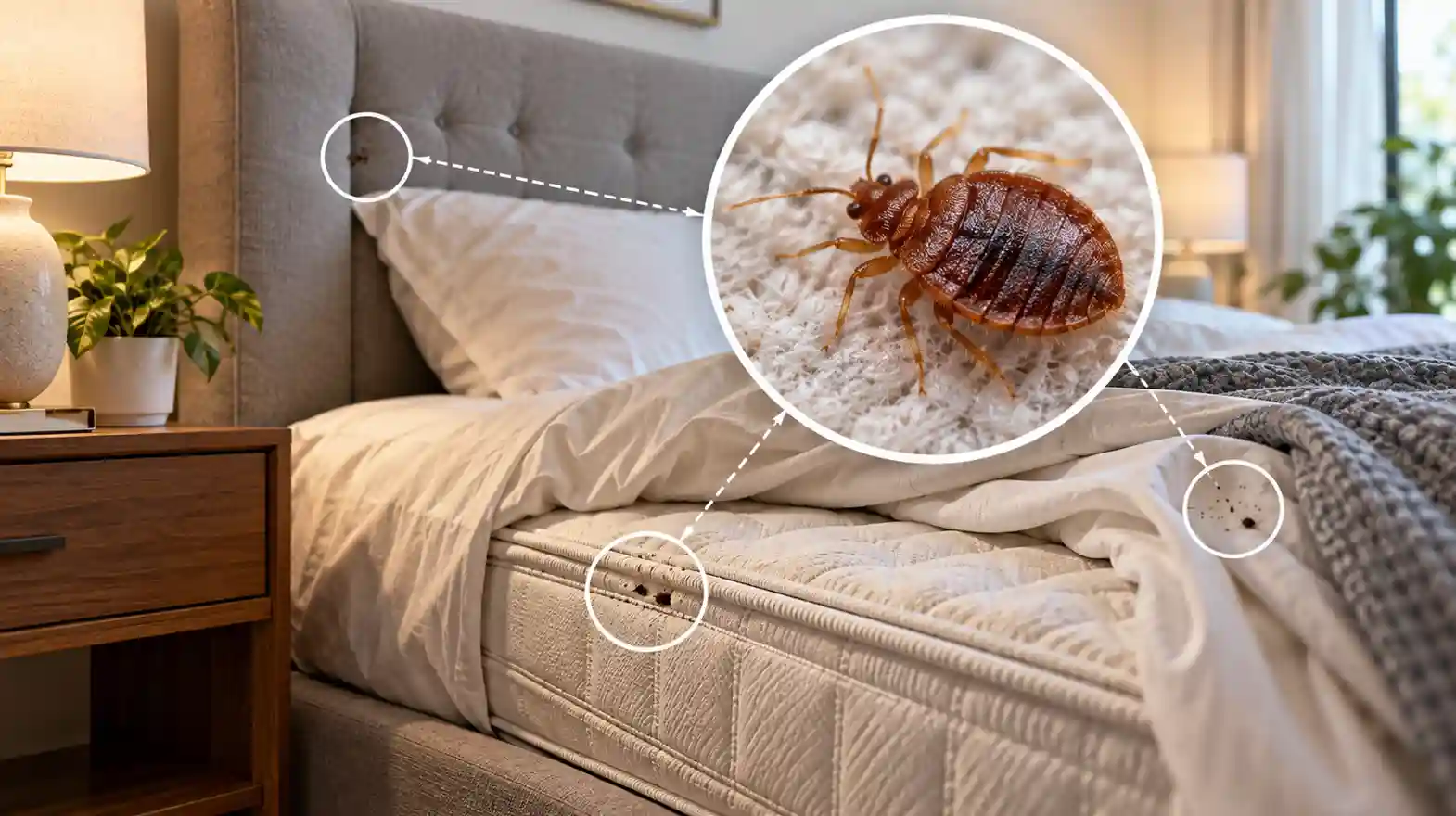
Unexplained bites overnight are unsettling, and the first instinct is to want an answer immediately. The trouble is that bites alone can’t give you one — they can look broadly similar whether the cause is bed bugs, another biting insect or something unrelated to insects altogether, and different people can react very differently to the same infestation.
The genuinely useful first step isn’t treatment. It’s confirming what you’re actually dealing with, without, in the process of looking for it, spreading the problem further around the property.
That distinction matters because some of the most expensive bed bug mistakes happen before a pest controller ever arrives: paying to treat something that was never confirmed, carrying bugs into another bedroom, throwing away furniture that didn’t need replacing, or treating one part of a building while the infestation extends beyond it.
Why bites don’t settle it — and what actually does
Bed bug bites can appear as itchy raised marks, sometimes clustered or roughly aligned on exposed skin, but neither their appearance nor their arrangement proves what caused them. One person can react markedly while someone sleeping beside them shows little or no visible response, which is another reason skin marks are a poor basis for deciding whether a property needs treatment.
The evidence in the room is more useful.
Bed bugs tend to harbour near places where people sleep or spend long periods sitting, which makes mattress seams an obvious place to inspect but not the only one. Bed frames, screw holes and joints, the back of a headboard, bedside furniture, narrow cracks and upholstered chairs or sofas can all provide protected spaces close to a host.
Dark faecal spotting around those harbourages is an important sign. Blood marks on sheets can support the suspicion but have other possible explanations. Pale cast skins show that bed bugs have been developing in the area, while eggs or empty eggshells add further evidence.
There is an important difference, though, between evidence that bed bugs have been there and evidence that they are active now. A cast skin, old eggshell or dead insect can remain after an earlier infestation has gone; a correctly identified live adult or nymph is much stronger evidence of present activity. Several characteristic signs found together in likely harbourages also make the case more convincing.
The British Pest Control Association’s bed bug guidance describes the same combination of live insects, eggs, cast skins, faecal marks and blood spotting that professional inspections look for.
Cleanliness does not settle the question either. Bed bugs can be introduced in luggage, clothing, bags and furniture and can establish themselves in a spotless bedroom just as readily as an untidy one.
The harder situation is when there are suspicious bites or occasional marks but a careful inspection finds nothing convincing. That does not justify spraying the room “just in case”. A small infestation can be difficult to find, and repeat professional inspection or monitoring may sometimes be more useful than treating without knowing what pest is present. Recent BPCA professional material also notes that monitoring can be less conclusive in an empty room because bed bug behaviour is influenced by host cues such as body heat and carbon dioxide. BPCA’s 2026 discussion of bed bug behaviour and monitoring explores that problem in more detail.
The practical distinction is simple: if you have bites but no bed bug evidence, keep investigating rather than buying a full bed bug treatment programme on suspicion alone.
Don’t spread the problem while you’re trying to solve it
Once bed bugs are suspected, the natural reaction is to do something immediately: strip the bed, empty drawers, move clothes somewhere clean, carry the mattress outside or start sleeping in another room.
In the first stages, restraint can be more useful than activity.
The immediate objective is not to empty the affected room. It is to avoid increasing the area that eventually needs inspecting and treating.
Bed bugs can hitchhike in bedding, clothes, bags, furniture and other belongings. Moving suspect possessions from one bedroom to another can therefore carry the infestation with them, while changing sleeping rooms and moving bedding or personal belongings at the same time can turn a relatively contained problem into one involving several rooms.
If a professional inspection is being arranged, it is usually better to follow that pest controller’s preparation instructions than to dismantle and redistribute the room beforehand. Evidence also matters: completely clearing, cleaning or treating the area before an inspection can make the infestation harder to map.
Laundry that can safely tolerate heat is one exception because it can form part of the containment process. NHS guidance on bedbugs recommends washing affected bedding and clothing at 60°C and tumble drying on a hot setting for at least 30 minutes. Where the care instructions allow that, bag suspect laundry before carrying it through unaffected parts of the property and put treated items into clean bags or containers rather than back into something that may still contain bugs.
The same containment logic applies to the mattress. Finding a bed bug on it does not mean the mattress itself is the infestation.
Bed bugs may also be harbouring in the frame, headboard, bedside furniture, skirting, adjoining cracks or upholstered furniture nearby. Throwing away a mattress while those harbourages remain can leave the infestation essentially untouched, and bringing a replacement into the untreated room simply supplies a new place beside the same feeding source.
Where furniture really is too heavily infested or unsuitable to treat, disposal can be part of the solution — but it should be planned. Carrying an uncovered infested mattress through a communal corridor can spread bugs, while leaving usable-looking furniture outside creates the obvious risk that somebody else takes it home. Pest-controller advice and the local council’s disposal requirements should therefore form part of that decision.
The first day after discovering suspected bed bugs should consequently be much less dramatic than many people imagine: preserve useful evidence, minimise movement between rooms, contain anything that does need moving and establish how far the problem actually extends.
What proper eradication looks like — and why treatment fails
A professional treatment programme should begin by answering the same question the occupant has been trying to answer: where are the bed bugs?
That means surveying likely harbourages and establishing the extent of activity before deciding how large an area requires treatment. Depending on the property and infestation, control may involve physical removal and vacuuming, targeted steam, authorised insecticides, professionally managed heat treatment or a combination of methods.
There is no single technique whose name proves that the job will succeed.
Professional heat treatment can kill bed bugs across their life stages when the necessary conditions actually reach the insects, but making a bedroom feel extremely hot is not the same thing as ensuring those conditions have penetrated the centre of furniture, mattresses and other protected harbourages. BPCA’s guidance on professional bed bug heat treatment stresses the importance of monitoring temperatures and identifying cold spots rather than relying on room-air temperature alone.
Chemical treatment has different weaknesses. Resistance to insecticides is a recognised problem in bed bug populations, while incomplete or badly targeted application can leave harbourages untouched. Members of the public should also distinguish household products from professional-use biocides: HSE’s current biocide guidance says non-professional users should use only products intended for the general public and follow the label, while products restricted to professional users require the appropriate information, instruction and training.
The common thread is that eradication fails when the treatment boundary does not match the infestation boundary. A concealed harbourage can be missed; clutter or inaccessible furniture can prevent proper treatment; heat may not penetrate a protected cold spot; possessions may carry bugs into another room; or an adjoining area may continue feeding bugs back into somewhere that has been treated competently.
That is why comparing pest-control quotations purely by whether they say “spray” or “heat treatment”, or simply by which one is cheapest, misses much of what the customer is actually buying.
A useful quotation should make it reasonably clear what is being inspected and treated, what preparation is required, whether adjoining areas need assessment, what follow-up is included and how the contractor proposes to determine whether activity remains.
There is an important difference between buying a treatment visit and buying a programme intended to achieve eradication.
The most useful question to ask a pest controller is therefore not simply:
“How are you going to treat it?”
It is:
“How will you establish that the treatment has worked?”
Depending on the method and infestation, that answer may involve a further inspection, monitoring or interceptors, or additional treatment where evidence remains. It does not follow that every competent programme needs exactly two visits or that activity after a first treatment automatically means somebody did the job badly. Different treatment strategies work differently.
What matters is that there is an answer to the question of when the job is finished.
A promise that every infestation will unquestionably disappear after one quick visit should consequently inspire more scrutiny than a contractor prepared to explain the extent of the infestation, the limitations of the proposed method and how success will be checked afterwards.
Flats, HMOs and hotels change the problem
A bed bug infestation in a detached house can often be investigated initially around the places where the occupants sleep and spend long periods sitting. In a flat, HMO, hotel, hostel or serviced accommodation, the room where the problem was first reported may not define the edge of the problem.
Bed bugs can be carried between spaces in possessions and, in some circumstances, move into adjoining rooms or units themselves. A confirmed infestation in a multi-occupancy building is therefore a reason for the professional investigation to consider adjacent or linking areas rather than assuming that treating the first bedroom will necessarily deal with everything.
That does not mean every room next door automatically needs pesticides or heat treatment. The important sequence is establish the infestation boundary first and then decide the treatment boundary.
For a hotel or serviced-accommodation operator, the consequences of getting that wrong can escalate quickly. One missed adjoining room can turn one complaint into several, while movement of bedding, housekeeping equipment, luggage or furniture provides additional opportunities to redistribute insects. Staff who regularly service rooms can also become useful early-warning eyes if they know what faecal spotting, shed skins and live insects actually look like.
The same building-wide thinking matters for landlords, letting agents and block managers. Early notification can be important because inspection may ultimately require access beyond the room — or even the dwelling — where the first evidence appeared.
Who pays for the treatment and whether responsibility lies with the tenant, landlord or somebody else is a different question, dependent on how the infestation arose and the circumstances of the property. That belongs in PFP’s separate Pests in a Rented Home: Who Is Responsible — Tenant, Landlord or Council? coverage rather than being inferred simply from the discovery of bed bugs.
Confirm, contain, eradicate, verify
The expensive mistakes with bed bugs often happen because those stages are tackled in the wrong order.
Treating bites without confirming the pest can mean paying for an infestation that was never established. Moving beds, bags and clothing can increase the number of rooms involved. Throwing away a mattress can destroy furniture while leaving the infestation behind. Choosing treatment without establishing how far the bugs have spread can leave the actual source untouched.
The sequence that holds up is simple even if carrying it out is not:
confirm what the evidence shows, establish the extent of the infestation, contain unnecessary movement, treat the affected area properly and verify that activity has stopped.
That is why bed bugs can be so frustrating. Killing the insects you can see is not the same thing as proving there are none left hidden elsewhere.
The treatment isn’t properly finished when the last visible bug disappears.
It’s finished when the evidence says the infestation has gone.
Important: This article provides general property information, not medical, legal or pesticide-use advice for individual circumstances. Bed bug bites cannot be reliably diagnosed from appearance alone, and suspected infestations are best confirmed by an appropriately experienced pest-control professional. Always follow product labels and professional preparation, re-entry and aftercare instructions. Do not use professional-only biocidal products or improvise whole-room pesticide or heat treatments yourself. Seek medical or pharmaceutical advice where bites cause significant swelling, persistent symptoms or signs of infection.

