

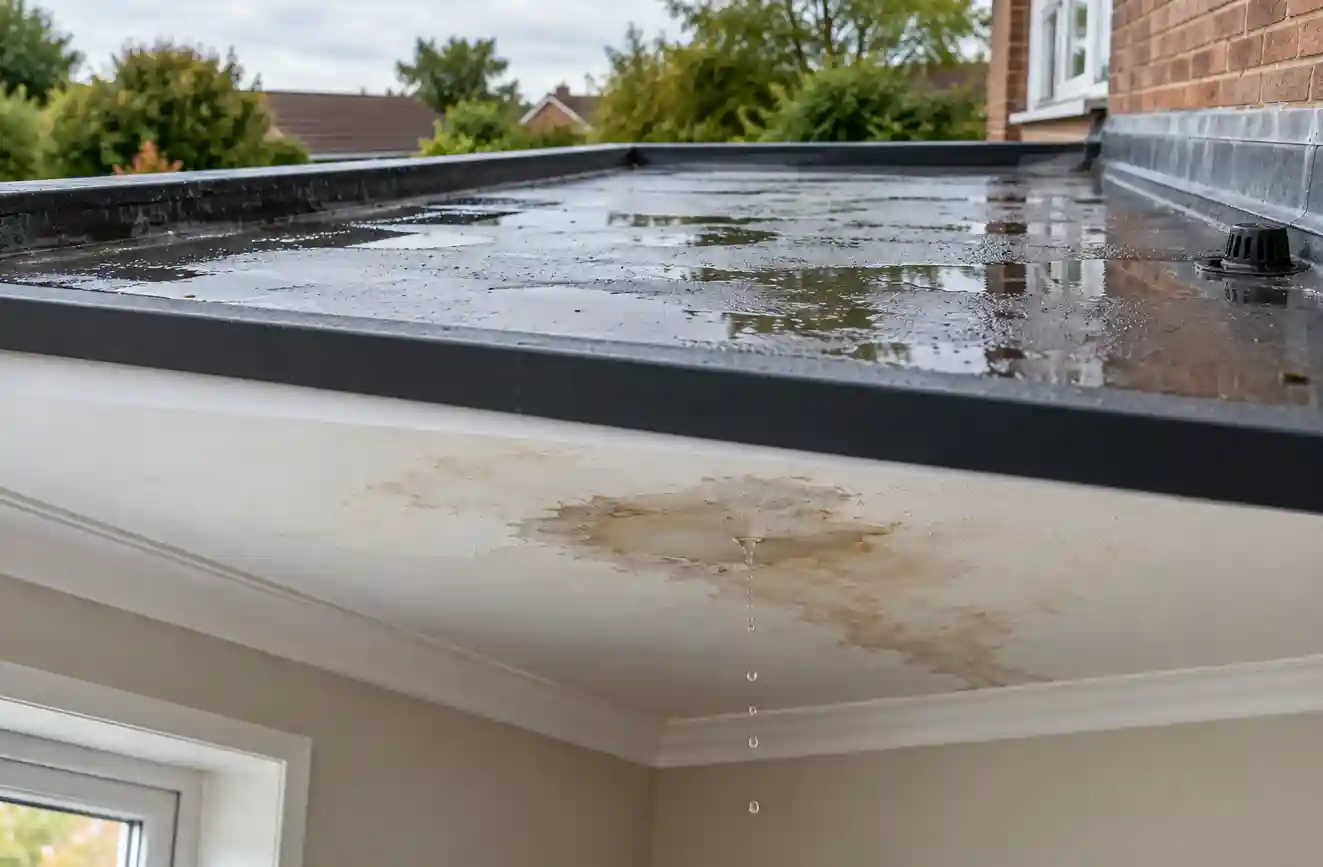
A stain spreads across a ceiling below a flat-roofed extension, or a patch of standing water sits stubbornly on the surface days after the rain stopped. The question that actually matters isn’t “is something wrong?” — it clearly is — but whether that’s a contained, fixable defect or evidence that the roof as a whole has reached the point where patching it further is simply delaying a larger and more expensive renewal.
In practice, the choice is often wider than repair or replace. A roof may need one local repair, a broader refurbishment or overlay that keeps much of the existing construction, or a complete strip-and-renew. The difficult part is working out which of those three the evidence actually supports.
That decision depends much less on how dramatic one blister, pond or ceiling stain looks than on what has failed, how far the damage extends and what is happening underneath the waterproofing.
The covering matters — but first establish what has actually failed
Flat roofs are not one material. Older bituminous felt, reinforced bitumen systems, single-ply membranes, liquid-applied waterproofing, GRP and mastic asphalt behave differently and have different repair requirements, so a method that is routine on one system may be unsuitable on another.
That is why simple lifespan rules are of limited value. “Felt lasts ten years” or “single ply lasts 30” sounds decisive, but systems within the same broad material family can have very different specifications and assessed design lives, while workmanship, drainage, detailing, exposure and maintenance all affect how long they actually perform. If paperwork survives from the original installation, identifying the exact system, approximate age and any remaining manufacturer or contractor guarantee can be more useful than applying a generic age threshold. An incompatible repair can create another defect and may also interfere with an existing warranty.
The visible leak does not necessarily tell you where the roof has failed either. Water can enter at one point, travel between layers or across the deck and eventually appear on a ceiling somewhere else. Repeatedly patching the membrane directly above an internal stain can therefore achieve very little if the entry point is actually at a rooflight, flashing, upstand, outlet or another detail some distance away.
There is another complication: not every damp mark beneath a flat roof is rain penetration. Moisture can also arise where the roof build-up has problems with insulation, vapour control, ventilation where that particular construction requires it, or moisture trapped within the assembly. LRWA’s refurbishment guidance makes the same distinction between defects in the waterproofing or deck, failures around associated details and condensation within the roof construction.
Before deciding whether a roof needs patching or replacing, the useful question is therefore not simply where the ceiling is wet. It is where the water or moisture is actually coming from, and what it has affected on the way through.
Ponding and blistering are clues, not verdicts
A flat roof should not, in conventional construction, be literally flat. The current BS 6229:2025 standard uses a minimum 1:80 finished fall for general roof areas and internal gutters, and NFRC’s summary of the revised standard emphasises the importance of the fall that remains after construction tolerances and deflection rather than simply the slope drawn on a plan.
That is useful when a roof is being designed or substantially refurbished. It is not a retrospective instruction to rebuild every older roof simply because it was constructed to a different fall.
Persistent ponding can have several explanations. A blocked outlet or a build-up of debris may be a straightforward maintenance problem. Elsewhere, the outlet may sit too high, the original falls may be inadequate, insulation or decking may have distorted, or the structure itself may have deflected enough to form a low point.
Those distinctions matter because another waterproof coating does not correct a roof that physically falls towards the wrong place. LRWA’s own technical guidance notes that a new waterproof finish alone cannot remedy inadequate falls on an existing roof and that refurbishment may instead require changes such as tapered insulation or additional outlets.
Standing water does not automatically mean the membrane has failed either. Some modern waterproofing systems can tolerate ponding, but the reason water continues to sit there still needs understanding. It adds load, collects dirt and organic matter and, where a low area is becoming deeper or larger, can point to progressive deflection rather than a harmless puddle.
Blistering deserves similar restraint. One blister can result from local separation, trapped air or moisture, or vapour pressure within the build-up and may be repairable where the surrounding system remains sound. Widespread blistering appearing alongside poor adhesion, leaks or moisture beneath the membrane is a very different signal.
The pattern matters more than the mere presence of the defect. That is also why cutting a blister open yourself to see what’s underneath is a poor shortcut: once intact waterproofing has deliberately been breached, a contained problem can become a route for water.
Repair, refurbish or replace?
A genuinely isolated defect remains the clearest repair case. If the source has been identified — perhaps one failed seam, split, penetration or detail — and the surrounding waterproofing and roof build-up remain sound, a local repair can be entirely proportionate.
The case changes when individual faults become a pattern. Repeated leaks from different areas, patches failing close to earlier repairs or widespread loss of adhesion and deterioration suggest that the roof is moving beyond one contained problem. At that stage, the condition below the membrane often matters more than the surface appearance.
Wet insulation can lose thermal performance and timber-based decks can soften, delaminate or decay, but finding moisture in one part of the roof does not automatically mean everything underneath has failed. On large commercial or block-managed roofs, moisture mapping, core sampling and selective opening-up can establish where wet material actually exists so that sound areas are not stripped unnecessarily. A small domestic extension may justify a simpler investigation, but the principle is the same: if a contractor says the roof is wet underneath and therefore needs major work, ask what evidence established how much of it is actually wet.
That can lead to the middle option that is often missing from repair-versus-replacement conversations: refurbishment.
LRWA’s guidance on roofing overlay systems recognises the established use of new waterproofing over suitable existing roofs. Where the existing construction is sufficiently dry, structurally sound, securely attached and compatible with the new system, an overlay can retain serviceable material and avoid unnecessary strip-out.
It is not simply a question of whether another coating will stick. Additional layers can alter loading and finished roof levels, while drainage, outlets, edge details, rooflights and available upstand heights still have to work when the job is finished. Wet insulation, rotten decking, poor attachment or unresolved ponding cannot be made satisfactory merely by hiding them beneath another membrane.
Covering a sound old roof can be refurbishment. Covering a wet or failing one is concealment.
The same decision has much greater financial consequences on an apartment block, warehouse or other large commercial roof. Establishing the boundary between wet and dry construction can make the difference between a targeted phased refurbishment and stripping thousands of square metres unnecessarily, which is why larger roofs often justify more formal investigation before the renewal scope is set.
Reading the pattern
| What you can see | What it may mean | Repair/refurbishment remains plausible when… | More extensive renewal becomes likely when… |
|---|---|---|---|
| One local split, failed seam or defective detail | Local waterproofing failure | The cause is identified and surrounding material remains sound | Similar failures are appearing repeatedly elsewhere |
| Ceiling staining after rain | Water is entering somewhere in the roof or adjoining detail | The true entry point is traced to a contained defect | Ingress is widespread or substantial areas beneath are affected |
| One blister | Local separation, trapped air/moisture or vapour pressure | It is isolated and the surrounding system and substrate remain sound | Blistering is widespread or associated with moisture or loss of adhesion |
| Persistent ponding | Blockage, poor falls, outlet position or deflection | A local drainage cause can be corrected | Roof geometry or structural/deck movement creates recurring low areas |
| Widespread cracking or deterioration | General ageing or breakdown of the covering | Deterioration is genuinely localised | Failure is occurring across substantial areas |
| Numerous historic patches | A history of previous local defects | Repairs remain isolated and the rest of the roof performs well | New failures continue appearing around and between previous repairs |
| Wet insulation | Moisture has entered the roof build-up | Investigation shows the wet area is limited and sound material can remain | Wetting is extensive or unsuitable to encapsulate |
| Soft, rotten or delaminating deck | Loss of supporting-deck condition | Damage is local and can be opened up and replaced | Significant areas are affected or structural performance is uncertain |
The point is not to diagnose a roof from a table. It is to decide whether the evidence still supports a contained intervention or whether the investigation needs to move deeper into the construction.
When roofers recommend completely different jobs
This is where the technical assessment becomes a spending decision.
One contractor may propose an £800 local repair, another a full overlay and another complete strip-off and renewal. The cheapest quotation is not automatically the best value, but neither is the most comprehensive job automatically the right one.
What matters is why each contractor believes that amount of roof needs work.
If a patch is proposed, has the actual ingress point been identified or is somebody simply repairing the area above the ceiling stain? If an overlay is recommended, what evidence shows the existing construction is dry and sound enough to retain? If complete renewal is proposed because the insulation or deck is supposedly saturated, what investigation established the extent of that moisture rather than merely confirming that one area was wet?
A good scope should also explain what caused the problem in the first place. If the existing roof failed because an outlet is badly positioned, the falls are inadequate, the deck has deflected or a rooflight detail is poorly designed, installing new waterproofing without correcting that weakness can reproduce the same failure under a newer membrane.
That leads to another useful question:
“What is changing in the new specification so this roof does not develop the same problem again?”
The quotation should make clear how wet or damaged material will be handled, whether drainage or falls are being corrected, whether insulation work is included, what details are being rebuilt and what guarantee applies to the completed system.
A quotation that explains the evidence behind the scope is considerably more useful than one that simply says “roof leaking — renew complete”.
A larger renewal may also mean upgrading insulation
A substantial roof renewal can turn into a bigger project for reasons that have little to do with the membrane itself.
In England, the currently applicable Approved Document L, 2021 edition incorporating 2023 amendments treats replacement of the waterproof membrane on a flat roof as renovation of a thermal element. Where more than 50% of the surface of an individual thermal element is renovated, the guidance says the whole element should generally be improved to the relevant thermal standard, subject to the provisions around technical, functional and economic feasibility.
For a heated extension or occupied building, a proposed “new roof” can therefore become an insulation and roof-build-up project as well. That can explain why a substantial renewal quotation bears little resemblance to the cost of simply laying another waterproof layer.
Requirements differ in Scotland, Wales and Northern Ireland, and the exact position depends on the building and scope. The important practical point is to establish this before comparing quotations, because a local repair and a compliant major renewal may not be pricing the same job at all.
Where a wider refurbishment is already justified, it can also be the sensible opportunity to correct inadequate falls, poor drainage or a condensation-prone construction instead of reproducing the same weaknesses beneath new waterproofing.
Look, but don’t climb
A homeowner or property manager can learn a useful amount without standing on the roof. Note whether staining follows particular weather, whether ponding is visible safely from an upstairs window, whether water is overflowing an outlet or edge and whether the same area keeps causing trouble.
Do not turn that observation into a walk across the roof.
HSE’s roof-work guidance describes roof work as high risk and says roofs should be treated as fragile until a competent person has established otherwise. Flat-roof edges, openings and rooflights can all present serious fall hazards, while water-damaged timber or board decking may be weaker than it appears.
A close inspection of the membrane, outlets, upstands, falls and underlying build-up needs safe access and somebody competent to understand what they find.
A flat roof with one identified defect and sound construction around it remains a very different proposition from one with repeated leaks, widespread deterioration, unresolved ponding and moisture distributed through the build-up. There is no honest rule saying one blister means repair, three patches mean replacement or a particular birthday means the roof must be stripped.
The sensible decision comes from establishing what has actually failed, how far that failure extends and whether the cause can be corrected without rebuilding sound parts of the roof. Sometimes that leads to a local repair. Sometimes the right answer is a properly assessed overlay. Sometimes the evidence shows that renewal really is the economical option.
The membrane tells only part of the story. What is happening underneath it — and what caused the failure in the first place — is what usually tells you whether another patch is a repair or merely a postponement.
Important: This article provides general property information, not structural, surveying, roofing, building-control or other professional advice for an individual property. The appropriate repair depends on the waterproofing system, roof construction, drainage, structural condition and extent of hidden moisture. Significant leaks, persistent or worsening ponding, suspected deck deterioration or widespread membrane failure should be assessed by a competent roofing professional and, where appropriate, a building surveyor or structural engineer. Do not access or walk on a flat roof unless suitable safe access and fall-protection arrangements have been provided.

