

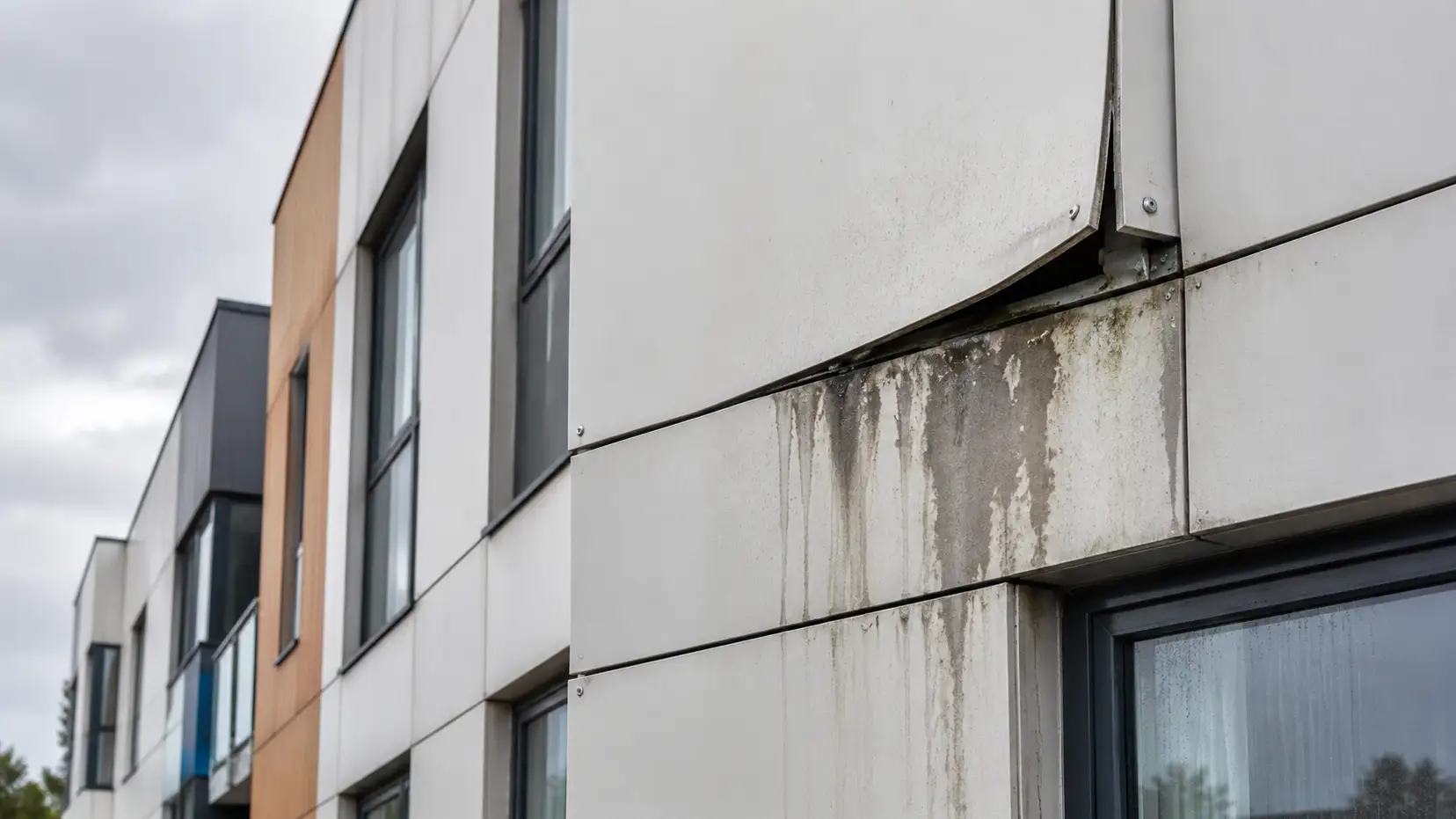
A panel that has come slightly loose at one corner. A dark stain spreading beneath a joint that used to look fine. A crack running across a rendered section that wasn’t there last year. None of these automatically means something serious is happening — but cladding and modern façade systems can be genuinely deceptive to assess by eye, precisely because what you can see from outside is rarely the whole story of how the wall actually manages rain, movement and weather.
That makes the first question less obvious than simply asking whether the cladding looks damaged.
It is: what sort of external-wall system are you actually looking at?
The panel is not the whole system
Many modern external walls are assemblies rather than single solid barriers. Depending on the construction, the visible finish may sit in front of joints, fixings, support rails, cavities, membranes, insulation, flashings and the underlying wall.
But those assemblies do not all keep water out in the same way.
A drained or ventilated rainscreen, for example, is designed on the expectation that a limited amount of rain may pass through the outer layer. The cavity and weather-resisting layers behind it then have an important part to play in controlling and draining that water safely back out.
Other external-wall systems depend much more heavily on the exposed face, joints or seals remaining weather-resistant. Rendered systems have different details again.
That distinction matters because an apparent gap between two panels is not automatically a failed joint. Some rainscreen cladding is deliberately designed with open joints. Filling one simply because it looks as though water could pass through it may misunderstand how the wall was intended to work.
CWCT, the Centre for Window and Cladding Technology, distinguishes between drained external envelopes, where water passing the outer defence is managed by a secondary defence and drainage route, and face-sealed construction, where failure of the exposed seal can provide a more direct route into the building. CWCT: Weathertightness and façade performance
The practical lesson is straightforward: before deciding that a crack, gap or joint needs sealing, establish what that particular joint was designed to do.
The same principle cuts the other way. A panel that looks reasonably sound from outside does not prove that everything behind it is functioning correctly. Concealed membranes can be damaged, drainage routes can be obstructed, fixings can deteriorate and poorly detailed interfaces can admit water without producing an obvious defect across the middle of the panel itself.
Cracks tell you where to look, not necessarily what has happened
Cracking deserves more attention than simply asking how wide the crack is.
A fine, stable surface crack in a finish may be relatively minor. A crack through a rendered system that is becoming longer or wider, repeatedly reopening after repair, following a panel junction or occurring alongside bulging, displacement or water staining deserves a different response.
Render and cladding finishes have to deal with movement. Materials expand and contract with temperature, backgrounds can shrink or move and different parts of a wall do not always behave identically. Openings such as windows and doors, changes in construction and junctions between materials can also concentrate stresses.
That means the width of a crack alone rarely tells the whole story. Its location, direction, whether it is changing and what else is happening around it can be more informative.
A crack appearing once and remaining unchanged is different from one that has been filled twice and returned. A surface hairline is different from cracking accompanied by a panel moving out of plane. And a crack beside a window that becomes damp during wind-driven rain raises a different question from general cosmetic crazing across a dry rendered elevation.
Cracking can sometimes be a symptom of movement originating behind the finish rather than a defect confined to the visible surface. That does not mean every cracked render system has a structural problem, but it is one reason repeatedly filling the same crack without understanding why it returns is not much of a diagnosis.
Where water gets in may not be where it appears
Water ingress through a façade can be difficult to trace because water does not have to travel straight through the wall at the place where the damp eventually becomes visible.
It can follow rails, joints, membranes and other concealed surfaces before emerging elsewhere. In some curtain-wall systems, water that gets beyond the outer seals is deliberately collected and drained through concealed routes. In a rainscreen assembly, the cavity behind the panels is itself part of the rain-management strategy.
This is why an internal damp patch near one panel does not prove that the panel immediately outside it is where the rain entered.
Junctions often deserve particular attention: around windows and doors, beneath copings, at parapets, where roofs or balconies meet walls, around service penetrations and where one façade material changes to another. A large area of cladding can perform satisfactorily while one poorly performing interface creates a surprisingly persistent leak.
The obvious defect and the actual entry point can therefore be two different things, which matters before somebody arrives with a tube of sealant.
Staining needs the same caution. Persistent dark streaking, discolouration or localised algae growth around a joint or panel edge is worth noticing because it shows that water has repeatedly travelled across or remained on that part of the façade. It does not, by itself, prove that water has penetrated through the wall. Rainwater may simply be following the external surface, dirt may accumulate along regular run-off paths and some materials weather unevenly.
What makes staining more significant is context: it is new, worsening, unusually concentrated around a particular junction, associated with cracking or deterioration of a joint, or corresponds with damp appearing internally during rainfall. The stain is useful evidence. It just isn’t a diagnosis.
The same qualification applies to failed sealant. On systems that rely on sealed joints, deteriorating sealant can become an important maintenance defect because the seal has to accommodate movement while maintaining adhesion to the surfaces on either side. Over time it can harden, shrink, crack or pull away, while installation defects can produce similar symptoms much sooner.
Where that joint is genuinely part of the weather seal, failure can create a route for wind-driven rain. But an open joint is not necessarily a failed sealed joint. Some rainscreen systems are designed with openings between panels and manage rain behind the outer surface.
That is another reason a competent repair should start by identifying the construction rather than assuming that every visible gap needs filling.
Loose components change the level of concern
Weatherproofing is no longer the only question when a panel or façade component is visibly loose, displaced or moving.
At height, it can become a falling-object risk.
That deserves a different response from a cracked seal or cosmetic staining, particularly where the component is above an entrance, pavement, parking area, garden, balcony or another place where people may pass underneath.
Façade components can become insecure for several reasons. Problems may involve the original design or installation, missing or unsuitable fixings, corrosion, movement, impact, deterioration of the supporting system or repeated wind loading and vibration.
CROSS, the confidential structural and fire-safety reporting system, has published incidents in which façade panels became detached from buildings and subsequent investigation identified additional loose panels or defective fixings elsewhere on the same façade. CROSS: Metal cladding panels fail and fall to ground
That does not mean a slightly misaligned panel is about to fall. It does mean that a visibly displaced panel should not be treated simply as a rain leak that can wait until the next routine maintenance visit.
A component that is moving, rattling, bulging away from the wall, hanging unevenly, has visibly lost a fixing or has already shed material warrants prompt professional attention. If people could pass beneath it, whoever controls or manages the building may also need to consider precautions around the area below until it has been assessed.
Do not push, pull or attempt to test the panel yourself, and do not climb a ladder for a closer look.
When does investigation become worthwhile?
Ordinary, stable cosmetic weathering with no associated cracking, movement, failed joints or damp may require little more than routine maintenance and observation.
Investigation becomes more worthwhile when the wall starts showing a pattern rather than an isolated blemish: a crack is changing or repeatedly returning, sealant has visibly separated on a joint that is supposed to be sealed, staining keeps developing around the same interface, water appears internally during particular weather conditions, several neighbouring panels show similar distortion or a previous patch repair has failed without anyone establishing why.
Uncertainty itself can matter. If nobody can establish from the ground what type of façade system has been installed, confidently prescribing a repair to its concealed drainage or weatherproofing is difficult.
The threshold rises again when there is movement. A loose, displaced or bulging component, evidence of fixing failure or material actually falling from the building moves the issue beyond routine maintenance and into potential safety territory.
The useful distinction is therefore not simply between “bad-looking” and “fine-looking” cladding. It is between a stable superficial condition, evidence that the system may no longer be controlling water or movement properly, and evidence that part of the façade may no longer be securely attached.
This is also why the most obvious repair is not always the right first response. A crack may need filling, a failed weather seal may need replacing, and a loose component may ultimately need refixing, but those actions make sense only once the reason for the defect is understood.
If a crack has formed because movement has not been accommodated properly, a rigid filler may simply crack again. If an apparently open panel joint is part of a drained rainscreen design, sealing it may be unnecessary or inappropriate. If water is entering around a window several metres away before tracking behind the cladding, sealing the stained joint below it may change nothing. And if a panel has moved because the fixing or support system is defective, making the outside look tidy does not restore the attachment behind it.
The aim is not to commission an elaborate façade survey every time a bead of sealant splits. It is to make the depth of investigation proportionate to the symptom and the building.
What proper investigation may involve
On a straightforward low-rise property, an experienced building surveyor or appropriate cladding or render specialist may be able to establish a great deal from the defect pattern, construction and a safe close inspection.
More complex façades may require the investigation to go further.
Existing drawings, specifications, operation and maintenance information and records of previous repairs can help establish how the wall was constructed. Safe access may allow joints, panels, fixings and interfaces to be inspected closely. Where water ingress is intermittent, the weather conditions in which it occurs may matter as much as what the façade looks like on the dry day somebody attends.
RICS has highlighted how curtain-wall and cladding systems can contain concealed components and drainage arrangements that are not apparent from casual visual inspection, making construction records and, in some cases, further investigation important in understanding what has actually failed. RICS: Understanding curtain wall framing systems
There are situations in which targeted testing or opening-up becomes justified, but that does not mean panels should routinely be removed whenever a façade leaks. Opening-up is most useful when simpler investigation has left a material question unanswered — for example whether a concealed membrane, fixing, support or drainage detail has failed.
The objective should be targeted evidence, not demolition in search of a problem.
Weather defects and fire-safety questions are not the same thing
The word “cladding” now carries an understandable association with external-wall fire safety, combustible materials and remediation.
Those issues are important, but they should not be confused with the physical defects discussed here.
A cracked render finish, failed weather seal or leaking panel joint does not, by itself, show that an external-wall system presents a fire-safety problem. Equally, an external wall can have a fire-safety issue without showing any obvious water leak.
The two subjects can exist on the same building and an investigation may sometimes involve overlapping information or expertise, but one should not be inferred simply from the other.
An EWS1 form is also not a general certificate declaring that a building is safe. Current government guidance for blocks of flats in England describes EWS1 as a document that mortgage lenders or valuers may request in connection with a sale or remortgage and expressly states that it is not a government or regulatory document or a safety certificate. GOV.UK: Understanding fire risk appraisals of external walls in blocks of flats
Fire-risk appraisal, building-safety duties and remediation therefore require their own proper assessment. This article is concerned with something different: the physical condition, attachment and weather performance of the external wall.
Who should deal with a defect on a block?
On a house where you own the external wall, deciding who arranges an inspection is usually straightforward.
Blocks of flats and mixed-use buildings can be more complicated because the legal obligation to repair the external wall depends on the ownership structure, lease and other management arrangements. It should not simply be assumed that the individual leaseholder, freeholder or managing agent is automatically responsible in every building.
A managing agent will often be the practical point of contact, but may simply be acting on behalf of the landlord, a resident management company, a right-to-manage company or another organisation with the repairing obligation.
For a resident or leaseholder who notices cracking, water ingress or a loose component on a communal façade, the useful first step is usually to report it promptly through the building’s management arrangements and keep a record of what has been observed, particularly where the symptom occurs only during certain weather.
Before arranging unilateral repair work to a communal external wall, establish who is responsible under the lease or management structure and who has authority to instruct the work.
Where the concern is a potentially insecure component rather than simply a maintenance defect, make that clear when reporting it. “A panel appears loose above the entrance” conveys a very different level of urgency from “the cladding needs looking at”.
Look past the surface, not just at it
A crack, opened seal, displaced panel or patch of staining is useful because it tells you where to start asking questions.
It does not necessarily tell you how the wall was designed, where water entered, what is happening behind the visible surface or whether a component remains securely fixed.
That is why the best response to a cladding defect is rarely to assume the worst — but it is equally unwise to assume that anything small on the surface must be small behind it.
Understand the system first. Look for a pattern rather than a single blemish. Treat movement differently from appearance. And where the symptom suggests that water is travelling through concealed parts of the wall, or that a component may no longer be secure, investigate the cause before simply making the visible defect disappear.
This article provides general property information, not legal, financial, surveying or other professional advice for your individual circumstances. External-wall systems vary considerably in their construction, weatherproofing and fixing arrangements, and visible symptoms alone may not establish the cause or extent of a defect. This article addresses physical condition, attachment and weather performance rather than external-wall fire safety or statutory building-safety obligations. Loose, displaced or potentially insecure façade components, particularly at height, should be assessed promptly by a suitably qualified building surveyor, façade specialist or other appropriately competent professional. Do not attempt to test, secure or inspect façade components yourself at height.

