

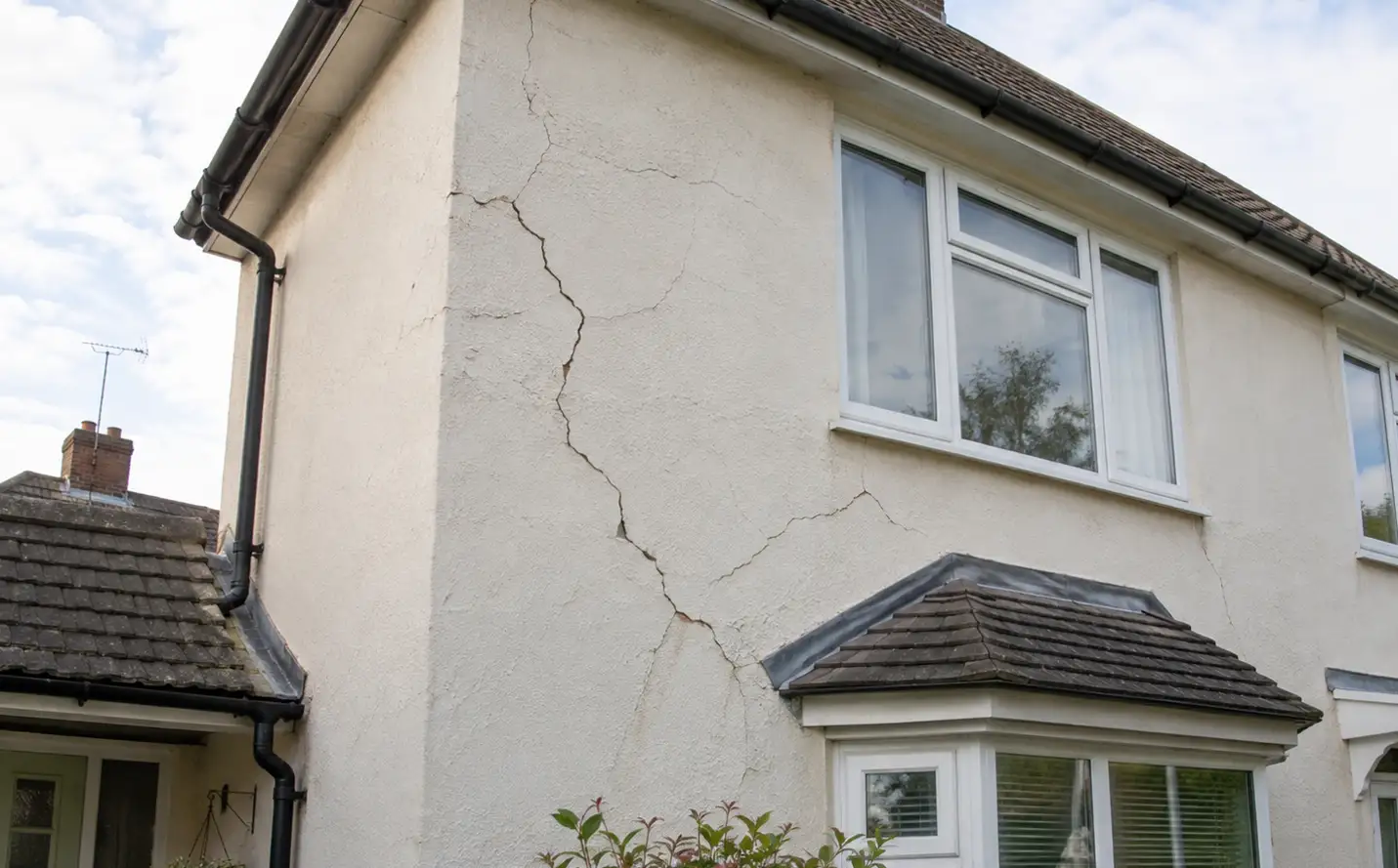
Render that’s cracking, sounding hollow when tapped, or dropping chunks onto the patio brings homeowners to more or less the same fork in the road: patch it, or strip the whole elevation and start again. A contractor may recommend the bigger job, and sometimes that will genuinely be the right answer. The render itself, read properly, usually gives useful clues about whether the failure is local or widespread — and it’s worth understanding those clues before agreeing to either option.
What you’re actually looking at
Render fails in genuinely different ways, and they don’t all mean the same thing.
Fine surface cracking, sometimes called crazing — a network of shallow, hairline cracks across the surface, without any looseness beneath — can be linked to shrinkage as the render cured, excessive working of the surface, thermal movement or the original mix and application. Where the cracks are genuinely superficial and the render remains well bonded, the problem may be largely cosmetic, although widespread or worsening cracking still deserves investigation rather than simply being painted over.
Isolated impact damage — a chip or a hole from something striking the wall — is exactly what it sounds like: localised, with an obvious mechanical cause, and normally a straightforward candidate for a small patch repair.
Hollow or “blown” render is different again, and more significant: the render has lost its bond with the wall behind it, even though it may still look intact from the outside. Tapping the surface and comparing the sound with adjacent well-bonded areas is one traditional way professionals identify possible detachment. A hollow area doesn’t necessarily mean the entire elevation needs replacing, but it does mean that section of render is no longer properly bonded and may eventually loosen further or detach.
Delamination, where separate coats or layers of the render system have parted from each other rather than from the wall itself, can produce a similar hollow response but reflects a different failure within the render system. It can occur where coats haven’t bonded properly or where incompatible materials have been applied together.
Recurring cracks in the same location, reappearing after being filled or patched, are worth taking seriously as a distinct category, because a crack that repeatedly returns often means something behind the finish — movement, moisture, detailing or a junction between different materials — is still causing it, rather than the render itself simply needing another surface repair.
Cracking that seems to reflect actual movement in the wall beneath, rather than a surface-level render problem — for instance, cracking that lines up with, or extends from, cracking visible in the brickwork or masonry itself — is a different category of problem entirely, and not one this article is the right place to diagnose. Render can crack because a wall is moving; it doesn’t explain why a wall is moving. Where that’s a possibility, our companion coverage in Cracks, Subsidence & Structural Issues is the place to start, not a render repair.
The principle that should drive every decision here
Don’t simply cover the symptom without understanding why the render actually failed. Patching or re-rendering over a cause that hasn’t been addressed doesn’t fix anything — it just creates the conditions for the same problem to return.
That matters particularly where the same section has already been repaired once. If a patch cracks again, another patch using the same materials and method isn’t automatically the logical next step. The useful question is what the first repair failed to address.
What’s usually behind render failure
A number of genuinely different underlying causes can produce similar-looking render damage, which is exactly why establishing the actual cause matters more than the render’s appearance alone.
Poor original application — the wrong mix, inadequate preparation of the wall beneath, poor bonding between coats, excessive thickness or unsuitable drying conditions — can leave a render system vulnerable to cracking or detachment well before it should reasonably need attention.
Incompatible materials can cause problems too, particularly where a hard or relatively impermeable finish has been applied to a substrate that moves or manages moisture differently. The materials then respond differently to moisture, temperature and movement, increasing the risk of cracking or loss of bond.
Water getting behind defective render is another important mechanism. It can enter through cracks, failed details around windows and doors, defective junctions or problems higher up the elevation. Once moisture gets behind the surface, repeated wetting and drying — and, in cold conditions, freeze-thaw action — can worsen deterioration and loss of adhesion.
Defective rainwater goods — precisely the gutters and downpipes covered in more detail elsewhere on Property Front Page — are an easily overlooked contributor, since a leaking or overflowing gutter can deliver a concentrated, repeated flow of water onto one section of render for years.
Movement in the wall beneath, whether long-settled historic movement or something more active, can crack a relatively rigid render surface simply because the finish cannot accommodate what the substrate beneath it is doing. Substrate failure — problems with the wall itself rather than the render system — needs addressing at that level, not simply covering again.
Poor detailing at junctions matters for much the same reason. Window and door openings, the base of the wall, parapets, sills and places where render meets another material are all locations where water management and movement have to be dealt with properly. Historic England notes that junctions between different materials are often failure points and that cracks in external render can provide a route for water into the wall. Its guidance on traditional building construction also identifies inappropriate cement render and defects in drainage as potential contributors to moisture problems in traditionally constructed buildings.
Local repair, or wider replacement?
Where render failure is genuinely isolated — a limited area of blown or cracked render, with a plausible and fixable cause such as a specific leak that’s since been resolved — a local patch repair is usually the proportionate response. This typically means removing the loose or detached material back to sound render and a sound substrate, dealing with the reason it failed, and rebuilding the affected area with a compatible system.
Matching an existing textured or coloured finish exactly can be genuinely difficult even for a skilled contractor, which is worth being realistic about before assuming a small patch will be invisible. Sometimes the technical repair can be perfectly satisfactory while remaining slightly visible in different light or weather.
Wider removal and replacement becomes the more sensible option where render is failing across much of an elevation rather than in isolated patches, where the underlying cause is systemic rather than local — an unsuitable render system was used across the whole wall in the first place, for example — or where repeated local repairs have reached the point that patching is simply postponing a wider failure.
A useful question when somebody recommends stripping an entire elevation is how much of the existing render they have actually established is defective. If the problem is being diagnosed as widespread debonding, they should be able to explain where that failure is, how they established it and why sound sections cannot reasonably remain. Conversely, if numerous apparently separate areas are hollow or failing, retaining isolated islands of old render can eventually become less sensible than starting again with one properly specified system.
As a general rule, if a wall is failing in enough different places, the cumulative cost and inconvenience of repeated patching can exceed a single, well-specified full re-render — though this is a judgement to make with proper inspection evidence, not an assumption to reach for automatically.
Traditional buildings need particular care — but not an automatic lime prescription
On many traditionally constructed solid-wall properties, particularly older buildings, a genuinely important principle applies: the wall was built from materials capable of taking up and releasing moisture rather than relying on impermeable barriers to keep the structure dry.
Lime renders and limewashes were commonly used as part of that system. Historic England explains that these permeable finishes can reduce rain penetration while still helping the wall dry by allowing moisture to evaporate across its surface. Its current guidance also warns that inappropriate low-permeability renders can trap moisture behind the external finish, leaving traditional fabric wetter for longer and contributing to deterioration. You can read its wider guidance on materials for historic building repairs.
That doesn’t mean every property built before an arbitrary date automatically needs the same lime render. Nor does it mean that every cement-containing render on an older property must automatically be stripped off regardless of condition.
What it means is that the render specification needs to suit the actual wall it’s going onto — its construction, masonry, surviving finishes, exposure and how it manages moisture — rather than defaulting to whatever is most commonly applied to modern cavity-wall construction.
For a genuinely traditional permeable wall, a compatible lime-based system will often be appropriate, and applying it correctly requires somebody who understands that type of construction. For modern construction, properly specified modern render systems can be entirely suitable.
Getting that judgement right is worth specialist advice before committing to a large-scale re-render, particularly where the existing wall is old, unusual or already suffering from damp or masonry deterioration.
What tends to drive the cost
Current 2026 UK trade pricing guides put ordinary house rendering broadly in the region of £30 to £80 per square metre, depending on the render system and finish. Checkatrade’s current rendering cost guide gives sand-and-cement render at roughly £30–£50 per square metre, acrylic around £55, silicone around £72.50 and monocouche around £80 per square metre.
These are commercial guide figures rather than fixed market rates, and the headline square-metre price doesn’t tell you what preparation a particular wall will need.
Scaffolding is a substantial factor on anything beyond easily accessible single-storey work. The extent of removal required — whether sound areas of old render can stay or an elevation genuinely needs stripping — significantly affects labour and waste costs. Repairs to damaged brickwork or other substrate defects uncovered once loose render comes off can add legitimate extra cost, while detailing around window and door openings becomes more time-consuming as the number and complexity of those junctions increase.
Traditional lime work can also cost more than standard modern rendering because of the preparation, skill, application method and curing conditions involved, although a simple price comparison between “lime” and “cement” is less useful than comparing two specifications that are actually appropriate for the particular building.
There is another cost issue that’s easy to miss when a local repair turns into a substantial re-render. In England, significant re-rendering can fall within Building Regulations requirements for the renovation of a thermal element and may bring requirements to improve the wall’s thermal performance. The exact position depends on the extent and nature of the work, and the rules differ across the UK, so this is something to establish before accepting a quotation rather than discovering after the render has been stripped. The Planning Portal’s guidance on external-wall renovation provides the current position for England.
Planning considerations can matter as well where a re-render materially changes a building’s external appearance, particularly for listed buildings and properties in protected areas. A repair that simply restores an existing finish is not the same planning proposition as changing bare brick to render or substantially altering a protected façade, so permission should be checked where the property has any heritage or planning constraints.
Reaching a decision
The right response to failing render isn’t determined by how bad it looks, or simply by how large a job a contractor proposes — it’s determined by how widespread the failure genuinely is, whether the underlying cause has actually been identified and can be fixed, and whether the wall beneath is suited to whatever’s being proposed to go back onto it.
Patch what’s genuinely isolated and explicable. Investigate properly before repeating a repair that’s failed before. If somebody recommends stripping an entire elevation, ask what evidence shows the failure really extends that far. And reserve full replacement for situations where the evidence — not just the render’s appearance — genuinely supports it.
This article provides general property information, not a diagnosis of your specific property. Where render cracking may be linked to structural movement, or the property is traditionally constructed, listed or subject to other planning controls, seek appropriate professional advice before committing to repair or replacement work.

