

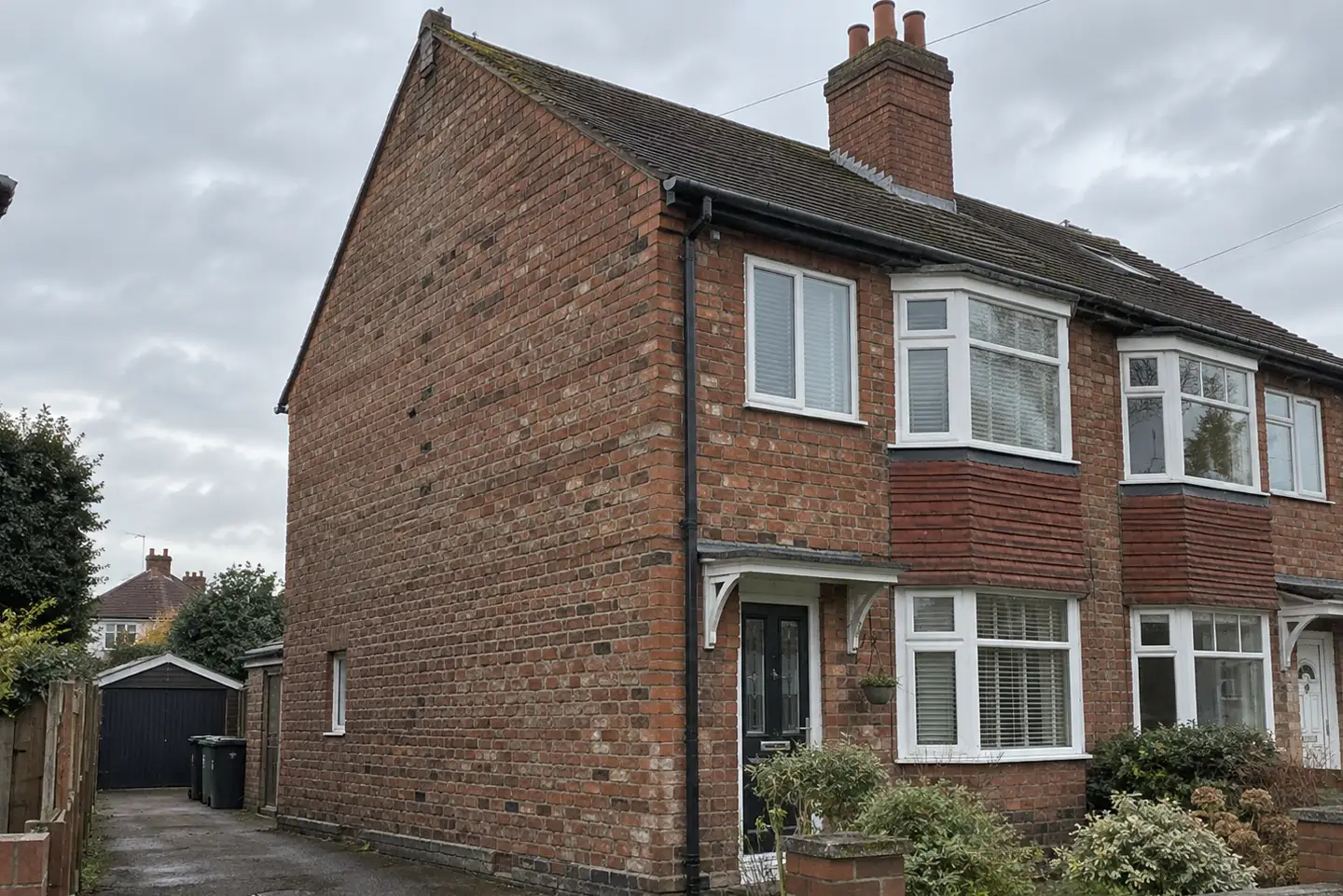
A contractor knocks, points at a patch of crumbling mortar, and quotes for repointing the whole house. Sometimes that’s genuinely the right answer. Very often, it isn’t — and the more useful question was never simply “how do I repoint this wall,” but “does this wall actually need repointing, and if so, how much of it?”
What mortar is actually doing
The mortar between bricks or stones isn’t just filling the joints. It forms part of the masonry system, binding the individual units together and helping accommodate the small irregularities between them.
On much traditional masonry, lime mortar also acts as the wall’s more sacrificial element. It is generally softer and more permeable than the brick or stone around it, so frost, salts and ordinary weathering tend to affect the joints preferentially rather than forcing deterioration into the masonry itself.
That changes how you should think about a weathered joint. Mortar becoming slightly recessed or gradually eroding over many decades isn’t automatically evidence that something has gone wrong. In an older wall, it can be part of the way the materials are intended to weather.
The question is whether the mortar is still doing its job, not whether it still looks new.
Reading what you’re actually looking at
Not all deterioration means the same thing, and the distinctions matter for deciding what, if anything, to do.
Mortar that’s recessed but still firm — sitting slightly behind the face of the surrounding brick or stone, perhaps with a rougher texture than when it was applied but remaining sound — doesn’t automatically need replacing.
Genuinely loose or failing joints are a different matter: mortar that’s breaking away readily, badly eroded or missing sufficiently deeply that the joint is no longer adequately filled.
The Society for the Protection of Ancient Buildings’ guidance on repointing gives a particularly useful rule of thumb for older masonry: repointing is generally premature until mortar has weathered back to approximately the depth of the joint’s width, or has become very loose. Softness alone isn’t enough reason to remove it.
That’s an important distinction. Old lime mortar can be considerably softer than a modern cement mortar and still be functioning perfectly well.
Isolated deterioration in one area, rather than spread evenly across a wall, usually has a specific cause worth understanding before repointing it: a leaking gutter or downpipe repeatedly wetting one section, a particularly exposed elevation weathering faster than sheltered ones, or persistent splashback around the base of the wall.
Fixing that underlying cause is often at least as important as repairing the joints. Repointing a wall while allowing a defective rainwater pipe to continue saturating it treats the damage without removing the reason it occurred.
Widespread deterioration across most or all of a wall’s joints is the situation where repointing the whole elevation, rather than repairing individual areas, genuinely becomes more reasonable — although even then it’s worth understanding whether the deterioration is simply the result of long-term exposure or whether something else is accelerating it.
Repair it, investigate it or leave it alone?
| What you’re seeing | Sensible next step |
|---|---|
| Mortar slightly recessed but still firm | Usually monitor rather than automatically repoint |
| A few genuinely loose or missing joints | Consider localised repointing |
| One concentrated area deteriorating much faster | Look for gutters, downpipes, splashback or another moisture source first |
| Mortar failing extensively across an elevation | Whole-wall repointing may be justified |
| Hard mortar with surrounding bricks beginning to spall | Get advice on mortar compatibility before removing anything |
| Cracking, bulging or movement in the wall itself | Treat this as a wider building defect, not simply a pointing job |
The final distinction matters particularly. Repointing repairs deteriorated joints; it isn’t a remedy for structural movement. If the wall is noticeably bulging, leaning or developing significant cracks, the underlying problem needs diagnosing before cosmetic mortar work is considered.
The point worth making clearly: not every crumbling joint means the whole wall
This is arguably the most financially significant thing to understand in this whole subject.
Historic England’s guidance on repointing brick and stone walls is explicit that comprehensive repointing of an older building is rarely necessary. Usually it is the areas most exposed to weather, or those affected by particular faults such as leaking rainwater pipes or gutters, that need attention.
Sound historic mortar elsewhere is generally better left undisturbed.
That’s a meaningful distinction from a contractor’s perspective too: a smaller, targeted repointing job is a smaller invoice, and it’s reasonable to ask why a whole-wall or whole-house specification is being proposed if deterioration appears confined to particular sections.
There’s also a genuine conservation argument for leaving sound old mortar alone, beyond just cost. Historic pointing can provide evidence about how a building was constructed and altered, while unnecessarily cutting it out risks damaging the edges of surrounding bricks or stones.
Removing mortar is itself an intervention. If the mortar is still serviceable, replacement doesn’t automatically constitute improvement.
Lime or cement: it’s not simply “old house, therefore lime”
It’s tempting to reach for a simple rule — old properties get lime mortar, modern ones get cement — and while there’s some truth behind it, treating that as an automatic formula misses what actually matters: compatibility between the mortar, masonry and construction of the wall.
Lime mortar was used extensively in traditional buildings and is commonly found in properties dating from before the widespread adoption of modern cement mortars. But age alone doesn’t tell you exactly what a wall contains. A building may have been repointed several times, parts may have been rebuilt, and not every historic mortar was identical.
What matters is how the materials work together.
Traditional bricks and stones can be softer and more porous than many modern masonry products. Compatible lime mortars are generally softer and more vapour-permeable, allowing moisture to evaporate preferentially through the joints.
A hard, dense and relatively impermeable cement-rich mortar used around softer masonry can reverse that relationship. Instead of the mortar taking the weathering, moisture and salts can become concentrated in the brick or stone itself, contributing over time to deterioration of the masonry faces while the harder joints remain intact.
That’s the opposite of what you want.
Historic England’s current guidance on materials for historic building repairs emphasises compatibility with the existing fabric rather than blindly applying one modern material to every building.
That said, the correct answer genuinely depends on what’s already there and how the wall is built. A compatible modern mortar can be entirely appropriate on modern masonry, while older brick or stone construction may require a carefully selected lime-based mortar.
Colour matters too, but colour alone isn’t enough. The strength, permeability, aggregate, texture and finished joint profile all affect how the repair performs and how the wall looks.
What about listed buildings and conservation areas?
Extra care is sensible where a building is listed or otherwise protected, but the position is more nuanced than saying that every repointing job automatically needs formal consent.
In England, Historic England advises that careful repointing of a listed building using compatible materials and methods, matching the original material, colour, texture and joint finish, will not necessarily require Listed Building Consent if it doesn’t affect the building’s special interest. More substantial changes — such as replacing traditional pointing with an incompatible material, altering the joint profile or mechanically cutting out historic mortar — can be a very different matter.
The position also varies across the UK, and local conservation requirements can matter. If a building is listed, or there is any doubt about whether its protected status affects the proposed work, check with the relevant local authority or conservation adviser before the existing pointing is removed.
A conservation area by itself doesn’t mean that every routine mortar repair automatically requires permission, but additional controls can apply to particular buildings and places.
What tends to affect the cost
Where repointing genuinely is needed, the price depends heavily on what is being repointed and how much preparation and access are required.
Current 2026 figures from Checkatrade’s UK repointing cost guide put ordinary brickwork repointing at around £50–£60 per square metre, including clean-up, with stonework around £60–£100 per square metre.
Those are commercial guide figures rather than a national tariff, and actual quotations can sit outside them.
Preparation can materially change the price. The defective mortar has to be removed sufficiently deeply for the replacement to form a durable joint rather than simply being smeared over the surface. Checkatrade currently gives a separate broad guide of around £20–£50 per square metre for raking out, where that isn’t already included within the contractor’s price.
Access is another major cost. Ground-floor patch repairs may need little more than normal working access, whereas upper elevations, gables and chimneys can require scaffolding.
The masonry itself matters too. Irregular stone joints generally take longer than straightforward modern brickwork, while repairing damaged bricks or stones alongside the pointing adds another layer of work.
Specialist traditional work can also cost more, particularly where an appropriate lime mortar has to be matched, trial panels are needed, decorative or historic joint finishes must be reproduced, or the building requires an experienced conservation contractor.
This is one of the reasons a price per square metre should never be read without asking what is actually included.
Deciding what to actually do
Before agreeing to any repointing quote, it’s worth working through the same sequence a careful surveyor or conservation-minded contractor would.
Is the deterioration genuinely widespread, or concentrated in specific, explicable areas?
Is the existing mortar actually failing — loose, missing or deeply eroded — or simply weathered and recessed but still sound?
Is there an underlying cause, such as a leaking gutter or downpipe, that should be fixed regardless of whether repointing happens?
Does the proposed mortar actually suit the wall it’s going into?
And if you’re being quoted for an entire elevation or house, what evidence shows that the sound-looking areas genuinely need to be removed as well?
A wall doesn’t need repointing simply because some of its mortar looks tired. It needs repointing where the mortar has genuinely stopped doing its job — and even then, often only in the parts where that’s actually true.
This article provides general property information and is not a survey of your specific property. Traditional, listed and otherwise protected buildings can require specialist materials, methods and permissions. If masonry is cracking, bulging or moving, or you’re uncertain about the correct mortar, seek advice from an appropriately experienced building surveyor or conservation professional before work begins.

