

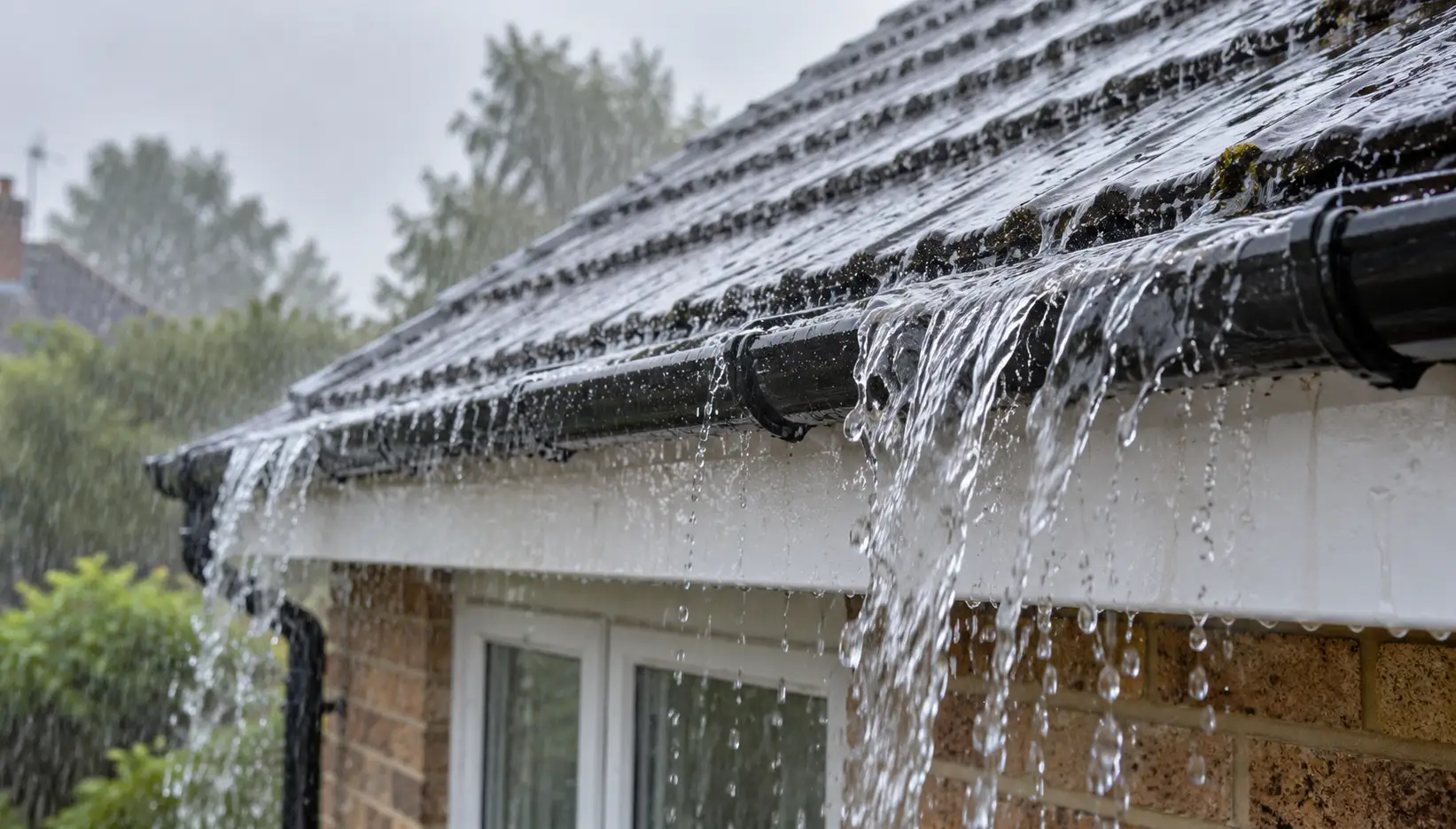
“It’s only a gutter” is exactly the assumption that lets a genuinely minor defect run for years, quietly doing damage somewhere it isn’t immediately visible. Gutters and downpipes aren’t peripheral fittings — they are part of the system designed to collect roof water and carry it safely away from the building. When that system fails, the water doesn’t stop arriving. It just stops going where it is supposed to.
That distinction matters because the eventual symptom may appear some distance from the original defect. A patch of persistent damp, deteriorating mortar, peeling paint on a fascia or wet ground beside a wall can all begin with a relatively simple rainwater problem above.
What actually goes wrong
Blockage is a common starting point, and one of the most avoidable. Leaves, moss washed down from the roof and general debris collect in gutters, around outlets and inside downpipes until water can no longer escape freely. The result may be obvious — water cascading over the front edge — or considerably less so.
A downpipe can be obstructed even when the gutter above it looks clear. If the gutter is filling during rain while little or no water appears to be passing through the downpipe, that can suggest a blockage at the outlet or somewhere lower in the pipe. It is a useful observation, but not a diagnosis on its own: the problem may also lie further downstream.
Mechanical defects create a different set of problems. Gutter joints can begin leaking as seals age, components move or sections become poorly seated. Plastic systems also move as temperatures change, which is why their fittings are designed to accommodate expansion and contraction. Poor installation or movement beyond the intended allowance can leave joints vulnerable.
Downpipes themselves can leak where a joint has pulled apart, a section has cracked or been damaged, or a fitting has become displaced. Repeated staining that follows the line of the pipe can help identify where water is escaping, although the source still needs confirming rather than assuming every wet mark beside a downpipe comes from the pipe itself.
Brackets can loosen, corrode or fail, allowing a gutter to sag. Once water starts ponding in a low point, or the gutter develops an unintended reverse fall, effective drainage towards the outlet can be reduced even though there is no obvious blockage.
Then there is capacity. A gutter or outlet that has been inadequately sized for the roof it serves may overflow despite being completely clear. Roof shape and the concentration of water into particular outlets matter too.
The timing of the overflow gives a useful clue. A system that spills during fairly ordinary rain deserves investigation for blockage, alignment, outlet or drainage problems. One that works normally but is overwhelmed only during exceptional downpours may instead be exposing a capacity or design limitation. Historic England notes that rainwater systems can fail through poor maintenance, but also because their design or capacity cannot cope with the rainfall reaching them. Historic England: Resilient Rainwater Systems
Repeatedly paying to have an already-clear gutter cleaned will not solve that second problem.
The overflow you can’t see is often the one that matters most
Overflow at the front edge of a gutter is easy to spot. Water running behind it can be considerably harder to notice from ground level because it may wet the fascia, roof edge and wall without producing the obvious waterfall associated with a blocked gutter.
That makes persistent staining or dampness behind and below a gutter particularly worth watching during actual rainfall rather than judging only on a dry day.
Back-edge overflow is not the only possible explanation, however. Water appearing behind a gutter can also indicate a problem with the roof-edge or eaves detailing above it. What matters is recognising that a gutter which looks perfectly acceptable from the pavement when the weather is dry has not necessarily been cleared of suspicion.
This is one reason inspecting the behaviour of the system while water is actually moving through it is far more informative than simply looking for leaves.
Why this becomes the building’s problem, not just the gutter’s
A wall that is repeatedly saturated at one particular point is experiencing something different from ordinary exposure to rain followed by drying.
Persistent wetting can contribute to deterioration of mortar, masonry and finishes, and the pattern itself can be revealing. Damage caused by a defective gutter or downpipe is often concentrated below or around the point where water is being delivered, rather than distributed evenly across the whole elevation.
Where bricks are beginning to flake or lose their faces, repeated saturation may also be one part of the explanation, particularly where freezing follows wet conditions. That relationship is covered in more detail in our guide to Bricks Flaking or Crumbling? What Causes Spalling and When Should You Worry?
Timber needs a more careful distinction. Fascias and soffits can themselves decay where persistent leakage keeps them wet, but they should not automatically be described as structural components. The greater concern is where water penetrates far enough to affect structural roof timbers behind or above them, such as rafter ends or wall plates.
Historic England identifies timber rot and damage to structural elements among the potential consequences when rainwater systems fail and water penetrates a building.
Water reaching the bottom of the building matters too, and sometimes sends the investigation in completely the wrong direction.
A downpipe simply dumping water beside a wall, an overflowing gully or defective drainage around the pipe can keep the ground and lower part of the wall persistently wet. Damp appearing at low level is then at risk of being labelled “rising damp” before the external source of moisture has been properly investigated.
RICS specifically warns that rising damp is often misdiagnosed and recommends looking for sources including blocked or leaking gutters, rainwater pipes and failed underground drainage before deciding what treatment is required. RICS: Damp and mould consumer guide
That makes checking where a downpipe actually sends the water genuinely useful. It is not enough for the pipe itself to look intact: the rainwater still needs an effective route away from the building.
Don’t stop investigating at the bottom of the downpipe
The downpipe is only one stage in the drainage route.
Where it discharges into a gully, that gully can fill with leaves, silt, vegetation and other debris. Where the pipe connects to underground drainage, the problem can be less visible still.
A clear gutter and clear downpipe will not prevent an overflowing gully or defective underground drain from depositing water back around the building.
Historic England advises that gullies and below-ground drains should be inspected and maintained as part of the same rainwater system. Broken underground drains or failed joints can saturate surrounding soil, while a soakaway that has silted up may cease to dispose of the water effectively. Historic England: Inspection, Maintenance and Repair of Rainwater Systems
This changes the diagnosis considerably.
If water is backing up at the bottom of a downpipe, the solution may have very little to do with the gutter at roof level.
What the pattern may be telling you
| What you notice | What it may indicate | What is worth checking next |
|---|---|---|
| Water spilling over one section during ordinary rain | Local blockage, sagging gutter or outlet problem | Look for debris, a visible low point and whether water is reaching the nearby outlet |
| Gutter fills but little or no water leaves through the downpipe | Blockage at the outlet or within the downpipe | Watch the outlet during rain and check what happens where the downpipe discharges |
| Dripping from one gutter or downpipe joint | Failed seal, movement, poor joint alignment or damaged fitting | Note whether the leak is confined to the joint rather than the gutter overflowing generally |
| Water or staining behind the gutter | Back-edge overflow or a defect in roof-edge/eaves detailing | Observe during rain and have the roof edge examined if the source is unclear |
| Clear gutter overflows only during exceptional downpours | Possible capacity, outlet or system-design limitation | Establish whether the same thing happens in ordinary rain before assuming another clean will solve it |
| Water pools or the gully overflows at the foot of the downpipe | Blocked gully or downstream drainage problem | Check whether water is actually leaving the gully rather than concentrating beside the wall |
| Persistent low-level damp close to a rainwater pipe | External rainwater or drainage defect may be contributing | Investigate the gutter, downpipe, gully, ground drainage and surrounding levels before assuming rising damp |
The point is not to diagnose a building from the pavement. It is to narrow the problem down before money starts being spent on the wrong remedy.
Checking safely, without a ladder
The most revealing inspection is also one of the simplest: look at your own gutters and downpipes from a safe position during actual rainfall.
From ground level or a suitable window, watch where water is overflowing, whether it happens at one joint or along a whole section, whether downpipes appear to be carrying water and what happens when that water reaches ground level.
Look for staining beneath joints and corners, algae or unusually wet masonry, recurring drips and places where a gutter visibly holds water. If a particular defect always appears in the same place, photographing it while it is raining can be far more useful to a contractor than saying later that “the gutter sometimes overflows”.
Autumn leaf-fall is an obvious time to pay attention, but storms can also move moss and debris from roofs into outlets and gutters. Historic England’s maintenance guidance recommends inspecting rainwater goods after heavy leaf fall and observing them while it is raining to identify leakage and overflow.
Also look down, not just up. If the gutter appears to be working but the gully below the downpipe is overflowing, the investigation has already moved further along the drainage system.
None of this requires climbing anything.
Close inspection, clearing or repair at eaves level should be carried out using suitable access equipment by somebody competent to work safely at height. HSE guidance emphasises carrying out as much work as possible from ground level and choosing appropriate equipment where work at height cannot be avoided. HSE: Working at height safely
Some rainwater systems are less forgiving
Not every property has a straightforward run of exposed guttering feeding an obvious downpipe.
Valley, box and parapet gutters can be difficult or impossible to assess properly from the ground, while some buildings contain concealed or recessed rainwater pipes whose route is not immediately apparent. A failure in one of these systems can therefore continue without producing the obvious visual clues associated with a domestic eaves gutter.
Larger buildings create another issue. A warehouse roof, block of flats or substantial commercial building can collect very large volumes of water, with significant flows passing through individual gutters, outlets and drainage routes. A restriction at the wrong point can consequently affect a large area of building fabric.
That is why rainwater goods on blocks, commercial premises and buildings with inaccessible or concealed drainage deserve scheduled inspection rather than attention only after somebody reports a leak. Historic England notes that ground-level inspection may not be sufficient for valley, box and parapet gutters and that appropriate access may be required to assess concealed systems.
For owners, managing agents and facilities managers, the economics are fairly straightforward: finding an obstruction, failed joint or deteriorating outlet early is normally a very different proposition from repairing the masonry, timber, internal finishes or drainage damage that follows prolonged water penetration.
A small defect with a long memory
A gutter defect can be visible immediately. The expensive consequence often isn’t.
The overflow happens during a rainstorm; the persistent damp patch becomes noticeable later. Water repeatedly reaches the same section of wall; the mortar or brickwork deteriorates gradually. A joint drips onto the roof edge for long enough that timber begins to decay before anybody has reason to look closely at it.
That delay is what makes rainwater defects easy to underestimate. The original fault may remain small while the area it is affecting becomes progressively more expensive to put right.
Treating gutters, downpipes, gullies and the drainage beyond them as part of the building’s protective fabric — rather than a collection of minor fittings to get around to eventually — is what interrupts that chain before a small maintenance problem becomes a building defect.
This article provides general property information, not legal, financial, surveying or other professional advice for your individual circumstances. The source of dampness, water penetration or deterioration can vary between buildings and may require investigation by a suitably experienced professional. Inspection, clearing and repair of gutters, downpipes or roof-level drainage at height should be undertaken using appropriate access equipment by a competent person.

