

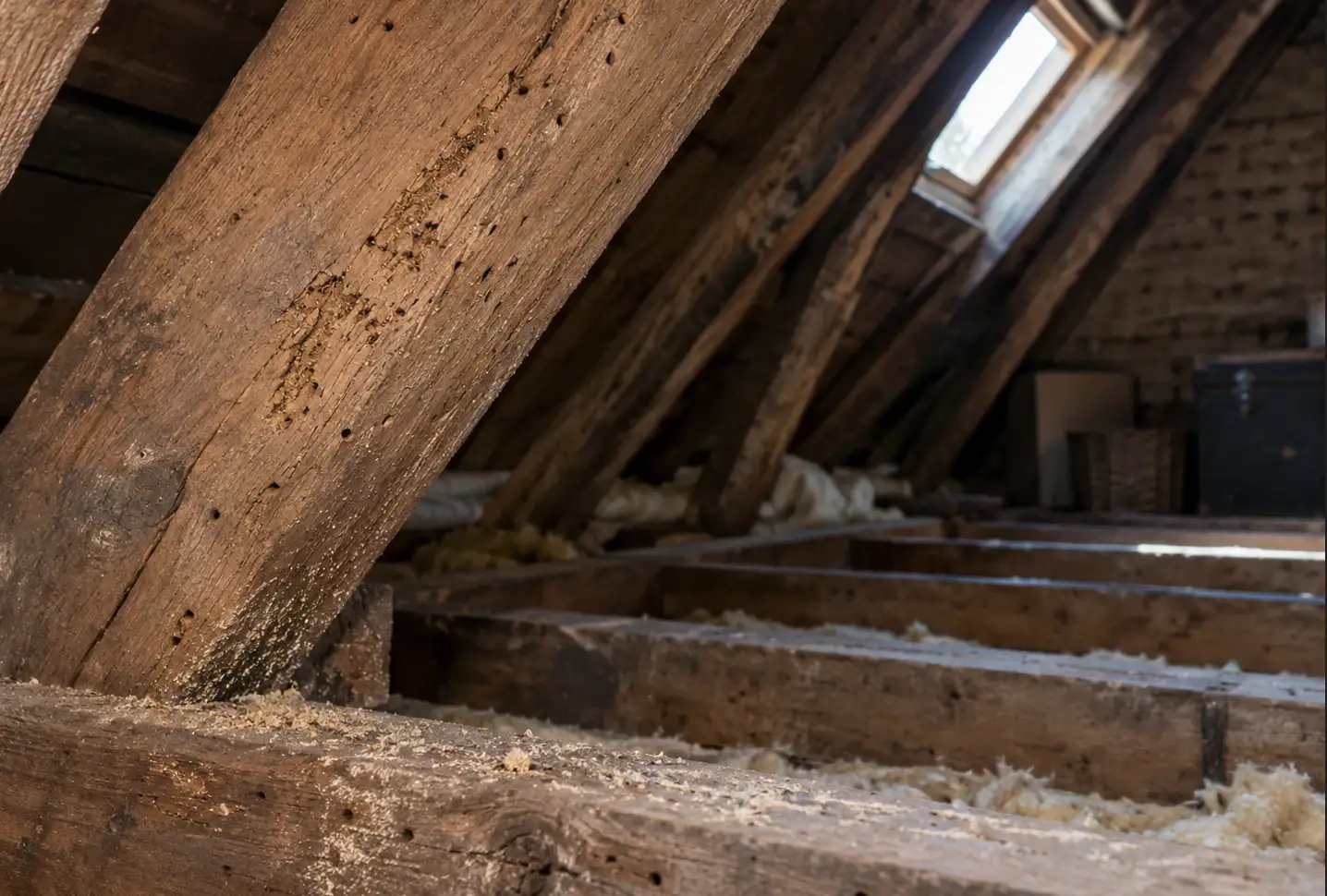
Small round holes in a floorboard, a roof timber, or a piece of furniture, and someone’s said the word “woodworm.” Before that becomes a treatment quotation, it’s worth asking the question that actually matters: is anything happening in that timber right now, or are those holes simply the record of something that finished years, possibly decades, ago?
Old holes are not, on their own, proof of a current problem — and understanding that distinction can be worth considerably more than the cost of identifying the holes themselves.
What “woodworm” actually refers to
“Woodworm” isn’t one specific pest. It’s the familiar name given to the larval stage of a number of wood-boring beetles whose larvae develop inside timber.
The most commonly encountered wood-destroying beetle in UK buildings is the common furniture beetle (Anobium punctatum), which can attack both softwoods and hardwoods under suitable conditions. Deathwatch beetle (Xestobium rufovillosum) is less common and much more closely associated with older buildings, particularly substantial oak and other hardwood timbers affected by dampness or fungal decay.
Other wood-boring insects occur too, and identifying the species can matter because they don’t all attack the same timbers, require the same conditions or justify the same response.
There is one particularly useful thing to understand about the holes themselves: the familiar round “woodworm holes” are generally exit holes. The larva may have been developing and feeding inside the timber for years before eventually pupating and emerging as an adult beetle through the surface.
The hole remains after the beetle has gone.
That’s precisely why finding holes proves historic beetle activity but doesn’t, by itself, tell you whether larvae are still active in the timber today.
The British Pest Control Association’s current guidance on wood-boring insects explains that distinction in more detail.
Signs that point towards genuine, current activity
Fresh frass — the bore dust and insect waste associated with activity within the timber — is useful evidence, particularly where a new deposit appears beneath or around an emergence hole after the area has previously been cleaned.
It needs slightly more careful interpretation than simply assuming larvae are continuously pushing dust out as they feed. Much of the material remains within the galleries inside the timber, and movement by larvae or emerging beetles can cause it to appear at an old or new flight hole. Old material can also be shaken loose by vibration or building work.
What matters is whether apparently fresh material is newly appearing and recurring, rather than whether dust happens to be present when somebody first looks.
New emergence holes are stronger evidence. Active outbreaks can produce holes with relatively sharp, clean edges and pale interiors closer to the colour of freshly exposed timber. Old holes tend to weather, darken and lose that freshly-cut appearance over time.
Adult beetles can be useful evidence too, particularly during their spring and summer emergence period. An identified common furniture beetle appearing repeatedly around affected timber or on nearby windowsills is much more meaningful than finding an unidentified small brown beetle somewhere in the house.
But even then, the evidence needs interpreting as a whole. An adult beetle tells you wood-boring insects are present somewhere nearby; it doesn’t automatically prove every old hole in every timber requires treatment.
The Society for the Protection of Ancient Buildings’ guidance on wood-boring insects makes the central distinction particularly clearly: much of the beetle damage encountered in old buildings is extinct, while active outbreaks are associated with fresh-looking holes, pale bore surfaces and fresh-coloured frass.
The straightforward test worth doing before paying for anything
If the timber is safely accessible and there is no structural reason not to disturb the surrounding area, clean away the loose dust beneath the suspect holes and photograph what you’re looking at. Note the date, then monitor rather than immediately treating.
Spring and summer are the useful periods because this is when adult common furniture beetles typically emerge. If fresh holes appear, new pale frass repeatedly returns after being removed, or correctly identified adult beetles are emerging around the timber, the evidence for current activity becomes considerably stronger.
If none of that happens through an appropriate emergence period, the case for an active infestation becomes weaker.
It isn’t an infallible one-season test. Common furniture beetle larvae can spend several years developing inside timber, and a small or sparse infestation won’t necessarily produce an obvious adult emergence exactly when you’re watching. The point is to replace a one-off observation of old holes with evidence gathered over time.
A useful way of judging what you’ve found is:
| What you find | How much it tells you about current activity |
|---|---|
| Dark, weathered holes with no other signs | Weak evidence — proves historic activity, not current infestation |
| Holes painted or varnished over by an older finish | Strong evidence the holes pre-date that finish |
| Loose dust present once beneath old holes | Inconclusive — old frass can be dislodged |
| Fresh-looking frass reappearing after the area was cleaned | Meaningful evidence of recent or continuing activity |
| New, sharp-edged holes with pale interiors | Strong evidence of recent emergence |
| Correctly identified adult wood-boring beetles emerging nearby in season | Strong evidence that active timber infestation exists somewhere nearby |
| Damp or elevated timber moisture without fresh beetle signs | A risk factor, not proof of active woodworm |
That distinction between evidence of past damage and evidence of present activity is the most important thing to establish before anyone discusses treatment.
Old holes are not, on their own, a reason to treat anything
This is the central point of the article, and it’s worth stating as plainly as possible: timber can retain the visible evidence of wood-boring insects for decades after the infestation itself has ceased.
Historic England specifically warns against assuming flight holes mean treatment is required. Its guidance asks the most basic question first — is the problem current or historic? — and says treatment will generally not be necessary where the insect damage is historic.
That matters particularly in older properties. A roof timber with scores of dark old holes can look dramatically worse than a relatively clean piece of timber, but appearance alone tells you very little about whether anything is still alive within it.
A hole that has been painted over is particularly useful evidence because the beetle clearly emerged before that layer of paint was applied. If an old coating remains uninterrupted across the hole and no fresh holes have subsequently appeared, treating that hole today because it looks alarming would make little sense.
A quotation for widespread chemical treatment based essentially on “there are woodworm holes” therefore deserves a further question: what evidence shows that those holes represent current activity?
Historic England’s guidance on timber treatment and pest control explicitly warns that treatment may not be necessary and that historic insect flight holes do not establish a live infestation.
Moisture is often part of the explanation
Moisture deserves a more important place in the diagnosis than simply being treated as an occasional associated problem.
Wood-boring insects differ in their requirements, but persistent common furniture beetle activity is much more strongly associated with timber that offers favourable moisture and environmental conditions. Cool subfloors, poorly ventilated voids, leaking roofs, plumbing leaks and persistently damp embedded timbers can all create conditions in which infestation is more likely to establish or persist.
That doesn’t mean every active woodworm problem comes with a visible damp patch, or that finding beetles proves the house has a major damp defect. Timber can be more moist than surrounding surfaces suggest, particularly where it enters masonry or sits in an enclosed void.
But genuinely dry, well-heated timber is substantially less favourable to continuing common furniture beetle activity than cool, damp timber. The original assumption that common furniture beetle is equally comfortable in genuinely dry timber would therefore be misleading.
This is why an investigation shouldn’t stop at identifying beetle activity. Where active attack is confirmed, it is worth asking whether something about the building is sustaining the conditions that allowed it to persist.
A leaking roof repaired properly, better ventilation to a persistently damp void or another genuine moisture source corrected at the same time may matter more to the long-term result than simply spraying the visible timber and leaving the environmental cause unchanged.
Where damp is suspected alongside timber damage, Property Front Page’s Damp, Mould & Condensation coverage deals with that separate building problem in more depth.
Beetle activity and structural weakness are two different questions
This distinction matters enormously, because the two are easily conflated.
Evidence that beetles have been active in timber tells you that insect attack occurred. It doesn’t tell you how much useful structural timber has actually been lost.
Historic England notes that wood-boring attack in many structural timbers is concentrated in the softer sapwood, while substantial sound heartwood may remain. A beam that looks alarming because its outer surface contains numerous old holes can therefore retain considerable strength.
The reverse can also happen: timber affected by extensive insect galleries, fungal decay or both can lose meaningful section and strength without the external number of flight holes neatly reflecting the seriousness of the problem.
Structural condition therefore shouldn’t be assessed by counting holes.
If the affected timber is a floor joist, roof member, beam or another load-bearing component and there is genuine concern about remaining strength, the question is no longer simply “is the woodworm active?” A suitably experienced building surveyor, structural engineer or conservation professional needs to assess what sound timber remains and whether repair or strengthening is actually required.
That’s a separate judgement from whether insect treatment is necessary.
What a genuine treatment quotation should actually justify
Before agreeing to significant timber treatment, it’s reasonable to expect the diagnosis behind it to be clear.
The first question should still be whether there is evidence of current activity, rather than simply old flight holes. If there is, the next questions are what species is involved, how widespread the active area genuinely is, what building conditions may be supporting it and why the proposed treatment is appropriate to that particular problem.
That matters because “woodworm treatment” isn’t one universal response to one universal pest.
A few genuinely active common furniture beetle timbers don’t automatically justify treating every accessible piece of wood in the house. Historic deathwatch beetle activity in damp oak isn’t the same biological or building problem. Timber weakened by decay may need repair regardless of whether the insect activity itself remains current.
A good quotation should therefore explain the evidence, extent and rationale, not simply attach a square-metre treatment specification to the existence of visible holes.
If the leap from diagnosis to treatment seems much larger than the evidence supporting it, asking for that reasoning in writing is entirely reasonable.
When an independent opinion is worth paying for
An independent opinion becomes particularly valuable where the diagnosis is uncertain, the proposed treatment is extensive or expensive, structural timber is involved, or the building is old enough that unnecessary intervention could destroy historic fabric.
The important word is independent.
A competent timber-treatment business can diagnose infestations perfectly well, and there is no reason to assume commercial specialists are routinely recommending unnecessary work. But where the same organisation both decides whether treatment is required and earns its income from carrying it out, a separately commissioned opinion can sometimes remove an obvious source of uncertainty.
That might come from a building surveyor with appropriate timber experience, a conservation-accredited surveyor on a historic building, or another genuinely independent timber specialist.
For a small, clearly active patch in a modern building, that level of investigation may be disproportionate. For widespread treatment of historic roof timbers or a recommendation involving structural replacement, the economics look rather different.
Spending hundreds to test the basis of a treatment or replacement programme costing several thousands can be a very rational purchase.
Older and traditional buildings need particular care
Older buildings are precisely where dramatic-looking historic insect damage is most likely to be mistaken for an urgent modern problem.
SPAB warns that sound historic timbers and old woodworm holes are still treated unnecessarily, while Historic England similarly cautions against blanket chemical intervention where attack is historic or the remaining timber remains serviceable.
Traditional timber also carries evidence of the building’s construction history that can’t simply be replaced once removed. The objective should therefore be to retain sound material where possible, understand the conditions behind any genuine active infestation and intervene only as much as the evidence justifies.
Chemical treatment adds another consideration in roof structures: bats.
UK bats and their roosts are legally protected, and timber preservatives or pest-control treatments used in roof spaces can harm bats through direct exposure or residues. Historic England advises that potential bat use needs to be considered before timber treatments in buildings where bats may be present and that appropriately suitable products and specialist advice may be required.
This doesn’t mean every old roof showing woodworm holes automatically needs a bat survey before anyone looks at it. It means that once intrusive or chemical treatment of a roof space is being proposed — particularly in a building with realistic bat-roost potential — wildlife considerations belong in the decision rather than being discovered after spraying has begun.
For a listed or otherwise significant historic property, the strongest approach is therefore rarely “holes found, spray everything”. It is diagnosis first: current or historic activity, species, moisture conditions, structural condition, wildlife constraints and then, only if necessary, a properly specified intervention.
If you’re buying or selling
Woodworm is a frequent flag in home surveys, and it can sound considerably more alarming in a report than the underlying evidence warrants.
A surveyor noting “evidence of wood-boring insect attack” isn’t necessarily saying the infestation is active. The distinction between visible historic damage and evidence of current activity matters just as much during a purchase as it does once you own the property.
How to use that finding in negotiations, whether to commission a specialist inspection before exchange, and whether a lender has imposed any particular requirements are buying-and-selling questions in their own right, and belong properly in Property Front Page’s Surveys & Valuations coverage rather than being expanded here.
The point worth taking away
Woodworm holes tell you something useful: at some point in that timber’s history, an adult wood-boring beetle came out.
What they don’t tell you is when.
That is the distinction on which almost every sensible decision in this subject rests. Old dark holes, historic surface damage and frass that has sat undisturbed for years are records of the past. Newly appearing holes, recurring fresh frass and identified emerging beetles are evidence pointing much more strongly towards something happening now.
Even confirmed activity doesn’t automatically answer the next questions — how extensive the damage is, whether moisture is helping sustain it, whether structural timber has genuinely been weakened, and whether chemical treatment is the proportionate response.
So before paying for treatment, the useful question isn’t simply “have we got woodworm?”
It’s more precise than that:
What evidence shows that this timber is being actively attacked now — and what, exactly, does that evidence justify doing about it?
This article provides general property information, not an assessment of your specific timber. Historic insect damage, active infestation and structural timber deterioration are different issues and may require different expertise. Where structural timber, a traditional or listed building, potential bat roosts or significant treatment costs are involved, obtain appropriately qualified independent advice before authorising extensive work.

