

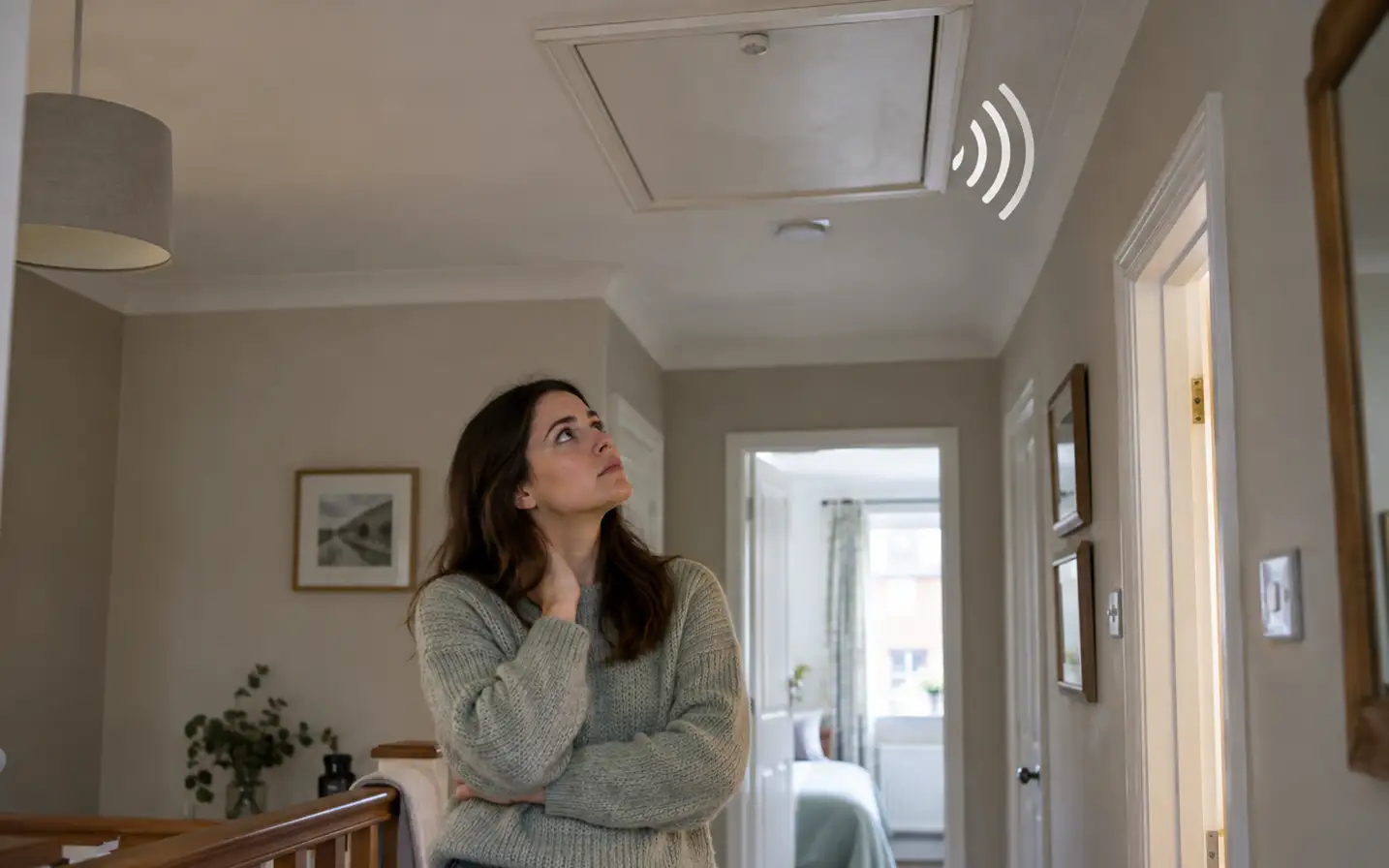
Something is moving above the ceiling, or inside a wall cavity, and the honest starting position is: you don’t know what it is yet.
That’s fine. Jumping straight to “it’s mice” is actually one of the least useful first moves, because several genuinely different animals can produce broadly similar noises inside a building, and sound travels through joists, plasterboard, cavities and roof timbers in ways that make both size and location surprisingly difficult to judge.
More importantly, some of the plausible explanations aren’t pests at all. Bats and nesting birds are protected wildlife, and bats bring particularly strict legal protection for the places they roost. Identifying what you’re dealing with before sealing holes or disturbing a roof space isn’t simply good diagnosis — in some circumstances it’s the difference between solving a nuisance and accidentally breaking wildlife law.
When it happens tells you something
Mostly at night is consistent with mice and rats, both of which are commonly active after dark, but timing alone doesn’t prove either one. Rodents can appear during daylight too, particularly where populations are established or food is scarce.
Around dusk and dawn is particularly worth noting where bats are a possibility. Bats leaving a building to feed around dusk, and returning towards dawn, can create a repeatable pattern that is much more informative than hearing one unexplained scratch in the middle of the night. The Bat Conservation Trust also notes that some roosts become more audible around these times, particularly during the summer.
During daylight makes squirrels and birds more plausible, because both are predominantly active when it’s light. Squirrels in a loft can generate surprisingly substantial running, rustling and gnawing noises, while birds tend to produce a mixture of fluttering, scratching and calling depending on where they’ve gained access.
Warm-weather activity can make wasps more likely, particularly where the noise is a persistent buzz from roughly the same part of a roof or wall and you can see repeated insect traffic outside.
Season matters as well. Birds may be building or using nests through spring and summer, while bat maternity roosts become particularly important during late spring and summer as females gather to give birth and rear young. Neither follows a perfectly fixed calendar, though, so the month is supporting evidence rather than permission to disturb something because you think its “season” should have finished.
What it actually sounds like
Sound can help narrow things down, but it is much less reliable than people often imagine.
Light, quick scratching or scuttling can be consistent with mice. Heavier movement or thumping can make a larger animal such as a rat or squirrel more plausible. Repeated gnawing points more strongly towards rodents or squirrels, because gnawing is a normal part of their behaviour in a way it isn’t for bats or birds.
Fluttering can suggest a bird or bat moving within a confined void. Buzzing concentrated in one location, particularly during warmer weather, is much more consistent with wasps or another active insect colony.
The important qualification is that the building changes what you hear. A mouse immediately above thin plasterboard can sound remarkably loud; a rat travelling several metres away through a substantial roof structure can sound faint. Pipes, joists and hollow walls transmit noise so effectively that trying to identify an animal purely because it “sounds too big to be a mouse” is unreliable.
Treat the sound as one clue, not the answer.
The physical evidence worth looking for
Physical signs usually tell you more than noise does.
Rodent droppings are generally firm and pellet-like, while bat droppings can look remarkably similar at first glance but are dry and composed largely of insect remains. The Bat Conservation Trust’s droppings guidance explains that bat droppings crumble easily under light pressure. If you do need to examine a suspected dropping, use tissue or gloves rather than handling it directly, and don’t disturb accumulations of droppings unnecessarily.
Nesting material can be revealing as well. Shredded paper, insulation, fabric or other soft material can indicate rodents; squirrels can also disturb and gather loft insulation; birds may bring recognisable plant material, grass, twigs or feathers into a nesting site.
Gnaw marks on timber, stored belongings, plastic or electrical cables are particularly useful because bats and birds don’t behave that way. Rats, mice and squirrels all gnaw.
Outside the building, repeated activity around one particular opening can be more useful still. A regular stream of wasps entering the same gap is far stronger evidence than buzzing heard through a ceiling. Watching a roofline safely from ground level at dusk may reveal bats emerging from a small gap you would never have identified by looking into the loft. The Bat Conservation Trust’s guidance on recognising a bat roost identifies dusk emergence, droppings and characteristic activity around roosts as useful clues.
Rodents can leave their own repeated-route evidence: droppings concentrated in particular areas, gnawing, footprints in dusty spaces and greasy smear marks where their coats repeatedly brush the same surface.
The useful judgement comes from combining these clues. One sound on its own tells you very little; several pieces of evidence pointing in the same direction are much more persuasive.
| Pattern of clues | What becomes more likely |
|---|---|
| Night-time scratching + gnaw marks + firm pellet-like droppings | Rats or mice |
| Daytime running or thumping + disturbed insulation + gnawing | Grey squirrel |
| Dusk or dawn activity + fluttering or chattering + dry crumbly droppings | Bats — stop before disturbing anything |
| Daytime fluttering or calling + nesting material + repeated roof entry | Birds |
| Warm-weather buzzing + repeated insect traffic to one opening | Wasps |
| Scratching with no droppings, gnawing or other animal evidence, linked to heating or wind | Pipes or building materials deserve consideration |
Even this doesn’t amount to perfect identification. Its value is in helping you decide what becomes more plausible — and, just as importantly, when you should stop investigating and avoid taking action until a protected species has been ruled out.
The likely candidates
Mice are a common explanation for light scratching and gnawing in wall and roof voids. Their small size allows them to use remarkably narrow routes through a building, so the point where you hear them needn’t be close to the point where they entered. If rodents are confirmed and the problem keeps returning, our companion article on recurring rats and mice looks at treatment failure, reinvasion and proofing in more detail.
Rats can also reach upper parts of buildings and roof spaces; finding them in a loft doesn’t prove they entered through the roof. Pipework, cavities, drains and connected structures can all allow them to travel upwards or through a property before their presence becomes obvious.
Grey squirrels are another established cause of loft noise and can cause significant damage to insulation, woodwork and cables once inside. They are generally active during daylight, although the exact pattern varies.
There is also a legal complication that makes live trapping a poor DIY experiment. Grey squirrels are invasive non-native animals, and releasing a trapped grey squirrel back into the wild is prohibited across the UK, although the precise legislation and rules differ between England and Wales, Scotland and Northern Ireland. In practice, if you believe squirrels are living in the roof, use a competent pest professional familiar with the law rather than setting a live-capture trap and only afterwards wondering what you’re legally allowed to do with the animal.
Birds can produce scratching, fluttering and calling from roofs, eaves, chimneys and voids. Active wild-bird nests are legally protected across the UK, although the relevant legislation differs between Great Britain and Northern Ireland. In Great Britain, the general rule under the Wildlife and Countryside Act 1981 is that the nest of a wild bird must not intentionally be taken, damaged or destroyed while it is being built or is in use; certain species receive additional protection. Northern Ireland has corresponding protection under its own wildlife legislation.
That makes identification important before blocking what appears to be a convenient hole in the fascia or eaves. If birds are actively nesting behind it, waiting until the nest is genuinely no longer in use may be necessary.
Wasps tend to announce themselves differently. A mature nest can create a noticeable hum or buzz, but the most persuasive evidence is usually outside: repeated traffic into and out of one small opening. Not every wasp nest automatically needs removing, particularly where it is remote from people and poses little risk, and the colony normally doesn’t persist indefinitely. Whether removal is appropriate is a separate pest-management question rather than something to decide from the sound alone.
Correct identification matters for more than deciding which pest controller to call. It can change the urgency and even the kind of risk you’re dealing with. Rodent or squirrel gnawing on electrical cables introduces an electrical and potential fire concern alongside the pest problem. A suspected bat roost changes what you’re legally allowed to disturb. An active bird nest can temporarily prevent an otherwise straightforward proofing job. And a wasp nest immediately beside a regularly opened bedroom window presents a very different practical problem from one high in an unused roof void.
The purpose of identifying the occupant isn’t therefore curiosity. It tells you what you can safely do next.
Bats: the one to handle with real care
Bats deserve their own section because they change what you can safely and legally do next.
They aren’t rodents, don’t gnaw timber or electrical cables and don’t build nests from material gathered around a loft. Many household bat roosts are small, seasonal and so unobtrusive that the occupier may not know they’re there for years.
They are also highly protected.
The legal wording differs across the four nations, but the practical protection is consistent: bats themselves are protected, and so are the places they use as roosts. Critically, a bat roost can remain protected even when there are no bats visibly occupying it at that moment. Blocking an access point during the months when a seasonal colony appears absent is therefore not automatically lawful.
The Bat Conservation Trust’s UK legislation guidance sets out the different legal frameworks for England and Wales, Scotland and Northern Ireland.
This is why suspected bats need a different response from suspected mice.
If the evidence starts pointing towards bats — dusk emergence, appropriate droppings, chattering or fluttering at characteristic times, or a bat actually seen entering or leaving the building — don’t block the suspected opening, spray treatment into the space or start disturbing insulation around the potential roost to “see what’s there”.
The Bat Conservation Trust’s National Bat Helpline can provide advice, and the statutory bodies responsible for protected species are Natural England, Natural Resources Wales, NatureScot and the Northern Ireland Environment Agency in their respective nations. Where building work is planned, a suitably experienced bat ecologist may need to assess the roost and advise on whether licensing or mitigation is required.
The point isn’t that discovering bats prevents you ever repairing or altering your home. It means the work has to be approached lawfully and at the right time rather than treating the animals as an ordinary loft pest.
What’s safe for you to check yourself
There is plenty you can observe without turning the investigation into a DIY wildlife survey.
From somewhere you can already reach safely, note where sounds seem strongest and when they occur. Photograph droppings, gnaw marks, disturbed insulation and obvious nesting material rather than immediately clearing everything away. From outside, watch suspected entry points from ground level rather than climbing onto roofs or ladders simply to get closer.
A short written record can be surprisingly useful. Noise heard at 2am for several nights says something different from regular activity at 8am. A photograph showing fresh gnawing gives a pest controller more to work with than the description “something was scratching”. Where bats are possible, a safe observation from outside around dusk can be much more informative than rummaging through the loft.
If you’re examining suspected bat droppings, follow Bat Conservation Trust guidance and use gloves or tissue rather than bare hands. Large accumulations of any animal droppings are better left undisturbed until you know what you’re dealing with.
What you shouldn’t do is venture across an unsafe or unboarded loft, disturb an active bird nest, block a possible bat access point, start dismantling roof structures or place traps for an animal you haven’t identified.
The purpose of looking is to improve the identification, not to force an immediate solution.
It might not be an animal at all
One final possibility is easy to overlook once you’ve convinced yourself something is alive in the wall.
Heating pipes can click, scrape or knock as they expand and contract. Loose roofing felt, cables, vents and other lightweight materials can move in the wind. Tree branches brushing a roof or wall can create remarkably animal-like scratching, particularly at night when the rest of the house is quiet.
The absence of droppings, gnawing, nesting material, entry activity or any other physical evidence doesn’t prove there is no animal, but it should stop the diagnosis becoming self-fulfilling.
If the noise follows the heating switching on and off, only appears during strong wind or occurs in a fixed mechanical pattern, the building itself deserves consideration alongside pests and wildlife.
Who to actually call
By the time you’ve paid attention to timing, physical signs and visible entry activity, the question of who to involve is usually much clearer.
Likely rats or mice are pest-control territory. Grey squirrels also need somebody competent in wildlife and pest-control law rather than casual live trapping. A suspected bat roost belongs with bat or ecological advice rather than pest treatment, while an active bird nest needs to be left undisturbed unless lawful specialist advice indicates otherwise.
And if the evidence for an animal simply isn’t there, a roofer, electrician or heating engineer may sometimes be more useful than another pest-control visit, depending on what the noise appears to correlate with.
You don’t need to identify the exact species from your sofa before making a call. What helps is being able to say that the noise occurs at dusk rather than all night, that there are gnaw marks rather than feathers, or that you’ve watched something repeatedly enter the same roof gap.
The goal isn’t perfect amateur identification. It’s to gather enough evidence to avoid taking the wrong action against the wrong thing — and to recognise when the identity of what’s making the noise changes the safety, legal or practical decision that follows.
This article provides general property information and cannot identify the specific cause of noise in your home. Wildlife protection differs in detail across England, Wales, Scotland and Northern Ireland. If bats or an active bird nest may be present, do not block access or disturb the site until you have appropriate advice.

