

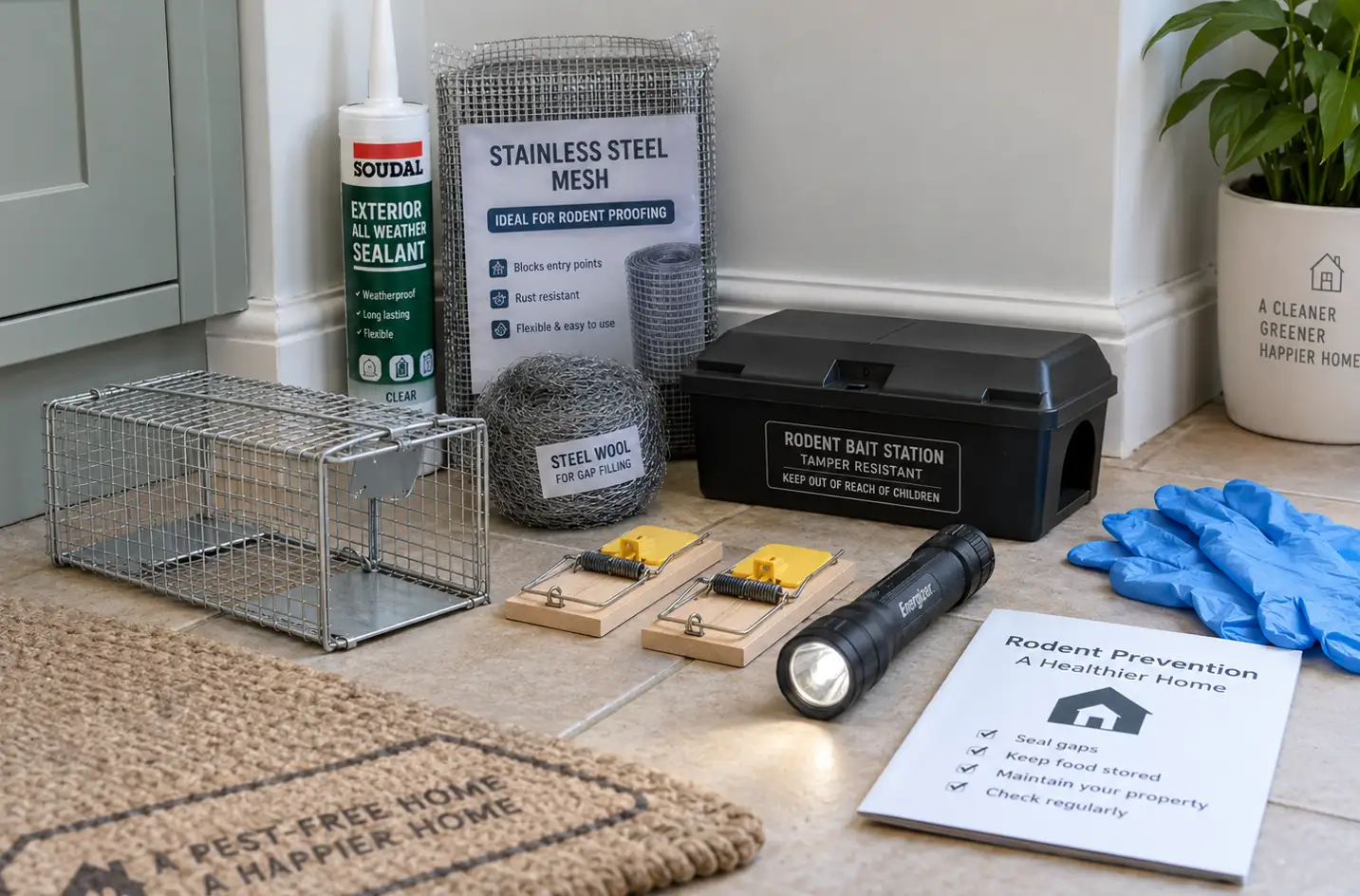
Traps set, bait laid, maybe even a paid treatment already carried out — and a few weeks later, the scratching or the droppings are back. It’s a genuinely frustrating pattern, and it points to something worth understanding clearly: removing rodents currently in a building and stopping rodents from being able to occupy that building again are two different jobs.
But there’s another distinction worth making before assuming the treatment simply “didn’t work”. When rats or mice reappear, either the original population was never completely removed, or the treatment worked and a new population subsequently found its way back in. Sometimes both things are happening at once. Working out which version you’re dealing with is more useful than simply repeating whatever was done last time.
First work out whether the treatment failed — or whether they came back afterwards
“They came back” sounds like one problem, but it can describe two genuinely different situations.
In the first, the original infestation never completely went away. Traps may have removed some animals but not others. Rats can be cautious around newly introduced objects, including traps and bait stations, and a control programme that isn’t positioned around the routes they’re actually using can reduce visible activity without eliminating the population. An inaccessible nest or part of the building that hasn’t been properly assessed can have the same effect: things become quiet for a while, then activity becomes noticeable again.
In the second situation, the original treatment genuinely succeeded. The property became clear — and then new rodents entered through the same access route that had allowed the first infestation to establish itself. If a gap around a service pipe remains open, a defective drain still connects the house to the sewer, neighbouring properties remain infested or the same external food and shelter remain available, removing one population doesn’t prevent another from taking its place.
The distinction matters because the remedy is different. Treatment failure means asking why the original population wasn’t eliminated. Reinfestation means asking why the building remained accessible afterwards.
Resistance to rodenticide is a genuine possibility in some UK rat and mouse populations, but it shouldn’t automatically be blamed whenever bait appears not to have worked. The CRRU UK Code of Best Practice places site survey, correct baiting practice, food availability, environmental management, proofing and reinvasion among the factors that need considering as part of effective control. Resistance becomes more relevant once those more immediate explanations have been properly examined.
That’s why simply changing trap brands or putting down another round of bait can become an expensive loop. Before repeating treatment, establish whether you’re trying to remove survivors from the first infestation or prevent new rodents replacing them.
Where they’re actually getting in
It’s tempting to picture rodent entry as a single obvious hole somewhere at ground level, but the real picture is usually more complicated.
Gaps around service pipes — where water, gas, drainage or cables pass through an external wall — are a common vulnerability because the opening made for the service can be larger than the pipe itself. Damaged or inadequately protected air bricks and vents can provide another route, as can gaps beneath external doors and defects around older building alterations.
The search shouldn’t stop at ground level. Rats and mice are both capable climbers, and openings around eaves, roof edges, pipes and vegetation close to the building can provide routes into lofts and upper voids. The British Pest Control Association’s guidance repeatedly stresses that rodent proofing needs to consider the building as a whole rather than concentrating only on obvious low-level holes.
Cavities, floor voids, service routes and other concealed parts of a building can then allow rodents to travel some distance from the place where they first entered before anyone actually hears or sees them.
Adjoining buildings complicate things further. Terraces, semis, converted properties and other connected buildings can have roof voids, service routes or drainage systems that provide movement between properties, so the room where the droppings appear isn’t necessarily anywhere near the original external entry point.
And drains deserve particular attention with rats. Defective drainage, poorly sealed connections, redundant pipes and damaged inspection chambers can provide a route from the sewer system into or beneath a building. A rat appearing inside doesn’t necessarily have to have crossed the garden and entered through the wall.
The useful question, then, isn’t simply “where is there a hole?” It’s what evidence tells you which route the rodents are actually using.
| What you’re noticing | Where it’s worth investigating |
|---|---|
| Fresh gnawing, droppings or smearing around pipes and cables | Service penetrations through walls or floors |
| Activity concentrated in a loft or upper floor | Eaves, roof junctions, climbing routes and connected roof voids |
| Rats around a downstairs WC, gully or inspection chamber with no obvious wall opening | Drainage and underground connections |
| Activity occurring in more than one attached property | Shared or connected voids, service routes and drainage |
| Repeated activity close to external doors, vents or low-level walls | Door gaps, vents, damaged masonry and other ground-level openings |
None of these signs proves the route on its own. Their value is in narrowing down where a proper inspection should concentrate rather than sealing random gaps and waiting to see whether the problem returns.
Rats and mice behave differently, and that matters for finding them
Size is the obvious difference, but there are practical differences too.
House mice can exploit extraordinarily small openings. BPCA guidance on house mice says they can enter through gaps of about 6 mm. For brown rats, BPCA’s prevention guidance gives roughly 15 mm as a possible entry gap.
That difference matters when you’re assessing an opening that looks far too small to explain what you’re seeing.
Their behaviour differs as well. Rats are notably wary of unfamiliar objects in their environment, which is one reason a newly installed trap or bait station may not produce an immediate result. Mice are generally more willing to investigate unfamiliar objects, although neither behaviour is predictable enough to use as a species test.
Noise is similarly unreliable. Building voids can amplify and carry sound in misleading ways, so droppings, gnaw marks, tracks and direct sightings provide much better evidence than trying to decide whether scratching overhead “sounds like a rat”.
Terraced and semi-detached homes have a particular problem
Connected houses create an additional difficulty because the place where rodents enter the building can be different from the property in which they’re eventually noticed.
Where roof spaces, sub-floor voids, service routes or drainage connections extend between adjoining homes, rodents can enter at one point and emerge elsewhere. Even apparently separate homes can be connected in ways that aren’t obvious from inside the rooms themselves.
That doesn’t only create an access problem. It can create a continuing source of new rodents.
If a neighbouring property, shared roof void or connected drainage system remains infested, clearing your own home may remove the immediate population while leaving another one close enough to recolonise it. In that situation, what looks like repeated failure by the traps or pest controller may actually be repeated reinvasion from the same nearby source.
That’s why proofing one visible opening in your own kitchen can achieve very little if the actual route sits elsewhere in the connected structure.
A stubborn infestation in a terrace or semi can therefore benefit from a conversation with immediate neighbours. If two or three attached properties are hearing activity in connected roof or floor spaces, or have seen rodents during the same period, you’re no longer looking at exactly the same problem as one isolated mouse behind one kitchen unit.
Food and shelter, without assuming it’s always about mess
External conditions can make a property more attractive to rodents regardless of how clean the inside is kept.
Bins that don’t close properly, accessible compost, bird seed accumulating beneath feeders, food stored in sheds, dense vegetation and piles of timber or debris can all provide food, shelter or cover close to a building.
This matters during treatment as well as afterwards. If rodents have plentiful familiar food available, bait may have to compete with those existing food sources, while the wider environment continues supporting the population regardless of how many individual animals are removed.
None of this means an infestation is automatically evidence of poor housekeeping. A very tidy home can still have rats entering through defective drains or mice travelling from an adjoining building.
The point is that food, shelter and access work together. Proofing becomes more valuable when the building is also made less rewarding for the rodents trying to get back in, and a treatment programme has a better chance when readily available alternative food isn’t constantly sustaining the population.
Proofing: the principle, not a DIY manual
Proofing means physically preventing rodents from using the routes they’ve identified or are realistically likely to exploit.
The material matters. Expanding foam, soft plastic and ordinary sealant on their own are generally poor barriers where rodents can reach and gnaw them. Depending on the opening, effective proofing can involve suitably robust metal mesh, metal plates, mortar or other gnaw-resistant construction.
But the right answer isn’t “put metal over every hole”.
An air brick still has to ventilate. A weep opening may still need to drain. Service penetrations have to remain compatible with the pipe, cable and building fabric around them. Roof-level openings can have functions of their own, and there may also be protected wildlife such as bats to consider before work is undertaken around roof spaces.
A good proofing detail therefore closes the rodent route without disabling whatever the opening was supposed to do in the first place.
That’s one reason permanent rodent proofing often benefits from somebody who understands buildings as well as pests. The objective isn’t simply to plug holes; it’s to remove access routes without creating a damp, ventilation, drainage or maintenance problem in their place.
A genuinely important warning before sealing anything
Proofing needs to be coordinated with control of the active infestation rather than treated as an unrelated job.
Simply racing around a building sealing every suspected opening while rodents remain active inside can move the problem rather than solve it. Animals may exploit other weaknesses, start gnawing at alternative routes or die in inaccessible voids, while the person carrying out the work believes the infestation has been permanently excluded.
There isn’t one universal sequence for every property because the right treatment and exclusion plan depends on the species, the building and the route involved. What matters is that removal and proofing form part of the same planned response.
The CRRU Code begins with a proper site survey and places environmental measures such as proofing and reduction of harbourage within the long-term control strategy. Where rodenticide is being used, those changes need to be coordinated with the treatment rather than undertaken blindly halfway through it.
For the homeowner, the practical lesson is simply that finding one plausible hole doesn’t necessarily mean sealing it immediately is the whole answer. You still need to know what’s inside, how it’s moving and whether other access routes exist.
When drains deserve a proper look
Drains are particularly important where rats keep returning despite a thorough inspection of the obvious building fabric.
The BPCA’s technical guidance on drainage inspections for rodents identifies damaged chambers, defective connections, redundant drainage and faults around toilet and waste pipes among the routes that can allow rats to reach buildings.
This adds an important qualification to the usual advice to “get a CCTV drain survey”.
A routine survey concerned mainly with cracks, blockages and general pipe condition isn’t necessarily the same as an investigation specifically aimed at finding rodent ingress. The camera operator needs to know why the survey is being commissioned and what kinds of redundant or defective routes they’re looking for.
So if rats repeatedly return and drainage is a serious possibility, tell the drainage company that the purpose of the inspection is to investigate a rodent-access route, not simply to establish whether the drains are flowing correctly.
A clear survey can then inform whatever permanent repair is necessary. The separate question of who owns the defective drain and who should pay for that work sits properly within Property Front Page’s Drains, Plumbing & Water coverage rather than being repeated here.
Why a competent professional does more than lay bait
A worthwhile pest-control visit should be interested in why the infestation exists, not only in reducing the number of rodents currently present.
And with a recurring infestation there is an additional question worth expecting them to consider: does the evidence suggest that the original treatment never completely cleared the rodents, or does it look as though a new population has subsequently entered?
Those aren’t academic distinctions. If activity never genuinely stopped, the control strategy itself deserves examination — where traps and bait were placed, what the rodents were actually feeding on, whether inaccessible areas were missed, and whether the population behaved as expected during treatment.
If the building was genuinely clear for a meaningful period and then activity restarted, reinvasion becomes more plausible and the emphasis shifts towards access routes, neighbouring properties, external harbourage and drainage.
That doesn’t mean a pest controller will always be able to identify the difference immediately. It means repeated visits that consist solely of replenishing the same bait in the same places, without asking why activity keeps returning, are unlikely to address the whole problem.
A competent professional won’t necessarily personally repair a drain, rebuild an air brick or inspect somebody else’s loft. They should, however, be able to explain what evidence they think points towards treatment failure, reinvasion or a particular access route — and what needs to happen next.
That’s the difference between repeatedly suppressing rodents and managing the reason the building remains infested.
A word on poison, used responsibly
Rodenticide can be an effective and legitimate part of rodent control, but it isn’t a substitute for proofing and environmental management, and its use carries risks beyond the target rodents.
The Health and Safety Executive’s guidance on rodenticide use confirms that anticoagulant rodenticides are subject to controls intended to reduce risks to people, pets, wildlife and other non-target animals.
The CRRU Code likewise treats rodenticide as one part of a planned control programme. Bait needs to be protected from children, pets and wildlife, monitored in accordance with the product and treatment plan, and removed when the treatment is complete rather than simply being left indefinitely. Dead rodents should be searched for and disposed of appropriately because poisoned carcasses can expose predators and scavengers further up the food chain.
For household products, the label isn’t optional guidance: restrictions on use, bait placement and disposal need to be followed.
Repeated rodenticide use should also prompt its own question if rodents continually return. If appropriate bait is being taken but the expected decline in activity never follows, that deserves professional assessment rather than endless repetition. Resistance can be relevant in some areas, but so can competing food, inadequate baiting, incomplete treatment and reinvasion.
The important point is that “the poison didn’t work” is itself a diagnosis that needs evidence.
The point worth remembering
When rats or mice appear again after treatment, the important question isn’t simply what product to try next. It’s whether the first population was ever completely removed, or whether a new population has been able to replace it.
If activity never genuinely stopped, the original control programme needs questioning. Perhaps some animals remained elsewhere in the building, perhaps the traps or bait never reached the whole population, or perhaps the conditions around the property allowed the rodents to continue thriving despite treatment.
If the property really did become clear and the problem returned later, access and reinvasion become much more important. The same service gap, shared roof void, neighbouring infestation, drain defect or external harbourage may still be supplying the building with new arrivals.
And in many persistent cases, the distinction won’t be perfectly clean: incomplete control and continuing reinvasion can reinforce each other.
That’s why recurring rodent problems are rarely solved by simply repeating the same intervention more enthusiastically. The lasting answer comes from identifying which part of the job was missed the first time — control, exclusion or both — and fixing that rather than merely starting another round of treatment.
This article provides general property information. Persistent rodent infestations, infestations involving connected properties or drainage, and situations where rodenticide is being considered can require professional assessment. Rodent-control products must be used in accordance with their labels and current safety requirements, and proofing should preserve necessary ventilation, drainage and other building functions.

