

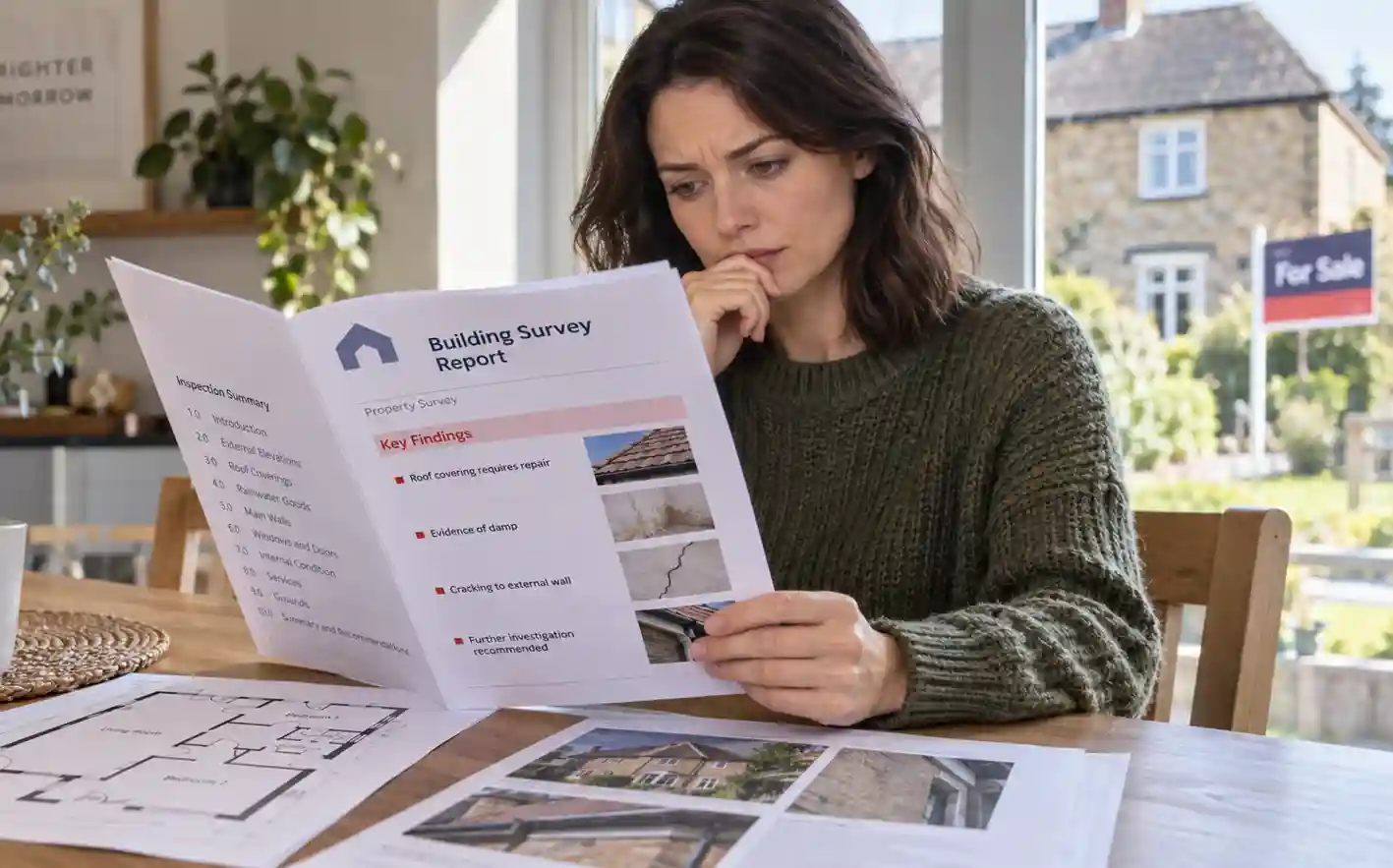
Most survey reports contain at least something that sounds like bad news, because most properties, however good, have defects, maintenance needs or uncertainties a surveyor is professionally obliged to record.
That’s the nature of the document. A surveyor’s job is to identify risk, explain limitations and flag matters that may need attention, not to reassure a buyer that everything is fine. Read without that context, a perfectly ordinary thirty-year-old semi can come back looking like a project. Read with it, many reports turn out to describe a normal house with a normal list of things that need doing over time, plus a much smaller number of points that genuinely deserve a considered response.
The skill worth building isn’t learning to ignore concerning language.
It’s learning to separate what actually changes the decision from what doesn’t.
Read the whole report, not just the ratings
Condition ratings are designed to make a report easier to navigate, and it’s tempting to jump straight to counting how many higher-priority items it contains.
That’s a poor way to use the document.
Under the current RICS Home Survey framework, ratings indicate the relative condition or urgency of an issue. They aren’t a repair-cost scale, and two findings carrying the same rating can have very different consequences for the buyer.
The useful information is in the explanation underneath: what the surveyor actually observed, what may be causing it, what could happen if nothing is done and whether anything further needs investigating.
Read those sections before deciding whether the report is genuinely worrying.
Separate the categories of finding
Most reports, read carefully, sort naturally into a few groups.
Ordinary maintenance. Worn external joinery, ageing finishes, minor deterioration and components that will eventually need repair or replacement are part of owning an existing home.
That doesn’t mean the costs should be ignored. It means they shouldn’t automatically be interpreted as evidence that buying the property is a mistake.
A twenty- or thirty-year-old house is not supposed to emerge from a survey as though it were newly built.
Findings that materially affect safety, the building or the likely cost of ownership. Significant structural movement, serious water penetration, extensive roof deterioration or major decay can change what the buyer thought they were purchasing.
These are the findings that deserve the closest attention, particularly where the cause, extent or cost is still uncertain.
Recommendations for further investigation. Sometimes the surveyor cannot reach a confident conclusion from a visual inspection alone.
Suspected movement may need an engineer. Drainage may need a camera survey. Electrical installations may need proper testing. A damp problem may need closer investigation before anyone can say what is causing it.
That is a normal part of a survey rather than automatic evidence of something catastrophic.
The important question is why the surveyor has recommended the investigation. RICS guidance expects further investigations to be justified, rather than added simply as a defensive precaution.
Understand what the surveyor could and couldn’t see
A home survey is principally a visual inspection of areas that can reasonably and safely be accessed within the agreed service.
It does not mean lifting fitted flooring, opening walls or ceilings, dismantling the building or comprehensively testing every service. Furniture, stored belongings, restricted roof spaces and physical access can all limit what is visible.
Those limitations matter.
A statement that an area was not inspected is not the same thing as a statement that no defect exists there.
Equally, an inaccessible area does not automatically mean there is something wrong behind it.
The report should be read as: this is what could reasonably be established from what was visible and accessible at the time.
If the surveyor could not inspect an area that particularly matters to this property — perhaps part of an altered roof, a cellar with a history of damp or an important section of an extension — ask what that limitation means in practice.
Talk to the surveyor directly
This is one of the most useful steps in the process and one of the easiest to skip.
Government guidance for home buyers recommends speaking to the surveyor after reading the report so that the buyer understands the problems, their seriousness and the possible remedies.
A conversation is often better than trying to infer emphasis from formal report language.
Rather than asking whether the house is simply “good” or “bad”, ask more precise questions.
Which findings would the surveyor want investigated before legal commitment? Which are ordinary ownership costs rather than purchase-changing problems? What happens if a particular repair waits for a year? Is the cause reasonably clear, or is further investigation necessary before anyone can sensibly discuss cost?
And if another investigation has been recommended, ask whether that recommendation follows from something specific the surveyor saw or from a limitation that prevented them reaching a conclusion.
Those answers are much more useful than counting ratings.
Decide whether a specialist opinion is genuinely needed
Not every recommendation for further investigation leads to a serious diagnosis, but questions that could materially change the purchase are usually better answered before the buyer becomes legally committed.
If suspected movement needs an engineer’s opinion, get one. If the roof may need substantial work, obtain an informed assessment and quotation. If electrics need proper testing, use an appropriately qualified electrician.
The person doing the investigation matters too.
There is a difference between paying somebody to diagnose a problem and asking a business whose income depends on selling the treatment it recommends. That is particularly relevant with damp and moisture problems, where the wrong diagnosis can lead to expensive work that never addresses the underlying cause.
RICS guidance on damp and mould recommends considering the building as a whole and, where appropriate, using advisers without a commercial interest in selling remedial products.
That doesn’t make every contractor’s advice suspect. It means the buyer should understand whether they’re receiving an independent diagnosis, a quotation for a known repair or a sales survey designed partly to generate remedial work.
Get the cumulative picture, not just the isolated cost of each item
A single moderate repair rarely transforms the economics of buying a home.
A collection of moderate repairs sometimes does.
£2,000 here, £3,000 there and another significant job likely within two years can become a very different proposition once the buyer looks at them together — particularly after moving costs, tax, legal fees and everything else already being spent on the purchase.
Where significant repairs appear necessary, RICS advises buyers to obtain written quotations from experienced contractors before making a legal commitment.
That is usually more useful than relying on a generic online cost range or assuming the survey report is a fixed-price schedule of works.
Once the important defects have been separated from ordinary maintenance, put the credible near-term costs together.
That cumulative figure is what the buyer actually has to absorb.
Renegotiating on the strength of a survey
Where a survey uncovers something genuinely significant and unexpected — not ordinary wear already apparent when the offer was made, but a defect that changes the financial picture — reopening the conversation about price is a normal part of the buying process.
In England and Wales, GOV.UK guidance explicitly recognises that an offer made subject to contract can be renegotiated where a survey identifies a problem.
But a survey does not create an automatic discount.
There is no rule that a £10,000 repair estimate entitles the buyer to £10,000 off the agreed price.
The negotiation is wider than that. How urgent is the work? Was the condition already visible and arguably reflected in the original offer? Is it a genuine defect or predictable age-related maintenance? What do proper quotations suggest rather than rough estimates? And what is the property worth to both sides now that the issue is known?
The seller can agree to reduce the price, offer something smaller, agree to carry out work or refuse to change the deal.
In England and Wales, the transaction is not normally legally binding until exchange of contracts. Northern Ireland follows the same broad principle. (nidirect)
Scotland starts from a different position because the seller normally provides a Home Report before marketing and the Single Survey already gives buyers condition information. If an additional investigation uncovers something significant, the buyer should raise it with their solicitor while the terms remain open for negotiation; once missives are concluded, there is a binding contract. (mygov.scot)
The key point is the same in each jurisdiction: get the information that could change the transaction before the point at which the buyer is legally committed.
Whether the property still works financially
Ultimately, the survey findings need folding back into the same question that shaped the original offer:
Does this property, at this price, with these known costs and risks now factored in, still represent a sensible purchase for this buyer?
Sometimes the answer is yes, unchanged.
A roof needing work several years from now may be entirely manageable. A boiler that will eventually need replacing may simply belong in the future household budget. Cosmetic deterioration may matter very little.
Sometimes the answer is still yes, but only after the price, planned expenditure or buyer’s cash reserves are reconsidered.
And sometimes a finding changes the property enough that walking away is rational.
The buyer’s own financial position matters as much as the theoretical repair bill. Taking on £20,000 of work with substantial reserves left after completion is very different from discovering the same £20,000 of work when the purchase was already going to exhaust nearly every available pound.
A mortgage can change the picture further.
If the problem also affects the lender’s valuation or leads to conditions on the mortgage offer, it stops being merely a question of whether the buyer personally accepts the defect. It may change how much can actually be borrowed. MoneyHelper notes that buyers may need to reconsider or renegotiate where survey problems prove expensive or the mortgage valuation comes in below the agreed price.
At that point, the lender or mortgage broker and the conveyancer belong in the conversation too.
The survey hasn’t damaged the property. The defect, if there is one, was already there.
What the survey has changed is what the buyer knows about it.
The question is what that new information does to the purchase.
Where this goes next
Some survey findings need another technical opinion. Others need a legal one.
Structural movement, damp, roofing, drainage or electrical concerns may need the appropriate specialist to answer the technical question.
Planning permission, building-regulation approval for previous alterations, title restrictions, boundaries, rights of way or lease terms belong in the conveyancing process.
The surveyor may spot the issue because something at the property raises a question. The legal representative establishes what the paperwork actually says.
The useful response to a difficult survey is therefore not to panic at the number of defects, or to negotiate mechanically from the total estimated repair bill.
It is to understand what has actually been found, investigate the uncertainties that could change the decision, and put realistic costs against the problems that remain.
Then return to the question that matters.
Knowing what you know now, would you still buy this property at this price and on these terms?
Sometimes the answer will still be an easy yes. Sometimes the price needs to change. And occasionally, the survey will have shown that the property is no longer the purchase the buyer thought they were making.
In that case, the survey has done exactly what it was supposed to do.
Important: This article provides general information about residential property surveys and the home-buying process, not legal, surveying, structural, mortgage or financial advice for a particular purchase. Survey scope and buying procedures differ by property and jurisdiction. Buyers should discuss material survey findings with the surveyor and obtain appropriate specialist, legal or financial advice before becoming legally committed.

