

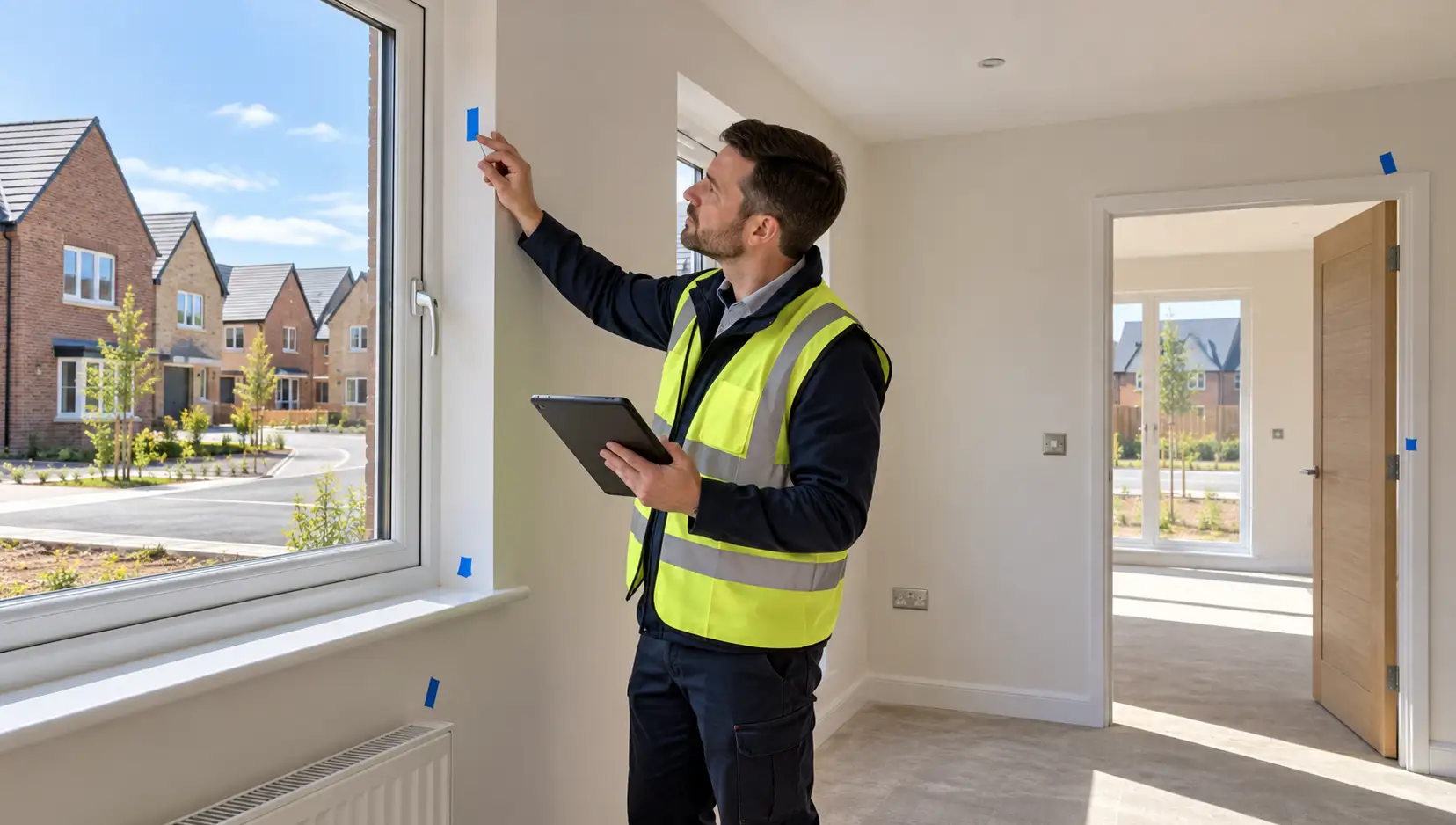
It’s a reasonable question to ask: the property is brand new, it has been through building control or the relevant building standards process, and it comes with a warranty. So why would you need to pay for anyone else to look at it?
The answer is that “new”, “regulated” and “covered by a warranty” are three different things, each dealing with a different slice of what could go wrong — and none does the job of the others. Understanding what each mechanism actually checks is the difference between assuming a new home has effectively been certified problem-free and knowing exactly what protection you do and don’t have.
Three assumptions worth correcting before you go any further
Building control or building standards approval is concerned with compliance with the applicable technical requirements. It is not a comprehensive quality-control inspection of every component, finish or piece of workmanship in the home.
In England, the 2026 Building Control Independent Panel report makes that distinction particularly clearly: building control is not responsible for guaranteeing the quality of all construction work or identifying every error, defect or instance of poor workmanship. Building Control Independent Panel report
Scotland operates a different building standards system, but the underlying point is similar. Current Scottish Government procedural guidance says responsibility for ensuring work is carried out correctly remains with the relevant person — usually the owner or developer — because verifiers cannot regularly or sufficiently monitor all construction work. Scottish Building Standards Procedural Handbook — completion
A new-home warranty is different again. It gives protection against problems falling within the particular policy terms, during the periods in which that cover applies. It is not a statement that no defects exist.
And a professional snagging or pre-completion inspection is another service altogether. Its purpose is principally to examine the finished home for outstanding work, defects in finish and workmanship, and relevant technical-standard issues. A conventional Home Survey looks at the property from a broader condition perspective.
So the practical answer is not that every new-build buyer automatically needs a conventional Home Survey. It is that buyers need to decide what they actually want independently checked: the quality and completion of a newly built home, the wider condition of the building, or sometimes both.
What “snagging” actually means
Snagging is usually associated with relatively minor faults, poor finishes and incomplete work — inconsistent paintwork, damaged surfaces, doors that do not close properly, uneven tiling, gaps around sealant, unfinished pointing or fittings that have not been installed correctly.
That does not mean a pre-completion inspection is confined to cosmetic blemishes. Under the New Homes Quality Board process, the inspection is carried out against an agreed checklist and the relevant warranty provider’s standards, meaning it can also identify issues that go beyond untidy finishing.
It is nevertheless important to understand its limits. The current NHQB house checklist describes the inspection as non-disruptive and non-invasive. Fixtures, fittings and services are assessed broadly as they would be used normally, rather than walls, floors or other parts of the building being opened up to investigate concealed construction. NHQB Pre-Completion Inspection Checklist for houses
That distinction matters because a buyer looking for reassurance about the finish and delivery of a new home may need a different service from someone worried about the wider construction, condition or behaviour of the building.
The right to an independent pre-completion inspection — and who it actually applies to
Buyers whose homes are covered by the New Homes Quality Code have the opportunity to inspect the property before completion themselves or appoint a suitably qualified independent inspector to do it for them.
Under the current version of the Code, which applies to homes reserved from 2 March 2026, the inspection should take place after the notice to complete has been served and before completion, unless the buyer and developer agree that it can happen earlier. In Northern Ireland, the Code refers instead to the estimated completion date. The completion notice period would normally be expected to be at least 14 calendar days. New Homes Quality Code — pre-completion inspection rules
Where the buyer appoints an inspector, the Code requires them to belong to a recognised professional association experienced in residential surveying, hold appropriate professional indemnity insurance, work within their competence and use the standard Pre-Completion Inspection Checklist. The Code gives bodies including CABE, CIOB, ICWCI, RICS and RPSA as examples. Buyers can also undertake the inspection themselves using the checklist, although developers must make clear that it was designed for professional use and that an unqualified buyer may miss or interpret some requirements differently.
This is useful protection, but it should not be mistaken for a universal right attached to every new-build home.
The developer’s registration status and the date on which the home was reserved both matter. The NHQB Register of Developers shows whether a developer is active and its registration start date; where a developer has active status, homes reserved on or after that registration start date are protected. Check the NHQB Register of Developers
If your developer is not covered, that does not automatically mean an independent inspection is impossible. It means this particular Code-based entitlement does not apply. Ask the developer what pre-completion access it allows and, where necessary, ask your conveyancer to check the reservation agreement or contract before assuming an inspector will be permitted access.
There is another limit worth understanding. The Code says that its Pre-Completion Inspection Checklist is not intended to delay or prevent completion in accordance with the notice to complete. Where the inspection identifies issues that breach the warranty provider’s technical standards, the developer is responsible for addressing them, ideally before legal completion or within 30 days if that is not possible.
In other words, the process gives the buyer an important opportunity to have the finished home independently examined, but it should not be understood as a general right to postpone completion until every minor snag has disappeared.
Where warranty cover fits in
Many new homes are sold with a warranty and insurance product from NHBC or another provider. But the familiar phrase “ten-year warranty” can disguise the fact that the nature of the protection changes over time.
NHBC’s Buildmark product, for example, includes a two-year builder warranty and NHBC guarantee after completion, followed by insurance cover — usually for a further eight years — against defined problems affecting specified parts of the home. During the builder warranty period, the builder is generally responsible for rectifying defects resulting from failure to meet NHBC requirements. NHBC Buildmark cover
Other warranty providers have their own policies, conditions and exclusions, so the documents supplied for the particular property matter more than the generic reassurance that the home has a “ten-year warranty”.
That is why warranty cover and independent inspection are not competing forms of protection. The warranty provides a route to remedy or insurance cover when qualifying problems arise. An inspection is an attempt to discover problems that are visible now.
Snagging, warranty, building control or a conventional survey — what do you actually need?
There is no single right answer because the four mechanisms are doing different jobs.
| Mechanism | What it is mainly for | When it matters to the buyer | What it does not replace |
|---|---|---|---|
| Building control / building standards | Regulatory compliance | Provides evidence that the applicable regulatory process has been followed | An inspection carried out specifically on the buyer’s behalf |
| New-home warranty | Protection for problems falling within the particular warranty terms and periods | Gives a route to remedy or insurance cover if a qualifying problem arises | Checking the finished property now for visible faults |
| Pre-completion / snagging inspection | Examining the newly completed home for workmanship, finish and relevant technical-standard issues | Particularly useful while the developer is still involved and before the buyer takes possession | A broader assessment of the building’s overall condition |
| Home Survey | Independent assessment of the property’s condition at an agreed level of inspection | Potentially more useful where the property is unusual, has stood completed for some time or there are wider concerns | Warranty protection or the developer’s own obligations |
For a straightforward newly completed house bought from a developer covered by the New Homes Quality Code, a properly conducted pre-completion inspection may address the buyer’s main concern: whether what has actually been delivered is finished to the expected standard before they take possession.
A different calculation may apply to a “new” flat that is really unsold completed stock and has stood empty for a substantial period, a house that has been used as a show home, a property using an unusual form of construction or one where a particular concern has already emerged. In those cases, a conventional survey may provide information that a snagging inspection alone was never designed to supply.
RICS describes its Home Surveys as physical inspections intended to assess a property’s condition and says the appropriate survey level depends on factors including its age, size, condition and complexity. RICS guide to Home Surveys
There may therefore be purchases where both forms of inspection make sense, but the aim should not be to pay twice for substantially the same work. Before appointing anyone, ask what they will inspect, what standards they will use, what is excluded and whether the report is intended primarily to identify snagging and warranty-standard issues or to assess the wider condition of the building.
What independent inspection genuinely adds
The honest case for paying for independent scrutiny of a new home isn’t that new-builds are inherently more defective than older properties — that’s not something this article sets out to claim either way.
It’s that “new”, “regulated” and “covered by a warranty” each answer a narrower question than buyers sometimes assume, and none necessarily means that an independent professional has inspected the finished home specifically on the buyer’s behalf.
For many straightforward new-build purchases, a specialist pre-completion inspection may be the proportionate independent check. For others — particularly unusual properties, homes that have been completed for some time or purchases where specific concerns already exist — it may be sensible to discuss a broader survey as well.
The mistake is not choosing one inspection rather than another. It is assuming that because the home is new, somebody else must already have carried out the same check you would be paying an independent inspector to perform.
This article provides general property information, not legal or surveying advice for an individual purchase. Building control and building standards arrangements differ across the UK, while New Homes Quality Code protection, warranty terms and developer obligations depend on the particular property and scheme. Check the current position with your developer, legal adviser, warranty provider or suitably qualified independent inspector before completion.

