

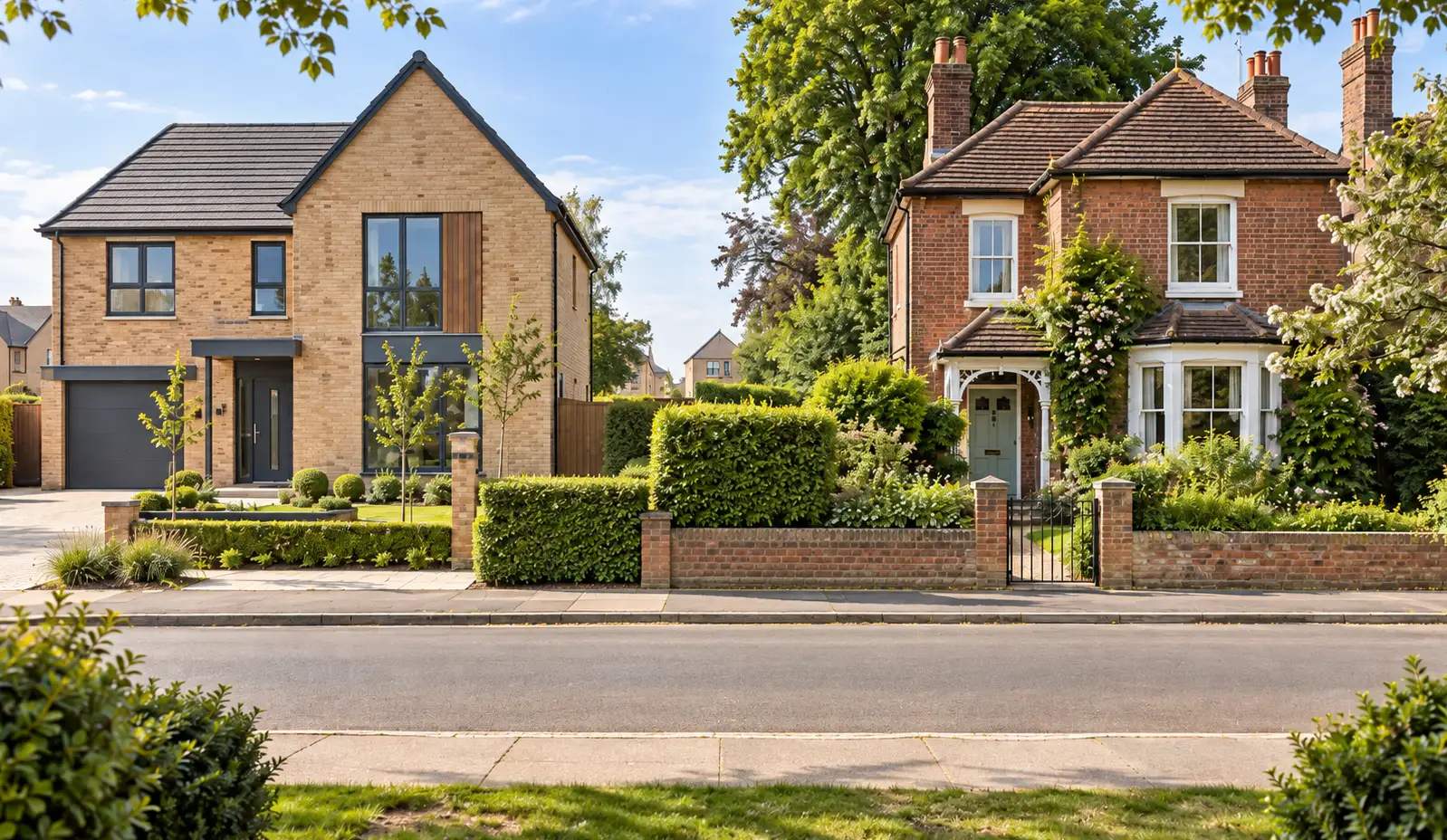
A new-build home and a 1930s semi rarely compete for the same buyer’s affection, but they very often compete for the same buyer’s budget. Once a search widens beyond a fixed idea of “what I’m looking for”, most buyers eventually stand in front of both options and have to weigh a genuinely different question: not which is nicer, but which represents better value for what they actually need over the years they’re likely to own it.
Neither answer is right in general. Each is right for a particular buyer, in a particular market, at a particular price point — and the comparison is worth doing properly rather than settling on whichever instinct arrived first.
The price you see isn’t the full price
A new-build asking price can sit above apparently comparable resale properties nearby. But even the idea of a “new-build premium” needs treating carefully: two three-bedroom homes are not necessarily equivalent if one has substantially more floor space, a larger plot, a garage, better parking or a more desirable position.
Developers also frequently use incentives to make the overall purchase more attractive: contributions towards legal fees, flooring or upgraded finishes, deposit contributions, or part-exchange arrangements on the buyer’s existing home. These can represent genuine value, but they’re also sales tools. The sensible approach is to decide first what the property itself is worth to you, then value the incentive separately rather than allowing the incentive to justify a price you wouldn’t otherwise pay.
Those incentives aren’t invisible to the mortgage process either. The UK Finance Disclosure Form used for newly built, converted and renovated property specifically records incentives alongside matters such as tenure and method of construction so that the lender, conveyancer and valuer have the relevant information.
There can be smaller costs hiding in the specification too. The show home may contain upgraded flooring, fitted wardrobes, lighting, landscaping, kitchen finishes or appliances that aren’t part of the standard plot. What matters is not what is visible in the marketing suite but exactly what is included in the home you’re buying.
Running costs cut the other way, generally in the new build’s favour. The latest government EPC statistics for England and Wales show new dwellings performing markedly better than the existing housing stock: in England, for example, 68% of new dwellings receiving EPCs between April and June 2026 were rated B, while existing dwellings were concentrated heavily in bands C and D.
An EPC is a modelled assessment rather than a prediction of an individual household’s actual bill, but the underlying efficiency difference is still meaningful.
An older property with poor glazing, limited insulation or an ageing heating system can require considerably more energy — and potentially substantial investment to improve it. A well-renovated older home may close much of that gap, which is why comparing the EPCs and actual heating systems of the two properties in front of you is more useful than comparing their ages alone.
The same principle applies to maintenance. A new home should not immediately need a roof, replacement windows or a new boiler. An older home might — but it might equally have had all three replaced recently.
Age is a clue to likely expenditure, not a bill in itself.
For two properties competing at roughly the same price, one of the more useful comparisons is therefore not simply asking price but what you are likely to spend during the first few years of ownership. A £350,000 older house needing £25,000 of fairly predictable work is financially different from a £365,000 new build that needs almost none, even before differences in energy use and ongoing charges are considered.
That doesn’t automatically make the new build better value. It makes the real comparison clearer.
Space, plots and the character trade-off
The familiar claim that new builds are simply smaller than older homes is too crude to be particularly useful. Government research into the size of English homes has not found an overriding rule that the newest homes are universally smaller, and older properties have also had decades in which to be extended or converted.
What buyers experience on individual developments can nevertheless vary enormously.
The more useful comparison is surprisingly simple: ignore the bedroom count for a moment and compare the actual internal floor area, room dimensions, storage and plot.
Two homes marketed as three-bedroom houses can provide very different amounts of usable accommodation. A generous landing, proper utility space, somewhere for a vacuum cleaner and coats, a garage that can genuinely take a modern car, and bedrooms that still work once wardrobes are in them may matter more over ten years than whether the kitchen worktop was new on moving day.
Where the asking prices are reasonably comparable, price per square foot or square metre can also be a useful sense-check. It shouldn’t determine what a house is worth — plot, location, condition, outlook and specification all matter — but it can expose how much additional money is effectively being paid for one property’s newness, finish or location.
Older homes from some periods do offer proportions that are difficult to recreate on constrained modern sites — larger gardens in particular locations, mature planting, established streets and, sometimes, higher ceilings or more generous frontage. But none of these belongs automatically to “old houses”. A Victorian terrace may have very little garden; a modern detached house on the edge of a development may have a particularly good plot.
The actual properties still have to win the comparison.
Future flexibility deserves the same scrutiny. An older home on a generous plot may offer obvious scope for an extension, loft conversion or reconfiguration, but planning rules, conservation restrictions, title conditions and the physical structure can still limit what is possible.
New-build developments can carry their own restrictions. Covenants or title conditions may control alterations to elevations, parking, fencing, satellite dishes, business use or what can be done to the front of the property. A garden that looks large enough for an extension does not mean an extension will necessarily be permitted.
If future alteration is an important part of the reason for buying, establish that flexibility before putting a value on it.
Warranties, snagging, and what actually happens after you move in
A new-build warranty is a significant advantage, but it is worth understanding what it actually provides rather than mentally converting “ten-year warranty” into “everything is guaranteed for ten years”.
NHBC Buildmark, one of the main warranty schemes, provides a ten-year warranty and insurance structure, with the builder responsible for qualifying defects during the initial period and insurance protection applying subsequently in accordance with the policy terms. Other providers have their own wording, limits and exclusions, so the actual warranty for the property matters more than the logo on the brochure.
There is a separate layer of consumer protection where the developer has active registration with the New Homes Quality Board. The New Homes Quality Code applies to qualifying homes reserved with registered developers and gives buyers access to standards covering the sales process, completion and after-sales service, together with the New Homes Ombudsman Service where applicable.
None of this eliminates snagging.
A newly finished house can still contain defects ranging from cosmetic finishing issues to problems that require more serious attention. Under the current Code, buyers purchasing from a registered developer must be given the opportunity to undertake a pre-completion inspection themselves or appoint a suitably qualified inspector. The pre-completion inspection requirements also set out the standard checklist and requirements for professional inspectors.
It is worth distinguishing this from the wider question of whether you want independent professional advice on the property itself.
A snagging inspection is primarily concerned with defects, workmanship and whether the completed home meets the relevant standards and specification. It should not automatically be assumed to answer every question a buyer might expect from a broader property survey or specialist investigation. The appropriate inspection depends on the property and what you need to know.
That makes the period before completion much more useful than simply walking around admiring the finished kitchen. It is the point at which condition, specification and finish should be checked against what was actually promised.
An older home comes without the same new-home warranty structure, but age provides a different sort of evidence. Decades of occupation can make previous alterations, patterns of maintenance and established problems easier to identify.
That is not the same as saying an old house has “proved” itself structurally. Roofs deteriorate, drainage fails, damp develops and buildings can move at any age.
The advantage is history. The disadvantage is that you may also be buying decades of accumulated maintenance and other people’s alterations. A proper survey therefore matters for a different reason than snagging does on a new build.
Tenure and estate charges matter even when the house is freehold
This is one area where the legal position is changing quickly enough that buyers should be particularly cautious about assumptions.
The Leasehold and Freehold Reform Act 2024 contains provisions intended to prohibit most new long residential leases of houses in England and Wales. But as of September 2026 that prohibition has not yet been brought into force. The current government leasehold toolkit says the Government intends to implement the ban and is working through commencement arrangements alongside its wider commonhold and leasehold reforms.
A buyer should therefore still confirm the tenure of the particular house rather than assuming that every new-build house being sold today must already be freehold.
Flats remain different. New flats in England and Wales can still be sold leasehold. The Government’s draft Commonhold and Leasehold Reform Bill proposes prohibiting most new leasehold flats and establishing reformed commonhold as the default, but that is proposed legislation rather than the law under which somebody buying today is necessarily purchasing.
For most newly granted qualifying long residential leases in England and Wales, financial ground rent has already effectively been removed. The Leasehold Reform (Ground Rent) Act 2022 guidance explains that most qualifying new leases granted since commencement are restricted to a peppercorn ground rent.
Service charges, lease length, management arrangements and future major expenditure can still matter enormously.
And freehold does not automatically mean charge-free.
Many privately managed estates contain freehold houses whose owners contribute towards landscaping, play areas, private roads, drainage or other communal facilities through an estate management charge or estate rentcharge. The Government’s guidance on freehold estates confirms that owners on some estates are required to contribute towards the upkeep of shared areas.
That makes the useful question much broader than simply “Is it freehold?”
Ask what annual estate charges apply, what they pay for, who controls the management company, how the charge can change, which roads and communal areas will eventually be adopted — if any — and what will remain privately maintained.
On a development that is still being built, also ask whether the figure being quoted is an established annual charge or an estimate for a partly completed estate, and what happens to responsibility for the communal areas once the developer has finished.
Scotland operates under a materially different ownership framework. Certain ultra-long leases were converted into ownership under the Long Leases (Scotland) Act 2012, as explained by Registers of Scotland. Northern Ireland also has its own land and leasehold arrangements.
A buyer moving between parts of the UK should therefore avoid carrying assumptions from one jurisdiction into another.
Neighbourhood maturity is a genuine, if underrated, factor
A new estate takes time to become a settled neighbourhood.
Landscaping needs to mature. Roads, open space and drainage may still be moving from construction arrangements towards their longer-term management position. Shops, schools, play areas or other facilities shown in the wider masterplan may belong to later phases rather than the one you’re buying into now.
There is also a more immediate consideration: how much development is still to come?
Buying in an early phase can mean living alongside construction traffic, unfinished roads and building work for considerably longer than the few weeks around your own completion. That may be an acceptable price for getting a preferred plot or buying early into an attractive development, but it should be part of the decision rather than a surprise afterwards.
An established older-home neighbourhood offers more of a known quantity. The shops, traffic, schools, public transport, parking pressure, trees and neighbouring streets already exist. You can walk around and see what the area has become rather than what the sales material says it is intended to become.
That certainty extends beyond appearances. You can see which routes people actually use, whether the local road becomes congested at school time, whether street parking becomes difficult in the evening and how established the surrounding development really feels.
The trade-off is that an older neighbourhood may have little prospect of the new infrastructure or public-realm improvements that sometimes accompany a large development.
Neither is automatically better. One is established; the other is still becoming itself.
Buying off-plan changes the risk profile again
Purchasing a new build that isn’t complete — buying off-plan — adds a layer of risk beyond the new-build-versus-older comparison itself.
The home you’re committing to may still exist largely as drawings, specifications and a plot on a building site. Completion can move, mortgage offers may need extending or reassessing, and the finished property may not feel exactly like the show home that helped sell it.
There is often a different pace to the transaction as well. Reserving a new-build plot can start a timetable in which the developer expects legal and mortgage work to progress promptly. That isn’t inherently a problem, but a sales deadline should not become a substitute for proper conveyancing, understanding the title or checking exactly what has been promised.
Where the New Homes Quality Code applies, registered developers must provide information including the expected completion date and plans showing matters such as the home’s size, specification, layout, plot position and orientation. The Code also deals with significant changes and excessive or unreasonable delay. Its legal documents and completion provisions are worth understanding before treating the reservation process as a formality.
That protection is useful, but it doesn’t remove the need for an independent conveyancer to examine the contract properly.
A buyer should understand what happens if construction is delayed, what specification is contractually promised, how any reservation or deposit money is protected, what changes the developer is permitted to make and what rights exist if the finished home differs materially from what was agreed.
That makes off-plan buying a materially different transaction from buying a completed new-build home, not merely an earlier version of it.
Which one actually suits you
A buyer prioritising low near-term maintenance, strong energy efficiency and the reassurance of new-home warranty protection is likely to find more comfort in a new build.
There can be practical transaction advantages too. A developer isn’t normally dependent on buying another home before selling you the plot, so there may be no upward seller chain in the conventional sense. Part-exchange can sometimes simplify the buyer’s own sale as well.
That does not mean the transaction is automatically simpler. Build timetables, reservation deadlines and off-plan uncertainty create their own pressures.
A buyer prioritising a particular style of architecture, an established neighbourhood, mature outside space or the potential to alter and add value may find those qualities more readily in older stock.
But once two real properties are competing for the same money, broad preferences become less useful than putting the same questions against both.
| Compare this | New-build property | Older property |
|---|---|---|
| Real acquisition cost | Price after considering incentives, but including upgrades and essentials not included in the specification | Purchase price plus immediate work needed to make the property comfortable or sound |
| Usable space | Actual floor area, room dimensions, storage, garage and plot — not bedroom count alone | The same measures, including whether previous extensions genuinely improve the layout |
| First few years’ expenditure | Snagging, landscaping, optional finishes and items outside the standard specification | Survey-identified repairs, heating, windows, roof, electrics, decoration or modernisation where required |
| Ongoing charges | Leasehold service charges where applicable and any freehold estate-management charges | Service or estate charges where applicable, alongside maintenance of the individual property |
| Energy and heating | EPC, construction standard and heating system | EPC, existing improvements and the cost or practicality of further upgrades |
| Protection and inspection | New-home warranty and snagging/pre-completion inspection arrangements | Property survey, specialist inspections where needed and whatever guarantees remain from previous work |
| Ability to change it | Covenants, title restrictions, plot constraints and planning | Planning, title restrictions, conservation or listed status where relevant and physical scope to alter |
| Transaction | Potentially no upward seller chain, but developer timetables or construction delays may matter | Seller chain and onward purchase can affect timing, but the completed property already exists |
| Resale setting | Remaining build-out period and whether new plots may still compete with your resale | Local demand for established resale homes and how the property’s condition compares with surrounding stock |
The last of those is easily overlooked.
Someone reselling a two-year-old home while the developer is still marketing effectively identical brand-new plots may find themselves competing not just on price but against untouched interiors, fresh warranties and incentives the private owner cannot offer.
That doesn’t make buying early in a development a bad decision. It means the likely build-out period deserves consideration if there is a realistic chance you’ll move again relatively soon.
One useful test is to mentally remove the word “new”. If this exact house were three or four years old, with somebody else’s furniture in it and no developer incentive attached, would you still think the underlying property, plot and location justified the price?
An older home has its own resale risks — expensive maintenance deferred rather than completed, poor energy performance, unsympathetic alterations or a layout that increasingly compares badly with local alternatives.
Resale is therefore difficult to call in general terms. Location, condition, usable space, local supply, ongoing costs and the price originally paid are likely to matter far more than the simple label “new build” or “older home”.
The comparison worth making isn’t new versus old in the abstract. It’s this specific new-build plot against this specific older house, on this budget, including the costs that sit outside the asking price, for this buyer, over the years they’re actually likely to stay.
Once the comparison is made that way, the age of the property becomes one factor among several rather than the decision itself.
Important: This article provides general property information, not legal, financial, surveying, mortgage or other professional advice for your individual circumstances. Property rights, tenure, charges, warranties, mortgage requirements and buying arrangements vary by property and jurisdiction and may change over time. If significant money, property or legal rights are at risk, take appropriate independent professional advice before committing to a purchase.

