

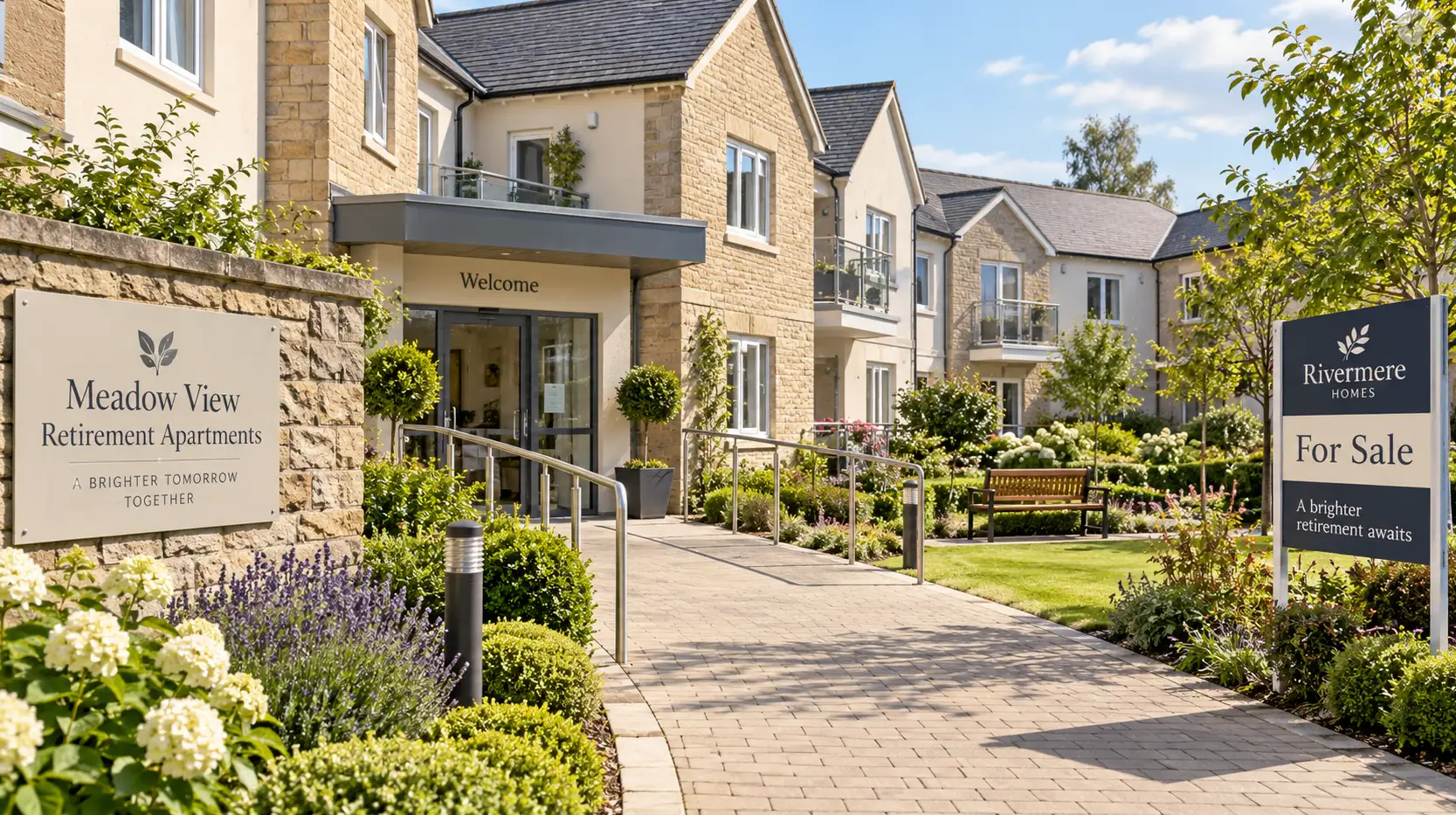
The appeal of a retirement development is usually easy to identify within the first few minutes of a viewing: a secure entrance, an on-site manager, a communal lounge that’s actually used, neighbours in a similar stage of life, and a home designed with less maintenance and better accessibility in mind than many ordinary properties of the same age.
What’s harder to see in that same viewing is the full financial shape of what you’d be signing up for, and how that shape differs, sometimes substantially, from buying an ordinary flat, bungalow or smaller house instead. This isn’t a case for or against retirement housing as a category. Plenty of developments genuinely deliver what they promise, and plenty of residents value the security, community and reduced day-to-day maintenance they provide. It is a case for treating retirement housing as a distinct kind of property purchase, with its own economics and its own resale market, rather than assessing it in exactly the same way as an ordinary home.
The detailed leasehold rules discussed below principally concern England and Wales. Scotland and Northern Ireland have different legal frameworks, so a buyer there should take advice appropriate to the property and jurisdiction.
What you’re actually paying for, beyond the purchase price
Many purpose-built retirement flats are leasehold, and the purchase price is only the entry cost. Some retirement houses and bungalows use different tenure structures, so the first job is to establish exactly what is being sold rather than assuming every development works in the same way.
For a leasehold retirement property, the service charge can be a much larger part of the decision than it would be with an ordinary block of flats because it may pay for substantially more: an on-site manager or staff, communal lounges and gardens, guest accommodation, lifts, emergency-call systems, cleaning, building insurance and the maintenance of shared facilities. Those services have genuine value if you want and use them. The issue is not that the charge exists, but whether the value it delivers to you justifies what it costs now and what it may cost over the period you expect to own the property.
Don’t stop at the current annual figure. Ask for recent service-charge accounts, the current budget, what is included, what is charged separately, whether a reserve or sinking fund exists and whether any significant works or changes to services are anticipated. A development with an attractive first-year charge but weak reserves or expensive work approaching can be a different proposition from one whose headline service charge initially looks higher but has better-funded long-term maintenance. It is also worth asking yourself whether the charge would still feel comfortably affordable if it rose materially during your ownership, particularly if your income in retirement is unlikely to rise at anything like the same pace.
Ground rent needs treating separately. For qualifying new retirement-home leases in England and Wales granted from 1 April 2023, the Leasehold Reform (Ground Rent) Act generally restricts ground rent to a peppercorn — effectively zero. That does not erase ground rent from older leases. Buying a resale property in 2026 does not turn a lease originally granted years earlier into a new lease for this purpose, so the actual lease still needs checking. GOV.UK — Leasehold Reform (Ground Rent) Act guidance
Event fees: the cost you may not pay until much later
The most distinctive financial feature of some retirement developments is the event fee — also described in different leases as an exit fee, transfer fee, deferred management fee or similar charge. Unlike the annual service charge, it becomes payable when a particular event occurs, commonly a sale but sometimes also subletting or a change of occupancy.
How it works varies enormously. The charge might be a fixed amount, a percentage of the eventual resale price, a percentage that increases according to the length of ownership, or part of a wider deferred-fee arrangement. That variation is precisely why a general statement such as “this development has an exit fee” isn’t enough.
Before committing, establish the percentage or formula, what event triggers it, who receives the money, whether VAT or any other charge is added, and — critically — what value the percentage is applied to. If the fee is based on the eventual selling price rather than any increase in value, it may be payable even where the property sells for less than you originally paid.
A simple hypothetical example shows why converting the percentage into pounds matters. If a lease charged an event fee of 10% of the eventual resale price and the property later sold for £180,000, the fee would be £18,000. That does not suggest 10% is a typical charge — actual arrangements vary widely — but it demonstrates why understanding the formula before buying is more useful than simply knowing that an event fee exists.
The Law Commission investigated event fees after concerns that some buyers had not understood the charges until too late in the purchase process, or in some cases until the fee became payable. Its recommendations included much clearer disclosure and regulation of when such charges could be imposed. Law Commission — Event fees in retirement properties
The Leasehold and Freehold Reform Act 2024 did not introduce the comprehensive event-fee regulation that buyers might assume from reading about wider leasehold reform. Event fees were specifically defined for parts of the legislation, but those provisions did not themselves implement the Law Commission’s proposed regime. As of 2026, government was still considering implementation of those recommendations, so a buyer should not assume that an existing lease fee has disappeared, been capped or become harmless simply because leasehold legislation has changed. For the property you’re considering, the lease that exists today is what matters.
Add up the cost as a period of ownership, not as a purchase
The most revealing comparison is rarely between two asking prices. It is between the likely cost of living in each property over the period you realistically expect to own it.
For a retirement home that can mean the purchase price or mortgage payment where applicable, annual service charges, any ground rent still payable under an older lease, charges for services not included in the main service charge, and any event fee that will become payable when you leave or sell. A cheaper retirement flat can therefore cost more over ten years than an ordinary flat with a higher purchase price. Equally, an ordinary bungalow may have no communal service charge but leave you personally paying for repairs, gardening, security improvements and maintenance that the retirement development’s charge would have covered.
Neither comparison is meaningful without understanding the services sitting behind the costs. The useful question is not simply “how much is the service charge?” but “what will I pay in total, and what am I getting in return?”
Resale is a different market
Resale is the part buyers most easily push into the future because, at the viewing stage, selling is often the last thing they want to think about. But retirement properties commonly have occupancy restrictions in the lease, often requiring at least one resident to have reached a particular minimum age. The exact age varies by development. That restriction is part of what creates the community in the first place, but it also means the eventual buyer pool is smaller than for an unrestricted flat.
A smaller buyer pool does not automatically mean poor resale performance. The government’s Older People’s Housing Taskforce found a much more complicated picture: some specialist retirement homes retain or increase their value, while other developments have experienced significant resale losses. Location, the original new-build premium, service charges, the quality of the development, local demand, fees and the way resales are handled can all matter. The Taskforce concluded that the overall resale picture needs better evidence rather than supporting a blanket claim that retirement property either performs well or badly. Older People’s Housing Taskforce — Our Future Homes
That makes evidence from the particular development far more useful than a national opinion about retirement housing. Look at recent completed resales within the scheme. Compare them with earlier purchase prices where possible. Ask how long properties have actually been taking to sell, not merely how quickly the operator says they normally sell, and notice whether several similar units are already competing for the same relatively narrow pool of buyers.
Also establish how resale works. Does the operator have to be notified? Is there a prescribed sales process? Can you appoint an outside estate agent? Does the operator take a fee for selling or approving the new owner? Is there an event fee in addition to normal estate-agent and legal costs?
These questions matter even more because the running costs do not necessarily stop when somebody stops living there. The Older People’s Housing Taskforce highlighted that service charges, and ground rent where applicable, may continue until a leasehold retirement property is actually sold even where it is vacant. That can matter particularly when an owner has moved into care or has died and the family is waiting for the property to sell.
Resale speed is therefore not merely about convenience. It can have a direct financial cost.
The lease can affect how useful the property remains later
A retirement development that suits you perfectly today may need to work through changing circumstances later, so the restrictions in the lease deserve more attention than the marketing brochure normally gives them.
Check the remaining lease length and what extending it would involve. Understand any age requirement and whether it applies to the owner, occupier or both. Check whether a spouse or partner below the normal minimum age can live there, and look at the rules on pets, longer-staying guests, alterations and parking.
Subletting deserves particular attention. Some retirement leases restrict or prohibit it, and an event fee can sometimes be triggered where letting is allowed. If you later move into a family member’s home or into care while waiting for the property to sell, the ability — or inability — to let it may suddenly become considerably more important than it appeared when you bought.
None of these provisions is inherently unreasonable in a specialist retirement development. They are part of the product you’re buying. The important thing is knowing about them before your circumstances make the restriction relevant.
Be clear about what kind of support you’re actually buying
The language around retirement housing can make quite different models sound similar. A secure development with an emergency-call system and a visiting or resident manager is not the same thing as housing where care staff are available to provide personal care. A communal lounge and organised social events are not the same thing as guaranteed companionship, and “low maintenance” does not necessarily mean the resident has no responsibility for anything inside the property.
That distinction matters because a large part of the value proposition is often not the bricks and mortar at all. It is what the development does for the resident’s life. At a viewing, establish what staff are actually present, at what times, what happens outside those hours, what the emergency system does, what services are included in the core charge and what would cost extra.
The right retirement property can solve very specific problems extremely well. It can make a home easier to manage, provide more security, reduce isolation and allow someone to retain independence in a setting that feels manageable. But it should be judged on what the development actually provides rather than on the word “retirement” above the entrance.
The comparison that actually matters
The real alternative to a retirement property is rarely “retirement living or stay in the same house forever”. It might be an ordinary flat in the same town, giving up the specialist community and support but gaining a larger unrestricted resale market. It might be a bungalow with no communal service-charge structure but more responsibility for maintenance. It might be a smaller conventional house. Or it might be adapting the current home and remaining somewhere familiar for longer.
Each solves a different problem, and the retirement development may be worth substantially more to someone who actively wants the community, security, accessibility and maintenance arrangements than to somebody whose only objective is finding a smaller property with fewer stairs.
That is why the headline asking price is such a poor way to make the decision. You are not simply comparing properties. You are comparing different ways of living, with different ongoing costs and different degrees of flexibility later.
A retirement property can be a very good purchase when the development itself works for you, the recurring charges are comfortably sustainable and the eventual exit costs have been understood rather than postponed mentally until some distant future sale. It can be a poor fit where the buyer is mainly attracted by a low resale asking price but has little use for the services that explain the charges, or where the restrictions and eventual costs remove flexibility they are likely to need.
The important question is therefore not whether retirement property is “worth it” in general, but whether this particular development is worth its full cost to you — while you live there, and when you eventually leave.
This article provides general property information, not legal, financial or care advice for your individual circumstances. Lease terms, service charges, ground rent, occupancy restrictions and event fees vary considerably between developments and individual properties. Review the specific lease and development documentation and take appropriate independent legal and financial advice before committing to a retirement property purchase.

