

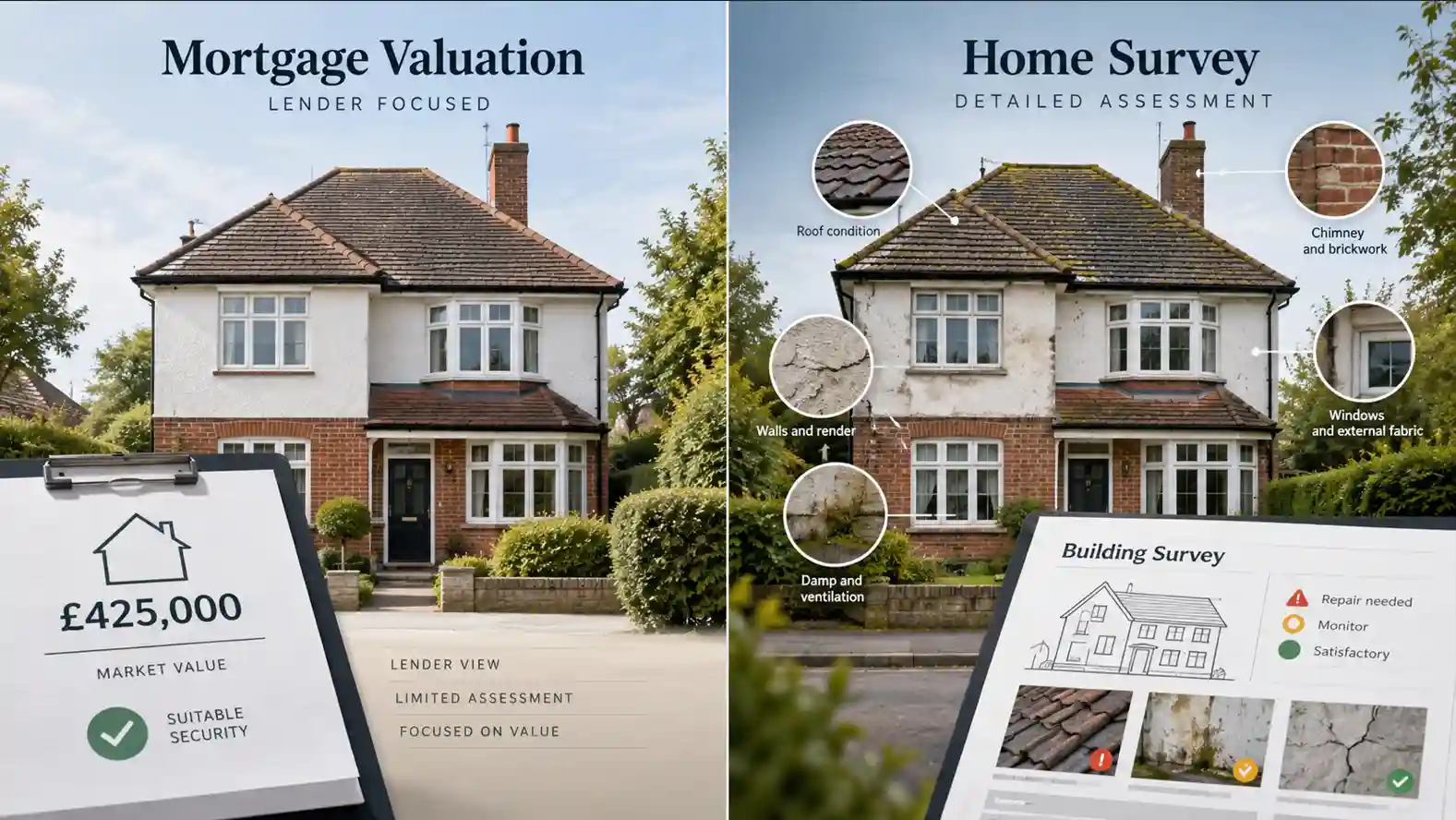
“Don’t worry, the mortgage company is doing a valuation” is one of the most common, and most costly, misunderstandings in the entire home-buying process.
A lender’s valuation and a buyer’s own survey sound similar, sometimes happen around the same time, and are frequently confused for one another — but they’re commissioned by different people, for different purposes, and answer entirely different questions.
Understanding the difference matters because it’s entirely possible to complete a purchase having had a mortgage valuation and nothing else, and only discover months later that nobody ever actually assessed the property’s condition on the buyer’s behalf.
Who each assessment actually serves
A mortgage valuation is commissioned by the lender, for the lender’s benefit.
Its job is to confirm the property is adequate security for the loan being offered — broadly, that it exists, appears to be roughly what it’s described as, and is worth enough to justify the amount being lent against it. The buyer may pay for it, or it may be included within the lender’s product, but it remains a lender check rather than a buyer service. RICS’s consumer guidance is explicit on the point: a mortgage or lender’s valuation is a limited check for the benefit of the lender, not the home buyer.
A home survey — whether Level 1, Level 2 or Level 3 under the current RICS Home Survey framework in England, Wales and Northern Ireland — is commissioned by the buyer, for the buyer’s benefit. Its job is to assess the property’s condition, identify visible defects and help the buyer understand what they are actually taking on, quite separately from whether a lender is willing to lend against it.
These are not two versions of the same check.
A property can easily be perfectly acceptable security for a mortgage while still having an ageing roof nearing replacement, damp that needs investigating, or other defects that matter enormously to the buyer but do not stop the lender feeling adequately protected. Equally, a property in good condition can sometimes present a lending concern for reasons that have little to do with day-to-day condition at all — an unusual construction type, for instance, or a valuation issue against comparable evidence.
For a buyer using a mortgage, that can mean both assessments happening during the same purchase. The lender arranges whatever valuation it requires for its lending decision, while the buyer separately decides whether to commission a survey for their own protection.
One does not replace the other because they are doing different jobs.
What a mortgage valuation actually involves
It may not involve a visit to the property at all.
A lender may choose a physical inspection, a desktop assessment using available data and comparable sales evidence, or a more automated approach, depending on the transaction and its own lending process. But even where a valuer does visit in person, the exercise is still not a condition survey.
That’s the crucial point.
The valuation is there to help the lender answer a lending question: is this suitable security for this loan, at this amount? MoneyHelper’s guide to buying costs puts it plainly: a mortgage valuation checks whether the property is worth the amount being paid or borrowed, and it is not a full structural survey.
So a buyer relying on a mortgage valuation for reassurance about condition is relying on something that was never designed to provide that reassurance in the first place.
That is why people can be caught out. The lender may be satisfied, the mortgage may proceed, and the buyer may understandably assume “someone has checked the house”. In reality, the lender has checked whether the property works for the lender.
That is not the same thing as checking whether it works for the buyer.
The valuation can still matter directly to the buyer. If the lender values the property below the agreed purchase price, it may be willing to lend less than the buyer expected, potentially leaving the buyer to find more cash, renegotiate the price or reconsider the purchase.
That is a financing problem. It still isn’t a substitute for understanding the property’s condition.
What a home survey actually involves
A home survey is specifically about condition.
Depending on the level chosen, a surveyor inspects visible and accessible parts of the property, reports on defects, flags anything that needs urgent attention or further investigation, and gives the buyer a much clearer picture of repair, maintenance and risk. This is the document that tells the buyer what condition the property appears to be in, what issues are visible, and what may need investigating or budgeting for after purchase.
That distinction becomes even more important because the language can overlap.
A buyer may hear the word “valuation” in several different contexts and assume they all refer to the same thing. They do not.
A lender’s valuation is the lender’s check for mortgage purposes. A Level 2 survey and valuation is a buyer-commissioned survey that includes both a condition assessment and the surveyor’s market valuation and insurance reinstatement figure. It is still fundamentally a buyer service, and it is still different from the lender’s own valuation process.
That overlap in terminology is one reason so many buyers confuse the two.
A hypothetical worked example
Consider a buyer purchasing a conventional 1930s semi at an agreed price of £320,000.
The lender arranges a desktop valuation, which confirms that £320,000 appears a reasonable reflection of value against nearby comparable sales. The mortgage proceeds without issue.
Separately, the buyer commissions their own Level 2 Home Survey. It identifies an ageing roof covering likely to need substantial work within the next five to ten years and recommends further investigation of a damp patch in one corner of the ground floor.
Nothing in that scenario is contradictory.
The lender’s valuation and the buyer’s survey were never answering the same question.
The lender confirmed the property looked adequate security for the loan. The survey told the buyer what they were actually taking on in terms of condition, risk and likely future spending. A buyer who relied only on the mortgage valuation could complete the purchase with no independent understanding of either issue.
Scotland: the starting point is different
In Scotland, the structure is different from the outset.
Sellers are generally required to provide a Home Report before marketing a property. According to mygov.scot, that report contains three parts: a Single Survey and valuation, a Property Questionnaire and an Energy Report. The Single Survey is based on a visual inspection by a chartered surveyor and tells prospective buyers about the home’s condition, accessibility, repairs and value.
That means a Scottish buyer usually starts from a different place than a buyer in England, Wales or Northern Ireland. Condition and valuation information already exist in one professional document before the offer is made.
That does not mean a Scottish buyer has no further decisions to make. If the Home Report raises concerns, if the property is unusual, or if the buyer wants a more detailed view for their own peace of mind, further advice or an additional survey may still be sensible.
But the starting point is not the same, and advice framed as though every UK buyer is choosing between a lender’s valuation and their first independent survey after offer acceptance is too England-and-Wales-centric to be reliable.
The point worth remembering
A mortgage valuation answers one question:
Is this adequate security for this loan?
A home survey answers a different, broader one:
What condition is this property actually in, and what does that mean for me as the person about to own it?
Treating the first as a substitute for the second is one of the most common and avoidable gaps in the whole home-buying process.
The lender’s concern is whether the property supports the lending decision. The buyer’s concern is whether the property, in its actual condition, still makes sense to buy.
Those are related questions.
They are not the same question.
Important: This article provides general information about mortgage valuations, home surveys and UK home-buying processes. It is not mortgage, legal, surveying or financial advice for a particular purchase. Survey options, lender practices and buying procedures can vary by property, lender and jurisdiction, and buyers should confirm the scope of any valuation or survey before relying on it.

