

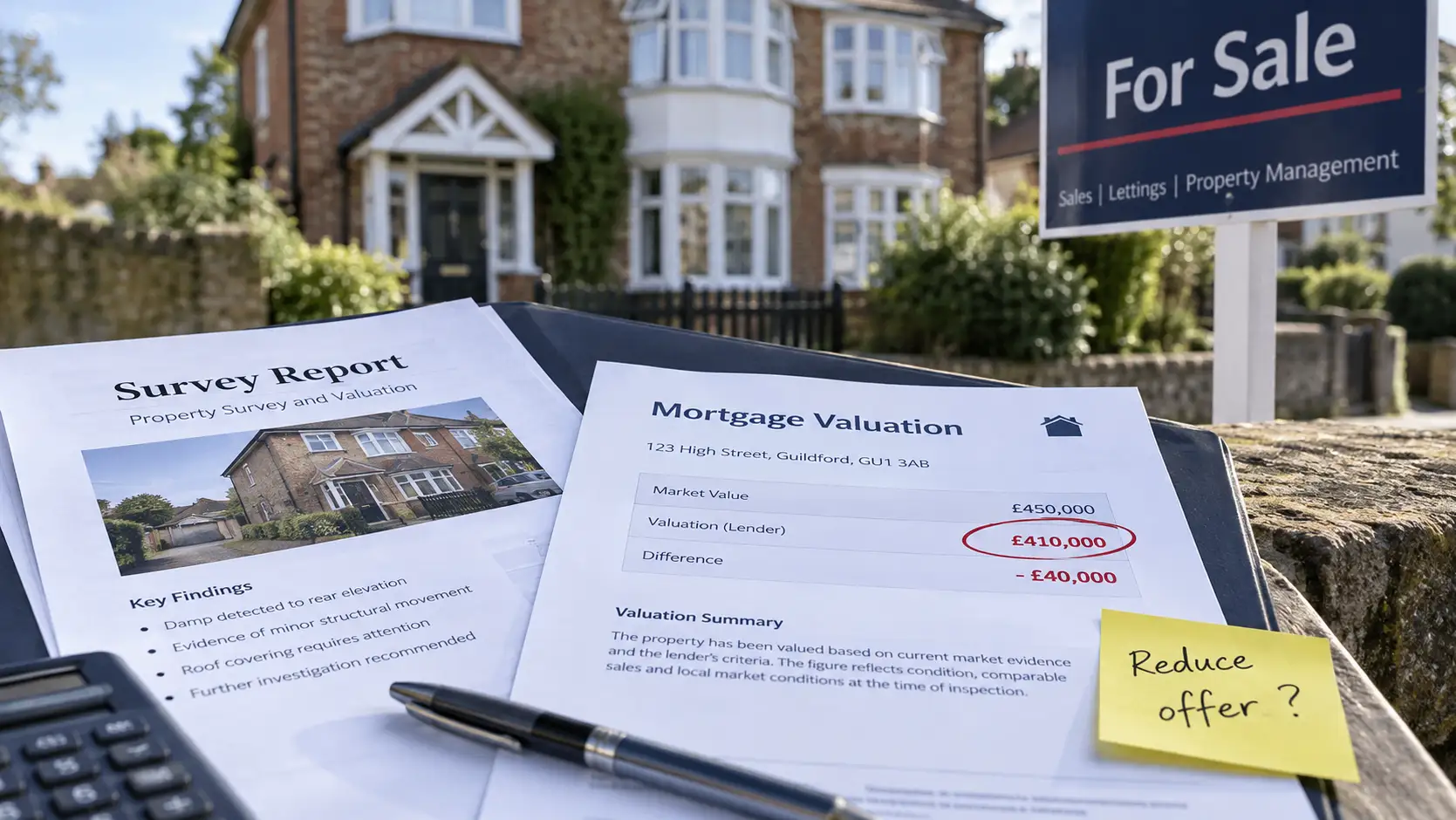
The offer was agreed weeks ago. Solicitors are instructed, a moving date has been mentioned in passing, and then the email arrives: the survey has flagged something, or the mortgage valuation has come back lower than expected, and the buyer wants a lower price.
The instinct is often to feel got at — as though the deal you agreed is being reopened after the fact. Sometimes that instinct is justified. Often it isn’t. The difference matters, because how you respond should depend on what has actually changed rather than simply how unwelcome the new number feels.
For a normal sale in England and Wales, the important legal background is that the agreed offer is not binding until contracts are exchanged. GOV.UK specifically recognises that an offer can be renegotiated before exchange, including where a survey identifies a significant problem. GOV.UK guidance on making and renegotiating an offer
That doesn’t mean every attempt to reduce the price is reasonable. It means the seller’s job is to separate a genuine change in the evidence from a buyer simply deciding they would now prefer to pay less.
Two different problems that feel the same
A survey-driven renegotiation and a mortgage down-valuation are often lumped together, but they are genuinely different situations.
A survey finding is new information — or sometimes more detailed information — about the property’s condition. The buyer’s surveyor may have identified damp, a roof defect, signs of movement, deteriorating services or maintenance that appears more significant than the buyer reasonably expected when making the offer. Renegotiation following a survey is not particularly unusual: RICS consumer research published in 2025 found that 23% of respondents who had commissioned a survey went on to negotiate the purchase price, while 21% sought further investigation from another professional. RICS research on how buyers use home surveys
A mortgage down-valuation is different. A lender’s valuation is principally carried out for the lender’s purposes, to assess the property being offered as security. It is not a substitute for a buyer’s condition survey and may not involve the same depth of physical inspection. RICS makes that distinction explicitly in its consumer guidance.
If the lender’s valuation is below the agreed purchase price, the practical problem is often financing rather than condition. Depending on the lender and mortgage product, the amount available to the buyer may be calculated using the lower valuation, leaving the buyer needing a larger deposit, a different mortgage arrangement or a lower purchase price. Both situations can therefore produce the same email to the seller — we need to renegotiate — while arising for entirely different reasons.
Ask for the evidence before you decide anything
If the request follows a survey, ask the estate agent what has actually been identified and for the buyer to share enough evidence for you to understand the request. That might mean an extract from the report, photographs, a specialist assessment or quotations for the work rather than necessarily the buyer’s entire survey.
That distinction matters. In England, Wales and Northern Ireland, the prospective buyer commissions and receives the survey report. A seller can reasonably ask for evidence before considering a substantial reduction, but should not assume the buyer will simply hand over the full report. Relevant extracts, photographs, specialist findings or quotations may tell you everything you need to know about the point being negotiated.
It is also worth asking whether the survey has genuinely uncovered something new. An ageing roof that was visibly nearing the end of its life, or a defect that was specifically disclosed before the buyer made their offer, is not quite the same as a survey discovering a serious problem nobody reasonably knew existed. New evidence showing that a known issue is materially worse than expected can still change the position, but the buyer should not automatically be able to price the same information twice.
There is a similar distinction between a diagnosed defect and a recommendation for further investigation. The latter should not simply be dismissed as a surveyor protecting themselves. RICS guidance explains that further investigation may properly be recommended where part of a property could not be adequately inspected or specialist expertise is needed before the issue can be assessed with confidence. That means “further investigation recommended” is not automatically evidence that a £10,000 reduction is justified, but nor is it meaningless. It is a reason to establish what the uncertainty actually is before either side tries to put a price on it.
If the buyer has produced a repair quotation, look at what it actually covers. One quotation is evidence, but not necessarily the final word on reasonable cost. For a substantial claim, obtaining another specialist opinion can be worth considerably more than negotiating thousands of pounds on the basis of an estimate nobody has tested.
A down-valuation calls for a different conversation. Ask what valuation the lender has actually returned and, crucially, what effect that has had on the buyer’s mortgage. A buyer saying “the bank valued it £15,000 lower” tells you less than knowing whether that £15,000 has created an actual funding shortfall they cannot bridge.
What a down-valuation can do to the buyer’s numbers
Consider a simplified example. A property is agreed at £300,000 and the buyer intended to use a £30,000 deposit with a £270,000 mortgage — effectively borrowing 90% of the agreed price.
If the lender instead values the property at £285,000 and will lend no more than 90% of that valuation, the maximum mortgage would be £256,500. Keeping the purchase price at £300,000 would therefore require the buyer to find £43,500 themselves rather than £30,000 — an additional £13,500.
The exact outcome depends on the lender, mortgage product and buyer’s circumstances, but the example shows why a down-valuation can turn into a renegotiation even when the buyer still believes the home is worth what they originally offered. Some lenders explicitly explain that a lower valuation may reduce the amount they are prepared to advance or alter the mortgage product available. Nationwide explanation of mortgage down-valuations
That does not oblige the seller to make up the difference. The buyer may be able to contribute more cash, change mortgage arrangements or, depending on the lender’s process, challenge the valuation with appropriate comparable evidence. But understanding the arithmetic tells you whether you are dealing with an opportunistic request or a genuine financing problem.
If the valuation looks questionable, ask your estate agent for recent completed sales of genuinely comparable properties, not merely current asking prices. Where the gap is substantial and the evidence remains contested, an independent valuation from an appropriately qualified valuer may provide more useful evidence than repeated reassurance that the property “should be worth” the agreed figure.
Would the same problem come up with the next buyer?
One of the most useful questions a seller can ask is whether the same issue is likely to reappear if this transaction collapses.
A significant structural defect, persistent damp problem, defective roof or other identifiable issue is unlikely to disappear because this buyer walks away. The next buyer may commission their own survey and reach a similar conclusion. The same applies to a down-valuation that appears well supported by recent comparable transactions: if one lender has reached a lower figure and the local evidence points in the same direction, starting again may simply reproduce the same argument several weeks later.
That changes the calculation. A reasonable, evidence-based compromise with the buyer already committed to the transaction can make more sense than losing them and returning to market with the underlying problem unresolved. The reverse is also true: if the survey request is based on an uncertain issue that has not been investigated, the repair estimate is poorly supported, or the lender valuation appears inconsistent with strong comparable sales, there is nothing unreasonable about challenging the request or holding the agreed price.
What matters is not whether the buyer has produced a survey or mentioned their lender. It is whether the evidence behind the revised offer survives scrutiny.
A repair bill and a price reduction are not the same thing
The cost of putting something right and the appropriate adjustment to the sale price are not necessarily identical.
Suppose a survey says an ageing roof may require replacement and the buyer obtains a quotation for £15,000. That does not automatically establish that the seller should reduce the agreed price by £15,000. The age and condition of the roof may already have been apparent when the property was marketed and reflected in its price, and replacing an old roof with a new one leaves the buyer with something materially better than the ageing roof they originally expected to acquire.
At the other extreme, a serious defect that was not apparent when the buyer offered — and which substantially affects the property’s value or requires unavoidable expenditure soon after completion — may provide a much stronger basis for renegotiation. The useful question is therefore not simply what will the repair cost? It is also what did the buyer reasonably think they were buying at the agreed price, and what has the survey genuinely changed?
Even where the seller accepts that the problem is real, the answer does not always have to be a price reduction. You might agree part of the reduction, obtain further evidence or offer to complete clearly defined work before completion. But if contracts have not been exchanged, spending substantial money on buyer-requested work does not itself guarantee that the buyer will proceed.
Before agreeing to repairs, establish exactly what work is expected, whether the buyer and their lender will regard it as resolving the problem, what invoices, guarantees or specialist certificates will be required, and whether somebody needs to inspect the work afterwards. Otherwise a seller can spend money solving one version of the problem only to discover that the buyer’s surveyor, solicitor or lender requires something different.
In some cases, a clean price adjustment will be commercially simpler. In others, carrying out a tightly defined repair removes an objection that could recur with every subsequent buyer. Which is preferable depends on the defect, the evidence and how much certainty each solution actually buys.
Watch for the pressure that has nothing to do with the evidence
The hardest part of this situation often isn’t the negotiation itself — it’s the position you’re in by the time it arrives. If you’ve already spent money on your own legal work, if your onward purchase depends on this sale completing, or if you’re deep into a chain that took months to assemble, the temptation to agree simply to keep everything moving can be strong. The buyer may be under pressure too: a lender has changed the financial assumptions behind their purchase, or a survey has raised something they did not budget for.
A £5,000 reduction that makes commercial sense because a genuine defect has changed the value proposition is one decision. The same £5,000 accepted solely because everybody is exhausted and terrified of breaking the chain is another. That does not mean the second decision is necessarily wrong — sometimes preserving a good buyer and an important onward purchase is worth more to a seller than extracting the final few thousand pounds — but it should be recognised as a commercial compromise rather than retrospectively justified by a survey finding that did not really warrant it.
Know what you would do if the buyer walks away
Before responding, ask yourself one slightly uncomfortable question: what is my realistic alternative?
If you reject the reduction and the buyer withdraws, how quickly could the property sell again? Has the market moved since the original offer? Were there other credible buyers? Would another survey probably raise the same issue? Would losing this transaction threaten your onward purchase? How much additional mortgage interest, council tax, legal cost and disruption might another two or three months create?
Those questions do not mean you should accept a weak renegotiation. They simply put the disputed amount in context. The buyer has an alternative to consider too: they have already spent money, invested time in the transaction and may have limited alternatives that suit them as well. A request for a reduction is not the same thing as a threat to walk away, and sellers should be wary of negotiating against themselves before discovering how strongly the buyer actually feels.
The range of reasonable responses
Depending on what the evidence shows, a seller might accept the revised price, offer part of the requested reduction, obtain further evidence, agree defined remedial work, hold the original price or decide that losing the buyer is preferable to accepting the new terms. None is automatically the right answer.
If an agreement is reached, make sure the revised figure and any agreed work are recorded clearly through the estate agent and conveyancers rather than leaving several slightly different versions circulating through the chain. What is worth avoiding is agreeing under pressure before understanding why the buyer is asking.
A buyer with a genuine, well-supported problem should be able to explain what has changed. A seller with good evidence for holding the price should be able to do the same. The strongest negotiation is therefore rarely the quickest “yes” or the angriest “no”. It is the point at which both sides understand what the new information actually changes — and what it doesn’t.
Scotland and Northern Ireland
The main discussion above most closely reflects the transaction process in England and Wales.
Northern Ireland also commonly involves the buyer arranging a survey after an offer has been accepted, with the transaction becoming legally binding at exchange of contracts. Nidirect separately distinguishes the buyer’s condition survey from the mortgage lender’s valuation. Nidirect guide to the Northern Ireland buying process
Scotland operates differently. A seller normally provides a Home Report before the property is marketed, including a Single Survey and valuation, so much of the property’s condition information is available before the buyer submits the formal offer. The contract becomes binding when missives are concluded. A later specialist investigation or lender valuation can still cause difficulty before that point, but the timing and negotiation process should not simply be assumed to mirror England and Wales. mygov.scot guide to the Home Report mygov.scot guide to offers and missives
Important: This article provides general information about residential property negotiations and is not personalised legal, surveying, valuation or financial advice. The main article principally describes the pre-exchange process in England and Wales. Property transaction procedures differ in Scotland and Northern Ireland. If contracts or missives are already binding, or the dispute involves a significant structural issue, mortgage condition or contractual commitment, obtain appropriate professional advice before changing the agreed terms.

