

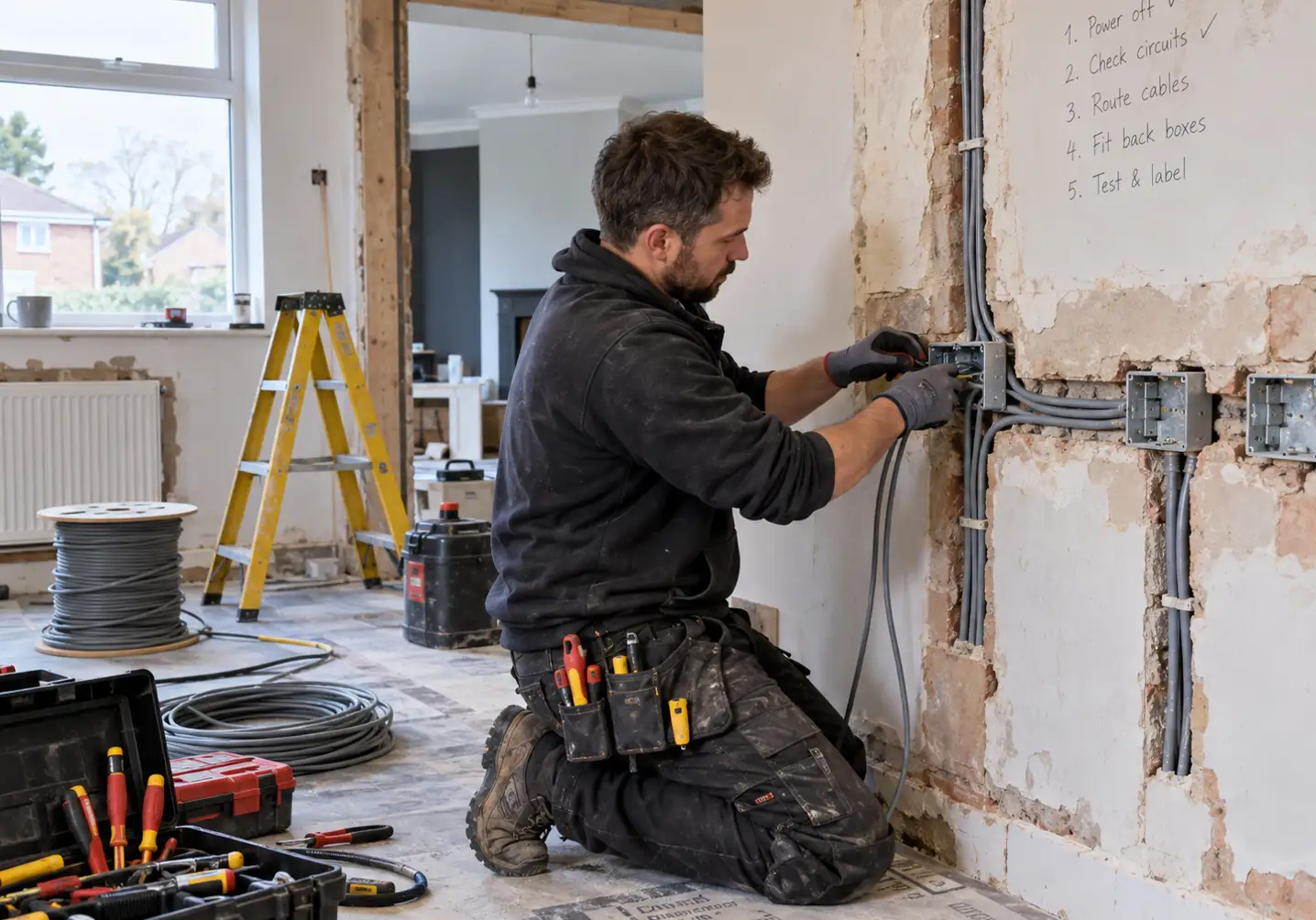
Someone’s looked at your consumer unit, or your old sockets, or simply learned how old the house is, and said the word “rewire.” Before that becomes a quotation running into thousands of pounds, it’s worth asking a more precise question than the one usually asked: not “is this house old enough to need rewiring,” but “what’s the actual evidence that it does?”
Age alone doesn’t answer the question
“The house is fifty years old, therefore it needs rewiring” is a common shorthand, and treating it as a rule rather than a rough guide leads people astray in both directions.
It’s entirely possible for a much-altered older property to have had its wiring substantially replaced at some point without an obvious visible sign of it — during a renovation, an extension or work commissioned by a previous owner. It’s equally possible for a much newer installation to contain genuinely unsafe defects through poor workmanship, inappropriate alterations, damage or deterioration.
Age is therefore a reasonable prompt to investigate. It isn’t, on its own, a diagnosis.
Electrical Safety First recommends periodic inspection of domestic electrical installations and says installations more than 50 years old should be checked and updated where necessary. The important words are checked and updated where necessary — not automatically stripped out because they’ve passed a particular birthday.
The consumer unit is a clue, not the whole answer
This distinction is worth understanding clearly, because it cuts in two directions that trip people up equally often.
An old-style consumer unit — particularly one with rewireable fuses, a wooden back or no apparent RCD protection — is a genuine reason to look more closely at the installation. Electrical Safety First’s guidance on older electrical installations identifies wooden-backed fuse boxes, older protective devices and a lack of modern RCD protection among the signs that an installation deserves professional assessment.
But an old consumer unit doesn’t automatically prove the entire house needs rewiring. Electrical Safety First is equally clear elsewhere in its consumer guidance that an older fuse box, by itself, doesn’t necessarily mean the installation is unsafe or must be replaced; an inspection establishes its actual condition.
The reverse assumption is where people get caught out too: a modern-looking consumer unit, with neat circuit breakers and visible RCD or RCBO protection, doesn’t prove that all the wiring behind it is equally modern.
Consumer units are replaced for many reasons, and an older installation may have had a new board fitted while significant parts of the original cabling remained in service. Whether those circuits are safe depends on their construction, condition and test results — not how modern the box on the wall looks.
The consumer unit is the part of an electrical installation most homeowners can actually see. It isn’t a certificate of health for everything connected to it.
Visible clues worth noting, without inspecting anything hidden or live
Without touching, opening or disturbing electrical equipment, there are several visible signs that reasonably justify a professional assessment.
Older round-pin sockets and round switches, sockets mounted in skirting boards, braided flex at older light fittings, and visible cable insulated with materials such as black rubber, fabric or lead sheathing all point towards an installation — or at least parts of one — dating from an earlier generation of wiring.
They don’t tell you exactly when it was installed, and they don’t prove that every circuit in the house is the same age. They do tell you that assuming the installation is modern would be unwise.
Electrical Safety First specifically identifies black rubber, lead or fabric-covered cable, older round-pin sockets, braided flex and skirting-mounted sockets as age indicators. Rubber-insulated and lead-sheathed cables deserve particular professional attention because deterioration can make them unsuitable for continued service or even vulnerable to damage when disturbed.
That doesn’t mean going into an unboarded loft looking for old cable, pulling fittings away from walls or removing socket fronts to see what’s behind them. If these materials are already visible safely, note them and show the electrician.
Beyond visible age clues, repeated electrical faults matter too: unexplained circuit-breaker or RCD tripping, crackling or buzzing, scorching, discolouration, excessive heat from sockets or switches, or persistent flickering that isn’t explained by a single lamp or fitting all justify proper investigation.
A property that’s accumulated extensive alterations over decades without meaningful records or certification can also warrant closer inspection. That doesn’t automatically condemn the wiring, but it makes a professional assessment much more valuable than trying to infer the installation’s condition from appearances.
The EICR: the actual tool for answering this question
An Electrical Installation Condition Report is specifically designed to assess whether an existing fixed electrical installation is satisfactory for continued use.
A suitably competent electrician carries out inspection and electrical testing of the fixed installation — including circuits, protective devices, earthing and bonding and accessible electrical equipment — and records deterioration, defects, dangerous conditions and other observations.
This is fundamentally different from somebody looking at a fuse box for five minutes and giving you a quotation for a rewire.
It’s also important to understand what an EICR doesn’t do. It isn’t a requirement for an older home to be rebuilt electrically so that every part suddenly matches every detail of today’s wiring standard.
Electrical standards aren’t retrospective in that way. An installation designed correctly to an earlier edition of the Wiring Regulations isn’t automatically unsafe simply because BS 7671 has subsequently changed. The purpose of an EICR is to assess whether the existing installation is safe for continued service and to identify defects or improvements that matter now. The IET specifically confirms that an installation complying with an earlier edition isn’t necessarily unsafe merely because newer requirements exist.
The classification codes tell you how seriously individual observations need to be treated.
A C1 means danger is present and immediate action is required to remove that danger.
A C2 means the condition is potentially dangerous and urgent remedial action is required.
A C3 means improvement is recommended. It is not, by itself, a finding that the installation is unsafe.
An FI means further investigation is needed because the inspector can’t yet reach a proper conclusion about a particular issue. Crucially, an FI doesn’t mean “full rewire required”. It means more information is needed.
There is a temporary wrinkle worth knowing because of the timing of the current Wiring Regulations. BS 7671:2018+A4:2026 was published on 15 April 2026 and becomes the sole current edition on 15 October 2026. During the six-month transition, an electrician can legitimately issue an EICR using either the previous edition or Amendment 4.
Under the new Amendment 4 format, C1 and C2 findings make the overall report unsatisfactory, while C3 and FI observations do not by themselves make it unsatisfactory. Earlier EICR forms treated FI differently. If you’re looking at a report issued during this 2026 transition period, check which edition is stated on it rather than assuming two differently formatted reports are contradicting each other. The IET’s explanation of the 2026 EICR changes explains the revised treatment of FI.
What none of these codes does is automatically prescribe a complete rewire. The code identifies the seriousness of an observation; the remedial work should address what the testing actually found.
The spectrum between “fine” and “full rewire”
This is genuinely one of the most important things to understand before authorising expensive work: a full rewire is one point on a spectrum of possible responses, not the automatic outcome of finding an electrical problem.
An inspection might identify one defective accessory that needs replacing. It might show that additional RCD protection would improve safety. It might justify replacing an outdated consumer unit while retaining circuits that test satisfactorily. One deteriorated circuit might need replacing while the rest remain serviceable. Several parts of the house might justify a partial rewire.
And, at the other end of the spectrum, the testing may show widespread deterioration or unsafe wiring across enough of the installation that replacing it systematically is more sensible than attempting to preserve individual fragments.
The evidence matters more than the label:
| What the evidence shows | What it may justify | Does it prove a full rewire is needed? |
|---|---|---|
| Older consumer unit or absence of some modern protection, but existing circuits test satisfactorily | Safety upgrade or consumer-unit work may be recommended | No |
| One isolated C1 or C2 defect | Make that danger safe and carry out appropriate remedial work | No, not by itself |
| One circuit has significant deterioration or fails relevant testing | Repair or replacement of that circuit may be appropriate | Not necessarily |
| Several circuits contain genuinely deteriorated older cable or repeatedly produce unacceptable test results | Partial or extensive rewiring becomes more plausible | Possibly |
| Widespread deterioration across the installation, with multiple circuits unsafe or unsuitable for continued service | A complete rewire may be the most proportionate solution | This is the kind of evidence that can justify one |
| C3 recommendations only | Improvements may raise the installation to a higher modern safety standard | No |
That table isn’t intended to override the judgement of the electrician who has inspected and tested the installation. Its purpose is to make one distinction very clear: finding electrical defects and proving that the whole house needs rewiring are not the same thing.
The question worth asking before authorising a full rewire
If a full rewire has been recommended, it’s entirely reasonable — and genuinely useful — to ask directly:
What specific inspection and test evidence shows that the installation needs replacing throughout, rather than repairing or replacing the circuits that have actually failed?
A competent recommendation should be capable of being explained in those terms.
If the answer is widespread deterioration of old insulation, consistently poor test results across numerous circuits, unsafe alterations throughout the property or several circuits no longer suitable for continued service, a full rewire can be a rational and defensible recommendation.
If the argument amounts largely to “the house is old”, “the fuse box looks dated” or “I’d replace the lot while we’re here”, it’s reasonable to ask for the evidence behind that conclusion before committing several thousand pounds.
It’s also reasonable to ask what can safely be retained. A full-rewire quotation tells you what somebody proposes to replace; the EICR and test results should help explain why retaining the existing installation isn’t the sensible alternative.
Where the cost is substantial and you’re genuinely uncertain whether the evidence supports it, commissioning an independent EICR or getting a second opinion from another electrician competent in inspection and testing can be money well spent.
Electrical Safety First’s registered electrician search covers appropriate registration schemes across England, Wales, Scotland and Northern Ireland and allows you to search specifically for contractors carrying out inspection and reporting work.
What it tends to cost
Electrical costs vary considerably by property, specification, location and how disruptive the work is, so national figures should be treated as planning numbers rather than quotations.
Current 2026 figures from Checkatrade’s UK house-rewiring cost guide put a typical three-bedroom house at roughly £4,450 to £8,000, with an average figure around £6,225 before VAT. A five-bedroom property can move well beyond £10,000, while smaller flats and houses can cost materially less.
An EICR is a much smaller commitment. Current 2026 commercial pricing guides put typical residential EICRs at roughly £100 to £250, depending on property size, number of circuits and complexity.
A standalone consumer-unit replacement can similarly be far cheaper than a rewire where the existing circuits are otherwise suitable. Current guide figures put a straightforward replacement broadly around £350 to £800, depending on circuit count, specification and whether defects have to be rectified as part of the work.
Those numbers explain why establishing the actual scope first matters financially. There is a very large difference between paying for professional testing, replacing one deficient circuit, upgrading a consumer unit and rewiring an entire occupied house.
What drives the full-rewire figure isn’t just the cable. Property size and layout matter; so does the number of sockets, lighting points and circuits being installed. An occupied and furnished home is harder to work through than an empty property. Solid floors, decorative finishes and difficult access can increase labour significantly.
And making good deserves particular attention. Chasing walls and lifting or accessing floors can leave plastering, decorating and sometimes flooring work behind. Some electrical quotations include limited making good; others effectively finish once the wiring is electrically complete. Two quotations can therefore differ by thousands of pounds while neither contractor is necessarily expensive or cheap — they’re simply pricing different finished outcomes.
Ask for an itemised written quotation that makes clear the electrical specification, number and location of outlets, consumer-unit work, testing and certification, removal of old wiring where applicable, and exactly what making good is included.
If significant electrical work proceeds, also establish what electrical certificate you’ll receive on completion and whether any building-standards or building-control notification applicable in your part of the UK is included in the contractor’s service. The administrative arrangements aren’t identical across all four nations, so this is another reason to use an appropriately registered contractor rather than assuming one process applies everywhere.
If you’re buying or selling
Rewiring questions come up constantly during property transactions, particularly when a survey notes an old consumer unit, dated fittings or an electrical installation whose condition couldn’t be established during the survey.
A normal building survey isn’t a substitute for an EICR. If electrical condition genuinely matters to the purchasing decision and there isn’t a sufficiently recent report available, an electrical inspection gives you substantially better evidence than assuming the installation needs rewiring because a surveyor noted that it appeared old.
How that evidence should then influence an offer, renegotiation or request for work before completion is a separate buying-and-selling question and is covered properly in Property Front Page’s Buying & Selling section rather than expanded here.
The decision, stated plainly
A house doesn’t need rewiring simply because it’s old, and a modern-looking consumer unit doesn’t prove the wiring behind it is safe.
Equally, an installation doesn’t have to be visibly falling apart before replacement can be justified. Electrical defects are often hidden, which is precisely why inspection and testing matter more than appearance.
What justifies spending thousands on a complete rewire is specific evidence that the installation is sufficiently and widely deteriorated, unsafe or unsuitable for continued service that targeted repair no longer makes sense.
An EICR gives you that evidence in a form you can interrogate. Which circuits failed? What codes were recorded? What did the electrical testing actually show? Which parts can safely remain? Why is complete replacement preferable to a smaller scope?
Those are much more useful questions than asking whether the house has reached an age at which rewiring is supposedly “due”.
This article provides general property information, not an assessment of your specific electrical installation. Electrical standards and building-control arrangements can change, and the correct scope of work depends on inspection and testing of the individual property. Use a suitably competent registered electrician for EICRs and significant electrical work, and obtain itemised written quotations before committing to a rewire.

