

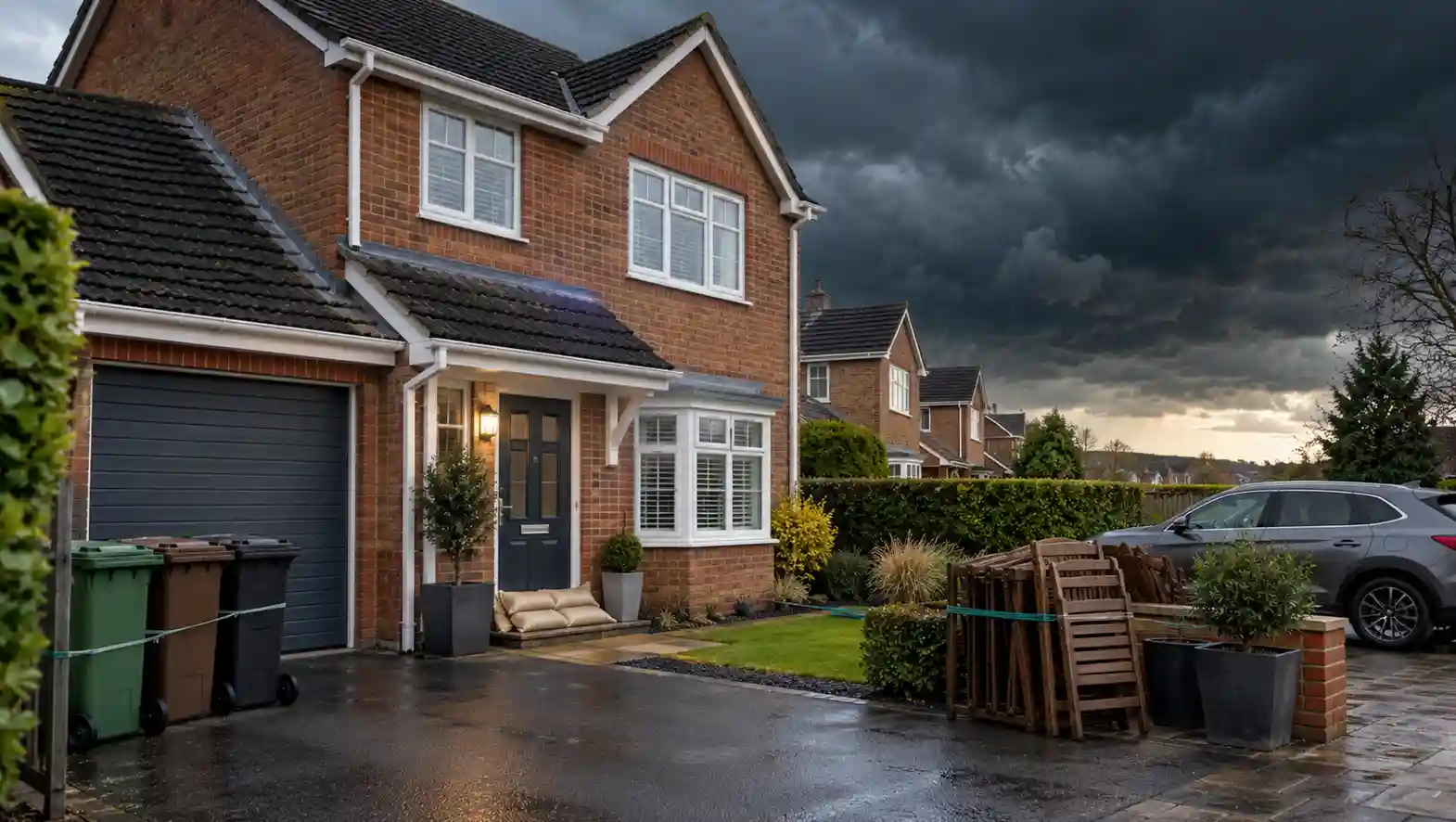
There are two very different kinds of “getting ready for a storm”. One happens months before any warning is issued — the maintenance that keeps a roof, gutters, fences, drainage and trees from becoming the weak points severe weather will find. The other happens when a particular warning covers your area, when the job changes from repairing the property to securing what’s already there and preparing for whatever disruption the forecast is actually describing.
Confusing the two is how people end up considering a loose ridge tile, unstable fence or questionable tree branch on the afternoon the wind is already strengthening. Some defects can still be dealt with professionally while conditions are safe and there is sufficient time, but a weather warning is a poor reason to begin rushed DIY work at height that should have been ordinary maintenance weeks earlier.
There is another distinction worth making at the outset. A named storm is not, by itself, an instruction to perform the same checklist everywhere. One area may be facing the strongest winds, another prolonged rain and surface-water flooding, while somewhere else the most likely consequence may be power or travel disruption. The useful starting point is therefore the warning for your location and the impacts it describes, not simply the storm’s name.
The maintenance that should already be done
Severe weather does not need to create a defect from scratch to cause damage. It can exploit something that was already deteriorating: a slipped tile, failing gutter bracket, decayed fence post, damaged branch or poorly maintained chimney. Routine maintenance cannot make a property storm-proof, but it removes many of the weaknesses that otherwise give wind and rain an easier place to start.
A roof is the obvious example, but this does not mean climbing onto it to perform a seasonal inspection. From ground level, look for visibly slipped, missing or damaged tiles and slates, an obviously disturbed ridge line, deteriorating chimney masonry that can genuinely be seen, gutters pulling away from their brackets and other clear changes in condition. If there is reason to suspect something that cannot be assessed safely from the ground, arrange an appropriate inspection in ordinary weather rather than discovering the problem for the first time because a storm has appeared in the forecast.
Gutters, downpipes and gullies deserve attention for more than cosmetic reasons. Leaves, moss and debris reduce the amount of rainwater the system can move and can make overflowing more likely during prolonged or intense rain; loose brackets and sagging sections also give high winds more to work on. Check that downpipes discharge as intended and that the gullies receiving them are not already blocked, particularly where the property has a history of water collecting close to the building.
Fences, gates, sheds and lightweight outbuildings need the same sort of honest appraisal. A gate hanging from a failing hinge or a fence post that moves substantially in normal weather is not a storm-preparation job waiting to happen: it is already a maintenance job. There is also an insurance angle worth remembering without turning routine repairs into a claims exercise — fences and gates are not covered against storm damage by every home policy, so it is worth knowing what your own policy actually says rather than assuming everything outside the house is treated in the same way.
Trees require rather more judgement. A branch overhanging a house or neighbouring garden is not automatically dangerous merely because it is overhead. Dead, damaged or structurally suspect limbs, obvious instability or other signs of deterioration are more meaningful reasons for assessment, and an appropriately competent arborist can investigate them in safe weather rather than somebody attempting improvised tree work when strong wind is already forecast.
Chimneys, aerials, satellite equipment and anything else exposed above the main roof line belong on the same side of the divide. If they need inspection or repair, routine maintenance is the time to do it. Storm preparation should reduce the number of unresolved questions left once conditions begin to deteriorate, not create a deadline for doing hazardous jobs quickly.
That distinction is slightly different if you do not control the whole building. A leaseholder may have no authority to repair the block’s roof, gutters or communal trees; a tenant should not be expected to diagnose or repair structural defects belonging to the landlord. In those situations, useful preparation means reporting visible defects early, keeping a record of them and knowing who controls common parts and emergency repairs before severe weather creates an urgent problem.
What actually makes sense once a warning is issued
The first job when a warning covers your area is not to start moving garden furniture. It is to read the warning.
The Met Office’s warning system considers both the potential impact and the likelihood of those impacts. Yellow warnings can represent quite different combinations of those two factors, while amber and red warnings require progressively more attention and action. Warnings can also combine hazards — for example wind and rain — so the colour alone never tells you everything you need to know. Met Office weather warnings guide
That immediately makes the next decisions more useful. If strong wind is the principal concern, loose outdoor objects deserve attention first: bins, ladders, garden furniture, pots, children’s play equipment and trampolines should be brought inside where practical or properly secured before conditions worsen. Doors and windows should be fully closed and fastened, including large openings such as garage doors, rather than simply pulled to.
Current national preparedness guidance also contains several less obvious precautions. It advises securing loft trapdoors, particularly where the roof pitch is below about 30 degrees; parking vehicles in a garage where available or otherwise clear of buildings, trees, walls and fences; and moving beds away from directly below tall chimney stacks known to be in poor condition. Those are unusually specific recommendations, but they remain part of current official UK storm guidance. UK government storm preparedness guidance
Power disruption deserves preparing for before anything goes off. Charge phones and power banks, make sure a battery or wind-up torch is actually usable and know how you would obtain information if broadband and mains electricity disappeared. Government preparedness guidance specifically recommends torches rather than candles and gives the power-cut reporting number as 105 in England, Scotland and Wales and 03457 643643 in Northern Ireland. People who depend on powered medical or telecare equipment have a stronger reason to check backup arrangements before severe weather arrives. UK government power-cut preparedness guidance
It is also sensible to have the insurer’s emergency contact details and policy number somewhere accessible without relying solely on an online account. The point is not to prepare a claim before anything has happened, but to remove an unnecessary problem if a power or broadband outage coincides with actual damage.
If the warning includes a credible flood risk, the priorities change again. Vehicles, sentimental or valuable possessions at low level and anything particularly vulnerable to water may need moving while conditions are still safe. Existing flood doors, barriers or air-brick covers should be deployed according to their instructions rather than discovered for the first time as water approaches, and householders should already know where their main water, electricity and gas controls are. GOV.UK’s flood guidance also links to the separate arrangements for Scotland, Wales and Northern Ireland, which matters because flood-warning systems and agencies differ across the UK. GOV.UK guidance on what to do before or during a flood
This does not mean every named storm requires flood barriers, batteries and a garden evacuation. It means the useful preparation is impact-led. Strong wind, prolonged rain, coastal flooding and power interruption create overlapping but different priorities, and the warning tells you which ones deserve attention at your property.
For vulnerable neighbours or relatives, the useful moment to check in is before the worst of the weather. Somebody who cannot easily secure an outdoor item, collect medication or prepare for a power cut may need practical help while travelling and working outside are still safe.
What to leave alone once conditions turn
There is a point beyond which “storm preparation” stops protecting the property and starts exposing somebody to unnecessary risk. Once strong winds, heavy rain or dangerous conditions have arrived, roof access, ladders and emergency tree work are no longer sensible property-maintenance decisions. Official storm guidance is explicit that people should not go outside to repair property damage while the storm is in progress.
The dividing line is the actual conditions, not the mere existence of a forecast. A warning issued well in advance does not magically make every ladder unsafe, and a competent contractor may still be able to carry out planned work before the weather deteriorates. What does not make sense is allowing the warning itself to create pressure for a homeowner to climb onto a roof, cut a branch or improvise a chimney repair because there suddenly appears to be a deadline.
The same judgement applies to loose outdoor objects. Securing the trampoline while conditions are calm is preparation; chasing it across a garden once high winds have arrived is not. If something was missed, accept that the property may sustain some damage and deal with it when it is safe rather than turning a repair bill into an injury.
Floodwater has its own hard boundary. Moving a vehicle before water reaches the road may be sensible; driving through floodwater to save it later is not. Turning off services can also be appropriate before flooding where official advice recommends it, but electrical switches should never be operated while standing in water.
Routine, warning-stage and off-limits
| Timing | What makes sense | What should normally wait |
|---|---|---|
| Routine maintenance, before any warning | Repair known roof, gutter, fence and gate defects; investigate questionable chimneys or trees; keep rainwater drainage functioning; report common-part defects if somebody else controls the building | Nothing should need to be rushed simply because a storm may occur later in the season |
| Warning issued, while conditions remain safe | Read the actual impacts; secure loose objects; fasten doors, windows and garage doors; secure the loft hatch; charge devices; prepare for outages; move vehicles where appropriate; deploy existing flood protection if flooding is forecast | Rushed DIY roof, ladder, chimney or tree work; unfamiliar repairs being attempted simply because a warning has created urgency |
| Dangerous weather has arrived | Stay somewhere safe, monitor official information and deal only with actions that can genuinely be performed without exposure to the conditions | Roof access, ladders, tree work, outdoor repairs, retrieving unsecured objects or entering floodwater to protect possessions |
The purpose of the table is not to create a comprehensive storm checklist. It is to keep the timing distinction visible. A task either belongs in normal maintenance, in the safe preparation window, or in the category that now has to wait.
Rental, multi-occupied and commercial property needs a plan before the warning
The same logic becomes more important where one person does not control everything. A landlord may own the building but not be present; a letting agent may be coordinating several properties at once; a managing agent may control a block’s roof, trees and common areas while residents control only their own balconies and possessions. Once a warning is issued, uncertainty about who is supposed to secure something can waste more time than the physical job itself.
For rental and multi-occupied buildings, the practical questions are therefore organisational as well as physical. Who checks that vulnerable common doors and gates are secure? Who has access to plant rooms or roof spaces if a pre-storm check is genuinely needed? Who contacts residents if a communal area needs clearing? Which defects are the tenant’s responsibility to report rather than repair? Those arrangements are much easier to establish as part of normal property management than during the final hours before severe weather.
Vacant properties deserve particular attention because nobody may be there to notice an unsecured gate, open window or developing leak. A landlord or agent managing an empty home should know whether a safe pre-storm visit is warranted and who can attend if the owner is elsewhere, rather than discovering after the event that nobody had responsibility for checking it.
Commercial premises apply the same discipline at larger scale. Loading doors, roller shutters, external signage, bins, temporary structures, outdoor stock and exposed equipment can all become problems in severe wind, while sites at risk of flooding may need vulnerable stock, records or equipment moved before water arrives. Rooftop plant and signage should already be maintained; a storm warning is not the moment to send staff onto a roof for an improvised inspection.
What matters operationally is having trigger points rather than vague intentions. If the forecast reaches a level where a site may close, somebody should already know who makes that decision, who contacts staff and customers, what must be secured before people leave and what happens if power, communications or access are lost. That is the commercial version of repairing the loose tile in good weather: the best response is the one where the important decisions were made before conditions made them harder.
Preparation is mostly about timing, not effort
The genuinely useful distinction is not between doing a lot and doing a little. It is between doing the right job at the right time.
Repairing a known roof defect in calm weather is maintenance. Securing garden furniture once damaging wind is forecast is storm preparation. Climbing onto the roof after the weather has deteriorated is neither. The same sequence applies to flooding: keeping gutters and drainage functioning is routine care, deploying flood protection or moving possessions belongs in the warning window, and entering dangerous water to rescue something afterwards is exactly the situation good preparation is intended to avoid.
A well-prepared property is therefore rarely the one where somebody worked hardest in the final few hours. It is the one where ordinary maintenance had already removed the obvious weaknesses, responsibility for shared or rented property was already clear, and the owner or occupier read the actual warning impacts rather than reacting to a storm name or colour in isolation.
That is what preparation really buys: fewer urgent decisions at exactly the point when the weather makes bad ones more dangerous.
This article provides general property information, not legal, financial, surveying, arboricultural or other professional advice for individual circumstances. Do not attempt roof access, ladder work, tree work or other hazardous outdoor repairs once conditions make them unsafe. Follow current Met Office warnings, flood warnings, emergency-service instructions and relevant national guidance for your area, and prioritise personal safety over property protection.

