

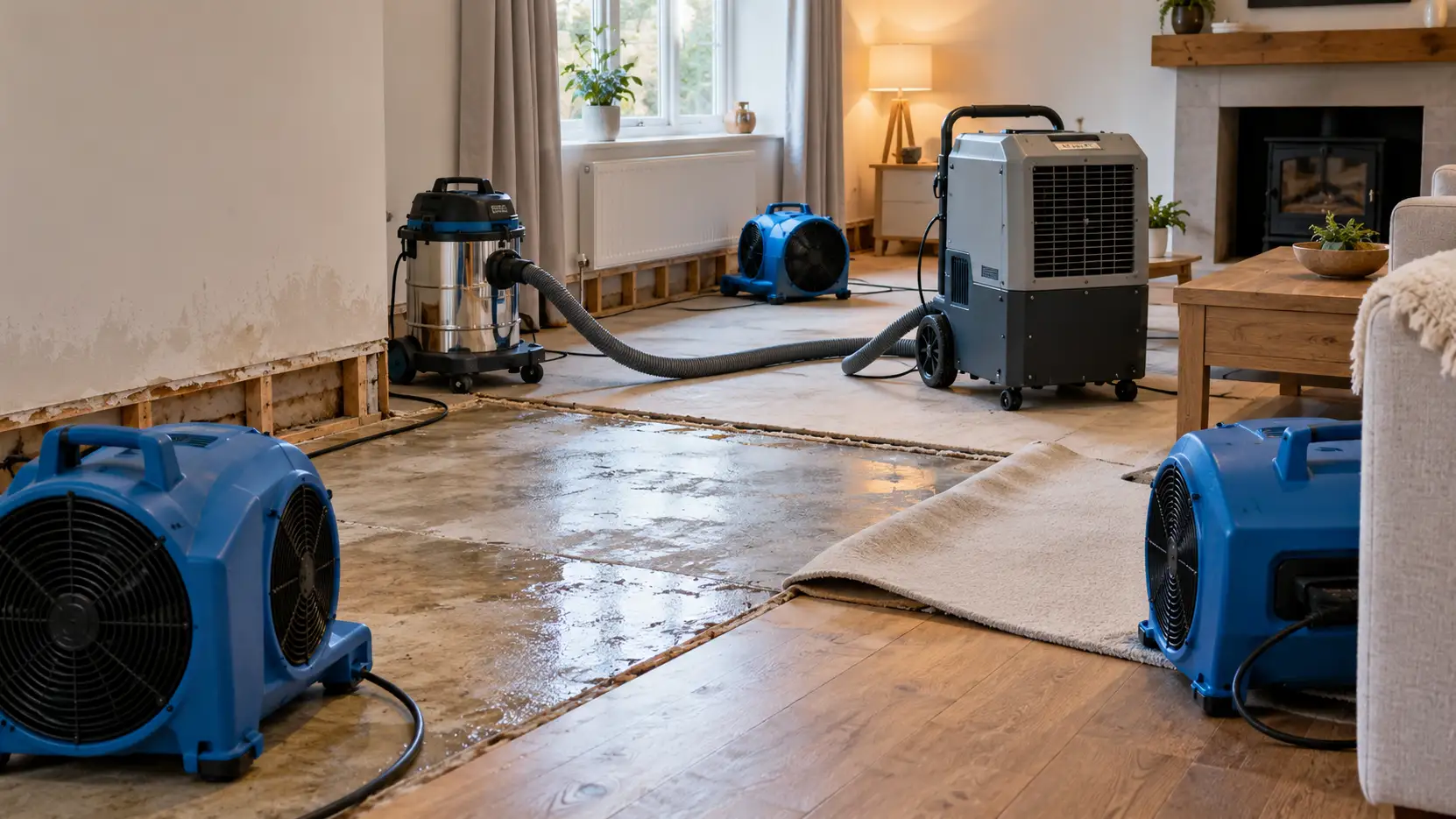
The water’s gone. The source is fixed, the puddles have been removed, and within a day or two the room can look surprisingly normal again. That is also the point at which a lot of avoidable damage begins, because a surface looking dry and a building actually being ready for repair are two different things.
A washing-machine hose caught quickly is not the same drying problem as river water standing across an entire ground floor. A small escape of clean water may need little more than prompt extraction, airflow and time; once water has soaked through floors, into wall construction, insulation, timber or concealed voids, drying becomes a building-fabric problem rather than a housekeeping one.
That distinction matters because the visible part usually gives reassurance first. Paint stops looking wet, the carpet has gone, the room loses its damp smell and life starts edging back towards normal. None of that proves that the structure behind the finishes is ready to be covered up again.
The expensive mistake is not usually failing to make the room look dry. It is starting the repair before the building actually is.
Before drying starts
The first stage after significant water ingress is safety and damage control. The source needs to be stopped if it has not already been isolated, standing water removed where that can be done safely, and any electrical or gas equipment affected by water treated cautiously until it has been appropriately checked.
After genuine flooding, contamination adds a separate problem. Water from rivers, surface flooding, drains or sewage should be treated as potentially contaminated because it can carry sewage, chemicals, oils, microorganisms and other pollutants. GOV.UK’s guidance on cleaning and recovering safely after flooding sets out precautions for cleaning flooded homes and advises professional checks before wet electrical, gas or oil equipment is returned to use.
That does not mean every material touched by floodwater must automatically be discarded. Some hard, non-porous materials can be cleaned and disinfected successfully; some heavily contaminated or absorbent materials cannot realistically be made safe. The judgement is about contamination, construction and recoverability rather than simply whether something became wet.
A burst supply pipe starts from a different position, but even apparently clean water can travel through dirty floor voids, building debris or other contaminated areas before it is discovered. Where water has spread extensively or remained trapped for some time, the sensible question is what it encountered on its journey rather than relying entirely on where it came from.
Insurance also matters before a major strip-out begins. Take photographs and retain a record of where water reached, contact the insurer early where a claim is likely and agree significant disposal or remedial work wherever circumstances allow. This should not mean preserving something that creates an immediate health hazard simply for inspection; insurers can often work from photographs or samples where retaining the entire item is unreasonable.
The same restraint applies to the building itself. Sodden carpet, swollen composite cabinetry or badly contaminated materials may plainly need removing, but taking every plastered wall back to masonry and lifting every floor simply because it became wet can destroy perfectly recoverable fabric. Before large-scale stripping, somebody should understand where the water has actually travelled and what needs exposure in order to dry.
Why the surface can dry before the building
Water rarely remains where it was first visible. It moves down behind skirting, through service penetrations, beneath floor coverings, into screeds and timber, around joist ends and into insulation or cavities. A decorated surface can therefore lose its obvious moisture while material farther inside the construction continues drying for considerably longer.
That difference is part of the reason flood recovery can seem to progress very quickly and then suddenly slow down. Historic England’s technical guidance on drying wet buildings describes an initially faster phase in which liquid moisture moves towards the surface, followed by a much slower phase dominated by vapour movement. Its guidance is directed particularly at historic and traditional construction, but the practical warning is widely useful: drying a surface quickly can create an impression of recovery while significant moisture remains deeper in the material.
Different constructions hide water in different ways. A suspended timber floor can conceal wet joist bearings or water sitting in the void below. A stud partition may retain moisture in insulation or timber behind a surface that feels dry. Screeds and concrete floors can hold moisture beneath finishes, while fitted kitchens, bathroom panels and built-in furniture can reduce airflow into exactly the places water has reached.
Traditional buildings add another complication because aggressive drying can damage the materials being saved. Thick masonry, timber, lime plaster and historic finishes do not necessarily benefit from being blasted with heat, and removing sound traditional plaster does not automatically accelerate drying. Equally, some modern boards and composite products that have swollen, distorted or become badly contaminated may be poor candidates for retention.
There is no honest single answer to how long a property takes to dry. The Association of British Insurers explains in its flooding guidance that serious flood recovery can be prolonged largely because of the time needed to decontaminate, dry and repair the property. A modest leak caught quickly can be an entirely different proposition.
So “these buildings normally take six weeks” is not much of a diagnosis. The useful questions are what became wet, how wet it became, what it is made from and whether the moisture has somewhere to escape.
How drying actually works
Drying is essentially a process of getting excess water out of the building without damaging the materials that are being retained.
Standing or trapped liquid water is removed first where possible. After that, air movement encourages evaporation from wet surfaces, dehumidification removes water from the air, and controlled heat can help water move out of materials. More complicated losses may require access to floor voids, cavities or concealed construction so that moisture is not left sealed in an area the room air cannot effectively reach.
The balance between those methods matters. Heating alone does not remove the water from a building; it helps turn more of it into vapour, which then has to be carried away or collected. The aim is controlled evaporation and removal of that moisture, not the highest temperature the building can tolerate.
Ventilation needs the same judgement. Opening the windows can help an open drying strategy when the outside air is drier and capable of carrying moisture away. It can work against a closed dehumidification regime if humid outdoor air is continually allowed back in. Historic England similarly notes that natural ventilation offers little drying benefit when the humidity outside is higher than it is inside.
Where a professional drying company has created a controlled environment using fans, heaters and dehumidifiers, repeatedly switching equipment off or opening windows because the house feels warm can therefore extend the programme. The occupant should understand whether the contractor is using an open or closed drying approach and follow that regime rather than combining the two at random.
Hidden areas are where the quality of the investigation becomes important. Water beneath a suspended floor may need pumping or additional ventilation. A wet cavity or layered floor construction may require specialist drying or carefully selected openings. None of that means every flooded house should be drilled, stripped and dismantled. It means drying should follow the water rather than simply filling the visible room with machinery.
How you know it is dry enough
This is the point that should decide when rebuilding begins, and it cannot be established reliably by touch.
Professional drying starts by identifying the affected construction and recording moisture conditions in a way that can be repeated. Measurements are then taken at consistent locations as drying progresses so the important evidence is not a single number but the direction of travel and the condition eventually reached.
The Property Care Association’s guidance on restoring flood-damaged buildings recommends a targeted and monitored drying regime with drying goals established for the building and its materials. That is a useful standard for homeowners too, because it changes the question from “has the machine been running long enough?” to “what evidence shows that the wet construction has recovered sufficiently?”
There is no universal moisture percentage at which every wall, timber, screed and floor can be declared dry. Building materials naturally contain different amounts of moisture, and the appropriate end point also depends on what is going back over them. A masonry wall ready for a vapour-permeable finish and a screed about to receive an impermeable floor covering do not necessarily require the same evidence.
Electrical moisture meters used against plaster and masonry are often most useful comparatively — finding wetter areas and tracking changes — rather than as universal percentage-moisture gauges. Salts and conductive materials can affect their readings. Timber can be assessed more directly with appropriate equipment, while some floors and specialist finishes may require material-specific testing before covering.
Unaffected areas of comparable construction can be useful reference points, particularly where nobody has a reliable pre-incident reading. Temperature and relative humidity records can also help show how the drying environment has behaved. Where water reached concealed areas, the monitoring strategy needs to address those areas rather than simply taking convenient readings from a painted wall beside the doorway.
The important end point is not zero moisture. It is that the excess water introduced by the incident has been removed sufficiently for the building to return towards its normal moisture condition and for the proposed repair to be carried out safely.
A competent drying process should therefore be able to answer four practical questions: what became wet, how was it measured, what happened to those readings over time, and why is the building now considered suitable for the next stage?
If those questions cannot be answered, “it looks dry now” is not much of a substitute.
Why decorating too early costs twice
Once the room looks normal again, there is understandable pressure to finish the job. That is particularly strong after a major escape of water or flood, when people may have spent weeks living around stripped floors, machinery and temporary accommodation.
But reinstatement changes the way the remaining moisture can escape. Paint can blister over a damp substrate; new timber and composite fittings can absorb moisture from wet masonry; laminate and timber flooring can distort; and an impermeable floor covering laid over a damp screed can trap moisture beneath it. New skirting, kitchen units or fitted furniture can also conceal the very areas that still needed air movement.
That is why repairs can appear successful for weeks before problems return. The new finish has not created the original moisture, but it may have reduced the routes through which the remaining moisture was leaving.
The reverse mistake is excessive stripping. A wet building is not automatically a disposable building. Where materials can be safely cleaned and dried, removing them unnecessarily increases both the repair bill and the amount that has to be reconstructed afterwards. The Property Care Association similarly advises that buildings do not always need to be pulled apart to dry and that the drying plan should consider what can reasonably be retained.
The decision should therefore be made material by material. Remove what is contaminated beyond recovery, structurally damaged, irreversibly swollen or genuinely preventing drying; retain what can safely recover.
What a good drying service should actually prove
For a homeowner, landlord or loss adjuster, one of the most useful distinctions is between a drying programme and proof that drying has worked.
“A drying programme described only as ‘three dehumidifiers for three weeks’ tells you what equipment was present, not whether the outcome was achieved.” A more useful record shows the extent of the affected area, the construction that became wet, the measurement locations, how those readings changed and why the final condition is considered suitable for reinstatement.
That does not require the homeowner to become a moisture surveyor. It does mean that if an expensive new floor, kitchen or decorative finish is about to be installed, it is reasonable to ask what evidence sits behind the decision to proceed.
For an insurer-managed loss, the insurer or loss adjuster will often coordinate the specialist drying and repair stages. ABI guidance explains that badly flooded homes can involve loss adjusters, surveyors, specialist cleaning and drying companies and builders, with the restoration timetable being managed between them. That coordination is important because the drying and reinstatement stages should not become disconnected from one another.
Privately commissioned work deserves the same logic. A contractor recommending extensive strip-out should be able to explain what cannot be saved and why. A contractor proposing to finish drying should be able to explain what was monitored and what has changed. A contractor recommending immediate redecoration should be able to explain why the substrate behind it is ready.
Those questions become even more important where there is disagreement between what the wall looks like and what the measurements say.
Keep the records afterwards. Photographs, moisture surveys, monitoring sheets, drying reports, invoices and details of what was removed or replaced can be useful if a finish later fails, a subsequent damp problem appears or a future purchaser asks what happened.
Commercial premises follow the same principles
A shop, office, restaurant or other commercial property obeys the same drying physics as a house, but the pressure to reopen can be greater and the construction can conceal water more effectively. Raised access floors, suspended ceilings, service voids, fitted counters and commercial kitchens can all look presentable at the occupied surface while moisture remains somewhere less obvious.
For landlords and managing agents of multi-let property, water may also cross lease boundaries or travel through common parts, making access and coordination part of the drying problem. A unit should not be treated as successfully restored simply because its own visible finishes look normal if the source or residual moisture sits elsewhere in the building.
The cost of closure makes verification more important, not less. Reopening a few days earlier only to remove a newly installed floor or refitted counter later is rarely the faster recovery.
Dry is a measurement, not an impression
A building dries according to what it is made from, how much water entered it, where that water travelled and the conditions created for it to leave. The decorating schedule does not get a vote.
The visible surface often offers reassurance first and useful evidence last. A wall can look normal while deeper material continues releasing moisture; a floor can conceal a wet void or screed; apparently dry joinery can sit against masonry that is still recovering.
The aim is not to chase an impossible state in which every material contains no moisture at all. Buildings normally contain moisture. The aim is to remove the excess introduced by the incident until what remains is appropriate for that building and for the repair being proposed.
That is why the order matters: make the property safe, establish what became wet, remove what genuinely cannot be retained, dry what can, monitor the fabric rather than the appearance and reinstate only when the evidence supports it.
A room looking dry is an impression.
Knowing it is ready to repair requires proof.
This article provides general property information, not legal, financial, surveying, insurance, electrical or specialist restoration advice for individual circumstances. Significant water damage, contaminated floodwater, suspected structural damage or moisture trapped within floors, walls, insulation or other concealed construction should be assessed by an appropriately competent professional. Electrical, gas or oil equipment affected by water should not be returned to use until appropriately checked. If an insurance claim is involved, contact the insurer or loss adjuster before substantial disposal, strip-out or repair work unless immediate action is necessary to protect health or prevent further damage.

