

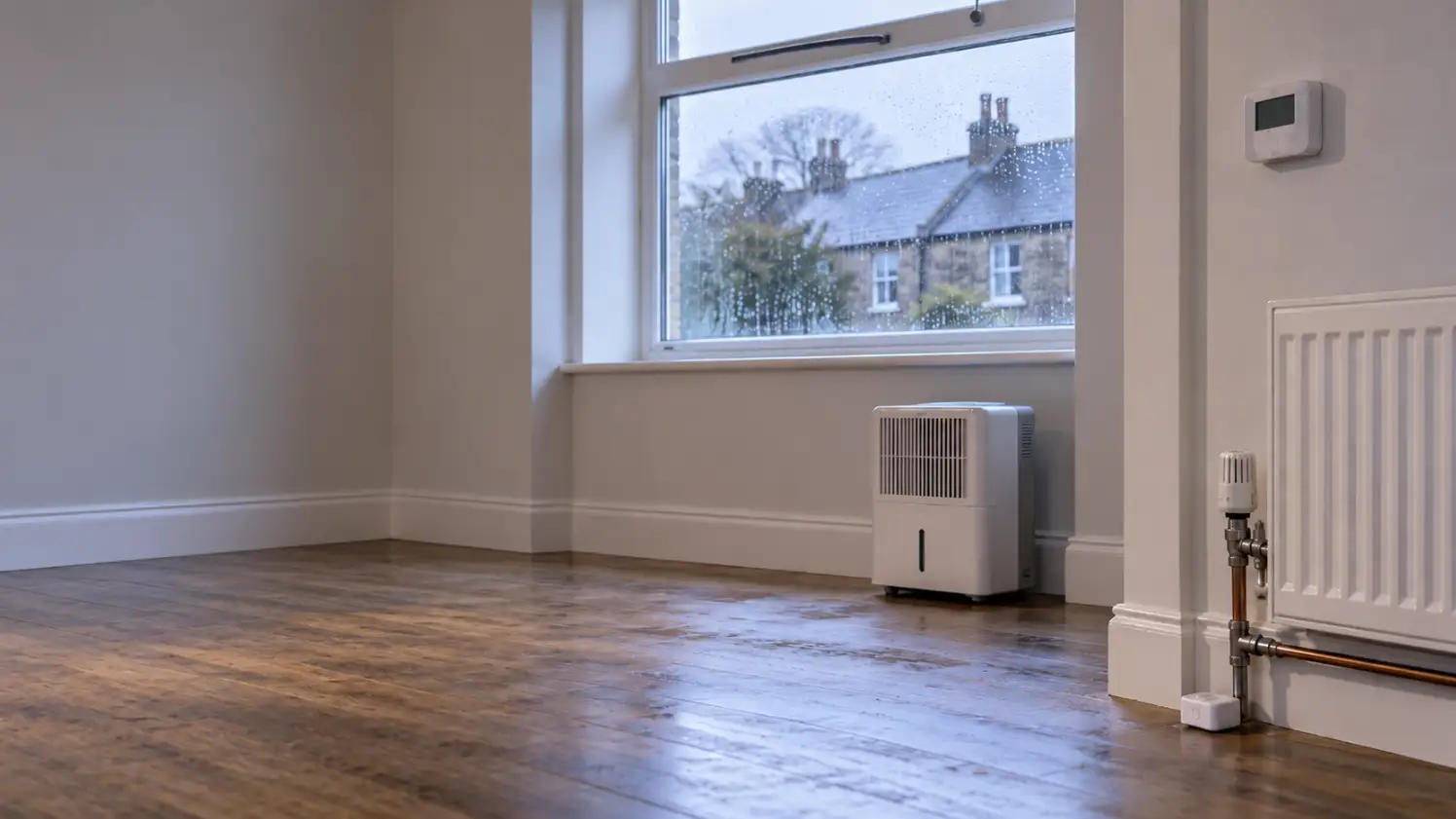
An empty building doesn’t stop being a building. Rain still falls on the roof, pipes still contain water, gutters still block and external walls still cool when the weather changes. What disappears is the person who would normally notice that something has gone wrong.
A fully vacant property actually loses many of the moisture sources associated with normal occupation because nobody is cooking, showering, washing clothes or breathing inside it. What it also loses is the person who would notice when something else starts adding moisture. In a genuinely empty building, an unnoticed roof, gutter, plumbing or drainage defect can therefore matter more than everyday condensation.
Rarely used properties create a slightly different problem. A second home can be occupied intensively for a weekend, filled with moisture from showers, cooking and wet clothing, and then be closed just as the heating is reduced and the indoor air begins to cool. A house between tenants can also start its vacancy with more moisture than expected if it has just been deep-cleaned, decorated or repaired. Preventing damp and mould therefore means understanding what sort of vacancy you actually have rather than applying the same routine to every empty building.
Why leaving a building empty changes its moisture behaviour
In an occupied home, moisture problems tend to announce themselves. Somebody notices condensation on a bedroom window, hears a dripping tap, smells damp in a cupboard or sees a stain developing beneath a gutter. Heating and ventilation are also being used as part of everyday life, even if not always perfectly.
Vacancy removes that feedback. A small plumbing leak can continue unnoticed, a slipped tile can admit water through several spells of rain, a heating failure can leave rooms much colder than intended, and an overflowing gutter can repeatedly soak the same patch of masonry before anyone visits. The issue is less that emptiness creates moisture than that it gives moisture problems much longer to develop without interruption.
The same is true inside the property. Furniture left tightly against a cold external wall, mattresses stored upright in a poorly ventilated room or cardboard boxes stacked directly on a cold floor can create sheltered pockets where air movement is limited and early mould is difficult to spot. RICS’s guidance on damp and mould stresses the importance of identifying the actual moisture source and distinguishes condensation from penetrating moisture caused by defects such as leaking roofs, rainwater goods and plumbing.
Properties between occupants deserve particular attention because they can be empty but far from dry. Carpet cleaning, deep cleaning, fresh plaster, screeds, decorating and other wet work can add substantial moisture immediately before a property is shut up. Reducing the heating and closing the building immediately after that work can leave the next tenant or owner inheriting a moisture problem that was created during the void rather than by whoever eventually moves in.
For a rarely used home, the departure routine matters for the same reason. After showers, cooking or drying wet clothes, use the property’s normal extraction and ventilation properly and allow the indoor moisture load to fall rather than generating it and immediately closing a cooling building for several weeks.
Heating: useful, but not the first defence against water
There is no single background temperature that prevents damp in every empty property. Construction, insulation, exposure, local weather, ventilation and the duration of the vacancy all matter, and the correct strategy for a well-insulated flat between tenancies may be quite different from that for a solid-walled rural house left empty through winter.
Where the heating remains operational, some background warmth can help keep internal surfaces warmer and reduce the likelihood of condensation when moisture is present. It can also be important for protecting plumbing during freezing weather. But heating does not stop rain entering through a defective roof, repair a leaking pipe or make an overflowing gutter harmless.
That hierarchy matters in an empty property. Keeping water out and catching leaks early comes first; heating helps manage temperature-related risks after that. A property with active water ingress will not become sound simply because the thermostat is turned higher.
A frost-protection setting and a damp-prevention strategy are not necessarily the same thing. Frost controls may be intended principally to stop parts of the heating or plumbing system reaching damagingly low temperatures. Whether they also keep vulnerable internal surfaces warm enough to reduce condensation depends on the building, where the sensors are, and where any moisture is coming from.
Intermittently used properties need a little more thought than permanently empty ones. A second home that is warm and occupied for a short stay and then rapidly allowed to cool can pass through quite different temperature and humidity conditions from a house that remains steadily unoccupied. Clearing the moisture created during the stay before reducing the heating can be more useful than relying on the frost setting to deal with it afterwards.
Any insurance requirements take precedence over a general heating strategy. If the policy specifies a particular precaution during cold weather or prolonged absence, the relevant condition needs to be understood and followed.
Ventilation: keep the intended airflow, not an open window by default
Securing an empty property does not mean blocking every route through which air was intended to move.
Background vents, sub-floor air bricks and purpose-designed ventilation all perform particular jobs. Covering vents to stop draughts or obstructing air bricks with stored items, vegetation or raised ground can remove ventilation from parts of the building that still need it even when nobody is living there.
For homes in England, the government’s current existing-home ventilation guide advises keeping background trickle vents open and unobstructed and using mechanical systems according to their intended operation. The precise arrangements vary between buildings and across the UK, so the useful principle is broader than that guidance: preserve the ventilation the building needs; do not assume either sealing everything shut or leaving windows open is automatically the right answer.
Leaving windows permanently ajar in an unattended property can introduce security problems and, in poor weather, the possibility of wind-driven rain. Opening them during an inspection can be useful where conditions favour drying, but outside air is not automatically “dry air”. On humid days, simply opening everything may offer little benefit.
Mechanical ventilation also needs to be understood rather than guessed at. Some whole-house systems are intended for continuous operation. A conventional bathroom fan may not be. Turning everything off because the building is empty can be inappropriate in one property; leaving every fan permanently running can be unnecessary in another. Manufacturer instructions and the way the system was designed to operate are better guides than a universal vacancy rule.
A dehumidifier can be useful where there is a genuine humidity problem, but it should not become the default substitute for finding the source of that moisture. In cooler buildings its effectiveness can also be limited, and an unattended machine needs to be suitable for the way it is being used, with safe power arrangements and a realistic method of dealing with collected water. SPAB notes that dehumidifiers can be effective in warm, damp rooms but of limited benefit in cold, humid conditions.
A portable unit whose tank fills and switches itself off shortly after the owner leaves is not much of a long-term moisture plan. Where continuous drainage is proposed, it needs to be arranged properly and the equipment still needs checking rather than assumed to be operating indefinitely.
Water systems need a vacancy plan of their own
Escape of water is one of the clearest examples of vacancy making an ordinary defect far more expensive. A small leak discovered the same evening in an occupied house can become weeks of concealed saturation in an empty one.
The first step is knowing where the stop tap is and making sure it can actually be operated. Visible leaks should be dealt with before the property is left, and pipework in lofts, garages, outbuildings and other cold spaces deserves particular attention before winter.
For longer absences, isolating the incoming water supply can reduce the consequences of many supply-side plumbing failures. WaterSafe’s guidance on protecting pipes during cold weather and prolonged absence recommends protecting exposed pipework and, where appropriate for a longer absence, turning off the supply and draining systems with professional advice if needed.
Turning off the incoming mains and draining or winterising a property are not the same intervention. Closing the stop tap does not empty every tank, pipe, cylinder or heating circuit, and a complete drain-down may interact with boilers, hot-water systems and other building services.
Nor should services simply be isolated without considering what depends on them. Heating or frost protection may need to remain active, while larger or commercial properties can have other essential systems whose operation needs to be maintained. For a prolonged winter vacancy or a complicated heating arrangement, a planned winterisation procedure is preferable to improvising it.
A two-week holiday, a three-month second-home closure and a probate property standing empty for an indefinite period therefore need different levels of intervention. The sensible response should follow the duration, season and building systems rather than the word “vacant”.
Insurance conditions can change what you need to do
Unoccupancy is not just a maintenance issue. It can change insurance cover and the precautions expected of the policyholder.
MoneyHelper’s buildings-insurance guidance warns that insurers normally need to be told when a home will be unoccupied for a long period — commonly around 30 days or more — and that owners may be instructed to take precautions such as turning off water or draining heating systems. The important point is that this is policy-specific rather than a universal 30-day rule.
The policy wording decides what counts as unoccupied and what precautions are required. An occasional visit does not necessarily turn an otherwise vacant house back into an occupied one for insurance purposes, and assumptions based on what another insurer required at another property are risky.
Inspection requirements can matter just as much. Some policies may specify how the building is to be checked or what must happen during cold weather. There is no sensible universal inspection interval to substitute for the policy and the circumstances of the property.
The practical time to check this is when a short vacancy starts becoming a long one, not after a claim. A sale can take longer than expected, probate can drag on, refurbishment can stall and a gap between tenants can extend unexpectedly. Once the property’s use has changed materially, tell the insurer and establish what conditions now apply.
Regular inspection replaces the missing occupant
Physical inspection remains the single most useful way to compensate for nobody living in the building, because it catches problems that heating controls and humidity readings cannot see.
The inspection should be consistent enough that changes stand out. Inside, look for new staining, leaks, musty odours, condensation, mould, failed heating, unusual temperature changes and moisture around kitchens, bathrooms, boilers and external walls. Check behind or beside stored furniture where access allows, and avoid packing absorbent belongings so tightly against cold walls or floors that neither air nor the person inspecting can reach them.
Outside, the inspection should consider roof coverings from safe ground level, gutters and downpipes, visible drainage, broken windows, damaged vents and signs of recent weather damage. After a significant storm or prolonged freeze, bringing the next visit forward can make more sense than rigidly waiting for the usual inspection date.
Remote monitoring can add another layer of protection. A simple temperature and humidity sensor can flag an unexpected change in conditions; leak detectors can provide an earlier warning around vulnerable plumbing; connected heating controls can show that the property is no longer reaching the temperature expected.
The useful information is usually the pattern rather than one isolated humidity number. Relative humidity changes as temperature changes, so one reading does not establish that a property has a damp problem. A room that becomes persistently more humid than its own normal pattern, or a sudden temperature change suggesting heating failure, is more useful as a trigger for inspection.
A sensor measures the conditions around the sensor, not the entire building, and it is useful only while its power, batteries and connection are working and somebody is able to respond to the alert. A hallway monitor may tell you very little about a cold rear bedroom, cellar or tightly packed store room.
Remote monitoring is therefore an alarm system rather than a replacement for physical inspection. Used together, the two are much more valuable: technology can bring a visit forward, while the visit can find the slipped tile, mould behind a wardrobe or overflowing gutter that no indoor humidity sensor can identify.
For landlords and agents, the same discipline is useful between tenancies. A short written or photographic inspection record establishes what was checked, whether remedial work was needed and whether conditions changed during the void. It also makes it much easier to distinguish a defect that arose while the property was empty from something first reported after the next occupier moved in.
Commercial voids need active management too
An empty shop, office or industrial unit follows the same basic principles as a house, but shutting the building down can be considerably more complicated. Mechanical ventilation, heating, water systems, flat roofs, internal drainage, sprinkler installations, security equipment and other building services may all require an intentional void-management plan rather than a blanket switch-off.
Larger premises also create more places for defects to remain hidden. A leak above a suspended ceiling, a blocked internal gutter or water beneath a raised floor can develop for some time before it becomes visible in the areas normally inspected.
For landlords, facilities managers and managing agents, the valuable part of a void inspection programme is consistency and accountability: somebody knows which services are supposed to remain operational, when the building was last checked, what defects were found and whether the remedial work was actually completed.
The objective is not to keep an empty commercial property operating as though it were fully occupied. It is to keep the building stable, secure and observable until it is used again.
Emptiness is not the same as dormancy
An unoccupied building does not automatically become damp because the people have gone. In many cases they were the largest source of indoor water vapour in the first place.
What vacancy removes is supervision. Rain penetration, plumbing leaks, failed heating and changing indoor conditions have more time to develop before somebody reacts. A rarely used property adds another complication because bursts of normal occupation can introduce moisture immediately before the building is closed and allowed to cool.
The sensible strategy therefore starts with the building rather than a thermostat number. Keep external water out, preserve appropriate ventilation, manage heating and plumbing according to the season and length of absence, clear the moisture produced during periods of use, understand the insurance conditions and make sure somebody will notice when the property stops behaving normally.
That may be an owner, a neighbour, a managing agent, a professional inspection service or a combination of physical visits and remote alerts. The mechanism matters less than the outcome.
An empty building does not need somebody living in it.
It still needs somebody managing it.
This article provides general property information, not legal, financial, insurance, surveying, plumbing or heating advice for individual circumstances. Requirements for unoccupied-property insurance, heating, inspection and water-system management vary between insurers, policies and buildings. Check the applicable insurance documents before a prolonged vacancy. Isolation, drain-down or winterisation of plumbing and heating systems should be planned around the systems installed and carried out by a competent person where appropriate.

