

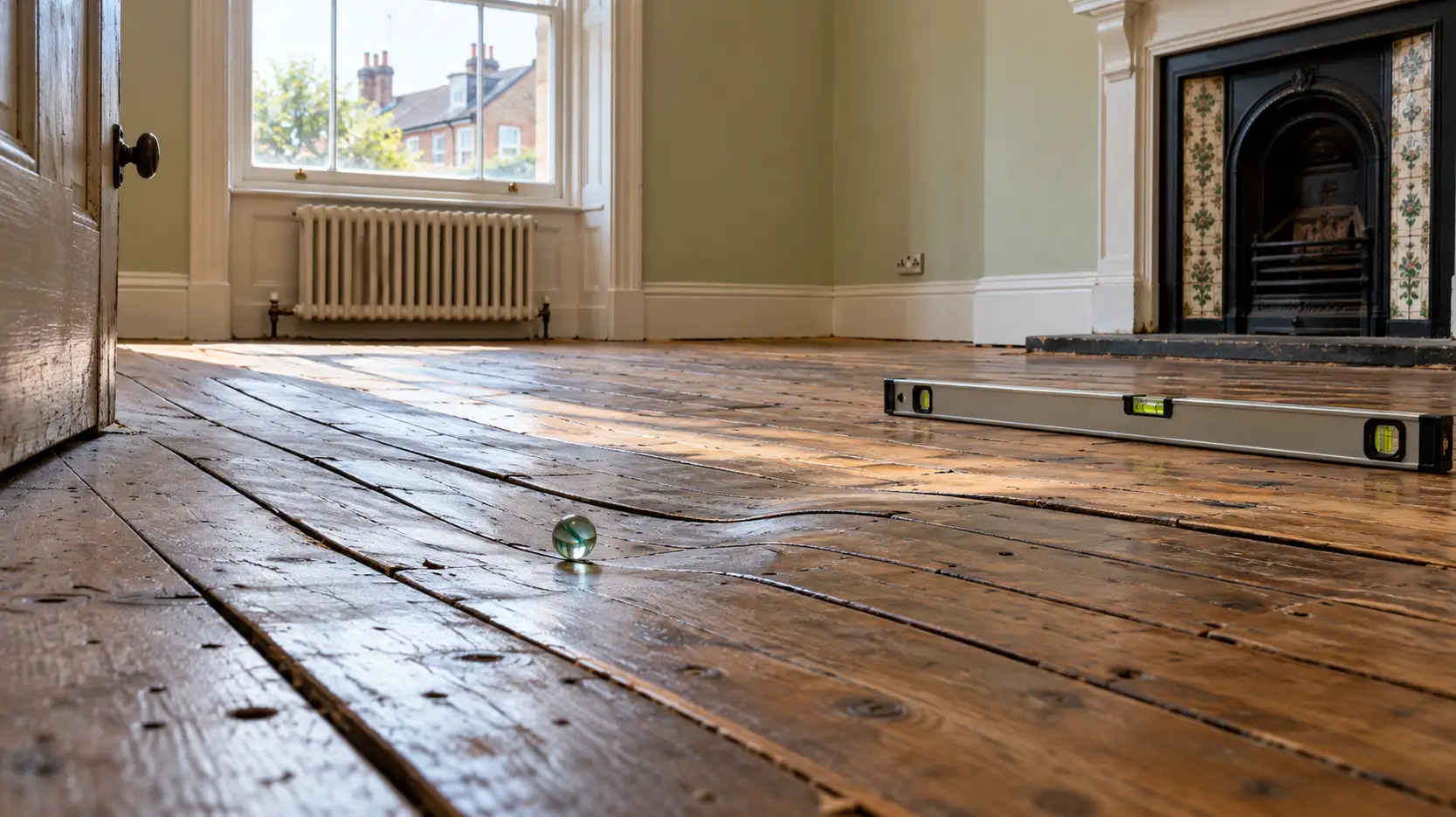
Roll a marble across an old floor and it will find the low corner every time. On its own, that tells you almost nothing — plenty of sound older houses have floors that have sat a little out of true for decades without showing any meaningful change. The more useful first question is whether the floor has always been like this, or whether something has changed.
Even that needs some judgement. A floor can be newly noticed without being newly uneven: removing a carpet, laying a hard floor, moving furniture or simply looking more closely can reveal a slope that has existed for years. The reverse is also true. A longstanding sag is not automatically satisfactory simply because it has stopped changing; it may still reflect an old support problem, excessive deflection or an alteration that becomes relevant when the floor is refurbished or asked to carry a substantially heavier load.
What matters is not simply whether the floor is level, but what is actually moving. A loose board or failed section of chipboard is one problem, flex in the joists and supports beneath it is another, and a floor changing shape alongside cracks or distortion elsewhere in the building is another again. They can feel surprisingly similar underfoot while requiring very different investigations and very different repair bills.
Slope, sag and bounce are not the same complaint
These terms are often used interchangeably, but they describe different behaviour.
A slope is a difference in level across the floor: one side or corner sits higher than another. It may be the legacy of historic settlement, movement in a local support, old alterations or movement affecting more of the building. The important point is that the slope itself does not tell you whether whatever caused it is still active. An old floor can remain permanently out of level long after the movement that produced that shape has stopped.
A sag is a persistent downward bow or deflection in the floor structure. It might appear across the middle of a span, towards a beam or around a point where the support arrangement changes. Long-term joist or beam deflection can produce it, as can deteriorated timber, inadequate original sizing or movement in something supporting the floor. A sagging floor does not necessarily feel particularly springy; its shape may have changed permanently while remaining comparatively firm underfoot.
Bounce or springiness is different because it happens under changing load. Somebody walks across the room, the floor moves and then largely returns. Timber floors inevitably flex to some extent, and a floor can feel noticeably lively without being close to structural failure. There is an important difference here between strength and stiffness: a floor can remain capable of carrying its intended loads but lack enough rigidity to feel satisfactory. SPAB’s guidance on timber floor structures makes the same distinction, noting that springiness can result from a lack of rigidity rather than a lack of strength.
That means a floor can have a genuine structural-floor problem without being dangerous. Excessive flex may be a serviceability issue requiring strengthening because the floor feels poor in use, while decay, failed support or progressive movement raises a different level of concern. The symptoms can also overlap: an old sloping floor can develop a new bounce, a sag can remain firm, and a small part of an otherwise sound floor can flex because the problem sits in the boards rather than the joists.
What actually makes a timber floor lose its stiffness
With suspended timber floors, excessive movement usually comes back to some combination of the way the floor was built, what has happened to it since, the condition of the timber and the supports carrying it.
Some floors were simply constructed more flexibly than we would expect today. Long spans, relatively shallow joists or limited restraint between them can create noticeable movement even where the timber remains perfectly sound. This is particularly relevant in older houses: making an adequate century-old floor feel like a modern one may require strengthening, but that does not mean the original construction has suddenly become unsafe.
Later alterations can matter more. Plumbing and electrical work requires routes through floors, and badly positioned or excessive cutting can reduce the capacity and stiffness of joists. Notches and holes in traditional solid timber joists have defined positions and size limits, while engineered joists require different treatment again. LABC’s guidance on notches and holes in solid timber joists illustrates why indiscriminate cutting is a problem.
For the homeowner, the useful information is not the dimensional rules themselves but the history of the room. If springiness appeared after a bathroom installation, major plumbing work, rewiring, a staircase alteration or substantial remodelling, it is reasonable to ask whether the floor structure was changed at the same time.
Support can be altered without anybody cutting a joist. A wall or partition may have been removed, joists may have been trimmed around a new opening, or a beam may have been introduced during an earlier refurbishment. All of those arrangements can be entirely satisfactory when properly designed, but they become relevant when a floor starts behaving differently afterwards.
Moisture is a different concern because it can affect the timber itself. Joist ends built into damp external walls, persistent plumbing leaks and poorly ventilated ground-floor voids are all places where deterioration can develop largely out of sight. RICS gives a useful example of blocked low-level ventilation leading to damp suspended-floor timbers, particularly where raised external ground or obstructed air bricks reduce airflow beneath the floor.
A local soft or springy patch still does not prove that a joist is rotten. Loose boards, damaged chipboard, failed fixings or movement within another layer of the floor can produce surprisingly obvious flex while the supporting structure remains sound. The extent of the movement therefore matters: one board moving under a foot is a different finding from furniture several metres away visibly reacting as somebody walks across the room.
Unusual loading can expose an already marginal floor as well. A large aquarium, safe, substantial home-gym equipment or dense storage can concentrate far more weight in one position than ordinary domestic furniture. That does not make every heavy object a structural problem, but it is relevant where the floor already sags, flexes excessively or is known to have been altered.
Suspended timber and solid floors fail differently
Before interpreting the symptom, it helps to know what sort of floor is actually beneath you. A single property can contain several types of construction: an older suspended timber front room may sit beside a later solid-floor extension, while the upper storeys remain timber throughout.
A suspended timber ground floor usually consists of boards or another deck carried on joists above a void, with those joists supported by walls, beams or intermediate supports. Joist condition, the points at which they bear, moisture, ventilation and the condition of the supporting structure can therefore all affect the shape and stiffness of the floor.
One easily overlooked cause of a local dip is movement in an intermediate support. Some suspended ground floors use low internal sleeper walls to shorten the joist span. If a sleeper wall, wall plate or another local support settles or deteriorates, part of the floor can lose level even though the joists themselves remain broadly sound and the main foundations of the house are unaffected. It sits in the middle ground between “bad joists” and “the house is subsiding”, which is why assuming either from the floor surface alone can send an investigation in the wrong direction.
Solid floors behave differently. A structural concrete slab should not normally produce the characteristic springiness of timber joists. If something laid over a solid floor feels locally bouncy, the movement may instead be in a floating floor, timber overlay, screed or another layer above the structural slab.
A solid floor that has genuinely developed a dip, significant cracking or a change in level deserves a different investigation. The slab, its immediate support or the material beneath it may have moved, but that still does not prove that the foundations supporting the walls have subsided. Before asking why the structure is moving, it is worth establishing whether the movement being felt is actually in the structure at all.
When the floor is a symptom of something happening below
An uneven floor becomes more significant when change is accompanied by other evidence. A floor that is becoming progressively more sloped or sagged while fresh cracks appear nearby, doors begin binding in visibly distorted frames or openings change shape deserves a broader look at the building rather than treatment as an isolated flooring defect.
Even then, subsidence is only one possibility. On suspended timber floors, the cause may remain comparatively local: a decayed joist end, a deflecting beam, movement in an intermediate support or an earlier alteration that changed the way the floor is carried. With a solid floor, the slab or the material immediately beneath it can move without the main wall foundations necessarily doing the same thing.
Only where the wider evidence points towards ground or foundation movement does the floor properly become part of a subsidence investigation. A gently sloping floor recorded on an earlier survey, still firm underfoot and with no associated changes elsewhere is a very different finding from one whose geometry is visibly changing. Equally, an old floor does not necessarily need to be levelled simply because modern equipment can measure its imperfections precisely.
Longstanding does not automatically mean irrelevant, however. A floor may have sagged years ago because its joists were marginal, a beam deflected or a support arrangement was altered. It may remain perfectly serviceable for everyday use while becoming important again before a major refurbishment, a new stone bathroom floor or another substantial increase in loading.
The useful distinctions are therefore not simply old or new, but stable or changing, local or widespread, and which part of the building is actually involved.
Reading the difference
| What you’re seeing | What it may mean | What deserves checking next |
|---|---|---|
| Gentle longstanding slope; floor feels firm and nothing nearby appears to be changing | Historic settlement, original unevenness or an old stable alteration | Previous survey evidence and whether there is any indication of continuing change |
| Persistent dip or bow but relatively little movement underfoot | Long-term joist or beam deflection, or movement in a local support | Span, support arrangement, previous alterations and the condition beneath the floor |
| One small patch flexes while the rest of the room remains firm | Floorboards, chipboard, fixings or another local deck problem | Whether the movement is confined to the surface or continues into the supporting structure |
| A wider area noticeably flexes or furniture moves as somebody walks across it | Floor stiffness, joists, supports or previous structural alteration may be involved | Whether it is longstanding or worsening and how the floor is supported |
| Local sag or softness near a bathroom, external wall or known leak | Moisture damage to boards, joist ends or other timber is possible | Water source, ventilation and timber condition |
| Ground floor dips towards an internal support line with no wider movement evident | Sleeper wall or another local support may have moved | What is supporting the joists before assuming foundation movement |
| New or worsening level change with fresh cracking or distorted openings | Potentially part of a wider structural movement pattern | Building-level assessment rather than treating the floor alone |
| Solid floor develops a new dip or significant cracking | Slab, floor build-up or supporting-ground movement | Establish what has moved before assuming the main foundations are affected |
These are not diagnoses from appearance or feel alone. Their value is in narrowing the investigation before somebody starts selling a repair.
Flats, offices and other floors beyond the house
The same principle applies in flats and rented homes, although the person reporting the problem does not need to diagnose the engineering. A report that the bedroom floor has become noticeably more springy beside an external wall since a leak gives a landlord, managing agent or surveyor useful information; saying that “the joists are failing” reaches a conclusion that inspection still needs to establish.
Commercial property adds the question of use and loading. Equipment, safes, concentrated storage or stock can impose loads quite different from whatever a floor previously carried, so a new symptom following a substantial change in use deserves to be considered in that context.
Responsibility for investigating or repairing a floor in a flat or leased property depends on the tenancy or lease and on which part of the building is affected. That legal question is separate from the physical one of establishing what is moving and why.
What’s safe to check yourself, and what isn’t
Useful information can be gathered without dismantling the floor. Start with its history. If a previous survey is available, see whether unevenness or springiness was already recorded, and think about whether anything significant happened before the problem became noticeable: a leak, bathroom refit, rewiring, wall removal, staircase work or installation of unusually heavy equipment.
Then look at the extent of the symptom rather than simply measuring its maximum point. Does one board move, one corner dip, the centre of the room sag or the whole floor slope? Does furniture elsewhere move when somebody walks past? Are there cracks in the ceiling below, or has a nearby door started behaving differently?
A straight edge, spirit level or laser can document that a floor is out of level, but the measurement is evidence rather than a structural verdict. A marble proves only that gravity can find the low point. On a suspended ground floor, outside observations can add useful context too: air bricks buried behind raised paving, soil or vegetation are worth noting, particularly where the floor above is damp or locally soft.
What is not useful is turning investigation into a load test. Deliberately jumping on a suspect floor, placing something heavy on it to see what happens, removing apparently redundant supports or cutting into joists can make an uncertain situation worse rather than clarify it.
A pronounced sag that has appeared suddenly, movement that is clearly worsening, a genuinely soft or weak area, or deterioration associated with an active leak deserves prompt assessment. Until the cause is understood, avoid deliberately adding heavy concentrated loads over the affected area.
A small, clearly local floorboard or deck defect may be suitable work for an experienced carpenter or competent builder. Persistent or unexplained sagging, broad springiness, suspected support problems or significant structural alteration may justify a chartered building surveyor or structural engineer. If deterioration is moisture-related, repairing timber without dealing with the leak, damp masonry or ventilation problem leaves half the job undone.
A useful inspection should leave the homeowner understanding what part of the floor is moving, why it is moving, whether the condition appears stable or progressive and what actually needs repairing. If the proposed answer is simply “strengthen the floor”, the obvious follow-up is what, specifically, has been found to be inadequate.
The floor is telling you something, if you read it right
An uneven floor is not automatically evidence of a building in trouble, particularly in an older property. Nor should every historic floor be made perfectly level simply because we can measure it more accurately today than when it was built.
But “old houses are wonky” is not a diagnosis either. A slope describes level, a sag is a persistent downward bow or deflection, and bounce is movement under changing load. A loose board can imitate a structural problem; a sound floor structure can still be excessively flexible; and a changing floor can also be the first visible sign of decay, lost support or movement extending beyond the floor itself.
The distinction that matters is whether the floor — or the structure supporting it — is behaving differently from before, whether that change is local or part of something wider, and whether the movement comes from the finish, the floor structure or the building beneath it.
That is what separates character from a repair, a stiffness problem from a safety concern, and a floor problem from a much wider structural investigation.
This article provides general property information, not legal, financial, surveying, structural-engineering or other professional advice for individual circumstances. Floor behaviour depends on construction, span, loading, alterations, moisture and the condition of structural members and supports. Seek appropriate professional assessment where sagging or movement is new or worsening, structural timber decay is suspected, supports or joists may have been altered, or floor movement occurs alongside significant cracking, distortion or other signs of wider building movement.

