

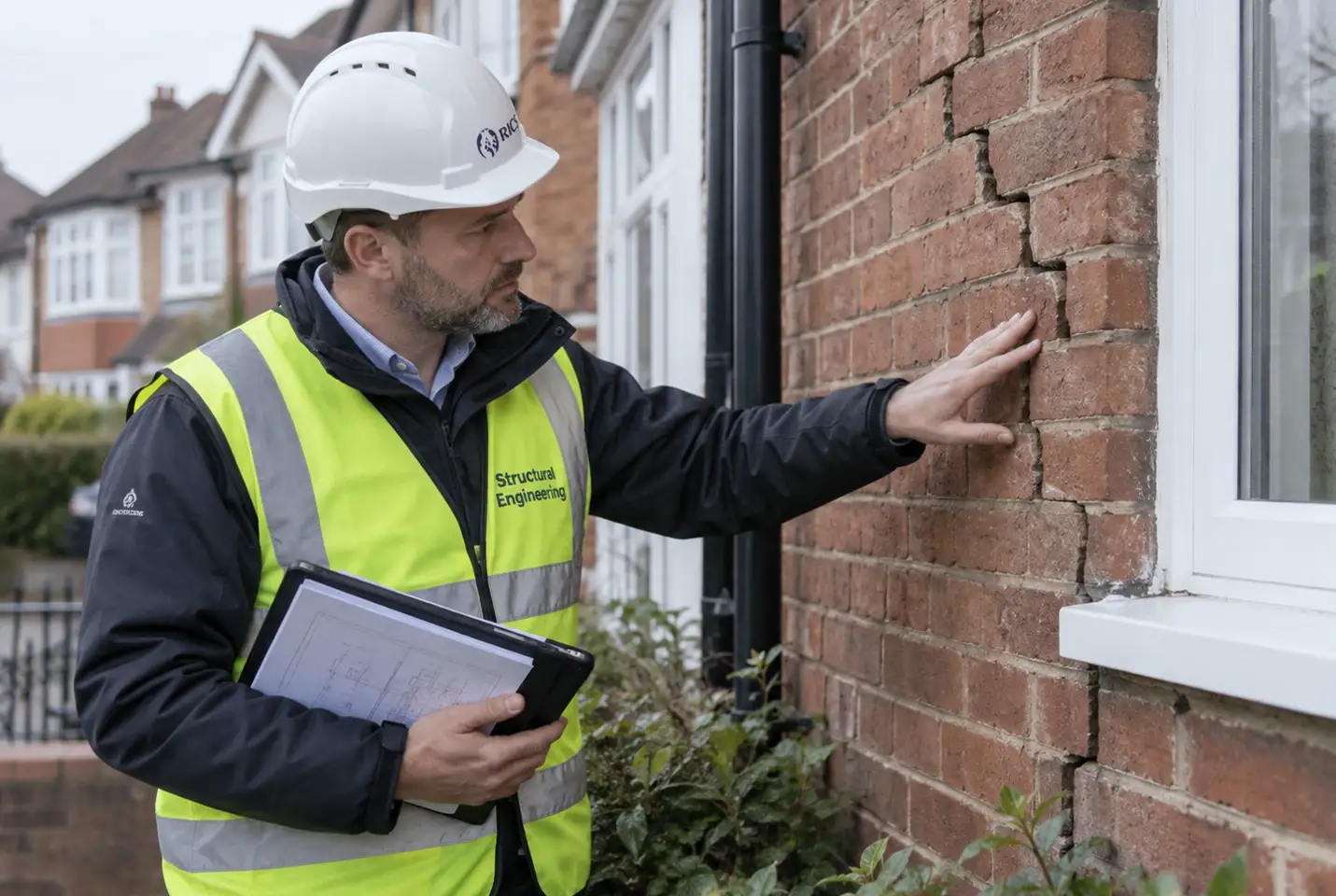
Cracking has appeared, or a door’s started sticking, and the obvious next question — who do I actually call? — turns out to have a surprisingly unclear answer. Builder, surveyor, structural engineer, drainage specialist, tree expert: several of them sound plausible, and the wrong choice can mean paying for the wrong kind of report, or paying twice.
The honest answer is that it depends on where you are in the process: whether you’re still working out what’s wrong, whether the cause is already clearly structural, whether drainage or a tree looks like the likely culprit, or whether an insurer is already involved.
Who should you call first?
| Situation | Usually the most useful starting point |
|---|---|
| You have cracking or movement but don’t yet know the cause | Building surveyor with relevant building-pathology or structural-movement experience |
| The problem is already clearly structural, or calculations/design are needed | Structural engineer |
| Nearby drains are a plausible cause | Drainage specialist as part of the wider investigation |
| A particular tree is genuinely suspected | Arboricultural consultant alongside the structural/ground investigation |
| Ground conditions themselves need detailed investigation | Geotechnical specialist |
| The signs genuinely suggest a possible insured subsidence claim | Buildings insurer before commissioning substantial independent investigation |
| The cause is established and the repair needs carrying out | Appropriate builder or specialist contractor |
That isn’t a professional hierarchy. It’s simply a way of matching the first call to the question that actually needs answering.
Building surveyor: the right starting point for most people
A chartered building surveyor is generally the sensible first call when you’re not yet sure what you’re dealing with. Their training covers the building as a whole, not just its structural frame — roofs, walls, damp, drainage, joinery and general condition, alongside movement and cracking — which makes them well placed to look at the wider picture and work out whether what you’re seeing genuinely needs specialist structural input, or has a more mundane explanation.
Where a surveyor’s inspection suggests the concern goes beyond what they can properly assess or resolve themselves, a competent surveyor will say so and recommend a structural engineer for focused follow-up, rather than guessing. It’s worth knowing that not every RICS member has the same level of experience with structural movement specifically — RICS membership covers a wide range of specialisms, from valuation to quantity surveying, and building pathology in particular is its own area of expertise. When cracking or movement is the concern, it’s worth asking directly about a surveyor’s experience with exactly this kind of problem before instructing them.
The official RICS Find a Surveyor service can help locate an appropriate RICS-regulated surveying firm.
The main exception is where the signs already point strongly towards a possible buildings-insurance subsidence claim. In that situation, speak to the insurer before paying privately for extensive investigations, because the insurer may want to appoint the relevant specialists itself.
Structural engineer: for the structure itself, once it’s the clear focus
A structural engineer’s expertise is specifically the load-bearing performance of a building — foundations, walls, beams, floors and roofs, and how forces move through the structure as a whole. This is the right specialist once cracking or movement has become the clear, primary concern, rather than one issue among several.
It’s also the appropriate choice where a mortgage lender or insurer has specifically requested structural engineering input, where you’re planning significant alterations such as removing a load-bearing wall, or where you need proper calculations and technical drawings to support structural remedial works or a Building Regulations application.
A structural engineer’s report tends to be narrower and more technically focused than a general building survey — it inspects the structural elements and associated defects specifically, rather than the property’s overall condition. For a straightforward, already-identified structural concern, that focus is exactly what you want. For a first opinion on a property you don’t yet understand well, a broader building survey is often more useful as the starting point, with a structural engineer brought in afterwards if the survey confirms it’s needed.
Chartered membership of the Institution of Structural Engineers is a strong professional benchmark, although the important point is the individual’s actual competence and experience with the kind of structural problem being investigated. The Institution provides an official Find an Engineer service for locating structural engineering firms.
Builder: useful, but not the right person for an independent diagnosis
An experienced builder can often recognise defects, price up repair work, and bring genuinely valuable practical construction knowledge to a project. What a builder generally shouldn’t be relied on for, though, is an independent diagnosis of an uncertain structural problem — not because builders are untrustworthy, but because the person who stands to be paid for carrying out a repair isn’t in a neutral position to be the one deciding, unassisted, whether that repair is actually necessary or correctly targeted at the real cause.
Where the cause of movement is genuinely unclear, getting an independent opinion first, from a surveyor or engineer with no stake in the resulting work, is the more reliable approach — after which a builder is exactly the right person to actually carry out whatever’s been identified as needed.
Drainage specialist: worth involving early where drains are a plausible cause
Leaking or damaged drains can be a genuine contributor to ground movement, and they’re often one of the sensible things to rule in or out where the cracking and drain layout make that explanation plausible.
A CCTV drainage survey — a small camera fed through the pipework — can identify fractures, displaced joints and other defects without immediately digging the drains up, and it is a recognised part of some subsidence investigations.
Finding a damaged drain doesn’t automatically prove that the drain caused the building movement, though. Its location and condition still have to make sense alongside the foundations, ground conditions and pattern of damage. Actually locating and repairing a drainage defect is separate, more detailed work covered elsewhere on Property Front Page, in our Drains, Plumbing & Water section.
Arboriculturist: for a proper opinion on a suspected tree
Where a nearby tree is genuinely suspected of contributing to ground movement, a qualified arboricultural consultant can offer a properly informed assessment of the tree itself — species, size, likely water demand, rooting characteristics and its relationship to the site.
It’s worth being clear about scope here, though: an arboriculturist assesses the tree. They don’t, on their own, diagnose subsidence in a building. Establishing that a tree has actually contributed to damaging movement requires the tree evidence to make sense alongside the soil, foundations, pattern of cracking and other possible causes.
That can mean an arboricultural consultant working alongside a structural engineer or other specialists rather than instead of them. Where independent tree advice is needed, the Arboricultural Association maintains a Find a Professional directory that includes Registered Consultants.
Geotechnical specialist: for the ground itself, in more complex cases
For more complex or uncertain cases, a geotechnical specialist may be brought in specifically to investigate soil and ground conditions directly — through trial pits, boreholes, soil sampling and laboratory testing where appropriate — to understand what’s actually happening beneath and around the foundations.
This tends to be reserved for cases where the cause genuinely isn’t clear from more straightforward investigation, where ground behaviour is central to the suspected movement, or where the scale of proposed remedial work justifies more detailed site investigation.
Not every cracked house needs a geotechnical investigation, and a properly staged investigation should normally become more detailed only where the evidence justifies it.
Insurer-appointed experts: a different situation once a claim exists
Once a potential subsidence claim is genuinely on the table, the insurer will typically manage its own investigation process. This may involve a surveyor, structural engineer, loss adjuster, drainage specialist, arboricultural consultant, ground investigation or some combination of these depending on what the evidence suggests.
The Association of British Insurers advises homeowners who suspect subsidence to contact their insurer as soon as possible. Where appropriate, the insurer may arrange for a specialist or engineer to inspect the property and investigate the cause.
The ABI’s guidance on what to do if subsidence happens explains the basic claims process and what homeowners can expect.
That matters practically. If the symptoms already make an insured subsidence claim a realistic possibility, it’s generally sensible to speak to the insurer before commissioning extensive investigation or remedial work independently. Otherwise, you can end up paying privately for work the insurer would have arranged through its own process.
The investigation itself may take time. Subsidence cases can involve crack monitoring, trial pits, boreholes, soil analysis and CCTV drainage surveys, and monitoring across the seasons can sometimes be necessary before the cause and extent of movement are clear.
What that process actually means for repairs, excesses and future insurance is covered in full in our companion article on subsidence and home insurance.
When paying for an independent opinion is worth it
Even once an insurer or a contractor has offered a view, there are situations where paying separately for a genuinely independent assessment is worth the extra cost: where the proposed work is extensive or expensive, where the diagnosis feels uncertain or contested, where different professionals disagree, where the property is older or unusually constructed, or simply where you’d value a second opinion before committing to something disruptive and costly.
An independent professional, with no commercial interest in the outcome of the report, is answering a different question from a contractor who’s also hoping to win the resulting work.
Where an insurance claim is already under way, though, it’s worth discussing that independent instruction with the insurer first. A homeowner shouldn’t assume the insurer will reimburse the cost of a privately commissioned second opinion simply because one was obtained.
Checking credentials properly
Professional body membership is a reasonable starting filter, but it’s not a substitute for checking someone’s actual experience with your specific kind of problem.
RICS is the relevant professional body for chartered building surveyors, and its official Find a Surveyor service can be used to locate regulated surveying firms. The Institution of Structural Engineers provides a corresponding service for structural engineering firms. For independent tree advice, the Arboricultural Association maintains a directory of accredited professionals and Registered Consultants.
Beyond membership itself, ask directly about the professional’s track record with cracking and structural movement specifically. Plenty of highly competent surveyors and engineers spend most of their working lives in other areas, simply because structural movement is a particular field of practice rather than something every member encounters regularly.
It’s also worth agreeing the scope before the inspection. A report answering “is this crack structurally significant?” isn’t necessarily the same instruction as one required to establish the likely cause of movement, recommend further ground or drainage investigation and design a remedial solution. Being clear about the question you need answered is one of the simplest ways to avoid paying for a second report later.
Matching the professional to where you actually are
If you’re still working out what’s wrong, a building surveyor with genuine building-pathology and structural-movement experience is generally the sensible starting point. If the problem is already clearly structural, a structural engineer is more directly appropriate, particularly if calculations, drawings or structural repair design are needed.
If drainage looks like a likely factor, a drainage specialist and CCTV survey can contribute useful evidence. If a specific tree is genuinely suspected, an arboricultural consultant can assess the vegetation as part of the wider investigation rather than replacing structural or ground expertise. More complex soil questions may require geotechnical input.
And if the evidence already suggests a realistic buildings-insurance subsidence claim, speak to the insurer early rather than automatically commissioning the whole investigation yourself.
The useful distinction is not really surveyor versus engineer. It’s what question still needs answering, and which professional is actually qualified to answer that particular question.
This article provides general property information to help you choose an appropriate professional. It does not constitute a recommendation of, or endorsement of, any individual firm or practitioner. Professional titles alone do not establish suitability for a particular instruction; check relevant qualifications, experience and the proposed scope before appointment.

