

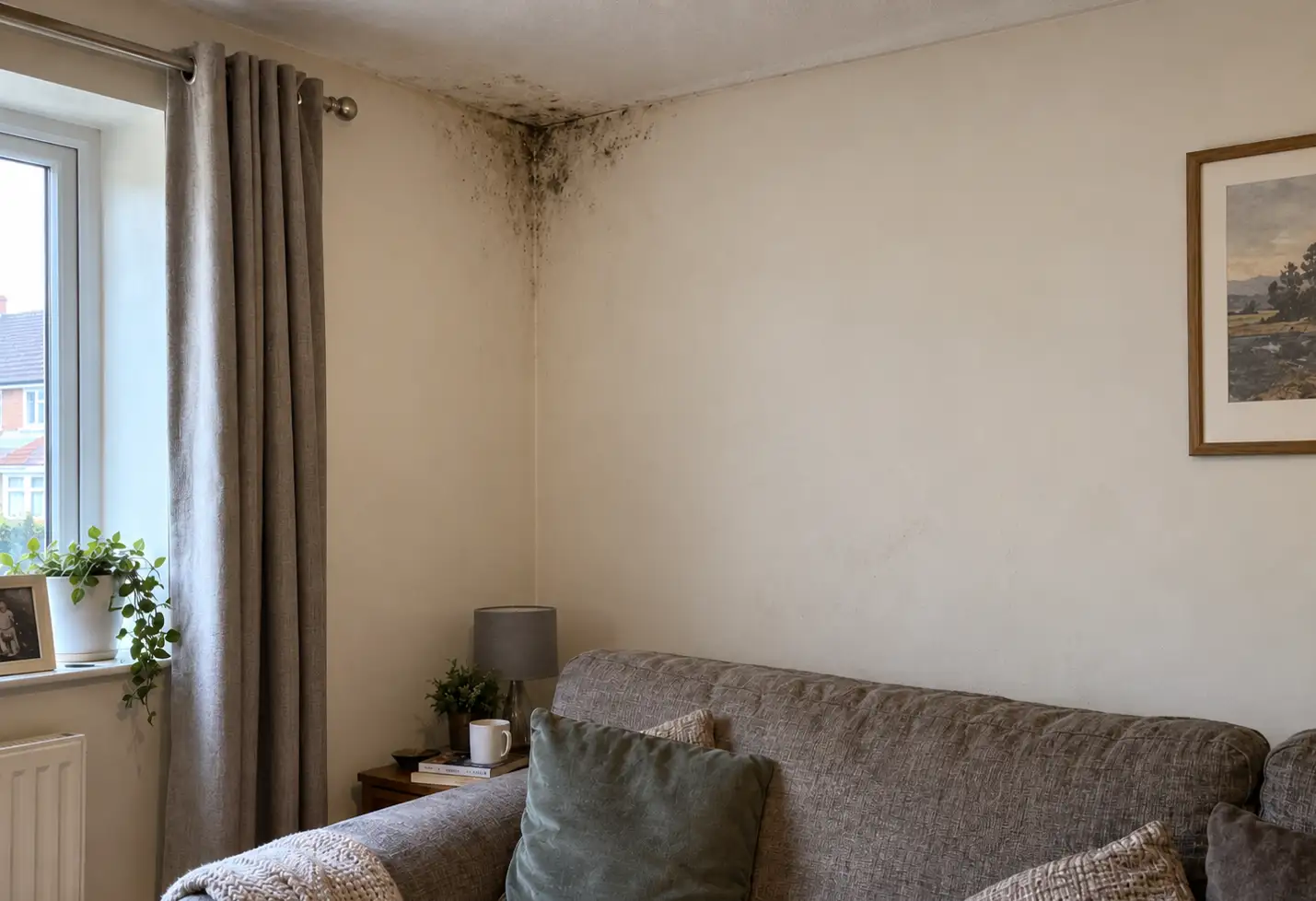
You clean it off. It comes back. Sometimes within a fortnight, sometimes reliably every winter, but always in more or less the same spot — the same corner, the same patch of ceiling above the bathroom, the same wall behind the same wardrobe. If this sounds familiar, the cleaning was never really the problem. It was never going to be.
Cleaning mould and fixing mould are different jobs
Mould is a fungus, and like any fungus it needs suitable conditions to grow, with moisture being the critical ingredient in buildings. Wipe it away with a cleaning product and you’ve removed the visible growth — you haven’t changed whatever it was about that spot that let the mould establish itself in the first place.
If the surface repeatedly stays damp, or becomes cold enough for condensation to keep forming, mould can establish again. This is the single most important thing to understand about recurring mould: what looks like the same problem “coming back” is often evidence that the conditions which allowed it to grow were never properly changed.
What actually creates the conditions mould needs
A long list of things can contribute, usually in combination rather than alone:
- high indoor humidity, from cooking, bathing, drying laundry indoors or simply a household producing more moisture than the ventilation can clear
- cold walls, particularly external walls with limited insulation
- thermal bridges — parts of the building where heat is transferred more readily, creating colder internal surface temperatures
- inadequate extraction in kitchens and bathrooms, or extractor fans that are poorly performing, poorly maintained or simply not used
- insufficient background ventilation, sometimes because trickle vents or other ventilation openings have been blocked or covered
- rooms that become persistently cold, increasing the likelihood of condensation on vulnerable surfaces
- furniture pushed hard against a cold external wall, restricting air movement behind it
- leaks, roof defects or penetrating damp feeding moisture into the fabric
- poorly detailed insulation, which can leave localised cold areas even while improving the building overall
Most recurring mould problems involve more than one of these at once, which is exactly why a single quick fix — buying a mould spray, say — so rarely solves it for good.
Location is a genuine clue, not a verdict
Where mould keeps appearing tells you something worth noting, even if it doesn’t settle the matter outright.
Mould behind a wardrobe or sofa pushed against an external wall often points towards a combination of a cold surface, elevated humidity and restricted air circulation. Moving the furniture away from the wall can improve air movement, but it won’t necessarily solve the problem on its own if the wall remains unusually cold or the room has a wider moisture or ventilation problem.
Mould in external corners, particularly where two external walls meet or at wall-to-ceiling junctions, can indicate a particularly cold surface or thermal bridge. Mould on a bathroom ceiling close to the shower should prompt a check of whether extraction and ventilation are actually coping with the moisture produced during and after bathing. Mould around a window reveal may relate to condensation on a cold area, insulation detailing or, in some cases, a defect allowing water in.
Mould confined to one area, especially if associated with wet weather or visible staining, deserves a look for a leak or penetrating damp source before you assume it’s purely a ventilation issue.
None of these are definitive diagnoses on their own — they’re starting points for a proper look, not conclusions to act on unquestioned.
Where the mould keeps returning can help narrow the search
| Recurring pattern | What it may suggest | What to check |
|---|---|---|
| Behind wardrobes or large furniture on an external wall | Cold surface + restricted air movement + condensation | Air gap behind furniture, room ventilation, surface temperature and insulation |
| External corner or wall-to-ceiling junction | Particularly cold surface, thermal bridging or insulation weakness | Whether it is consistently colder than surrounding surfaces and whether insulation is continuous |
| Bathroom ceiling | High moisture load exceeding effective extraction | Extractor operation, ducting, ventilation path and whether it continues extracting after bathing where designed to do so |
| Around window frames or reveals | Condensation, a cold bridge or possibly a window/seal defect | Whether it follows cold weather, rain, or both; ventilation and condition of seals/reveals |
| One isolated wall or ceiling patch that worsens after rain | Possible penetrating damp or leak | Roof, gutters, downpipes, pointing, render, flashing and nearby plumbing |
| Several cold surfaces around the room each winter | Wider condensation problem | Indoor humidity, heating, background ventilation, extraction and insulation |
The useful distinction is between mould caused because a surface repeatedly becomes damp from indoor condensation and mould associated with moisture entering from somewhere it shouldn’t. The repair is different, which is why location and timing matter.
Why “just open a window more” isn’t good enough advice
It’s an old reflex, and it’s not wrong exactly, but it’s incomplete. Recurring mould is very often a combination of building fabric, heating patterns, ventilation and moisture production working together, not a single behavioural failing that a bit more fresh air will fix on its own.
Opening windows can help reduce indoor humidity, and effective ventilation absolutely matters. But a persistently cold surface, defective extractor, hidden leak, insulation gap or area cut off from normal air movement still needs addressing.
Current RICS guidance on damp and mould specifically cautions against reducing condensation problems to occupant behaviour alone. Building design, defects, maintenance, alterations, heating and ventilation can all be part of the explanation.
The health context, without the scare tactics
Damp and mould exposure is a genuine, evidence-based health concern, not an exaggerated one.
Current government health guidance cites research estimating that, in 2019, damp and/or mould in English homes was associated with approximately 5,000 cases of asthma and 8,500 lower respiratory infections among children and adults. Those are estimates for that study year, not figures that should automatically be presented as the exact annual toll every year.
Damp and mould primarily affect the airways and lungs, with recognised effects including cough, wheeze, shortness of breath, respiratory infections and the development or worsening of conditions such as asthma. People with existing health conditions, weakened immune systems, children and older adults can be at greater risk.
The government’s current health guidance on damp and mould sets out the evidence and groups at increased risk.
That said, the phrase “toxic black mould” isn’t a useful diagnosis for a patch on a wall. Mould can occur in different colours and the appearance alone doesn’t reliably identify the species or establish the degree of health risk. The sensible response to persistent mould is to take the moisture problem seriously and deal with it, rather than trying to classify the danger from colour alone.
If you or anyone in your household has ongoing or worsening symptoms that seem to track with exposure to a damp or mouldy room, that’s worth raising with a healthcare professional alongside dealing with the building itself.
Cleaning what’s there, safely
Once you’ve thought about why the mould is there, dealing with what’s currently on the surface matters too. Leaving visible mould indefinitely while investigating the cause isn’t sensible — removing it reduces exposure while the underlying problem is being addressed.
For small amounts of mould on hard surfaces, current government guidance recommends an appropriate mould and mildew cleaning product, used according to the manufacturer’s instructions and allowed to dry fully. It recommends these products in preference to bleach for health and safety reasons.
Protect yourself while cleaning: wear gloves, suitable eye protection and a mask, keep the door closed to reduce the spread of spores into other areas, and ventilate the room by opening windows. Never mix cleaning chemicals together.
Absorbent materials are different. Mould can penetrate carpets, soft furnishings, ceiling tiles and similar porous materials deeply enough that cleaning may not remove it completely, and badly affected items may sometimes need specialist cleaning or disposal.
Larger areas — for example, a substantial part of a wall or ceiling — should be dealt with by an appropriately qualified professional rather than approached as a larger version of a small DIY cleaning job.
What about anti-mould paint?
Anti-mould or mould-resistant paint can have a useful role after the moisture problem has been understood and the surface has been properly treated and dried.
What it can’t do is correct inadequate extraction, stop a roof leak, insulate a thermal bridge or prevent condensation forming on a persistently cold surface.
Painting over recurring mould without dealing with why the wall keeps becoming damp is another version of the same problem as repeatedly cleaning it: the finish has changed; the conditions behind the mould have not.
When recurring mould should trigger a proper investigation
A small amount of seasonal mould in a bathroom that disappears once faulty extraction is restored is very different from mould that keeps returning in the same area despite reasonable heating, working ventilation and proper cleaning.
Persistent recurrence is a reason to investigate what is particular about that location: a cold surface, thermal bridge, insulation defect, hidden leak, rain penetration or another source of moisture.
A suitably experienced building surveyor or building-pathology specialist can investigate the building fabric, moisture source, ventilation and temperature patterns. Thermal imaging can sometimes form part of that investigation by helping identify temperature differences and possible cold areas, but it is a diagnostic aid rather than proof of a cause by itself.
The important shift is from asking “what do I clean it with?” to asking “why does this particular surface repeatedly become suitable for mould growth?”
If you’re renting
Renters dealing with mould should report it to their landlord or managing agent promptly and preferably in writing, keeping photographs and a record of when the problem was reported and what response was received.
Government guidance for housing providers is clear that simply removing surface mould is not enough: landlords should investigate and address the underlying causes, including building deficiencies, inadequate ventilation and condensation.
The detailed rights, responsibilities and enforcement routes belong in our Renters’ Rights and Repairs & Property Standards coverage rather than being duplicated here.
The underlying lesson
Recurring mould is rarely a cleaning problem alone. Cleaning deals with what has already grown; lasting control means changing the moisture, surface-temperature, ventilation or building-defect conditions that allowed it to grow there.
If the same patch keeps returning in the same place, that’s useful information. Instead of reaching automatically for a stronger spray, use the pattern to work out what that particular part of the building is telling you.
This article provides general property information, not medical or building diagnosis. If mould exposure is affecting anyone’s health, seek appropriate medical advice. Where mould is extensive, persistent or the underlying moisture source is unclear, get advice from a suitably experienced building professional before committing to substantial remedial work.

