

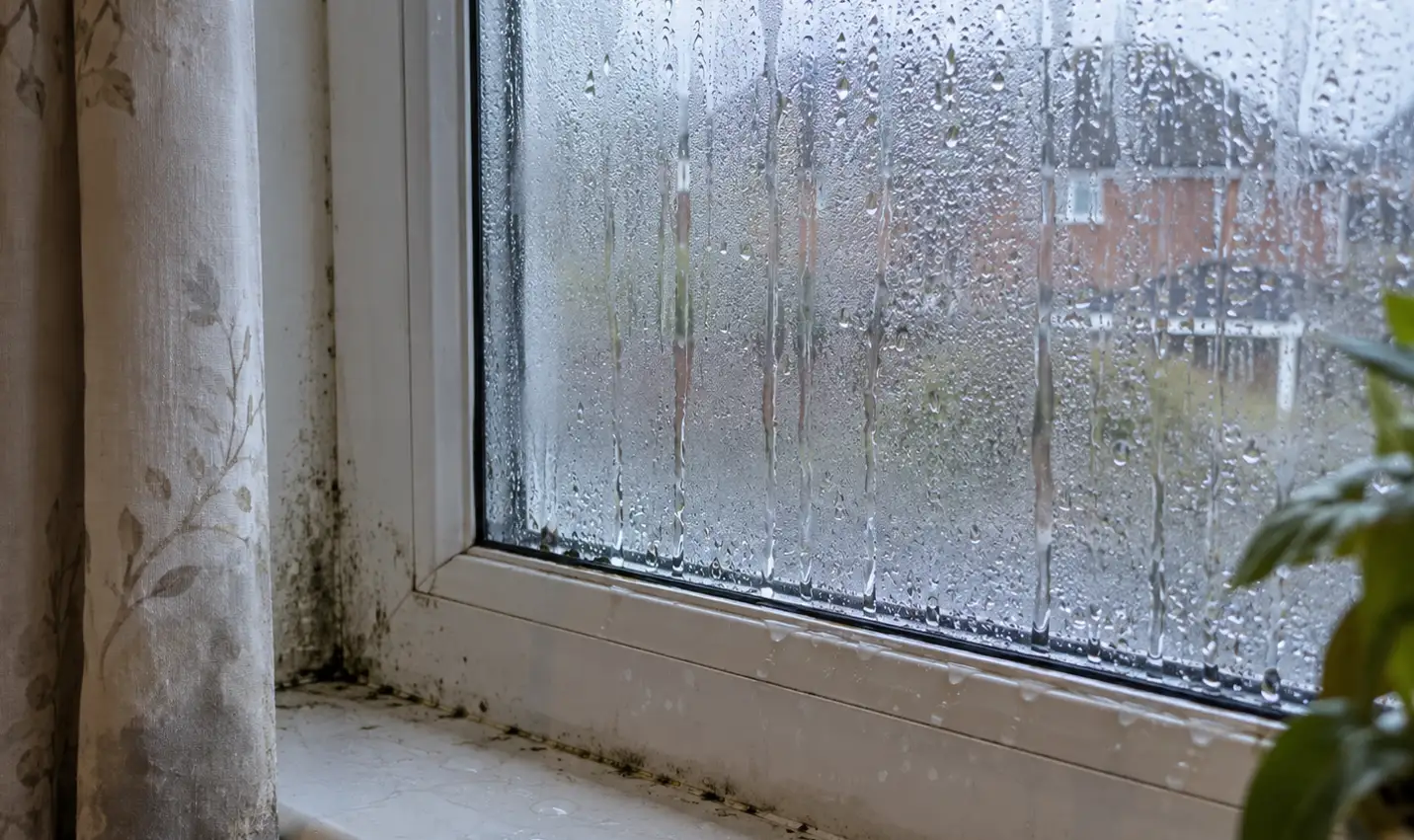
Water running down the glass. A puddle collecting on the sill. Curtains that feel damp when you draw them back. If this greets you most winter mornings, you’re dealing with condensation — and while the fix isn’t always simple, the cause almost always is.
What’s actually happening on the glass
Air contains water vapour, and warmer air can contain more moisture before becoming saturated than colder air. When moist air meets a surface cold enough to take it to its “dew point” — the temperature at which water vapour starts turning back into liquid water — condensation forms.
Window glass is very often one of the coldest surfaces in a room, particularly overnight when outside temperatures fall, so it’s usually the first place condensation shows up. The water isn’t leaking through the pane. It’s moisture that was already inside your home meeting a cold surface.
The RICS damp and mould consumer guide makes the same important point: condensation is a form of moisture movement, and the lasting solution depends on understanding why humidity is high, why surfaces are cold, or why ventilation isn’t removing enough moisture.
Why bedrooms are often the worst room in the house
A closed bedroom overnight, several hours of breathing, and a room that’s allowed to cool once the heating switches off can create very favourable conditions for condensation.
People add moisture to indoor air simply by breathing, and if background ventilation or air movement is limited, that moisture can accumulate through the night. As the room and window surfaces cool, the coldest surfaces reach dew point first — usually the glass, but sometimes external walls and corners, particularly behind wardrobes or other furniture where air movement is poor.
Why it gets so much worse in winter
Three things stack up against you in the colder months: surfaces get colder, so the dew point is reached more easily; everyday life continues to produce moisture indoors through cooking, washing, drying clothes and breathing; and homes tend to be ventilated less because nobody particularly wants cold outside air pouring in during January.
Combine colder surfaces with a similar moisture load and less air exchange, and condensation becomes considerably more likely.
The moisture is coming from your daily routine — but that’s not really the point
Cooking, showering and bathing, drying laundry indoors, and even people and plants all add water vapour to the air. A vented tumble dryer that isn’t properly ducted outside can add a large amount of moisture to a room. Recirculating cooker hoods filter grease and odours but generally don’t remove cooking moisture from the building in the way an externally ducted extract system does.
It would be easy — and it’s a genuinely unhelpful habit — to frame all of this as something the occupants are doing wrong. Everyday living produces moisture; that’s unavoidable. What determines whether it turns into a condensation problem is how well the building handles it: how much effective ventilation there is, how cold vulnerable surfaces become, the insulation and thermal performance of the fabric, and how the home is heated.
A building with poor ventilation and cold surfaces can develop condensation under perfectly ordinary household use. Blaming the occupants for cooking dinner or having a shower misses the point.
Does replacing old windows cause damp?
This comes up constantly, and the answer is more nuanced than either “yes” or “no.” Old, draughty windows allowed uncontrolled air leakage — wasteful from an energy point of view, but nevertheless a source of background air change.
Replace them with modern, well-sealed windows and that accidental ventilation can be substantially reduced even though the moisture-generating habits in the house haven’t changed. The result can look like the new windows “caused” the condensation, when what’s actually happened is that one route by which moist indoor air previously escaped has been removed.
New double glazing doesn’t create moisture. But improving airtightness means the home’s deliberate ventilation provision matters more.
In England, current Approved Document F explicitly recognises this issue. When windows are replaced, the ventilation of the dwelling should not be made less satisfactory; where existing windows have background ventilators, replacement windows should retain suitable background ventilation, and replacing previously leaky windows without vents can require ventilation provision to be reconsidered.
So if condensation appears after replacement windows have been fitted, don’t assume either that the windows are defective or that trickle vents are pointless. Check whether the overall ventilation strategy still works for the more airtight home you now have.
Not all “wet windows” mean the same thing
It matters where the moisture actually is. Condensation on the inside face of the glass, which you can wipe away with your hand, is the everyday indoor-moisture problem described above. Condensation between the panes of a double- or triple-glazed unit is different — it usually indicates that the sealed glazing unit has failed, allowing moisture into the space between the panes. That’s a glazing-unit problem, not something opening a bedroom window will solve.
Condensation on the outside face of modern glazing can also occur on cold, clear mornings because the external pane has become cold enough for outdoor moisture to condense on it. This is generally not a defect in the window.
Where is the water?
| Where you can see moisture | What it usually suggests | What to do next |
|---|---|---|
| Inside surface of the glass | Indoor humidity meeting cold glass | Look at ventilation, moisture production, heating and surface temperatures |
| Between double- or triple-glazed panes | Failed sealed glazing unit | Have the glazing unit assessed for replacement |
| Outside surface of the glass | Outdoor condensation on a cold external pane | Usually no action required unless there are other signs of a window defect |
| Around the frame or surrounding wall rather than mainly on the glass | Could still be condensation, but leaks, defective seals or another damp source should also be considered | Check the pattern, weather relationship and surrounding building fabric |
That distinction is useful because three windows can all look “wet” while requiring three completely different responses.
What actually helps
There’s no single fix — condensation control is about several things working together rather than one silver bullet.
Extraction at the source. Use effective extraction when cooking, bathing or showering and allow it to continue afterwards where appropriate. Removing moist air close to where it’s produced prevents it spreading into colder parts of the home.
Background ventilation. Trickle vents and other properly designed background ventilation provide air exchange without relying entirely on occupants remembering to throw windows open. Don’t permanently block ventilation openings without understanding what they’re there for.
Reasonable heat levels. Maintaining adequate heat helps keep internal surfaces warmer and therefore less likely to fall below dew point. The important principle isn’t that every home must be heated continuously at one prescribed temperature, but that very cold rooms combined with moisture moving in from elsewhere are particularly prone to condensation.
Reducing avoidable moisture where it’s easy to do so. Put lids on pans where practical, keep bathroom and kitchen doors closed while large amounts of moisture are being generated, use effective extraction, and make sure a vented tumble dryer actually vents outside. Condenser and heat-pump dryers should collect moisture as their design intends.
Air movement around cold surfaces. Mould frequently develops behind wardrobes and large pieces of furniture against cold external walls because the surface is cold and air movement is restricted. Where practical, allowing a little space for air circulation can help.
Wiping down. Wiping standing water off windowsills and glass each morning limits damage to frames and finishes and reduces prolonged surface wetness — but it treats a symptom, not the reason the condensation formed. Relying on wiping alone won’t resolve a recurring problem.
What about a dehumidifier?
A dehumidifier can be genuinely useful where indoor humidity is high, particularly when laundry has to be dried indoors or as part of managing a difficult condensation problem. It removes water from the air and can therefore reduce the amount available to condense on cold surfaces.
But it’s a management tool, not automatically a cure.
If the real problem is an ineffective bathroom extractor, blocked background ventilation, very cold building fabric or an actual water leak, buying a dehumidifier without addressing that problem simply means running an appliance indefinitely around an unresolved cause.
Energy Saving Trust’s guidance on damp and condensation makes the same distinction: dehumidification can help with excess moisture, but ventilation, insulation and the underlying moisture source still matter.
A practical order to try things
If morning window condensation is the main symptom and there are no obvious signs of another damp problem, the sensible order is usually to start with the simple questions before assuming the house needs major work.
First check whether bathroom and kitchen extraction actually works and discharges appropriately. Then make sure existing trickle vents or other designed ventilation haven’t been blocked. Look at obvious moisture sources such as indoor laundry and incorrectly vented dryers. Check whether particularly affected rooms are being allowed to become much colder than the rest of the house. Wipe away standing condensation while you’re working on the cause.
If the problem remains severe despite reasonable ventilation, moisture control and heating, that’s the point to look more closely at the building itself — insulation gaps, cold bridges, window performance, ventilation adequacy or another source of damp may be contributing.
The aim isn’t to eliminate every occasional droplet from every home. It’s to stop persistent condensation from becoming normal.
The “heat the person, not the home” trap
For households genuinely struggling with energy costs, advice to prioritise heating the person over the whole home is understandable, but it comes with a real trade-off worth knowing about: a colder home still needs ventilating.
Moisture from cooking, washing and breathing doesn’t stop because the heating has been turned down, while colder surfaces make condensation more likely. That doesn’t mean households facing fuel poverty should simply be told to turn the thermostat up regardless of cost. It means the building consequences of prolonged low temperatures need to be recognised alongside the financial reality.
If affording enough heat is a genuine struggle, the government’s help with energy bills service sets out current support for eligible households, including energy-bill assistance and energy-saving improvement schemes.
When wet windows point to something bigger
If the glass itself is wet but you’re also seeing a stained patch of wall nearby that doesn’t fit the same pattern, substantial mould spreading well beyond the window reveal, water appearing independently of normal indoor moisture, or damage that seems disproportionate to simple condensation, it’s worth widening the investigation rather than assuming it’s all one problem.
Penetrating damp, plumbing leaks and condensation can coexist in the same room. Treating one while ignoring another rarely solves anything.
Persistent damp and mould also deserves taking seriously as a health issue. Current government guidance states that damp and mould primarily affect the airways and lungs and can worsen or contribute to respiratory illness.
Wet windows, in isolation, usually mean exactly what they look like: indoor moisture meeting a sufficiently cold surface. The lasting fix is rarely one single change — it’s reducing avoidable moisture where practical, providing effective ventilation, and keeping vulnerable surfaces warm enough to reduce how often they fall below dew point.
This article provides general property information and is not a substitute for professional advice on your specific building. If condensation is severe, persistent, accompanied by significant mould or other signs of damp, get the underlying cause investigated. If damp or mould is affecting someone’s health, seek appropriate medical advice.

