

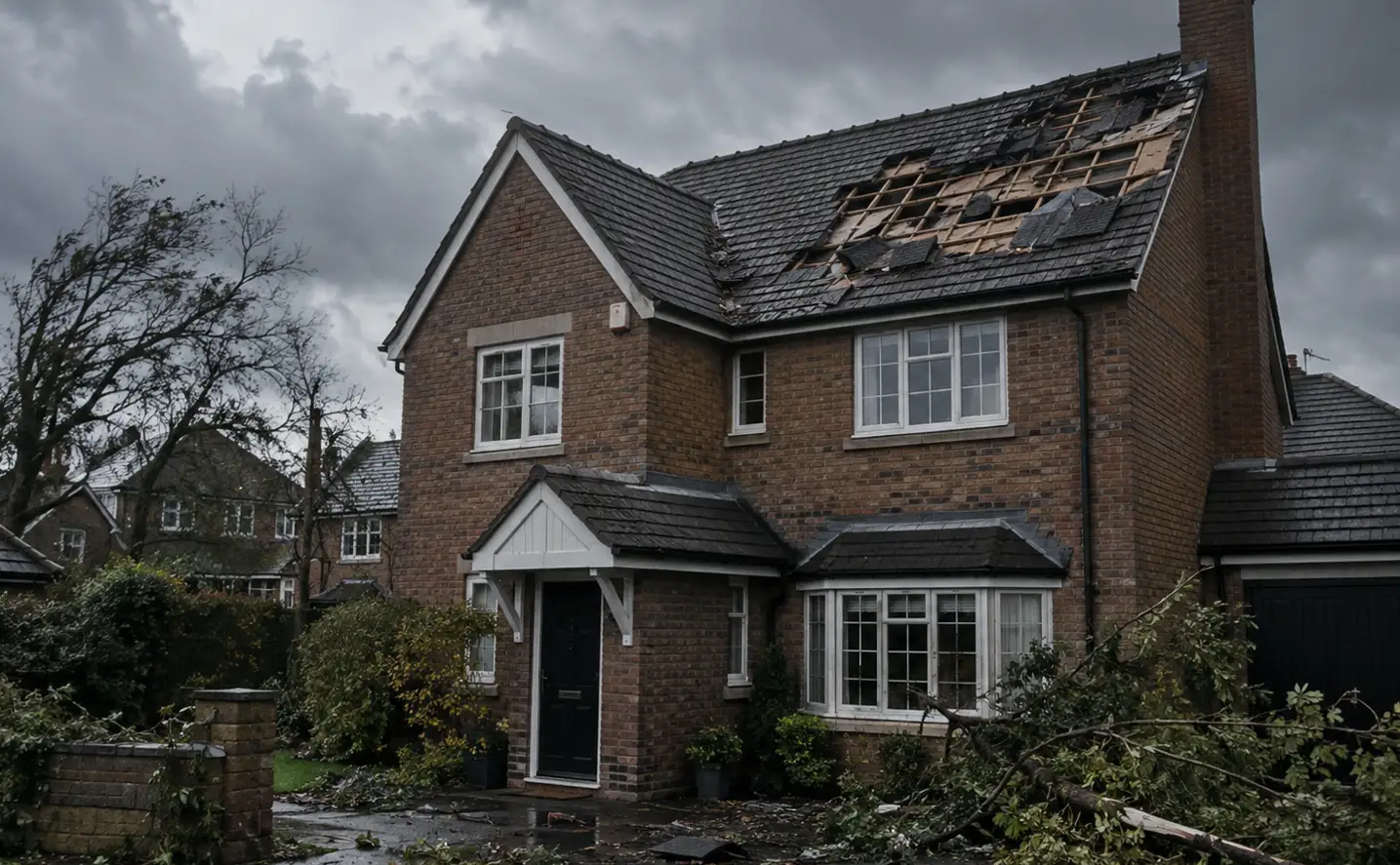
You step outside after a rough night to find tiles in the garden, a fence flattened, or a branch through the shed roof, and the immediate question is whether home insurance is going to cover it.
The honest answer turns on something more specific than “was it windy?” The question that matters is whether the storm actually caused the damage, or whether it simply exposed a weakness that was already there.
That distinction sits behind a great many disputed storm claims. It’s also why two neighbours can suffer apparently similar damage during the same night’s weather and end up with very different insurance outcomes.
What actually counts as a “storm”
There isn’t one universal wind-speed figure that automatically decides whether a home-insurance claim counts as storm damage.
Some policies define storm conditions themselves, sometimes using particular thresholds, in which case your own policy wording matters. Where they don’t, the Financial Ombudsman Service’s approach to storm-damage disputes is more useful than trying to fixate on a single number.
The Ombudsman generally describes a storm as involving violent winds, usually accompanied by rain, hail or snow, while recognising that sufficiently extreme rain, hail or snowfall can sometimes amount to storm conditions even without exceptional wind.
More importantly, it considers the claim in three broad stages: were there genuine storm conditions around the relevant time, is the damage consistent with the kind of damage a storm could cause, and was the storm actually the main cause of the damage?
That last question is normally where the difficult claims are decided.
A reading from the nearest weather station is useful evidence, but it doesn’t necessarily tell the whole story. Local gusts and conditions can vary, and the Ombudsman can consider wider weather information rather than treating one reading several miles away as automatically decisive.
Equally, “it was incredibly windy here” isn’t proof of an insured loss if the physical evidence suggests that whatever failed was already close to failing anyway.
The real question: did the storm cause it, or expose it?
Imagine two roofs losing tiles during the same night.
One has been reasonably maintained and showed no obvious problem beforehand. Severe winds tear otherwise serviceable tiles away.
The other has badly corroded fixings, loose tiles and deteriorating mortar that have been getting progressively worse for years. The severe weather happens to be the final event that makes part of the roof give way.
From the garden the following morning, both can look like storm damage. From an insurer’s perspective, they aren’t necessarily the same thing.
The Association of British Insurers’ storm guidance gives examples including roof tiles loosened by corroded fixings, deteriorating chimney pointing and ageing flat-roof coverings as problems severe weather may expose rather than genuinely cause.
Home insurance isn’t a maintenance contract, and that principle is reasonable. It would make little sense for ordinary gradual deterioration to become an insured event simply because the eventual failure happened on a windy night.
But that cuts both ways.
An older roof isn’t automatically an uninsured roof. Tiles, slates, chimneys and flat roofs don’t have to be new before genuinely sudden storm damage can be covered. The Financial Ombudsman expressly says that a property being in less-than-perfect condition doesn’t necessarily establish wear and tear as the real cause.
A simple example shows the distinction. Three tiles ripped from an otherwise sound roof during severe winds present a very different causation case from an entire badly deteriorated ridge beginning to collapse during relatively ordinary weather.
Age is evidence. Condition is evidence. Weather is evidence. None of them should be used as a substitute for establishing what actually caused the failure.
That is why a contractor’s description can become much more important than simply obtaining a price. “This roof is old and would benefit from replacement” says very little about whether the storm damaged it. “These previously serviceable tiles were torn away and their fixings failed under the storm loading” addresses the insurance question much more directly.
Internal water damage: a related but distinct question
A storm claim doesn’t necessarily stop with whatever happened to the roof.
A tile is displaced, water enters and damages a ceiling. Flashing fails and rain ruins plaster or flooring. A branch damages the roof covering and water subsequently reaches bedrooms below.
The insurer may need to consider the external defect and the resulting internal damage separately.
That doesn’t mean internal water damage is automatically covered whenever the roof repair isn’t. Policy wording and exclusions still matter. But a decision that the underlying roof defect is wear and tear does not necessarily answer every other coverage question created by the incident.
The Financial Ombudsman expects insurers dealing with disputed claims to consider whether other parts of the policy might respond rather than looking only at the storm section.
So if an insurer says the roof itself isn’t covered, but considerable internal damage followed, ask whether the whole policy has been considered — including any relevant water or accidental-damage cover you actually purchased.
That is usually more useful than arguing endlessly about whether every part of the loss should carry the same label.
Fences and gates: a common, genuine surprise
This catches a lot of people out.
A fence feels every bit as much a part of the property as the roof, but insurance policies frequently treat them differently.
The ABI says storm damage to fences, hedges and gates is generally excluded by standard home-insurance policies. Individual policies vary, so yours may provide different cover, but assuming a fence is protected simply because the policy includes “storm damage” is risky.
The important principle is to check the cover applying to the thing that was damaged, not only the event that damaged it.
The same issue can arise where a falling tree destroys a fence. The fact that the immediate cause was a tree doesn’t necessarily override an exclusion specifically applying to fences or boundary features.
This is one of the reasons reading the actual policy wording matters more than relying on the general description of your insurance as “buildings cover”.
Trees: several genuinely different scenarios
“A tree came down in the storm” sounds straightforward until you ask what it actually damaged.
If your own tree falls during severe weather and damages your insured house, garage or another structure included in your buildings policy, the structural damage will usually be considered under the policy’s storm or falling-tree provisions.
Where a neighbour’s tree lands on your house, you don’t necessarily have to establish that the neighbour was negligent before approaching your own insurer. If the damage is covered by your own buildings insurance, your insurer can normally deal with that insured loss and consider separately whether anybody else may ultimately be liable.
That second question is important, but it shouldn’t be confused with the first.
A neighbour isn’t automatically negligent because a healthy tree came down during exceptional weather. The position can be very different where a tree was obviously dangerous, rotten or unstable and the owner knew — or reasonably ought to have known — that it required attention.
There’s another distinction homeowners often discover only after a tree has fallen: damage caused by a tree and the cost of removing the tree can be different insurance questions.
A tree through the roof has caused damage to insured property. A large tree lying harmlessly across the lawn may have created an expensive clearance job without damaging anything the policy insures.
That doesn’t mean removal is never covered. It means the wording matters.
Likewise, trees, shrubs, hedges and general landscaping can have much more restricted storm cover than the building itself. Garages and sheds are often included within buildings insurance, but definitions and limits vary, so a branch through an outbuilding needs to be checked against the particular policy rather than assumed either way.
The useful lesson isn’t that tree claims are unusually complicated. It’s that the insurer is covering specified property against specified events. Knowing which piece of property was damaged is therefore just as important as knowing that a tree fell.
Reasonable emergency action, done safely
If the storm has left a hole in the roof or a broken window through which rain is continuing to enter, insurance isn’t a reason to stand by watching the damage become worse.
Insurers generally expect policyholders to take reasonable measures to limit further loss.
Where it’s safe, photograph or video the damage before temporary work begins and contact the insurer as soon as reasonably possible. If an emergency contractor has to make the property safe or weatherproof before an insurer can inspect it, retain the invoice and ask the contractor to photograph what they find before covering or removing damaged material.
The distinction between temporary protection and permanent repair is worth keeping clear.
Making an opening weatherproof can prevent thousands of pounds of further damage. Commissioning a complete reroof before the insurer has had any opportunity to inspect what failed can make a later dispute considerably harder to resolve.
If you’re already considering a relatively small claim, check the applicable excess as well. A repair costing only slightly more than the excess poses a different financial question from widespread roof or structural damage, although potentially serious damage shouldn’t be left unreported simply while you wait to decide whether claiming is worthwhile.
And none of this justifies unsafe investigation. Storm-damaged roofs may contain loose tiles, unstable masonry and wet surfaces. Fallen trees can retain enormous stored tension in damaged branches, and anything touching overhead electrical cables should be left well alone.
Photograph what you safely can. The insurer doesn’t need evidence badly enough for you to climb onto the roof to obtain it.
Wear and tear: a real principle, applied fairly
Wear and tear is a legitimate insurance issue.
Roofs age, timber decays, fixings corrode, mortar breaks down and flat-roof coverings eventually fail. If gradual deterioration is genuinely what caused the loss, an insurer can reasonably rely on exclusions designed to keep routine property maintenance outside home insurance.
What matters is whether that is actually what happened.
Where an insurer declines a claim because of wear and tear, it’s reasonable to ask what evidence supports that conclusion. Was the relevant part of the property inspected? What precisely was deteriorated? Were failed fixings, rot, longstanding cracking or another pre-existing defect identified? Does that defect explain why this particular part of the property failed when it did?
A general statement that “the roof is old” isn’t the same thing as demonstrating that deterioration caused the damage.
For a substantial disputed claim, this is where independent technical evidence can sometimes be worth paying for.
A roofer may be able to explain what failed. A building surveyor or structural engineer may be more appropriate where the cause is technically complicated. An arborist may be needed where the condition of a fallen tree is disputed.
The purpose isn’t to commission expensive reports for every missing tile. It’s to recognise when the value of the disputed claim makes an independent opinion on causation financially rational.
On larger claims, the insurer may appoint a loss adjuster to inspect and assess what has happened. A loss adjuster may work for and report to the insurer, while a policyholder can separately appoint their own claims professional if they want representation. The Chartered Institute of Loss Adjusters’ guidance for policyholders explains the distinction.
The important thing for the homeowner is simply to understand who has appointed the person assessing the loss and not assume that every professional involved in the claim is acting as their personal adviser.
What actually helps a claim
The strongest claim evidence often existed before the storm.
Previous survey photographs, reroofing invoices, maintenance records, chimney repairs, estate-agent photographs and ordinary family photographs can all help establish the condition of the property before the event.
That matters most where the dispute is whether the storm caused genuinely new damage or merely finished off something already failing.
After the storm, photographs should capture both the overall damage and, where safely possible, the detail: displaced tiles, broken fixings, damaged flashing, fallen branches and the route water took once it entered.
If a contractor attends, their observations can be particularly valuable. Ask them to photograph what they find before disturbing it and, where they reasonably can, distinguish storm-created damage from older deterioration.
A report that only says what the repair will cost is useful for pricing the claim. A report explaining why the repair became necessary can be much more useful where causation is disputed.
Weather information supports the same picture. Named-storm reports, Met Office warnings and recognised weather data can all help, but you don’t need to assemble a meteorological dossier before notifying the insurer.
Keep receipts for emergency work and retain important damaged material where doing so is safe and practical until the insurer has had a reasonable opportunity to consider it.
The aim isn’t to produce the largest possible file of evidence. It’s to preserve the evidence that helps answer the one question most disputed storm claims eventually come back to: what caused this damage?
If your claim is declined and you disagree
A rejection doesn’t necessarily mean the claim has been considered correctly, but neither does disagreement automatically make the insurer wrong.
Start by understanding precisely why the claim has been declined.
If the insurer says the weather wasn’t severe enough to constitute a storm, ask what evidence it relied on. If it says the property was already deteriorated, ask what physical evidence supports that conclusion. If only the external repair has been addressed, ask whether consequential internal damage or another potentially relevant section of the policy has also been considered.
Where a loss adjuster or surveyor inspected the damage, asking for the substance of their findings can be particularly useful. The dispute is much easier to assess when you know whether the decision rests on failed fixings, rot, historical cracking, insufficient weather conditions or something else altogether.
If you still think the decision is wrong, make a formal complaint to the insurer.
The Financial Ombudsman Service provides an independent and free route where the complaint remains unresolved. Insurers normally have up to eight weeks to issue their final response, after which an eligible complaint can be referred onwards within the applicable time limit.
The value of the Ombudsman’s approach is precisely that it doesn’t start with a presumption that either side must be right. It looks at the policy wording, weather evidence, physical condition and technical evidence and asks what most likely caused the loss.
Sometimes that supports the insurer’s wear-and-tear decision.
Sometimes it shows that “wear and tear” has been asserted far more confidently than the evidence justifies.
The point worth remembering
A storm claim doesn’t succeed simply because the weather was dramatic, and it doesn’t fail simply because your house or roof isn’t new.
The question underneath almost everything else is much more useful:
What actually caused the damage?
If an insured storm suddenly damaged something that was reasonably serviceable beforehand, that is the kind of loss buildings insurance exists to address. If years of deterioration left something on the verge of failure and the weather merely exposed it, the position can be very different.
Fences, trees, outbuildings and resulting internal damage add their own policy questions, but they don’t change that central principle.
Home insurance shouldn’t be expected to renew an ageing property at the insurer’s expense. Equally, genuine storm damage shouldn’t disappear behind the words “wear and tear” merely because the building has some age to it.
The strongest position — for either side — is the one the evidence actually supports.
This article provides general property information, not advice on a particular insurance policy or claim. Cover, exclusions, limits and excesses vary between insurers and policies, particularly for fences, gates, gardens, trees, outbuildings and consequential damage. Check your own policy wording and contact your insurer promptly following significant storm damage.

