

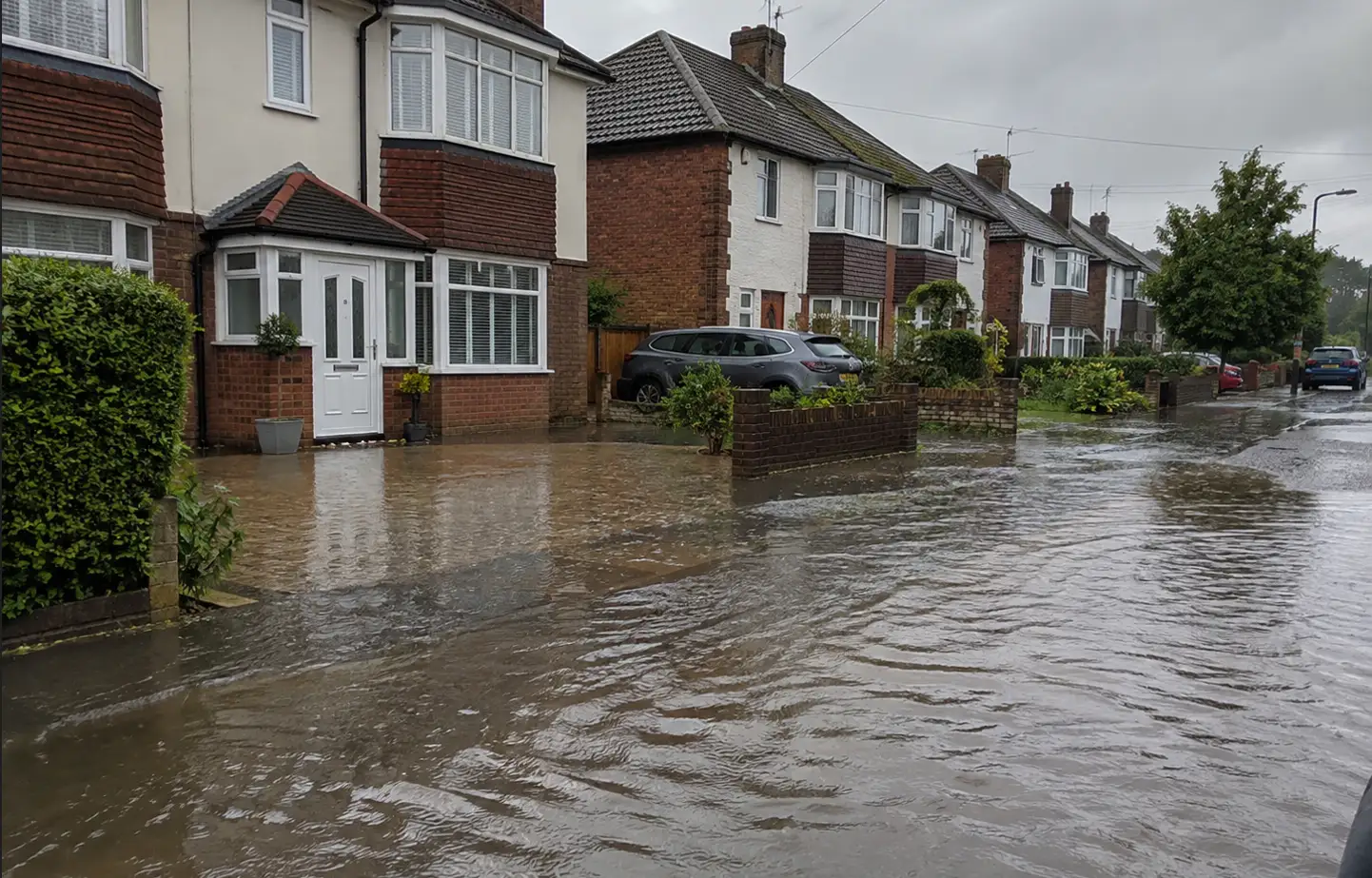
Water flows down the road during heavy rain, pools across the driveway and eventually reaches the house. Or it comes up through a gully. Or a ditch behind the garden overtops again. The understandable reaction is to ask: who is responsible for this?
The awkward answer is that “responsible” can mean three different things.
One organisation may be responsible for managing the source of the flood risk. Another may be the right organisation to report the incident to and investigate what happened. Neither is automatically legally liable for the damage to your home.
That distinction matters. A council can have statutory flood-risk functions without guaranteeing that your property will never flood. A water company can be responsible for a public sewer without automatically being liable every time exceptionally heavy rainfall overwhelms it. And a watercourse can fall within a public authority’s flood-management remit while the landowner beside it still retains responsibility for maintaining their own stretch.
So the useful starting point isn’t simply “council or water company?”
It’s where did this particular water come from, what infrastructure was involved, and who actually controls or maintains that part of the system?
Start with the source, not the destination
This is the single most useful shift in thinking.
Two houses can end up with water beneath the back door after the same thunderstorm for completely different reasons. At one, a road gully has blocked and water that should have entered the highway drainage system is running down the drive instead. At another, the public sewer has become overwhelmed and is pushing water back through a private drain. Somewhere else, rain is simply travelling over saturated ground, or a small stream behind the garden has burst its banks.
Increasingly, serious flood events involve more than one source at the same time.
Government guidance for England’s Lead Local Flood Authorities specifically recognises that flooding can involve combinations of surface water, sewers, groundwater and watercourses, which is one reason responsibility can be so difficult to establish from what the homeowner sees at the final point of entry.
The government’s current guidance on investigating flooding puts identifying the source — and therefore which risk-management authorities have relevant functions — at the centre of the investigation.
If you can establish what the water was doing before it reached your property, you’re already much closer to contacting somebody capable of doing something useful about it.
Road gullies and highway drainage
Where water is building up on a public road because a road gully, channel or other highway drainage feature is blocked or apparently failing to take water away, the first organisation to contact is normally the highway authority.
For ordinary local roads in England that will usually be the county council or unitary authority responsible for the highway. National Highways manages motorways and relevant trunk roads.
The distinction matters because the council’s highway-drainage function is separate from its role as Lead Local Flood Authority. You may be reporting to the same council, but internally they are different responsibilities.
Current government flood-risk guidance confirms that highway authorities are responsible for providing and managing highway drainage.
That doesn’t mean a road is guaranteed never to hold water during an exceptional storm. Highway drainage has a finite capacity, and flooding can occur even where the infrastructure is maintained. A blocked gully that repeatedly causes flooding and a correctly functioning system temporarily overwhelmed by extreme rainfall are therefore not necessarily the same problem.
If you repeatedly see water unable to enter a visibly blocked road gully before it reaches your property, photograph that sequence. It is much stronger evidence than simply photographing water already sitting in your hallway.
Public sewers
Where water is backing up through toilets, drains, manholes or gullies — particularly where it contains sewage or has an obvious sewage smell — the public sewerage system becomes a much stronger suspect.
Public sewers are the responsibility of the relevant water and sewerage company, not the council.
Ofwat’s guidance on public and private sewer responsibility confirms that sewerage companies maintain public sewers, including some that run beneath private land.
Surface water complicates the picture because public sewer systems can carry rainwater as well as foul sewage. In older areas, combined sewers carry both in the same pipe. A very intense rainfall event can therefore produce sewer flooding even though the original water falling from the sky would ordinarily be described as surface water.
That is another reason the final appearance of the flood doesn’t necessarily reveal which organisation’s infrastructure was involved.
Where sewer flooding affects several neighbouring properties, public manholes are surcharging or sewage is backing up from the network, report it to the sewerage company promptly rather than treating it simply as “council flooding”.
A burst water main
A sudden release of relatively clean water from beneath a road or pavement, water visibly bubbling through the highway, an unexpected loss of mains pressure nearby or a large flow continuing independently of rainfall points in a completely different direction again.
A leak or burst on the public water-main network belongs with the water company.
That doesn’t mean every underground supply-pipe leak is theirs. The pipe serving an individual property can become the owner’s responsibility at a particular point, and the boundary differs with the infrastructure involved. Property Front Page’s separate article on drain and pipe responsibility deals with that distinction properly.
But where the source is clearly a burst public main, neither the Lead Local Flood Authority nor a highway drainage team is the useful first call.
Main rivers and the sea
In England, the Environment Agency has the principal flood-risk role for main rivers and the sea, including flood forecasting, warnings, strategic management and powers to carry out flood-risk works.
There is an important qualification to the word “responsible”, though.
The Environment Agency has permissive powers rather than an absolute duty to maintain every stretch of every main river. Riverside land can still have a private riparian owner with responsibilities for the watercourse alongside those public flood-management functions.
Current government guidance on the Main River network expressly states that the Environment Agency has powers, but not a general duty, to carry out maintenance, improvement and construction works on main rivers.
So if a main river floods, the Environment Agency is an important authority to report to and may manage flood defences or undertake work, but “it’s a main river” doesn’t automatically mean every maintenance problem transfers from the adjoining landowner to the Agency.
This becomes particularly important where the issue isn’t the river overtopping generally, but a specific blockage, structure or neglected bank on private land.
Ordinary watercourses
Smaller streams, brooks, ditches and channels that aren’t legally designated as main rivers are normally classed as ordinary watercourses.
This is where private land ownership becomes especially important.
If an ordinary watercourse runs through, alongside or sometimes beneath your land, you may be a riparian owner. That brings genuine responsibilities to allow the natural flow of water to pass, maintain the bed and banks and prevent obstructions on your stretch from creating problems.
The government’s guidance for watercourse owners explains those responsibilities and also makes clear that permission may be needed before altering banks, culverts, channels or other structures.
That last part matters. A homeowner worried about flooding shouldn’t simply deepen a ditch, enlarge a culvert or divert a stream because it appears obvious that “more capacity” would help. Changes can shift flooding somewhere else and may require formal consent.
In England, Lead Local Flood Authorities and, in some low-lying areas, Internal Drainage Boards have flood-risk functions and permissive powers relating to ordinary watercourses. Relevant authorities can also have enforcement powers where a watercourse is being improperly obstructed or maintained.
But those powers are permissive. An authority having power to intervene isn’t the same thing as being obliged to carry out routine maintenance for the landowner.
This is one of the areas where identifying who owns the ditch or culvert can be just as important as identifying which public authority regulates it.
Surface runoff and groundwater
Rain falling onto the ground and flowing over the surface before entering a watercourse, drainage system or public sewer is the classic definition of surface-water flooding.
In England, Lead Local Flood Authorities — county councils or unitary authorities — have the lead operational role in managing flood risk from surface water and groundwater, as well as a strategic role around ordinary watercourses.
The government’s overview of flood-risk management authorities sets out that division.
But “the LLFA manages the risk” shouldn’t be translated into “the council must stop water reaching my particular house”.
The council develops the local flood-risk strategy, works with other responsible organisations, can carry out flood-risk works and investigates qualifying flood incidents. It doesn’t provide every individual property with a guaranteed drainage solution.
Section 19 of the Flood and Water Management Act 2010 requires an English LLFA, once aware of flooding, to investigate to the extent it considers necessary or appropriate and, where it investigates, establish which authorities have relevant functions and whether they have exercised them.
That means there isn’t necessarily an automatic full formal investigation every time one driveway floods. LLFAs commonly publish local criteria based on matters such as the number of properties affected, recurrence, severity and duration.
This is one reason reporting repeated flooding remains worthwhile even if the first event doesn’t lead to immediate engineering work: without reports, the authority may never build an accurate picture of the recurring problem.
Private drainage
Sometimes the answer really is much closer to home.
A blocked channel, soakaway or drain serving only your property, defective private pipework or a poorly maintained private drainage feature can place responsibility with the owner rather than a public authority.
The legal boundary between private drainage and the public sewer network varies with the type of pipe and differs somewhat across the UK, so it isn’t sensible to compress the whole subject into this article.
The important distinction is that water occurring outside doesn’t automatically make the drainage public.
A drain beneath your driveway may still be private. A public sewer can, equally, run beneath your garden.
That ownership question should be established before somebody spends thousands digging up a pipe on the assumption that its location tells you who owns it.
New housing estates can introduce another responsible party
This is increasingly worth checking because modern developments don’t necessarily drain surface water through a simple council-road-gully-to-water-company-sewer arrangement.
Sustainable Drainage Systems — SuDS — can include swales, attenuation basins, permeable paving, storage features and other infrastructure designed to slow, store or infiltrate rainfall.
Who maintains those features depends on how the particular development was set up.
In England, some estate drainage remains privately managed by an estate management company or resident management company rather than being adopted by a public authority. Current government standards for SuDS specifically require long-term maintenance arrangements to identify who is responsible for the drainage system.
The current English SuDS standards make that maintenance responsibility explicit.
So if a relatively new estate repeatedly floods around an attenuation pond, swale, private road or communal drainage feature, don’t assume automatically that the council or water company owns it. Check the development’s drainage plans, adoption records, management-company documents and service-charge information.
Wales is different again: qualifying new developments have operated under a statutory SuDS approval and adoption regime since 2019, with local authorities acting as SuDS Approving Bodies.
For owners on newer developments, the question “has this drainage actually been adopted, and by whom?” can therefore be more useful than simply asking whether something looks like a public drain.
Neighbouring land
Water coming from higher neighbouring land is one of the most difficult situations to reduce to a simple responsibility rule.
Natural surface water doesn’t respect title boundaries, and the fact that rain flows downhill from one property to another doesn’t automatically mean the higher landowner is legally responsible for every consequence.
The position can become very different where somebody has changed the way the water behaves: extensively paved an area, altered ground levels, removed drainage, blocked an existing route or deliberately concentrated runoff towards neighbouring land.
At that point, questions of nuisance, negligence, planning, drainage rights and causation can arise, and the legal answer can depend heavily on exactly what was changed and what effect it had.
This is one situation where photographic evidence before and after works, drainage plans and an independent drainage or flood assessment can be more useful than correspondence based on assumptions about what a neighbour “must” legally do.
A council’s flood team may be able to help establish the source or whether public drainage is involved, but it doesn’t automatically arbitrate private civil liability between neighbouring owners.
Where substantial damage or a persistent dispute is involved, specialist legal advice can become more appropriate than repeatedly asking the council to decide which neighbour is at fault.
Councils: what they actually do, and what they don’t guarantee
The word “council” hides several different responsibilities.
The same authority might be acting as the Lead Local Flood Authority for surface water, as highway authority for road drainage and, in some areas, as the authority dealing with ordinary watercourse consents or enforcement.
Those functions don’t turn the council into the universal owner of every drain, ditch or volume of surface water in the area.
Nor does a statutory flood-risk role automatically create liability for your insurance loss.
Flood management is primarily about understanding, reducing and managing risk. No drainage network or flood authority promises that flooding can never occur.
Where several sources combine, the council’s particularly useful role can be bringing the evidence together. Current government Section 19 guidance specifically expects LLFAs investigating floods to identify the relevant risk-management authorities and work with partners such as the Environment Agency, highway authorities and water companies.
For a homeowner caught between organisations saying “that’s not ours”, that coordinating role can be important — provided the incident meets the local criteria for formal investigation.
Water and sewerage companies
Water and sewerage companies have specific responsibilities for their own infrastructure rather than a general duty to manage every form of surface water in the landscape.
They manage public sewers, including surface-water and combined sewers, and the public water-supply network. Where those systems are the source of flooding, they are directly relevant.
They aren’t generally responsible simply because rainwater exists and needs somewhere to go.
That distinction becomes especially important where highway water eventually enters a public sewer. A blocked road gully may belong with the highway authority, while a public sewer further downstream may be the water company’s asset. In a severe event both systems can contribute.
This is why different organisations can all be involved in the same flood without any one of them being solely responsible for everything that happened.
Documenting repeated flooding properly
If flooding has happened more than once, evidence collected during the event can be unusually valuable.
The most useful record isn’t simply a photograph of a wet carpet. It shows the route.
A short video of water flowing down the carriageway towards a driveway, a photograph of a road gully completely submerged while nearby gullies remain clear, water surcharging from a manhole, or a ditch visibly overtopping can help distinguish several causes that look identical after the event.
Record the date and approximate time, how long the flooding lasted and the greatest depth you can establish safely. Keep report-reference numbers from the council, highway authority or water company and retain their replies.
Where neighbours are affected, encourage them to report their own properties rather than relying on one resident to mention everybody else. That can help an LLFA or utility understand the extent of the event and identify a pattern.
This evidence also has value beyond persuading an authority to investigate. It can become relevant to insurers, surveyors, future resilience work and — if liability genuinely becomes disputed — professional or legal advice later.
Who to actually contact, based on what you’re seeing
For an active flood, safety comes before working out administrative responsibility. If anybody is in immediate danger, call 999.
For everything else, the source gives you the best first route:
| What appears to be happening | First contact in England | Important qualification |
|---|---|---|
| Water pooling on a public road around blocked gullies | Highway authority | National Highways rather than the council on relevant motorways/trunk roads |
| Sewage or water backing up from a public sewer/manhole | Water and sewerage company | Private drains remain a separate responsibility |
| Public water main visibly burst or leaking | Water company | A private supply pipe may instead belong to the property owner |
| Rain flowing over land with no obvious sewer or river source | Lead Local Flood Authority | Its role is flood-risk management/investigation, not a guarantee against flooding |
| Groundwater rising | Lead Local Flood Authority | Often slow-moving and difficult to solve with one drainage intervention |
| Main river or sea flooding | Environment Agency | EA powers don’t remove all riparian-owner responsibilities |
| Small stream, brook or ditch | LLFA / Internal Drainage Board and relevant riparian owner | Ownership and maintenance need establishing |
| Drainage failure serving only the property | Property owner or landlord | Exact private/public boundary depends on the system |
| Communal SuDS or private estate drainage | Whoever has adopted or is contracted to maintain it | May be a management company rather than council or water company |
| Runoff apparently altered by neighbouring works | Establish source first; professional/legal advice may follow | Civil liability is fact-specific |
The table is useful for choosing the first call, but it shouldn’t be mistaken for a legal-liability chart. The organisation responsible for an asset isn’t automatically the organisation that must compensate you for every flood involving it.
This differs meaningfully across the UK
The source-first principle works across the UK. The institutional map doesn’t.
In Wales, local authorities are Lead Local Flood Authorities for surface water, groundwater and ordinary-watercourse risk, while Natural Resources Wales has the principal flood-risk role for main rivers and the sea. NRW’s current watercourse responsibility guidance directs main-river flooding and blockages to NRW and ordinary-watercourse and road-drainage problems towards local authorities. Public sewerage remains with the sewerage undertaker. Wales also has its statutory SuDS Approval Body regime for qualifying new developments.
In Scotland, SEPA provides the national strategic, mapping, forecasting and flood-warning role, but local authorities carry substantial operational responsibilities for surface-water flood management, local flood plans, watercourses and local-road drainage. Scottish Water manages the public sewerage network and drainage from roofs and paved areas connected to it, while Transport Scotland is responsible for trunk-road drainage. The Scottish Government’s flood-responsibility framework also makes explicit that property and business owners remain responsible for managing their own risk and protecting their property alongside those public functions.
Northern Ireland is different enough that trying to recreate the English LLFA model is unnecessary. There is a single 24-hour Flooding Incident Line — 0300 2000 100 — which routes non-emergency flood reports to the appropriate body, whether DfI Rivers, DfI Roads or NI Water. DfI’s current flood guidance confirms that callers don’t need to work out which of those bodies is responsible before reporting the incident. DfI Rivers maintains designated watercourses; non-designated watercourses can remain the responsibility of riparian landowners, although DfI Rivers has enforcement powers in some circumstances.
Those differences are precisely why a national property publication shouldn’t tell every UK homeowner simply to “call the council”.
The point worth taking from all of this
When surface water reaches a home repeatedly, the instinct is to look for a single organisation that owns the problem. Real flooding is often less tidy than that.
Rain may fall onto a road maintained by one authority, enter a drainage system operated by another organisation, overflow because a downstream system has reached capacity, then reach a private property through land or drainage owned by somebody else.
The most productive question is therefore not “who owns the flood?”
It is “what route did the water take, which asset or piece of land changed that route, and who controls that part of the system?”
Once that is established, the distinction between highway drainage, public sewerage, surface runoff, watercourses, private drainage and neighbouring land becomes much more useful.
And if several organisations are involved, that doesn’t necessarily mean everybody is passing responsibility. It can mean the flood genuinely crossed several systems before reaching you.
What matters then is documenting the route well enough that the relevant bodies can no longer look only at their own individual asset in isolation.
For the homeowner, there is another difficult but important distinction to keep in view: public responsibility for managing flood risk is not the same thing as a guarantee that somebody else will protect your individual house.
Where recurring flooding remains possible, establishing the cause and pressing the right authority to address what sits within its control should happen alongside considering sensible property-level resilience of your own.
That isn’t accepting responsibility for somebody else’s failed infrastructure. It’s recognising that, whatever ultimately happens between councils, utilities, landowners and insurers, your home is the part of the system you have the strongest direct interest in protecting.
This article provides general property information, not legal advice about a specific flood, drainage dispute or compensation claim. Flood-risk functions, watercourse law and reporting structures differ across England, Wales, Scotland and Northern Ireland, and responsibility for managing an asset does not automatically establish civil liability for resulting damage. Where repeated flooding, significant losses or a dispute over liability is involved, obtain appropriately qualified drainage, surveying, flood-risk or legal advice.

