

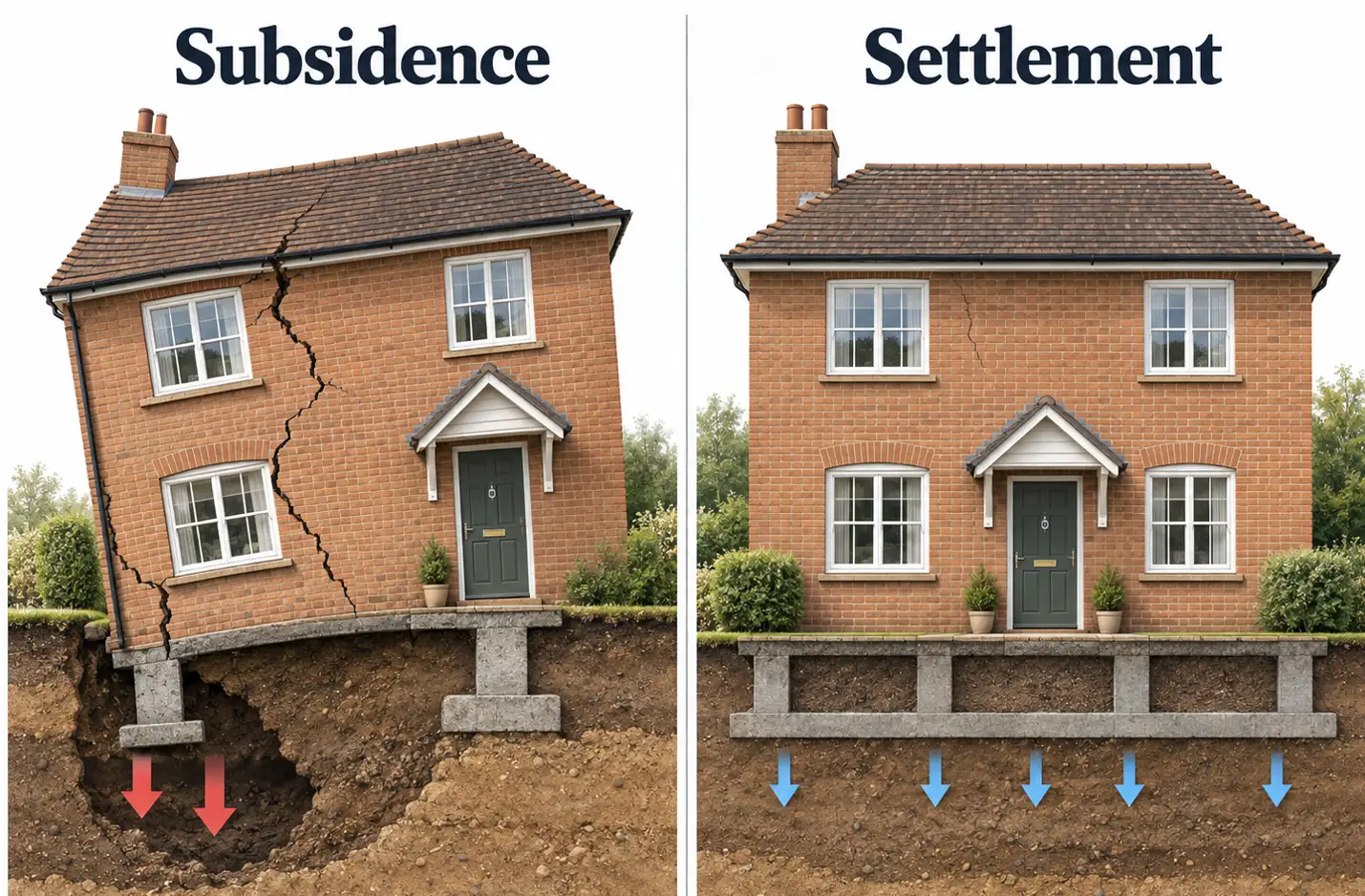
“The house has moved” is the kind of sentence that can mean almost anything, from a genuinely minor and expected process to something requiring months of monitoring and significant repair. Subsidence, settlement, heave and landslip are all forms of ground or building movement, but they’re not interchangeable, and mixing them up matters — for how the problem gets diagnosed, how it gets fixed, and how (or whether) it’s covered by insurance.
Subsidence: the ground itself sinking away
Subsidence is downward movement affecting a building because the ground supporting its foundations loses volume, changes condition or otherwise moves beneath it. It’s a ground-support problem that then shows up as a building problem, rather than the ordinary compression associated with a newly constructed building settling under its own weight.
Several things can cause it. On clay-rich soils, prolonged dry weather can cause the clay to shrink as it loses moisture, reducing the volume of ground supporting the foundation — this is explored in detail in a companion article on dry weather and trees. Trees and large shrubs can contribute to this same process by drawing moisture from susceptible soil through their root systems.
Leaking drains or water mains can cause problems through a different mechanism, washing away or softening supporting ground. Poor or variable ground conditions can also be relevant, and in some parts of the country historic mining, solution features or other local geology can create their own ground-movement risks.
The RICS guide to subsidence provides a useful overview of the principal causes, warning signs and investigation process.
Settlement: not automatically a problem
Settlement generally describes downward movement caused as a building’s weight compresses or consolidates the ground beneath it. Some settlement is expected, particularly during the early years after construction or after a substantial new extension has been added.
This is why some minor cracking in a newly built or recently extended property is unsurprising and usually nothing to be concerned about.
The important distinction is between expected, relatively uniform settlement that stabilises and differential or continuing movement, where one part of the structure moves differently from another or the movement doesn’t settle down as expected.
Not all settlement is harmless simply because the word sounds gentler than “subsidence”. The useful questions are: when did it start, is it still moving, and is the movement uniform or differential?
Heave: movement in the other direction
Heave is upward movement of the ground beneath a building as the soil expands.
Shrinkable clay is one important example. Clay that has lost moisture and shrunk can expand again as its moisture content increases. This can become particularly relevant where a mature tree or substantial vegetation that has been influencing soil moisture for many years is removed: the water demand disappears and the clay may gradually rehydrate and swell.
That does not mean removing a tree automatically causes heave. Soil type, foundation depth, tree species, the existing moisture deficit and the history of the site all matter.
The British Geological Survey’s guidance on shrink–swell soils explains how clay moisture changes, vegetation, drainage and tree removal can contribute to both subsidence and heave.
This is one of the reasons removing an established tree purely because it’s close to a house is not a sensible DIY response to suspected subsidence. The relationship needs investigating first.
Landslip: a different mechanism entirely
Landslip is movement of sloping ground rather than simply vertical shrinkage or swelling directly beneath a building. The ground moves down or along the slope, potentially carrying or disturbing whatever is built on it.
That makes site topography important. A property on or close to a slope with evidence of ground instability presents a very different investigation from a typical house on level ground showing cracks after a dry summer.
The underlying geology, drainage, retaining structures and history of the slope can all be relevant, so suspected landslip is firmly specialist territory rather than something that can be identified from a wall crack alone.
The four types of movement at a glance
| Movement | What is moving? | Typical mechanism | Key distinction |
|---|---|---|---|
| Subsidence | Supporting ground moves downward | Clay shrinkage, leaking drains, unstable or collapsing ground and other geological causes | The supporting ground changes beneath an established building |
| Settlement | Building and supporting ground move downward under load | Compression or consolidation after construction | Often associated with the weight of new construction; concern rises if movement is excessive, differential or continuing |
| Heave | Ground moves upward | Expansion of susceptible soil, including rehydrating shrinkable clay | Upward rather than downward ground movement |
| Landslip | Sloping ground moves | Instability causing ground to move down or along a slope | Movement relates to slope instability rather than ordinary vertical foundation movement |
That table is useful for understanding the language. It is not a way of diagnosing a crack from its appearance.
Why the distinction actually matters
This isn’t just a vocabulary exercise. Diagnosis, repair and insurance all depend on correctly identifying which type of movement is happening, because the appropriate response can be completely different in each case.
Treating harmless or stabilised settlement as though it were active subsidence can mean investigation or remedial work a property never needed. Missing genuine subsidence because it’s been dismissed as “just settling” can mean an active ground problem is left unresolved.
The cause also determines the remedy. A leaking drain affecting granular soil is a different engineering problem from tree-related clay shrinkage; heave caused by recovering clay isn’t treated as though the ground were continuing to shrink; slope instability needs a different investigation again.
Historic movement versus active movement
This is arguably the single most important distinction in the whole subject, and it’s often overlooked. A crack, or evidence of past movement, doesn’t automatically mean there’s an active structural problem today.
Many properties carry visible evidence of movement that occurred years or even decades ago and has since stabilised completely — a previous, long-resolved subsidence episode, historic settlement following construction, or an old repair that’s held perfectly well ever since.
The practical question is never simply “did movement happen at some point in this building’s history?” The useful question is whether movement is currently continuing.
That’s precisely what monitoring, discussed in the companion article on recognising significant cracks, is designed to establish, and it’s also why a surveyor or engineer will often want to understand a property’s history, previous reports and repairs rather than looking only at how one crack appears today.
Does soil move with the seasons even without a problem?
Yes. Shrinkable clay can naturally change volume as its moisture content changes.
The British Geological Survey confirms that shrink–swell behaviour is influenced by rainfall, vegetation, drainage and seasonal moisture changes. A dry period can shrink susceptible clay; wetter conditions can allow it to swell again.
That means some seasonal ground movement isn’t, by itself, proof of damaging subsidence.
But the existence of a seasonal cycle doesn’t automatically make cracking harmless either. The amount of movement, whether it is affecting the building, whether cracks close again, and — most importantly — whether the pattern remains broadly stable from year to year or progressively worsens all matter.
If cracks repeatedly appear and change with the seasons, record the pattern rather than relying on memory. That history can be extremely useful if professional investigation later becomes necessary.
How professionals actually work out what’s happening
A proper investigation typically draws on more than a single visit and a visual inspection.
Depending on what the initial evidence suggests, it might involve:
- monitoring crack widths over a period of months
- level surveys to establish whether parts of the building have moved relative to others
- inspection of drainage, potentially including CCTV surveys where leakage is suspected
- trial pits to establish foundation depth and inspect the ground immediately around them
- soil or geotechnical investigation where ground conditions need understanding
- assessment of nearby trees and vegetation
- examination of historic maps, geological or mining information where relevant
- previous survey, insurance or repair records
- structural assessment of the building itself
Not every case needs every one of these.
RICS notes that suspected subsidence cracking may need monitoring for up to 12 months and sometimes longer, because establishing whether movement is continuing can be more important than rushing straight to a permanent repair.
The investigation should therefore narrow as the evidence develops rather than automatically starting with the most invasive or expensive test available.
What is the investigation trying to answer?
For most cases, the professional process is ultimately trying to establish four things:
- Has genuine structural movement occurred?
- Is it still active?
- What is causing it?
- What needs to change to stop it or allow a lasting repair?
Until those questions are answered, “subsidence” is a possibility rather than a complete diagnosis.
A word on insurance terminology
If a claim becomes relevant, it’s worth knowing that insurers distinguish between different forms of ground movement.
Most home buildings policies commonly provide cover for damage caused by subsidence, heave and landslip, subject to the policy terms, exclusions and excess.
Settlement is more complicated. The Financial Ombudsman Service’s current ground-movement guidance distinguishes settlement — also called consolidation or compaction — from subsidence and notes that insurers sometimes reject claims because the movement is considered settlement rather than an insured subsidence event.
But it also makes an important qualification: whether settlement is excluded depends on the wording of the individual policy. It should not simply be assumed that every policy treats it identically.
That makes your own policy wording more important than a general internet rule.
And if you suspect active subsidence, contact your buildings insurer before commissioning major remedial work independently. Insurers commonly appoint their own surveyors, engineers or other specialists to establish the cause and manage a claim.
What to actually take from this
“The house has moved” isn’t a complete diagnosis on its own — it’s the opening question, not the answer. Direction of movement, likely cause, how long ago it happened or started, and whether it’s still ongoing all matter, and they’re usually not things you can determine confidently just by looking at a crack.
Working through them properly, ideally with appropriately qualified help where the signs warrant it, is what actually gets you from “something has moved” to a genuine understanding of what’s going on and what, if anything, needs to happen next.
This article provides general property information and is not a diagnosis for any individual property. The type, cause and significance of building movement can only be reliably established through proper site-specific investigation. If subsidence is suspected and the property is insured, contact the buildings insurer before arranging major remedial works.

