

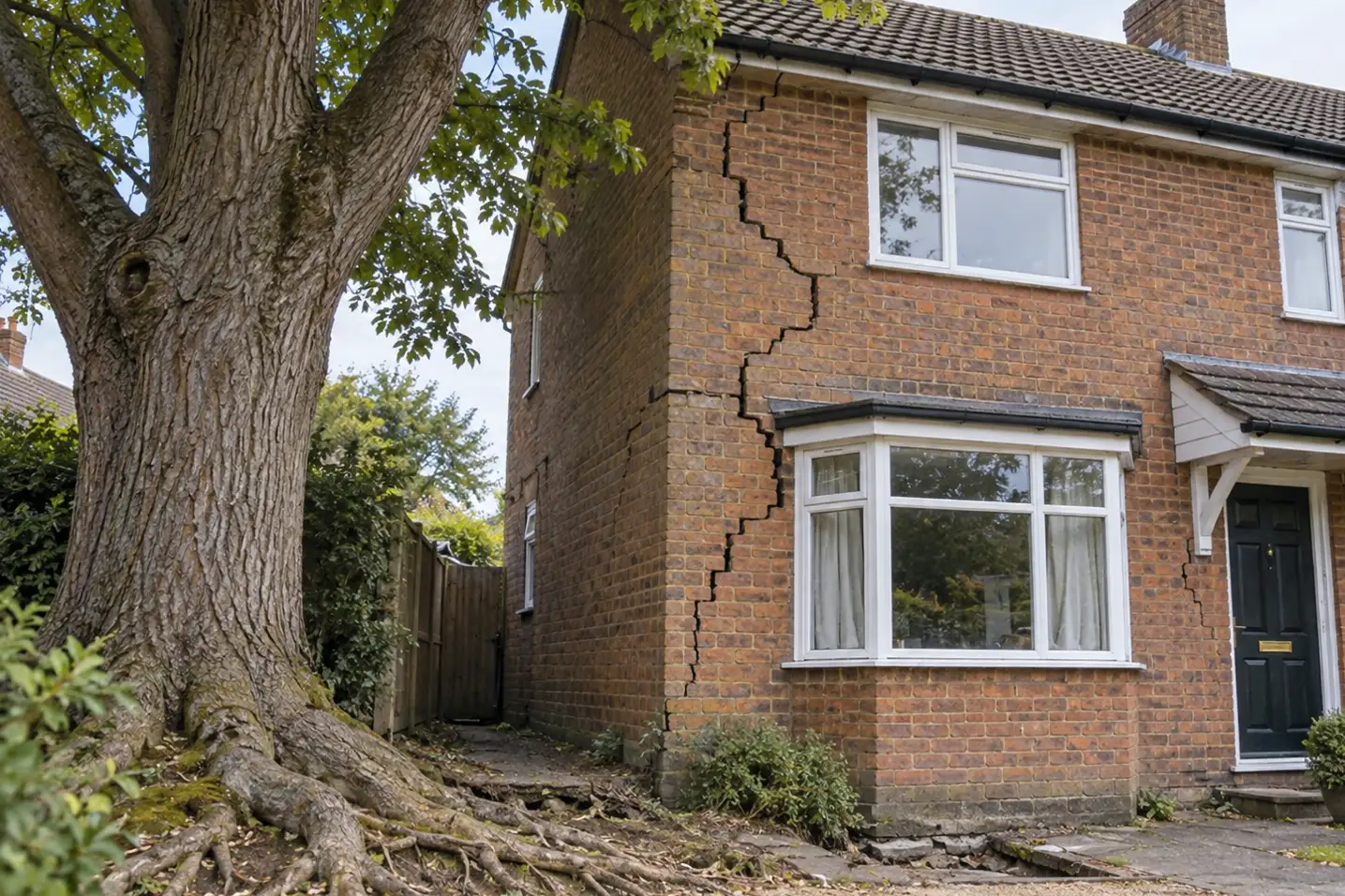
New cracks turning up after a run of hot, dry weather are a familiar trigger for a call to a surveyor — and 2026 has given plenty of UK homeowners reason to make that call.
The Association of British Insurers reported that home insurers paid out £72 million for domestic subsidence claims in the second quarter of 2026 alone, with the average claim reaching a record £20,000. The ABI linked those figures to prolonged dry conditions following the warmest spring on record for England and Wales and the third warmest for the UK.
The weather story continued after those claims figures were published: the Met Office subsequently reported summer 2026 as provisionally the hottest UK summer on record.
That follows an already severe 2025, when full-year domestic subsidence payouts reached a record £307 million.
So the timing isn’t a coincidence. But “the weather did this” and “that tree did this” are both a good deal more complicated than they sound.
The physical process: clay that shrinks as it dries
The mechanism behind much dry-weather subsidence is specific to certain soil types. Clay-rich soils contain minerals that absorb water and expand when wet, then lose that water and shrink again as they dry out — a process geologists call shrink–swell.
The British Geological Survey’s shrink–swell guidance describes this as one of Britain’s most damaging geological hazards. BGS estimates that shrink–swell ground movement has cost the economy around £3 billion over the past decade.
When a prolonged dry spell causes susceptible clay beneath or around a building’s foundations to shrink significantly, the resulting ground movement can reduce or alter the support beneath part of the structure. If the foundation moves downward with it, the result can be subsidence.
This is why hot weather alone isn’t enough to explain a crack. The important question is whether the building is sitting on ground capable of significant shrink–swell movement in the first place.
Why it varies so much between one house and the next
Two houses on the same street can have entirely different experiences of the same summer, and this is where a lot of the confusion comes from.
Risk depends heavily on the local geology — not every part of the UK sits on highly shrinkable clay, and even within a clay area the volume-change potential can vary.
Foundation depth matters too. Older properties can be more susceptible where their foundations are relatively shallow and therefore sit within the part of the ground most affected by seasonal moisture changes. But age alone doesn’t tell you foundation depth, and an old house shouldn’t simply be labelled high-risk without knowing how it was actually built.
Building type and construction matter. So do nearby vegetation, drainage and the rainfall history of that particular area over more than one season. Repeated dry periods can create a different ground-moisture picture from one isolated hot week.
BGS’s latest climate-related shrink–swell work identifies parts of London and the South East among the areas of greatest susceptibility, but even there it is the combination of geology, climate and the individual building that determines risk.
Where trees fit in
Trees and large shrubs draw water from the soil through their root systems as part of ordinary transpiration. On shrinkable clay, that can increase the moisture deficit already being created by warm, dry weather.
How important a particular tree is depends on several things at once:
- the species and its typical water demand
- its mature size
- its distance from the foundations
- the type and shrinkability of the soil
- foundation depth
- the tree’s age and history
- rainfall and soil-moisture conditions
- whether roots are actually influencing the ground beneath the affected part of the building
Professional foundation design guidance, including NHBC’s approach to building near trees on shrinkable soils, considers these factors together rather than using one simple distance rule.
And an important point gets lost surprisingly often: tree-related subsidence is usually about roots removing moisture from shrinkable soil, not roots physically pushing the house down or bursting through sound foundations.
“The tree is right there — it must be responsible”
This is the single most common leap homeowners make, and it’s worth challenging directly: most trees growing near houses do not cause structural damage.
The Royal Horticultural Society’s guidance on trees near buildings makes that point explicitly. Shrinkable clay, dry weather, foundation depth, species, size and proximity all matter, but even where conditions appear favourable for damage, most nearby trees still never cause subsidence.
Proximity alone — “it’s the closest tree to the crack” — isn’t evidence of causation.
What makes a tree-related explanation more convincing?
| Evidence | How useful is it? |
|---|---|
| A tree simply happens to be near the affected wall | Weak evidence on its own |
| The property is confirmed to sit on shrinkable clay | An important part of the case |
| Movement appears or worsens through a prolonged dry period | Supports a shrink–swell explanation but doesn’t identify the tree |
| Damage is concentrated on the part of the building nearest substantial vegetation | Relevant pattern, but still not proof |
| Species, mature size and distance place the tree within a plausible zone of influence | Strengthens the hypothesis |
| Monitoring shows a repeatable seasonal movement pattern | Much stronger evidence that soil-moisture change is involved |
| Site investigation identifies relevant roots, shrinkable clay and a moisture deficit close to the affected foundation | Stronger evidence linking vegetation and ground movement |
| Other causes such as leaking drains have been properly investigated | Essential before attributing the problem solely to a tree |
In other words, causation usually comes from several pieces of evidence pointing in the same direction, not the simple presence of a tree.
Do not cut the tree down as a first response
This deserves its own heading because it’s a genuinely important, and commonly overlooked, point.
Removing an established tree without first understanding how it’s interacting with the ground and the building can sometimes create a different problem: heave.
If a mature tree has contributed to a long-term moisture deficit in shrinkable clay, removing it can allow that ground to rehydrate and swell. In susceptible circumstances, that upward movement can itself affect foundations.
This doesn’t mean a tree identified as causing subsidence should never be removed. Once proper investigation has established that a particular tree is materially contributing to damage, removal or management may form part of the solution. That’s very different from felling the nearest tree on suspicion.
It’s also worth checking the legal position before doing any substantial work. In England and Wales, trees may be protected by a Tree Preservation Order, and work to trees in conservation areas can also be controlled. The GOV.UK protected-tree service provides the appropriate starting point. Rules and procedures elsewhere in the UK should be checked with the relevant authority.
If the tree isn’t on your land, ownership and neighbour considerations come into play as well. Those issues belong in more depth in Property Front Page’s Home & Neighbours coverage rather than being duplicated here.
Weather and trees aren’t the only explanation
It’s worth resisting the temptation to reach for “it’s the dry summer” or “it’s that tree” as the default explanation every time cracking appears after hot weather, because plenty of other causes can coincide with the same season without being caused by it.
Leaking drains or water mains can soften or wash out supporting ground.
Cracking that’s actually historic, and simply noticed for the first time in summer, can be mistaken for something newly active.
Lintel problems above windows and doors can develop independently of the ground.
Thermal movement can cause cracking without any foundation movement at all.
Recent building work, inadequate foundations, unstable fill and other geological or structural conditions can also produce movement.
The date a crack was noticed is evidence. It isn’t automatically the date the movement began, or proof of what caused it.
Warning signs worth taking seriously — without over-reading any single one
Movement associated with subsidence can show up as diagonal cracking, particularly around windows and doors; cracks appearing internally and externally in corresponding locations; doors or windows becoming difficult to operate; and movement concentrated in one part of the property rather than occurring uniformly.
The ABI’s current homeowner guidance also flags cracks appearing suddenly, cracks wider than around 3mm, and diagonal cracks wider at the top than the bottom as reasons to investigate further.
None of those signs is definitive on its own.
The useful question is whether several things are happening together: new cracking, measurable change, matching distortion elsewhere in the building and a plausible ground-related cause.
A sensible sequence, rather than a rush to conclusions
If new cracking appears after a hot, dry spell, a reasonable approach is to work through it in order rather than jumping straight to the most dramatic possible cause.
First, document what is actually happening. Photograph the cracks, date the images and record widths consistently where practical. Our companion article on cracks explains sensible monitoring in more detail.
Second, look for obvious alternative explanations. Drainage defects, leaking water supplies and recent building work can all matter.
Third, establish whether the ground conditions make dry-weather subsidence plausible. Clay susceptibility is a far more important starting point than simply noticing a tree outside the window.
Fourth, get appropriate professional advice where cracking is new, progressing or accompanied by other movement. Depending on the circumstances, this can involve a building surveyor, structural engineer, drainage specialist, arboriculturist or geotechnical investigation rather than one person diagnosing everything from the crack alone.
Fifth, involve the buildings insurer where the evidence genuinely suggests subsidence. Insurers commonly have their own investigation process, so it makes sense to check the policy and speak to them before commissioning major remedial work independently.
Only then should action against a tree be considered, if the evidence actually identifies vegetation as a material contributor.
The honest summary
Hot, dry weather and nearby trees absolutely can contribute to subsidence, in the right soil and the right circumstances — and the 2025 and 2026 insurance figures make clear that dry-weather subsidence remains a significant UK property issue.
But neither the season nor the nearest tree should be treated as an automatic explanation without proper investigation.
The ground beneath a house, and what’s growing near it, is genuinely more complicated than “it was a hot summer” or “there’s a tree there”. Getting that complexity right is exactly what stands between a proportionate response and an expensive, potentially unnecessary one.
This article provides general property information current at publication. Claims figures and weather records will change over time and should be checked against current sources for the latest position. It does not diagnose the cause of movement at any individual property. Where new or progressing movement suggests subsidence, obtain appropriate professional advice and check the buildings-insurance position before major remedial work.

