

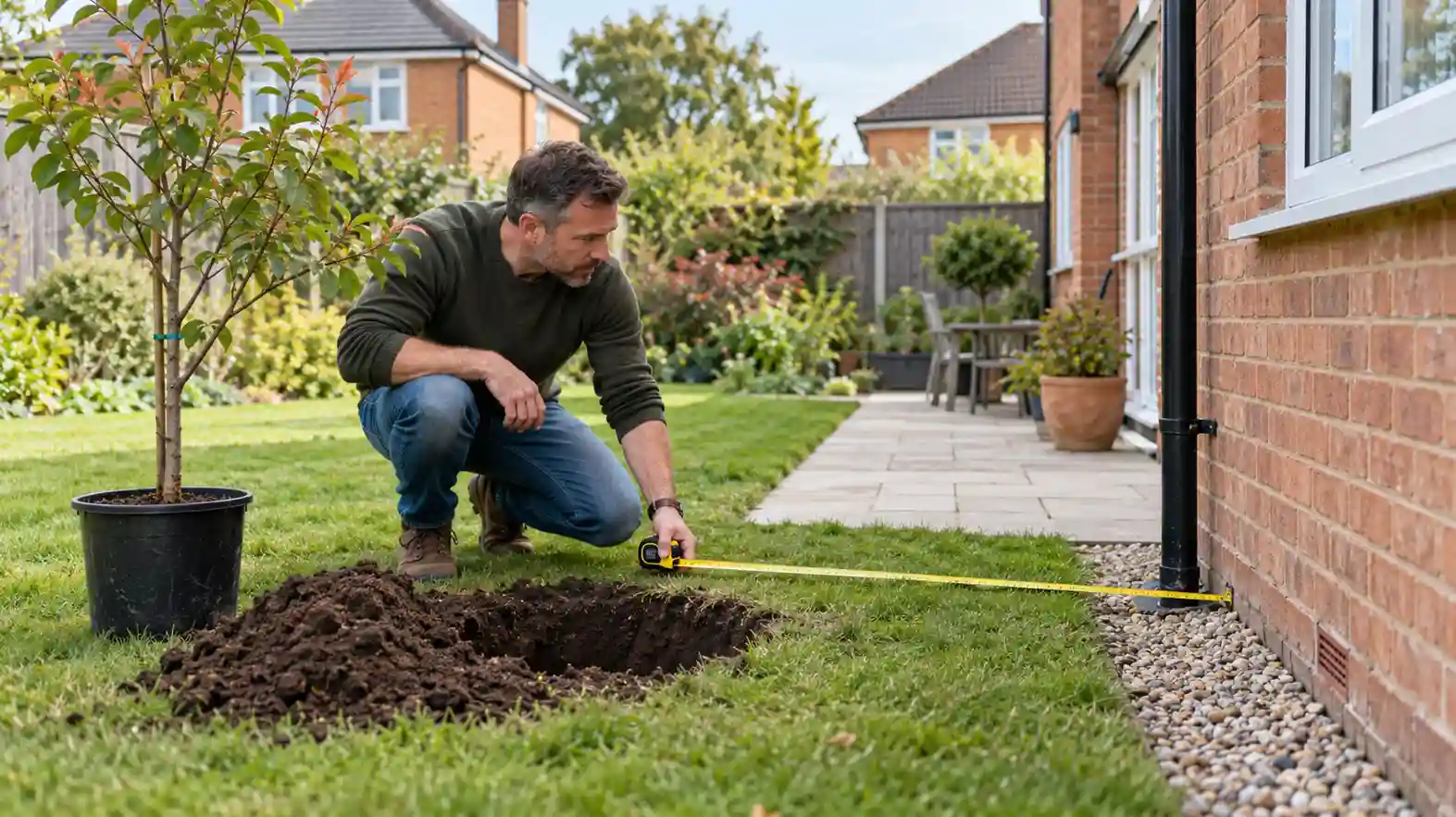
There’s a piece of received wisdom that circulates endlessly among homeowners: never plant a tree closer to the house than some fixed number of metres. It’s repeated with total confidence, and it’s wrong — or at least, it’s the wrong way to think about the question.
There is no single safe distance that applies to every tree, every soil and every building, because the actual risk depends on a combination of factors that a blanket rule simply can’t capture. Get those factors right, and a tree can often be planted closer than the rumour suggests. Get them wrong, and even a supposedly “safe” distance tells you very little.
The more useful question is not simply how far the trunk will be from the wall. It is what the tree will eventually become, what ground it will be growing in, what foundations and drains already exist nearby, and whether the position will still make sense when the sapling in front of you is a mature tree.
The two risks people conflate — and they’re not the same thing
The first is subsidence caused by changes in soil moisture.
This is principally a problem where buildings stand on shrinkable clay. Trees and large shrubs take water from the ground through their roots. On susceptible clay soils, drying can cause the soil to shrink; if that movement affects the ground supporting foundations, the building above can move with it.
The RHS notes that tree-related subsidence is generally associated with shrinkable clay soils and that foundation depth, tree size and species all affect the risk. Its guidance on trees near buildings is a useful starting point.
This is also why NHBC devotes a substantial part of its technical standards for new homes to building near trees. Its method considers soil volume-change potential, tree water demand, mature height, distance from the foundations and other site factors rather than applying one universal planting distance. The current 2026 NHBC Standards apply to NHBC-registered homes whose foundations begin on or after 1 January 2026. NHBC Standards
That distinction matters: NHBC foundation guidance is not a statutory rule telling every homeowner how many metres a tree must be from an existing house. It is evidence of why a single distance is too crude.
The second problem is physical interaction with drains and other relatively lightweight structures.
Roots are unlikely simply to punch their way through an intact modern foundation or a sound watertight drain. With drains, the more usual problem is roots proliferating around moisture and entering through an existing defective joint, crack or leak. Older drainage with poor seals or rigid joints is more susceptible. Roots can also lift paving, paths and other lightweight structures as they enlarge.
So a tree can be a subsidence consideration because of the soil it dries, while being a drainage consideration because of where its roots find water. They are different mechanisms, and the answer to one tells you very little about the other.
Why “five metres”, “ten metres” or any other single number doesn’t work
Species makes a substantial difference.
NHBC groups common trees according to water demand. Its published guidance places species including English oak, poplars and willows in the high-demand category; ash, beech, lime, plane, apple and pear are among those classed as moderate; while birch, hazel, holly and magnolia are examples in the low-demand group.
That immediately exposes one problem with generic advice. “Fruit tree” is not itself a useful structural category: apple, pear, plum and several cherries are not simply treated as low-demand trees in NHBC’s guidance.
Mature size matters too. For proposed trees, NHBC’s foundation-design approach works from the tree’s expected mature characteristics rather than treating the sapling standing in the garden today as though it will remain that size.
That is the part homeowners most easily underestimate. A young tree can look comfortably distant from a house, fence, drain or neighbour because almost everything about it is currently small.
It will not stay that way.
There is a rough screening principle that helps explain why mature size matters, although it should not be mistaken for a safe planting-distance formula. RHS guidance says the soil-drying influence of high water-demand trees can extend outwards to around the tree’s height, while the influence of intermediate- and lower-demand species is generally less extensive. On shrinkable clay, that is a reason to look more closely at the proposed position — not a guarantee that a tree beyond a particular distance is automatically safe, or that one within it will necessarily cause damage.
Soil can change the calculation just as dramatically. On shrinkable clay, moisture extraction is a genuine structural consideration. On soils without significant shrink–swell potential, that particular mechanism is much less relevant — although drains, paving, branches and future size still matter.
The British Geological Survey explains that shrink–swell susceptibility depends on the type and amount of clay present and maps areas where susceptible geology occurs. Its free geology viewer can be useful for understanding the broad bedrock and superficial geology around a property, but it should not be mistaken for a soil investigation of a particular garden. BGS Geology Viewer
BGS also produces more detailed ground-stability and property-subsidence datasets. The important practical point is that seeing “clay” on a regional geological map does not tell you, by itself, the volume-change potential of the soil immediately beneath your house.
A practical way to judge a proposed planting position
Instead of looking for one magic distance, work through the actual property.
- What is the ground likely to be? If shrinkable clay is present or suspected, tree water demand becomes much more important. If you are making an expensive planting or construction decision, broad geological mapping is a starting point rather than the final answer.
- What will the tree become? Check the expected mature height and, just as importantly for ordinary garden use, the mature spread. Do not base the position on the dimensions of the young tree you are buying.
- What species is it? Two trees capable of reaching a broadly similar size can have different water demands. Species matters alongside height.
- What do you actually know about the foundations? Foundation depth can substantially affect vulnerability. Older properties can have shallower traditional foundations, but age alone does not tell you exactly what is under the building. Equally, do not assume that a modern house or extension is automatically immune simply because it is newer.
- Where do the drains run? A sound drain is considerably less vulnerable to root ingress than a defective one. If an old drain crosses directly through the proposed planting area, or has leaked or blocked previously, that deserves specific attention.
- Are there other structures nearby? Patios, paths, small retaining walls, lightweight outbuildings and driveways may react to expanding roots differently from the house itself.
For new construction, tree effects should be considered as part of foundation design where relevant. NHBC’s standards for registered new homes explicitly account for existing, removed and proposed trees on shrinkable soils.
That does not mean every extension or modern house can safely have any tree planted close beside it. The answer depends on what foundations were actually designed and built, the ground conditions and the vegetation involved.
If you have drawings or structural information from a relatively recent extension, they may be useful. And if you are planning an extension at the same time as deciding where trees will go, treat the landscape plan and foundation design as related decisions rather than two separate projects.
There is little sense in designing expensive foundations around one planting scheme and then putting a completely different large tree beside them five years later.
This is also why measuring only from the external wall can be misleading. The relevant structural relationship is to the foundations, while the practical relationship may involve underground drainage, paving, boundaries and the eventual canopy as well.
Future size matters above ground too
There is another reason not to squeeze the biggest tree you can into the smallest apparent gap: roots are only half of the future tree.
A tree can be entirely free of subsidence problems and still be badly positioned.
A canopy that eventually reaches the house may shade windows far more than expected, overhang gutters and roofs, obstruct access for maintenance or require repeated pruning simply to keep it within the space available. Leaves, fruit, seeds and twigs falling into gutters may become an annual maintenance job. A tree placed hard against a boundary can eventually put most of its canopy into the neighbouring garden rather than your own.
None of these is an argument against planting trees close to homes. It is an argument for choosing the tree for the available space, rather than choosing the tree first and hoping pruning will permanently solve the mismatch later.
For a smaller garden, a naturally modest tree or a cultivar selected for restrained height or spread can often achieve what the homeowner wanted in the first place without creating a twenty-year maintenance problem.
When a professional opinion is worth the money
For a small ornamental tree in a generous position, professional structural advice would usually be disproportionate.
The calculation changes where you are considering a large or high water-demand tree near a house on known or suspected shrinkable clay; where existing foundations are shallow or uncertain; where important drains run through the proposed planting area; or where a new extension or other permanent structure is also being designed.
An arboriculturist can help with species, mature dimensions, likely rooting characteristics and the suitability of a particular planting position. Where the question is whether nearby vegetation should alter foundation design, that becomes a structural or geotechnical issue rather than simply a gardening one.
For an existing mature tree that is already being blamed for cracking or other building movement, resist jumping straight from “there is a tree nearby” to “the tree caused the subsidence”. Establishing causation is a different exercise and may involve structural inspection, soil information, drainage investigation, arboricultural evidence and monitoring.
That is also a different reader problem from choosing where to plant a new tree, and Property Front Page’s separate coverage of tree-root damage and liability deals with the established-tree situation rather than duplicating it here.
The useful answer to “how close can I plant it?” is therefore less satisfying than a number, but much more useful.
First establish the soil risk. Then look at the species, mature height and spread, foundations, drains and the rest of the site. A small, appropriately chosen tree on ground with little shrink–swell potential is a very different proposition from a large, high water-demand tree beside shallow foundations on susceptible clay.
The aim is not to keep trees as far from houses as possible. It is to put the right tree in a position that will still look like the right decision when it is mature.
This article explains general considerations when choosing a position for a new tree and is not a site-specific structural, geotechnical or arboricultural assessment. Ground conditions, foundation construction, drainage and tree characteristics vary between properties. Where a large or high water-demand tree is proposed close to a building on known or suspected shrinkable clay, or where significant construction is planned near existing trees, obtain appropriate professional advice before relying on a general planting-distance rule.

