

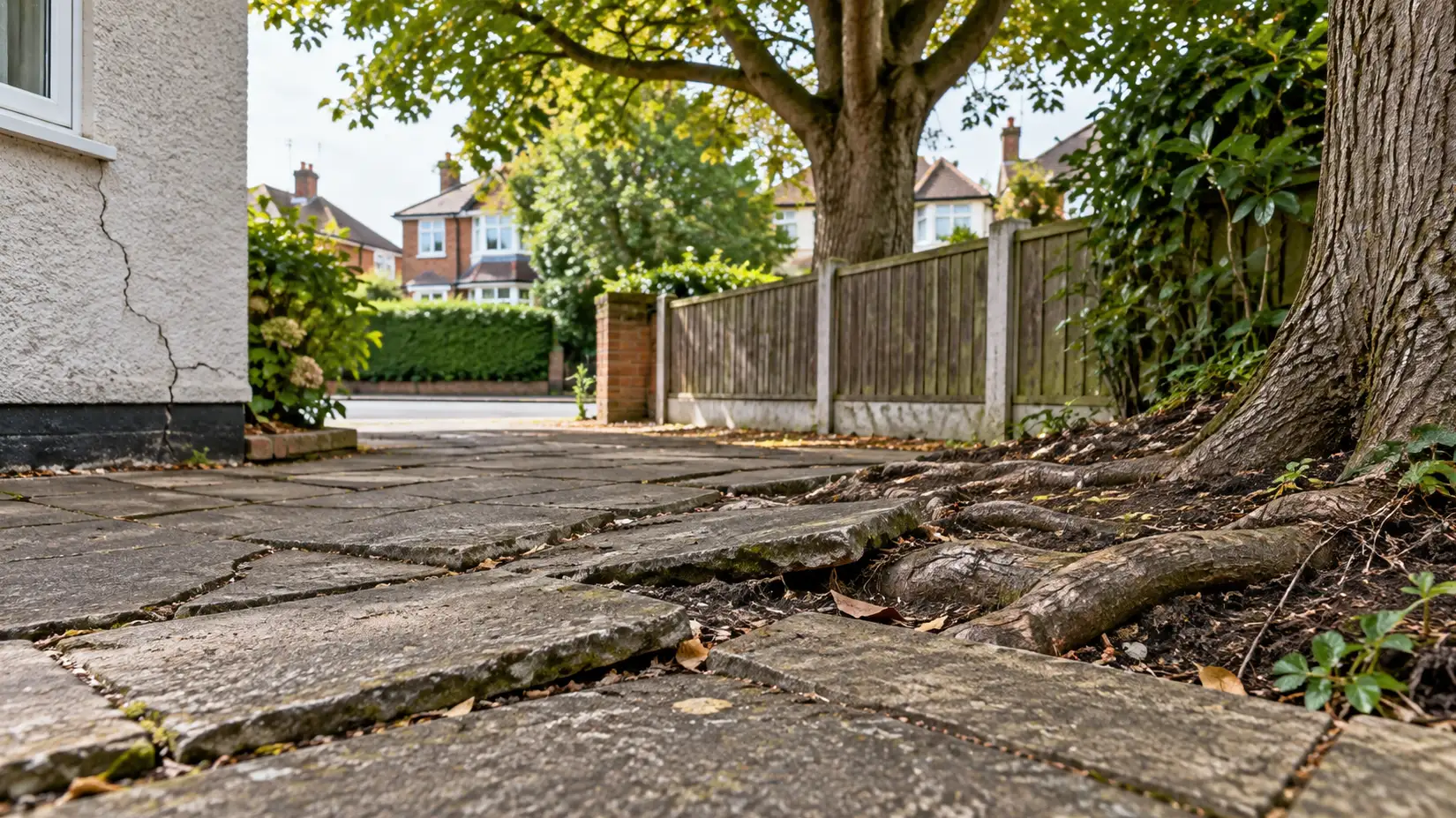
A cracked driveway and a large tree twelve feet away look, to most people, like an open-and-shut case. It’s rarely that simple, and treating it as obvious is precisely how these disputes go wrong on both sides — either the affected homeowner assumes liability that hasn’t actually been established, or a tree owner dismisses a genuine problem because “it’s just a tree, it doesn’t have that kind of power.”
Trees can damage property in several ways, and the most expensive problems don’t necessarily involve roots physically pushing against foundations. A neighbour’s tree might be responsible for lifted paving, a damaged garden wall or subsidence affecting the house itself. But establishing that connection can require considerably more than pointing to the tree nearest the damage.
Even where the cause is proved, responsibility for the repair bill isn’t automatic. In England and Wales, the law considers whether the damage was reasonably foreseeable, what the tree owner knew or ought to have known, and whether they took reasonable steps once the risk became apparent.
For most homeowners, the practical route involves their buildings insurer and some careful investigation long before anyone considers legal proceedings against next door. Getting that sequence right matters, because removing a tree, cutting its roots or carrying out substantial repairs before the cause is established can make an already expensive problem considerably worse.
This article concerns the law of nuisance in England and Wales. Scotland deals with comparable damage through its own law of delict, while Northern Ireland has its own legal framework. The English case law discussed below shouldn’t be assumed to apply unchanged throughout the UK.
How tree roots actually damage property
There are two quite different ways trees can affect a building or its surroundings, and the distinction matters when deciding what needs investigating.
Direct root damage is the easier one to picture. As roots grow and increase in diameter, they can disturb relatively lightweight structures, lifting paving slabs, displacing sections of driveway or affecting garden walls. Roots may also enter defective underground drains, where continued growth can obstruct the pipework or worsen an existing problem.
In these situations, the physical evidence may be comparatively accessible. A section of paving has lifted, the ground beneath is opened up and substantial roots are found immediately below the affected area. That doesn’t establish every element of a legal claim, but it gives investigators something tangible to examine.
Subsidence affecting a house is more complicated.
Tree roots don’t ordinarily damage substantial foundations by forcing them sideways. Where vegetation contributes to subsidence, the mechanism is usually moisture extraction from shrinkable clay beneath or near the building.
Clay soils expand and contract as their moisture content changes. During prolonged dry weather, a tree drawing water from the surrounding ground can contribute to the clay shrinking. If that movement occurs unevenly beneath foundations, parts of the building may settle at different rates, potentially causing cracking and other structural symptoms.
The Association of British Insurers explains the relationship between vegetation, shrinkable clay and ground movement in its guidance on subsidence.
A tree doesn’t necessarily need to be physically pressing against a wall or foundation to contribute to this type of damage. The effect on soil moisture can be significant even when no large roots are visible beside the building.
Not every property near a mature tree is at risk, however. Soil type, foundation depth, weather, tree species, maturity and distance all affect the likelihood of damage. Willows, poplars and oaks are among the species commonly associated with substantial water demand, but their presence alone doesn’t establish a subsidence risk.
A large tree close to a building on shrinkable clay deserves a different assessment from one growing in ground that isn’t susceptible to the same degree of shrinkage. Equally, rules suggesting that trees within a particular distance are automatically dangerous overlook differences in their size, water demand and the conditions beneath the property.
The ground beneath the building matters at least as much as the tree above it.
Why the nearest tree might not be responsible
A homeowner notices diagonal cracking in an external wall. There’s a mature tree in the neighbouring garden, and the obvious conclusion is that its roots have caused the problem.
The neighbour disagrees. The tree has stood there for decades, they say, and nothing like this has happened before.
Neither position establishes the cause.
Buildings crack for numerous reasons, including ordinary settlement, temperature-related movement, defective foundations, leaking drains and other forms of ground instability. Some cracks are relatively harmless; others warrant prompt professional investigation. Their appearance can provide useful clues, but it cannot reliably identify the cause on its own.
Leaking drainage is an important alternative explanation. Water escaping from defective pipes can soften or wash away supporting soil, causing movement that may resemble tree-related subsidence. Even when roots are discovered inside a damaged drain, they may have entered through an existing defect rather than broken a previously sound pipe.
That can make a considerable difference to both the repair and the question of liability. Removing a tree won’t repair a leaking drain, while replacing defective drainage may not resolve movement caused by clay drying beneath the foundations.
Where substantial structural damage is suspected, the investigation will commonly involve a structural engineer assessing the building and the pattern of movement. If vegetation may be contributing, an arboriculturist can examine the tree and advise on its likely influence.
Further investigation may involve trial pits to establish foundation depths, soil sampling, drainage inspections, root identification or monitoring cracks over time. Seasonal movement can be particularly informative where shrinkable clay is involved, because it may reveal how the building responds to changes in ground moisture.
The Financial Ombudsman Service’s guidance on subsidence and other ground movement explains why insurers may require technical investigations and monitoring before deciding what has caused the damage.
Not every cracked driveway needs an elaborate programme of testing. Where the problem is confined to paving and substantial roots are visibly lifting the surface, a competent inspection may establish the cause relatively quickly. Suspected movement of a house’s foundations calls for a more careful approach, particularly where expensive structural repairs may follow.
The investigation should be proportionate to the problem. What matters is that the conclusion comes from evidence rather than proximity or assumption.
This is also why removing the tree before the cause has been established can be a costly mistake. Apart from potentially damaging a neighbour’s property, doing so may alter the conditions being investigated and make it harder to determine what originally caused the movement.
When does the tree owner become legally responsible?
The leading English authority is Delaware Mansions Ltd v Westminster City Council [2001] UKHL 55, a House of Lords decision concerning a large London plane tree growing in a public pavement.
Its roots had contributed to the drying and shrinkage of clay beneath neighbouring buildings. The dispute concerned responsibility for substantial remedial expenditure incurred in dealing with the continuing nuisance.
The decision illustrates an important principle: owning the tree isn’t enough, by itself, to make somebody liable for every piece of damage associated with it.
Where damage results from a continuing nuisance, the owner’s knowledge of the problem, what they reasonably ought to have foreseen and whether they had an opportunity to take appropriate action can determine liability.
A tree owner isn’t expected to guarantee that their tree will never cause damage. But once a continuing risk is reasonably foreseeable, ignoring credible evidence of a problem may expose them to liability for the consequences.
Suppose investigations establish that a neighbour’s tree is contributing to subsidence. The affected homeowner, or their insurer, provides the tree owner with the findings and explains why further damage may occur.
If the owner refuses to consider reasonable preventative action despite being given a fair opportunity to respond, their position may become considerably harder to defend.
The opposite situation is different. Somebody presented with a substantial repair bill for work already completed, without having been informed of the suspected problem or given a reasonable opportunity to address it, may have a legitimate argument about the expenditure being claimed.
In Delaware Mansions, the House of Lords treated notice and a reasonable opportunity to deal with a continuing nuisance as important considerations before imposing liability for substantial remedial expenditure, while recognising that the circumstances of individual cases matter.
That makes communication more than a neighbourly courtesy. Once credible evidence identifies a tree-related problem, providing the owner with the relevant findings establishes what they have been told and gives them an opportunity to investigate or act.
The owner doesn’t necessarily have to fell the tree. A reasonable response depends on the evidence, available remedies and potential consequences of different interventions. It may involve further assessment, appropriate tree management or cooperation with the insurer’s proposed approach.
Nor does responsibility automatically disappear because the tree was planted by a previous owner. Somebody who acquires property with an existing tree may still be responsible for a continuing nuisance they know, or reasonably ought to know, is causing damage during their ownership.
The key questions are therefore not simply who owns the tree or how long it has stood there. They concern whether the tree is causing a legally relevant nuisance and whether its owner has responded reasonably to a foreseeable problem.
Why insurance usually matters more than a lawsuit
If you suspect subsidence affecting your house, your buildings insurer should ordinarily be one of the first people you contact.
That doesn’t mean accepting that the neighbour’s tree caused the damage. It allows the insurer to consider the policy position and arrange whatever investigation is needed to establish what is happening.
A subsidence claim may involve structural engineers, loss adjusters, drainage specialists and arboricultural experts. Sometimes monitoring is required before a reliable repair strategy can be established, particularly where movement appears to change with the seasons.
This can be frustrating when cracks are appearing and the homeowner understandably wants them repaired immediately. But repairing visible damage before dealing with continuing ground movement may simply mean that the cracks return.
Insurance cover also deserves closer attention than many homeowners realise.
Buildings insurance commonly provides cover for qualifying subsidence damage, subject to the policy’s conditions, exclusions and excess. But damage confined to patios, paths, garden walls or other external features may be treated differently, particularly where the insured building itself hasn’t been affected.
A homeowner whose driveway has been lifted by roots shouldn’t automatically assume their insurer will pay for its replacement. Equally, an uninsured paving problem shouldn’t be treated as though it necessarily follows the same claims process as structural movement affecting the foundations of the house.
Where subsidence is confirmed, the appropriate remedy depends on the cause and whether movement is continuing. Investigators may recommend changes to vegetation management, drainage repairs or monitoring before structural work is undertaken. In more serious circumstances, foundation strengthening or underpinning may be necessary.
Even removing the tree isn’t necessarily a straightforward solution.
On shrinkable clay, substantial tree reduction or removal can allow soil moisture levels to recover. As the clay absorbs water, it may expand, potentially causing upward ground movement known as heave.
The Financial Ombudsman Service recognises that excessive tree management can sometimes create a different problem from the one it was intended to resolve. The decision to reduce or remove a mature tree should therefore form part of a properly considered remediation strategy, not an improvised response to cracking.
There is also a specific insurance industry arrangement that can make these disputes less confrontational than homeowners might expect.
The Association of British Insurers’ Domestic Subsidence Tree Root Claims Agreement restricts recovery action by subscribing insurers against domestic tree owners for qualifying root-related subsidence or heave claims. An important exception applies where the owner was aware of the problem and failed to take reasonable preventative measures.
The agreement doesn’t apply to every insurer, and it doesn’t extend in the same way to local authorities or other non-domestic landowners. Nor does it remove the underlying law of nuisance, determine every question of liability or extinguish separate claims for uninsured losses.
Its practical effect is that a homeowner with an eligible insured claim may not need to pursue the neighbour directly to get the damage investigated and remedied.
The insurer can assess the cause, decide what the policy covers and consider whether cooperation from the tree owner is necessary. Where a neighbour refuses reasonable measures supported by the evidence, the insurer may need to explore other remedies, including legal action in appropriate circumstances.
That is very different from the homeowner immediately threatening proceedings or demanding that next door pay for a new set of foundations.
For most people, establishing the cause and the insurance position before arguing about ultimate responsibility will be the more productive approach.
Cutting the roots yourself could create another problem
There’s an understandable temptation when substantial roots are found crossing the boundary: cut them off and remove the source of the damage.
In England and Wales, the common-law right to deal with encroaching roots broadly follows the same principle as overhanging branches. The Government’s guidance on neighbouring trees and boundaries confirms that roots extending into your property can generally be cut back to the legal boundary.
But having the right to remove an encroachment doesn’t mean doing so is necessarily safe or advisable.
Roots help anchor a tree and provide the water and nutrients needed for its survival. Removing substantial roots can weaken a mature tree, affect its health or increase the risk of failure during high winds.
The consequences could be serious if the tree stands close to houses, roads or neighbouring gardens. Someone trying to deal with relatively modest damage to paving might inadvertently create a much more dangerous situation.
If negligent or excessive root cutting damages or destabilises the neighbour’s tree, the person who carried out the work may face liability of their own.
There is also an evidential problem where subsidence is being investigated. Cutting roots before engineers and arboriculturists have completed their assessment could alter the relationship between the tree, soil and foundations, making it harder to understand the cause and choose an appropriate remedy.
Protected trees introduce an additional legal restriction.
A Tree Preservation Order can prevent unauthorised work affecting a tree, including cutting its roots. In England, the Government’s guidance on Tree Preservation Orders and trees in conservation areas makes clear that root cutting is treated as an activity requiring consent where a TPO applies, unless a relevant statutory exception permits the work.
Trees in conservation areas may also be subject to notification requirements. The procedures depend on the location and protection involved, and the ordinary common-law boundary right doesn’t override them.
For minor, clearly identifiable roots affecting garden surfaces, the circumstances may be relatively straightforward. Significant roots supporting a mature tree, particularly near buildings, deserve professional assessment before any cutting begins.
If the concern involves possible subsidence or structural movement, contact your insurer before undertaking work that could change the conditions being investigated.
An encroaching root may be legally removable, but cutting it without understanding its role in the tree’s stability or the building’s damage can create a problem much larger than the original one.
When the neighbour refuses to accept responsibility
Tree-root disputes can become personal very quickly.
The affected homeowner sees cracking, worries about the cost of repairs and wants the neighbour to take responsibility. The tree owner may see a healthy tree that has stood for decades and resent being blamed for damage that hasn’t been properly explained.
Neither reaction is particularly surprising. But a dispute about blame is unlikely to achieve much until the cause is understood.
If you discover cracking, displaced paving or other suspected damage, keep dated photographs and any earlier images showing the property’s previous condition. Note when the problem first appeared and whether it is changing. Where a structural investigation is needed, professional reports, drainage findings and monitoring results will be considerably more useful than speculation about the tree’s size or proximity.
Once there is credible evidence connecting the problem to the neighbouring tree, the owner should be informed clearly. A written explanation accompanied by the relevant professional findings gives them an opportunity to understand the concern and consider the proposed response.
For an insured subsidence claim, that communication may be best coordinated through the insurer or its appointed experts. It avoids contradictory demands and keeps decisions about tree management connected to the technical investigation.
If the owner refuses to cooperate despite evidence of a foreseeable continuing nuisance, further action may be appropriate. Depending on the circumstances, that could involve an insurance-led process or legal advice about a private nuisance claim.
The appropriate route for a cracked driveway may be different from one involving substantial insured damage to a house. The amount at stake, insurance arrangements, available evidence and practicality of the proposed remedy all matter.
For the person who owns the tree, receiving a credible warning doesn’t automatically establish liability or mean the tree must be felled. It does mean the concern deserves proper consideration. Seeking arboricultural advice, cooperating with reasonable investigation and responding to evidence are much more defensible than dismissing the problem out of hand.
The same principle applies to the affected homeowner. A neighbour’s reluctance to remove a tree isn’t necessarily unreasonable, particularly if the cause remains uncertain or felling could introduce a risk of heave.
Both households have an interest in establishing what is happening before taking action that could make matters worse.
A large tree beside a cracked driveway may eventually prove responsible for the damage. The cause could equally be a leaking drain, historic settlement or another defect unrelated to the tree.
And even where the tree is responsible, deciding who must pay depends on more than ownership.
For the homeowner, the strongest position comes from proper evidence, a clear insurance position and a reasonable approach to the person who owns the tree. For the tree owner, it comes from taking a credible risk seriously and responding appropriately once the problem is known.
Because with tree-root damage, proving the cause and dealing with it reasonably will usually matter far more than being the first person to point at the tree.
This article provides general property, legal and insurance information and does not constitute legal, structural engineering, arboricultural, financial or other professional advice. Tree-root damage and liability depend on the cause of the damage, soil conditions, foundation design, the tree’s characteristics, the owner’s knowledge and response, and applicable legal and insurance arrangements. The legal position and procedures differ across the UK. If you suspect subsidence, significant structural damage or a continuing risk to property, notify your buildings insurer and obtain appropriate professional advice before cutting roots, removing trees or undertaking major repairs.

