

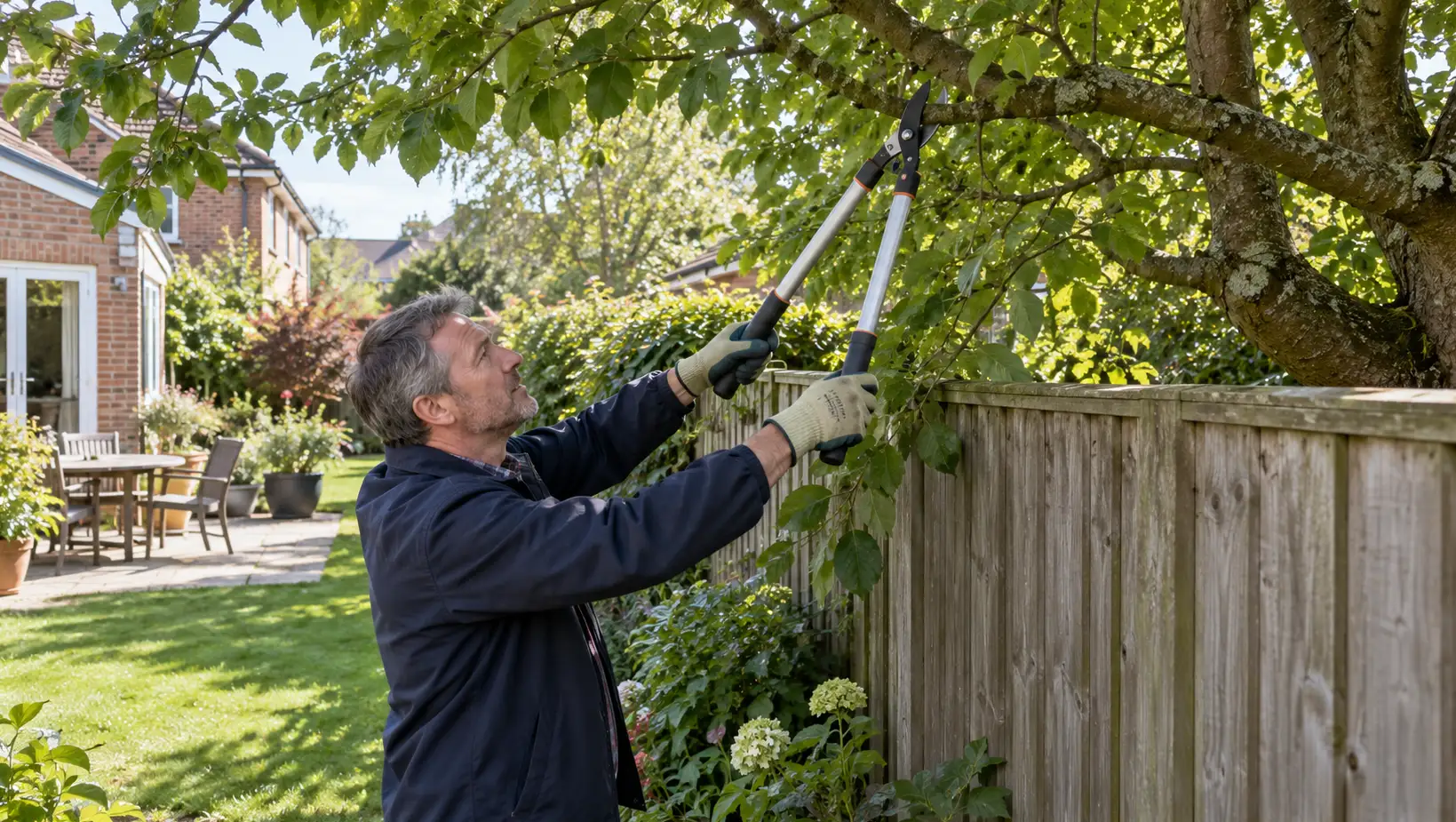
Yes, generally — and this is one of the rare corners of neighbour law where the headline answer really is that simple. What trips people up isn’t the basic right, which has been settled since a Victorian court case in 1894. It’s the handful of conditions attached to it, several of which are easy to get wrong in ways that turn a straightforward bit of pruning into a genuine liability.
A branch hanging over your lawn, dropping leaves into the gutter or making part of the garden difficult to use can be irritating, particularly when the tree belongs to somebody who seems perfectly happy to leave it alone. You might reasonably assume that anything growing into your space is yours to deal with, and to a considerable extent that’s true.
But there is a difference between being entitled to remove the overhang and having unrestricted permission to work on somebody else’s tree. The boundary determines how far you can cut, the condition of the tree affects how safely you can do it, and planning and wildlife protections may prevent work that would otherwise be perfectly lawful.
The following rules concern England and Wales. Scotland and Northern Ireland recognise broadly similar rights to deal with encroaching branches and roots, but their legal traditions and statutory procedures differ, so the specific English and Welsh provisions discussed here shouldn’t be assumed to apply unchanged elsewhere.
Your right to prune stops at the boundary
The principle was established in Lemmon v Webb, a case decided in 1894 which confirmed that a landowner could cut back branches overhanging their property without first giving the tree owner notice.
It is commonly described as the right to abate a nuisance. Rather than having to bring legal proceedings whenever a neighbouring tree extends across the boundary, you can generally remove the encroaching growth yourself.
You don’t ordinarily need to prove that the branch is damaging your property. It may simply be hanging over a patio, obstructing part of the garden or growing further across the boundary than you’re comfortable with.
The Government’s guidance on neighbouring trees and boundaries confirms the essential rule: branches and roots extending into your property can generally be cut back, but only as far as the boundary.
Suppose your neighbour’s apple tree has a large branch stretching over the fence and above your patio. You can normally remove the part on your side. You cannot follow the branch further into your neighbour’s garden because the resulting shape would be tidier or because cutting it there might prevent regrowth.
Neither can you enter their garden simply because doing so would make the job easier. The right to prune doesn’t automatically include permission to place ladders, climbing equipment or contractors on neighbouring land. If access is necessary, it needs to be agreed separately.
There’s a practical complication where fences are concerned. The position of a fence doesn’t always establish the exact legal boundary. It may have been installed slightly inside one property or moved during earlier work, leaving the true boundary somewhere other than the obvious dividing line.
For a small overhanging twig, that uncertainty may have little practical significance. When a substantial limb is involved, cutting to the wrong side of the boundary could have rather more serious consequences. It’s worth establishing where the line actually lies before carrying out significant work.
Although the common-law right doesn’t ordinarily require advance notice, speaking to the neighbour is often sensible. They may already be arranging tree maintenance, or a tree surgeon might recommend a pruning point that produces a healthier result than simply cutting at the boundary. That additional work would need the neighbour’s agreement, but it could leave both gardens with a better outcome.
A brief conversation can also prevent an otherwise straightforward gardening job becoming a dispute about somebody interfering with a valued tree.
The branches still belong to your neighbour
One of the more surprising details is that cutting off an overhanging branch doesn’t make it yours.
The timber, branches and attached fruit remain the property of the tree owner. The sensible approach is to offer the material back and, if it isn’t wanted, arrange to dispose of it responsibly yourself.
What you shouldn’t do is throw a pile of cuttings over the fence and leave your neighbour to clear it up. Offering somebody their property back is quite different from dumping garden waste onto their land without permission.
Fruit can be another source of misunderstanding. Apples or pears growing on an overhanging branch don’t automatically belong to you simply because they’re hanging above your garden. Taking attached fruit without the owner’s permission can, depending on the circumstances and whether the taking is dishonest, potentially raise an issue under the Theft Act 1968 in England and Wales.
That is unlikely to become a serious criminal dispute over a few apples in an ordinary neighbourly situation, but it illustrates why permission is preferable to assuming ownership.
The more substantial risk lies in damaging the tree during the pruning itself.
Having a lawful right to remove overhanging growth doesn’t excuse careless work that harms the tree or leaves it unsafe. Removing a major limb can affect the balance of the crown, create large wounds and increase the risk of decay or instability, particularly where the tree is mature or already in poor condition.
Imagine a heavy branch extending over a shed. Cutting it at the boundary might appear straightforward, but the branch could account for a significant part of the crown’s weight. Removing it badly could affect the tree’s stability or leave a wound that encourages deterioration.
If negligent or excessive pruning causes damage, the person who carried out the work may face liability even though they were originally entitled to remove the encroachment.
The difficulty is that the best arboricultural pruning point isn’t necessarily on the boundary. A tree surgeon may prefer to cut at a suitable branch junction further back, but your right to remove the overhang doesn’t automatically authorise work beyond your land.
For anything involving substantial branches, climbing equipment or possible effects on the tree’s health and stability, using a competent, appropriately insured arborist is the sensible choice. Recognised professional practice includes the recommendations in British Standard BS 3998, Tree work — Recommendations.
A small branch that can be safely trimmed with ordinary garden tools is one matter. A mature tree with large limbs extending over buildings deserves a different level of care.
Protected trees are a different proposition
The ordinary right to cut back overhanging branches doesn’t override statutory tree protection.
A Tree Preservation Order, usually called a TPO, can restrict pruning, cutting down or other work without the necessary consent. In England, a tree covered by a TPO will generally require permission from the local planning authority before pruning begins, even if the work concerns branches extending into somebody else’s garden.
The Government’s guidance on Tree Preservation Orders and trees in conservation areas explains the consent requirements and the circumstances in which exemptions may apply.
This catches people out because there’s no reason a protected tree should look obviously different from an unprotected one. A homeowner might have lived beside it for years without knowing an order exists, particularly if the property has changed hands or the tree was protected long before they moved in.
Conservation areas introduce another restriction. In England, work to a qualifying tree within a conservation area generally requires six weeks’ prior notice to the local planning authority where a TPO doesn’t already govern the work. That gives the authority an opportunity to consider whether the tree should receive formal protection.
Wales operates its own procedures, explained in the Welsh Government’s guidance on protected trees and Tree Preservation Orders. The underlying purpose is similar, but homeowners should follow the requirements for the country in which their property is located.
The important point is that an apparently ordinary tree may be protected even when only a small part of it extends over your boundary. Unauthorised pruning can be a prosecutable offence, so the common-law right shouldn’t be treated as permission to proceed without checking.
There are exceptions, but they are narrower than many people assume.
In England, certain work may be exempt where it is the minimum necessary to prevent or abate an actionable nuisance. That has a specific legal meaning involving actual damage or an immediate risk of actual damage, rather than the everyday inconvenience of shade, falling leaves or a branch spoiling the view.
A protected tree overhanging your patio and blocking sunlight wouldn’t automatically qualify. A branch presenting an immediate and evidenced risk of damage may require a different assessment, but the work must still fall within the applicable exemption.
Separate provisions can cover certain work involving dead trees or branches and genuine safety situations, with conditions and notification requirements depending on the circumstances. Where urgent work is claimed to be necessary, keeping photographs and other evidence of the danger is particularly important.
For most homeowners, checking with the local planning authority before pruning a potentially protected tree is considerably safer than trying to interpret an exemption after the work has been done.
Birds and bats can prevent otherwise lawful pruning
A tree doesn’t need a preservation order to be subject to legal restrictions. Wildlife protection applies independently of who owns the tree or where its branches grow, and it can prevent work that would otherwise fall within your ordinary boundary rights.
The most familiar concern is nesting birds.
Under section 1 of the Wildlife and Countryside Act 1981, which applies in Great Britain, it is an offence intentionally to damage or destroy the nest of a wild bird while it is being built or is in use, or to take or destroy its eggs. Particular species and circumstances can attract additional protections. Northern Ireland has its own corresponding legislation under the Wildlife (Northern Ireland) Order 1985.
This is sometimes reduced to a supposed rule that trees cannot be cut between March and August. That isn’t the general legal position.
Spring and summer are higher-risk periods because many British birds are nesting, but the protection depends on whether a nest is active, not simply the date. A nest still being used in September remains protected, while the calendar alone doesn’t prohibit every piece of routine pruning earlier in the year.
If a branch or section of dense foliage could contain a nest, examine the area before starting work. Where pruning would damage or destroy an active nest, the sensible and generally necessary course is to postpone it until the nest is no longer in use.
Older trees can present a less obvious difficulty because they may contain bat roosts.
All UK bat species and their roosts receive strict protection under the relevant wildlife and habitats legislation. A roost can remain legally protected even when no bats are visibly present, because the protection extends to the site itself rather than only to animals occupying it at that particular moment.
Mature trees with cavities, hollow limbs, splits, loose bark, woodpecker holes or similar features deserve particular care. Removing a major branch could damage a roost that isn’t apparent from ground level, especially where dense ivy or decay obscures suitable features.
This doesn’t mean every small branch requires an ecological survey. Light pruning of an ordinary young garden tree presents a very different level of risk from reducing or removing substantial parts of an old tree with obvious cavities.
Where significant work could affect a potential bat roost, seek advice from someone competent to assess the risk. If a roost is confirmed, a licence from the relevant conservation authority may be necessary before work proceeds. The responsible bodies include Natural England, Natural Resources Wales, NatureScot and Northern Ireland’s Department of Agriculture, Environment and Rural Affairs, depending on the location and applicable legislation.
None of these protections is a reason to abandon ordinary, necessary garden maintenance. They are reasons to check what the proposed work could affect before doing something that cannot be undone.
A small overhanging branch with no nesting activity or apparent roost features is one thing. Removing a substantial limb from a hollow mature tree is quite another.
Roots follow the same principle, but the risks are harder to see
The right to deal with encroaching growth also extends beneath the boundary. Roots from a neighbour’s tree can generally be cut back to the legal boundary, subject to applicable protection and the same need to avoid causing unnecessary damage.
The difficulty is knowing what you’re cutting.
An overhanging branch is visible, and its connection to the tree can usually be assessed before work begins. Roots are largely hidden, and severing a substantial root may affect the tree’s ability to take up water and nutrients or weaken the anchorage that keeps it upright.
A homeowner might uncover roots lifting patio slabs and reasonably think the solution is to cut through them before relaying the paving. If they’re important structural roots, however, that apparently simple repair could leave a mature tree more vulnerable to falling in high winds.
The consequences could extend well beyond the original problem, particularly where the tree stands close to houses, roads or neighbouring gardens.
Professional arboricultural advice is therefore especially valuable before cutting significant roots. If the real concern is suspected subsidence or structural damage, contact your buildings insurer and obtain appropriate technical evidence rather than assuming a particular tree is responsible.
Tree-related building damage can involve complicated questions of cause and liability. Cutting roots without understanding their role may worsen the situation and make a subsequent dispute harder to resolve.
Who pays for the pruning?
If you choose to exercise your right to trim branches on your side of the boundary, the cost is generally yours.
The common-law remedy allows you to remove the encroachment. It doesn’t ordinarily oblige your neighbour to pay simply because the branches belong to their tree.
That can feel unfair where the tree provides little benefit to your property but causes considerable inconvenience. Nevertheless, the right to carry out the work and the right to recover its cost are separate questions.
The position may be different where a tree is dangerous, causing actual property damage or has become the subject of a known hazard that the owner has failed to address reasonably. Those circumstances can raise wider issues of liability, but they shouldn’t be confused with an otherwise healthy tree whose branches have simply grown across a boundary.
For routine overhanging growth, assume that you will pay for pruning your side unless you and your neighbour agree otherwise.
That agreement can sometimes produce a better result than either household acting independently. A neighbour may prefer to have the tree professionally maintained rather than see a substantial branch shortened at the boundary. They may already be planning work, or both parties may be willing to share the cost of an approach that addresses the overhang without compromising the tree’s appearance or condition.
Neither person is automatically obliged to accept such an arrangement, but it can avoid the expense and frustration of two separate jobs or an argument over where the saw should stop.
For most ordinary gardens, the issue never needs to become a legal dispute. A branch grows over the fence, the neighbours discuss it, and some careful pruning resolves the problem.
The situations that require greater caution are those involving a substantial or unstable tree, uncertain boundaries, statutory protection, wildlife or work that could cause damage beyond the branch being removed.
The headline answer remains yes: in England and Wales, you can generally cut your neighbour’s overhanging branches back to your boundary without first obtaining their permission.
For one small branch on an ordinary unprotected garden tree, that may be all you need to know before carrying out careful pruning. For a substantial limb on a mature tree, the right to cut is only part of the decision.
Knowing where you can legally put the saw is straightforward. Knowing whether you should, and what might happen to the tree afterwards, deserves a little more thought.
This article provides general property and legal information and does not constitute legal, arboricultural, ecological or other professional advice. Rights relating to overhanging trees depend on the legal boundary, the tree’s condition, statutory protection, wildlife and the nature of the proposed work. Rules and procedures differ across the UK. Where significant pruning, protected trees or species, structural damage, tree instability or a serious neighbour dispute is involved, seek appropriate professional advice before carrying out irreversible work.

