

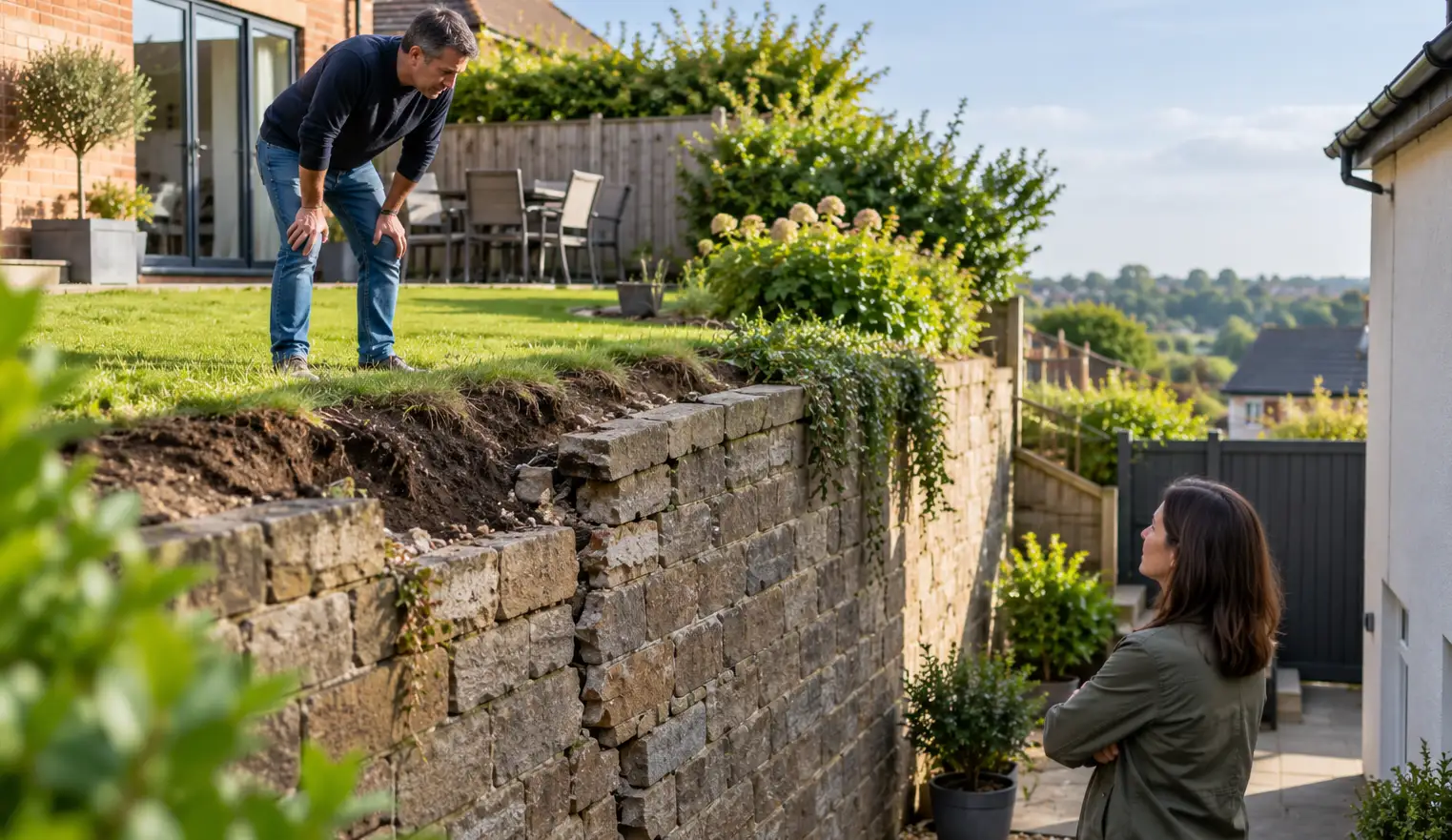
Soil visibly working its way through a crack in a retaining wall is one of the more alarming things a homeowner can find in their own garden, not least because the obvious question — whose problem is this? — doesn’t have the same tidy answer that a leaning fence panel does. Retaining walls hold back real weight, real cost, and, when the paperwork is silent, a genuinely harder legal question than an ordinary boundary wall. This article reflects the position in England and Wales; Scotland and Northern Ireland have their own separate property-law systems, and the Party Wall Act provisions discussed below do not apply there.
Ownership and responsibility for repair are two separate questions
It’s worth separating these clearly before going any further. Who owns the wall is one question — settled, where possible, by the deeds, in the same way as any other boundary structure. Who is responsible for maintaining it is a related but different question, because a retaining wall’s whole function is to hold back land, which brings in a layer of reasoning that a simple garden fence doesn’t need.
A wall can stand entirely on the lower property’s land while supporting the higher neighbour’s garden, and an old conveyance can impose a repair obligation on one owner regardless of where the wall physically sits. Equally, neither property’s documents may say anything useful about it. HM Land Registry’s guidance on boundary ownership and maintenance acknowledges that ownership and maintenance responsibility are not always recorded definitively, and that a maintenance covenant does not, by itself, establish ownership. The title register, original conveyance and any express rights of support or repair obligations are therefore worth examining before either neighbour assumes the wall is theirs to maintain.
The general presumption: whoever benefits from the support generally carries the responsibility
Where the deeds are silent — which, for older retaining walls in particular, is common — a practical starting assumption is often that maintenance responsibility rests with the owner whose land is being retained: usually, in practice, the property on the higher ground. The reasoning is straightforward enough. They’re the one benefiting from the wall doing its job, so there’s an understandable argument that they should keep it doing that job. But this is a starting point for investigating responsibility, not a binding presumption that overrides the history of the land, the parties’ legal rights or the actual cause of the problem.
The benefit a property receives from a wall can matter under the Party Wall etc. Act 1996 itself, where a retaining wall also qualifies as a party structure and the relevant provisions apply. Section 11 provides for the apportionment of certain repair costs by reference to the use each owner makes, or may make, of the structure and, where applicable, responsibility for its defective condition. The Government’s explanatory booklet on the Party Wall Act explains how the Act operates. A wall retaining your garden is plainly performing a function from which your property benefits, but that doesn’t automatically mean the Act applies to the wall, or that every repair bill falls on the higher owner.
It’s worth being precise about what case law actually establishes here, because this is a fact-heavy area where it’s easy to turn a complex judgment into a misleading rule of thumb. The courts in England and Wales apply what’s known as a measured duty of care for certain hazards on land that an owner may not originally have caused. The principle was developed in Goldman v Hargrave and adopted in English law in Leakey v National Trust, before being considered in the context of a retaining-wall dispute in Coope v Ward [2015] EWCA Civ 30. What those cases establish is a principle about taking reasonable steps in response to a known or reasonably foreseeable danger, judged against the circumstances, rather than a fixed rule about who automatically pays for a retaining wall.
Coope v Ward is particularly instructive because the higher land had been raised by predecessors of its owners, increasing the load against a wall standing on the lower property’s land. The Court of Appeal did not require the lower owners to contribute towards the engineering solution simply because the wall stood on their property. The result turned on the history and circumstances of that particular wall, and shouldn’t be treated as a general guarantee that the higher landowner always foots the bill.
The presumption is genuinely a presumption, not an automatic rule
It can be displaced by the specific facts. A commonly cited exception is where the lower landowner, or one of their predecessors, excavated their own ground to create a level, sunken area — effectively manufacturing the height difference from their side rather than the upper owner raising theirs. Responsibility for providing support to the neighbouring land can then involve the lower property instead. The direction in which the height difference was created matters as much as which side currently sits higher.
Consider two gardens separated by a wall, with one lawn a metre above the other. In one, the upper owner imported soil and built the wall to retain it. In the other, both gardens were originally level until the lower owner excavated to make a driveway or sunken patio. The finished arrangement may look identical, but the reason the wall was needed is entirely different. That’s why a historic photograph, an old conveyance or evidence of the original ground levels can sometimes be more useful than the modern title plan when the neighbours are trying to establish responsibility.
The common law right of support, and its limits
Separately from any particular wall, land in its natural, undeveloped condition carries a right to support from adjoining land under the common law of England and Wales. An owner generally cannot excavate in a way that removes the natural support required by a neighbour’s land and causes it to subside. The principle was considered in the longstanding House of Lords decision in Dalton v Henry Angus & Co, and it helps explain why excavation on the lower side of a boundary can raise legal questions that don’t arise merely from looking at where the retaining wall stands today.
This is a right to support, though, not necessarily a right to any particular wall, and it doesn’t automatically extend to artificially raised or built-up ground in the same way that it protects land in its natural state. Additional rights can arise through deeds, easements or long-established arrangements, but their existence has to be demonstrated rather than assumed. A retaining wall replacing natural support removed by excavation may therefore involve different rights and obligations from a wall holding back soil deliberately added to the neighbouring garden. Scots law approaches neighbouring rights of support through its own distinct legal framework, rather than through these particular English common law rules.
What if it collapses — is someone automatically liable?
Not automatically, no. A retaining wall falling from one property onto another doesn’t, by itself, establish liability for the resulting damage. A claim may depend on negligence, private nuisance, breach of a specific covenant, interference with a right of support or the Party Wall Act, depending on the facts. Establishing why the wall failed, what either owner knew about its condition and whether anything was done to cause or aggravate the problem can be considerably more important than simply establishing which side of the boundary the masonry landed on.
There’s a further point worth understanding about how liability actually arises. The measured duty of care discussed above means that even where neither current neighbour originally caused the defect — nobody now living there built the wall badly, and nobody necessarily caused the first crack — a duty to take reasonable steps can arise once the danger becomes apparent. What is reasonable depends on the seriousness of the risk, the practicality and cost of dealing with it and the circumstances and resources of the people involved. It is not an unlimited obligation to rebuild someone else’s wall at any price, but neither does uncertainty about ownership necessarily allow a known danger to be ignored indefinitely.
The cause of failure can also change the position significantly. A wall that has gradually deteriorated over decades presents a different problem from one that starts moving after excavation, additional loading or changes to drainage on one side. Water building up behind a retaining wall can create considerable pressure, so repairing cracked masonry without addressing the underlying ground or drainage conditions may simply lead to another failure. An independent structural engineer should be asked to establish the cause, not merely recommend how the visible damage could be repaired.
If it looks genuinely dangerous right now
Keep people, pets and vehicles well clear, and don’t excavate behind the wall, remove visible supports or get close enough to inspect unstable brickwork yourself. A wall that is leaning significantly, developing a growing bulge, shedding masonry or allowing soil to spill through widening cracks needs prompt professional attention, particularly if movement follows heavy rain or recent excavation. Contact a structural engineer, and the emergency services if there’s an immediate threat to life.
Local-authority building control can also intervene under the Building Act 1984 — section 77 provides a procedure for requiring a dangerous structure to be made safe or demolished, while section 78 permits emergency action where the danger cannot wait. Those powers address the immediate safety problem. They don’t, by themselves, settle who ultimately foots the bill, which remains a separate question to be resolved through the relevant property rights, legal obligations and circumstances of the failure.
Getting it resolved without it becoming ruinously expensive
Record the condition and any visible movement with dated photographs, and gather whatever title, planning and historical documentation exists on both sides. Get an independent engineer’s view on the cause rather than just the symptoms, since establishing why the wall is failing matters enormously to who’s responsible. If the history is unclear, old conveyances, photographs, estate plans and evidence of earlier excavation or changes in ground levels may help explain how the problem arose. A boundary surveyor or solicitor may also be needed where the wall’s ownership, position or supporting rights remain disputed, since those are not necessarily questions an engineer can answer.
Notify your buildings insurer early, particularly where damage has occurred or a claim may arise. Don’t assume that every retaining wall is covered simply because it stands within your boundary; policies vary, and an insurer may want to inspect the structure before permanent repairs begin. Emergency safety measures are a different matter, but keeping photographs, professional reports and invoices can be valuable if the cause of failure or the cost of making the wall safe is later disputed.
Where possible, share the evidence calmly with your neighbour and propose a joint inspection before either side commits to serious expenditure. A jointly instructed engineer and a written agreement about access, repair design and the allocation of costs may be considerably more economical than competing reports and solicitors’ correspondence. Where responsibility genuinely remains uncertain, agreeing a practical solution need not mean either owner accepts a legal obligation that has never been established.
Retaining-wall disputes that reach litigation can rack up costs well beyond the value of the wall itself, which is exactly why getting a proper professional assessment early, establishing what the paperwork and history actually show, and having a straightforward conversation before positions harden is, by a wide margin, the cheapest path through this.
Important: This article provides general property information, not legal, financial, surveying or other professional advice for individual circumstances. Retaining-wall responsibility can depend on title documents, historic ground levels, rights of support, ownership, the cause of failure and the work proposed. If a wall is moving, significant money or property rights are at risk, or there is a danger of collapse, obtain appropriate professional advice promptly.

